
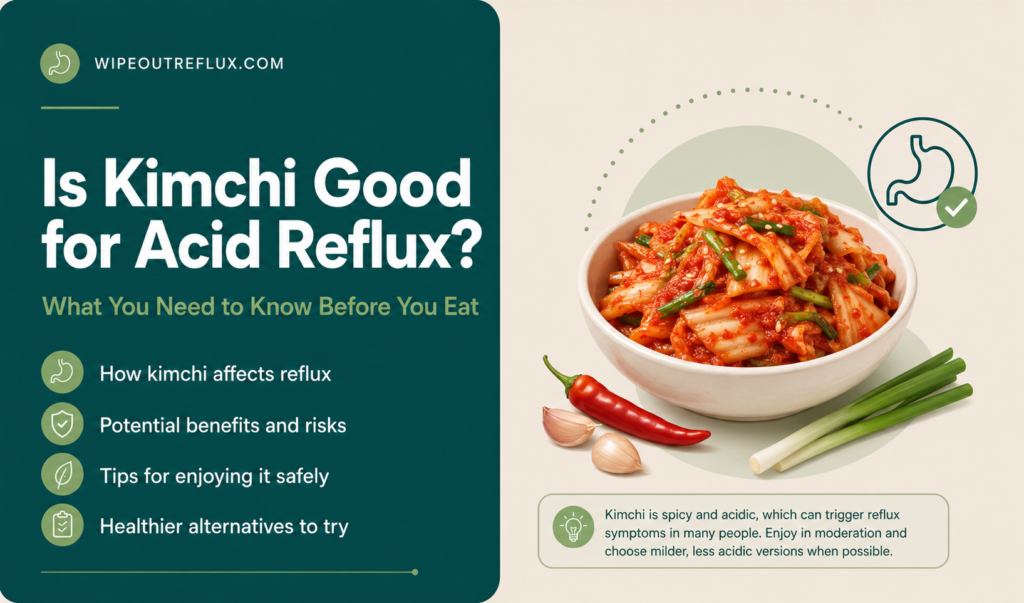
Kimchi is one of the most genuinely divided foods in reflux nutrition — and the oversimplified answer in either direction misses something important. Standard spicy kimchi is a legitimate problem for most people with acid reflux: it combines capsaicin, raw garlic and onion compounds, moderate acidity, and high sodium into a single food. That combination makes it a reliable trigger for heartburn and regurgitation in sensitive individuals.
But kimchi also contains some of the most diverse and resilient probiotic strains of any fermented food — Lactobacillus species that have been shown to support the gut microbiome, reduce gastrointestinal inflammation, and in small clinical studies, actually reduce heartburn and acid reflux symptoms. And there’s a version of kimchi that delivers all of those benefits without the capsaicin: white kimchi (baek-kimchi), made without chilli, which is the single most practical recommendation for reflux sufferers who want to include fermented vegetables in their diet.
This article covers both sides honestly, explains the mechanisms, and gives you a practical path forward depending on your specific situation.
Key Takeaways
- Standard spicy kimchi contains capsaicin, raw garlic, onion, moderate acidity (pH 4.0–4.5), and high sodium — all established reflux triggers that compound each other.
- Capsaicin activates TRPV1 receptors in the esophagus, directly producing burning sensations and sensitising already-inflamed tissue to further acid exposure.
- Kimchi’s Lactobacillus strains are genuinely diverse and resilient — among the most probiotic-rich of any fermented vegetable food.
- A 14-day pilot study found that daily kimchi consumption significantly reduced heartburn, acid reflux, abdominal pain, and belching in people with digestive problems.
- White kimchi (baek-kimchi) contains no chilli, retains full probiotic and fibre benefits, and is far more reflux-friendly than standard kimchi — this is the key practical recommendation.
- For LPR specifically, even non-spicy kimchi should be approached carefully due to its acidity.
- SIBO sufferers should approach any fermented food with caution — the added bacteria can worsen bacterial overgrowth.
- If you want the probiotic benefits of fermented food without the reflux risk, kefir or plain yogurt are more reliably tolerated alternatives.
What’s in Kimchi That Causes Reflux Problems
Capsaicin — The Primary Trigger in Standard Kimchi
The chilli component of standard kimchi — gochugaru (Korean chilli flakes) or gochujang — contains capsaicin, the compound responsible for the heat. For reflux sufferers, capsaicin is not just an irritant in the way that acidic foods are. It activates TRPV1 receptors in the esophageal lining, directly producing a burning sensation and sensitising the tissue to acid exposure. Research found that 90% of GERD patients experienced esophageal symptoms following capsaicin exposure, with the most severe responses in those with erosive disease [__Mujica-Coopman et al., Revista de Gastroenterología de México, 2010__]. Capsaicin can also delay gastric emptying, meaning food stays in the stomach longer and creates more pressure on the LES.
For LPR sufferers this is especially relevant. The throat and larynx are far more sensitive to capsaicin than the esophagus, and even trace amounts reaching the upper airway can provoke significant throat symptoms.
Garlic and Onion — LES Relaxing Compounds
Both raw garlic and spring onions (scallions) are core ingredients in most kimchi recipes. As covered in our article on garlic and acid reflux, allicin and related organosulfur compounds in garlic relax the lower esophageal sphincter and delay gastric emptying — the two key mechanisms driving reflux. The fermentation process doesn’t neutralise these compounds, and in the amounts present in kimchi, they remain meaningful triggers for sensitive individuals.
Acidity — pH 4.0–4.5
Kimchi ferments to a pH of approximately 4.0–4.5, which sits in the moderately acidic range — comparable to kefir or plain yogurt. For most people with standard GERD, the acidity itself at small serving sizes is unlikely to be the primary problem. For LPR sufferers, however, this pH range is relevant: pepsin deposited in the throat can be reactivated by anything with a pH below around 4.0–5.0, and the acidity of kimchi combined with its spice creates a compounding effect on throat symptoms.
High Sodium
Kimchi is traditionally salted heavily as part of the fermentation process. A 100g serving typically contains 500–900mg of sodium, which is significant when considered alongside other dietary sodium sources. High sodium intake is associated with increased GERD risk independently of other dietary factors — a consideration worth factoring in if you’re eating kimchi regularly alongside other processed or salty foods.
Fermentation Gas and Bloating
Even without the spice problem, fermented cabbage produces gas during digestion. Increased gas and bloating raises intra-gastric pressure, which promotes transient LES relaxations and reflux events. For people whose reflux is driven primarily by pressure — particularly those with a hiatal hernia or delayed gastric emptying — this gas-production effect can worsen symptoms regardless of the other ingredients.
Why Kimchi Can Actually Help Reflux — The Case for It
The picture above is not the whole story, and it’s worth being honest about the evidence that supports kimchi’s potential benefits for reflux.
Kimchi contains extraordinarily diverse lactic acid bacteria — dominated by Lactobacillus and Leuconostoc species — that are among the most studied probiotic strains in fermented food research. These bacteria are acid-tolerant (they survive stomach transit effectively), anti-inflammatory, and help modulate the gut microbiome in ways that can reduce the dysbiosis that contributes to reflux. Probiotic-rich foods like kimchi have been specifically noted in GERD functional food research as supporting gut microbiome balance and improving digestive function [__Niu et al., Nutrients, 2023__].
Beyond general probiotic activity, a 14-day dietary intervention study found that 20 participants with a history of digestive problems who consumed 75g of kimchi twice daily reported significant reductions in abdominal pain, heartburn, acid reflux, bloating, and belching [__Han et al., Journal of Nutrition and Food Sciences, 2019__]. This is a small pilot study and should be interpreted with appropriate caution, but it represents direct clinical evidence that kimchi can reduce — rather than worsen — reflux symptoms in some people.
Separately, a randomised controlled trial of kimchi consumption in IBS patients found significant reductions in pro-inflammatory cytokines (TNF-α, IL-4, IL-10) after 12 weeks, demonstrating the real anti-inflammatory capacity of kimchi’s bacterial strains [__Kim et al., Frontiers in Nutrition, 2022__]. Reducing systemic gut inflammation has downstream benefits for reflux, since inflammation of the esophageal and gastric lining makes acid damage more pronounced and recovery slower.
The practical problem is that standard kimchi delivers these benefits wrapped in a package that also contains capsaicin, garlic, and onion — for most reflux sufferers, the triggers outweigh the benefits. Which is where white kimchi comes in.
White Kimchi (Baek-Kimchi) — The Reflux-Friendly Alternative
Baek-kimchi — white kimchi — is a traditional Korean variety made without chilli pepper. It uses the same fermentation process, the same probiotic base, and the same vegetable foundation as standard kimchi, but contains none of the capsaicin that makes regular kimchi so problematic for reflux.
The probiotic profile of white kimchi is comparable to standard kimchi. The fibre content from the fermented cabbage, radish, and other vegetables is identical. The anti-inflammatory Lactobacillus strains are present in similar quantities. What’s absent is the TRPV1-activating capsaicin — the primary driver of kimchi-related reflux symptoms.
White kimchi still contains garlic and onion in most traditional recipes, so it’s not entirely reflux-free. But it removes the most potent trigger (capsaicin) and tends to have a slightly higher pH than standard kimchi (less acidic), making it significantly more tolerable. It can be found in Korean supermarkets and Asian grocery stores, and is readily made at home. For reflux sufferers who want the genuine probiotic benefit of kimchi without the spice risk, white kimchi is the practical answer the original version can’t offer.
A note on SIBO: even white kimchi adds significant bacteria to the gut, and for people with confirmed or suspected SIBO, this can worsen bacterial overgrowth and the bloating and reflux that accompanies it. If SIBO is a factor in your reflux, address that first before adding any fermented food. For more on the SIBO-reflux connection, see our article on silent reflux and SIBO.
Kimchi and LPR (Silent Reflux)
Standard spicy kimchi should generally be avoided if you have LPR. The combination of capsaicin, garlic, acidity, and sodium creates a consistent throat-irritant profile that’s difficult to mitigate by portion size alone. Even small amounts can reactivate pepsin in the laryngeal tissue and trigger coughing, throat clearing, and hoarseness that can persist for hours.
White kimchi in a very small amount — a tablespoon or so as a side — may be tolerable for some LPR patients, but I’d test cautiously and monitor your response over 24–48 hours before incorporating it regularly. If you have active LPR symptoms, the safer probiotic choices are kefir (if dairy is tolerated) or plain yogurt with live cultures.
How to Include Kimchi With Acid Reflux (If You Want To)
If you want to try including kimchi in a reflux-conscious diet, these principles reduce the risk:
- Start with white kimchi (baek-kimchi) rather than standard kimchi — eliminates the capsaicin problem entirely.
- Start with a very small amount — 1–2 tablespoons as a condiment alongside a meal, not as a main dish. Observe your response over the following day before increasing.
- Always eat it with food — the acidity and garlic compounds are better buffered alongside a neutral meal than consumed alone.
- Avoid it in the evening — the combination of fermentation gas and acidity is particularly poorly timed close to bedtime.
- Choose fresher kimchi over very aged — younger kimchi is less acidic than kimchi that has fermented for several months. Freshly made or recently packaged has a higher pH and tends to be better tolerated.
- Don’t add it to a meal that already contains other triggers — kimchi paired with garlic bread and tomato sauce creates a compounding trigger load.
Frequently Asked Questions
Is kimchi good or bad for acid reflux?
It depends almost entirely on which type. Standard spicy kimchi — with chilli, garlic, onion, and moderate acidity — is a likely trigger for most reflux sufferers and actively bad for LPR. White kimchi (baek-kimchi), without chilli, offers the probiotic benefits with significantly less risk. In very small amounts as a condiment, either variety may be tolerable for people with mild reflux, but neither should be eaten in large quantities if reflux is a problem.
Does kimchi increase stomach acid?
Kimchi itself is acidic (pH 4.0–4.5) and will lower the pH of whatever it’s mixed with in the stomach temporarily. For most people with acid reflux, this mild additional acidity isn’t the primary concern — the capsaicin and garlic effects on the LES are more clinically significant. For LPR, the acidity is more directly relevant as it can reactivate pepsin in the throat.
Can fermented foods worsen acid reflux?
Yes, in some situations. Fermented foods produce gas during digestion, which increases intra-gastric pressure and promotes reflux. For people with SIBO, adding more bacteria through fermented foods can worsen overgrowth and symptoms. Spicy fermented foods like standard kimchi add capsaicin on top of these effects. Milder fermented foods — plain kefir, low-fat yogurt, white kimchi in small amounts — are generally far better tolerated.
Is kimchi good for gut health?
Yes, from a gut microbiome and immune standpoint, the evidence is reasonably good. Kimchi’s diverse Lactobacillus and Leuconostoc strains have anti-inflammatory effects, support microbial diversity, and have shown benefits in IBS. Whether this translates into consistently reduced reflux depends on the individual and whether the trigger ingredients (particularly capsaicin) outweigh the probiotic benefits in practice.
Is kimchi okay for gastritis?
Standard spicy kimchi is generally not a good choice for gastritis — capsaicin directly irritates an already-inflamed gastric lining, and the garlic compounds compound this. White kimchi is somewhat safer but even then should be consumed in small amounts during an active gastritis flare. The probiotic benefit of kimchi may help long-term recovery of the gastric mucosa, but the timing matters — introduce it when acute inflammation has settled.
Who should avoid kimchi with acid reflux?
Standard kimchi should be avoided by people with LPR, active GERD flares, SIBO, gastritis, and anyone whose reflux is reliably triggered by spicy or acidic foods. White kimchi may still be tolerable for GERD patients in small amounts. For LPR during active symptoms, even white kimchi warrants caution. People on blood thinners should also be aware that kimchi is high in vitamin K, which can affect anticoagulation.
Conclusion
Kimchi is more nuanced for acid reflux than it initially appears, and the standard advice — either “it’s great for gut health, eat it” or “it will worsen reflux, avoid it” — both miss the point. The truth is that the probiotic case for kimchi is genuine: its Lactobacillus strains are diverse and resilient, its anti-inflammatory properties are clinically demonstrated, and small pilot evidence suggests it can actually reduce heartburn and acid reflux symptoms in some people. But these benefits come packaged with capsaicin, garlic, onion, and acidity that collectively make standard spicy kimchi a poor choice for most reflux sufferers.
White kimchi resolves most of that tension. It delivers the probiotic benefit without the capsaicin, and at a slightly higher pH, making it the most practically useful form of kimchi for people managing acid reflux. If you want the gut health benefits of fermented vegetables and can tolerate small amounts of a garlicky, mildly acidic food, white kimchi eaten in small quantities alongside a meal is a reasonable inclusion. If you have LPR, SIBO, or your reflux is currently active, other fermented options — kefir, plain yogurt — carry less risk.
For a structured approach to diet and gut health with acid reflux — including where fermented foods fit within a broader plan — my Wipeout Diet Plan covers this in practical detail. For personalised guidance on your specific situation, a Private Acid Reflux Consultation is also available.
Related Articles
- Is Kefir Good for Acid Reflux?
- The Complete Guide to LPR (Silent Reflux)
- Is Cabbage Good for Acid Reflux?
- Is Garlic Acidic or Alkaline? (Bad for Acid Reflux?)
- Is Ginger Good for Acid Reflux?
- Silent Reflux and Bad Breath: The SIBO Connection
- The Ultimate Guide to Acid Reflux and GERD
Research & References
- Capsaicin activates TRPV1 receptors in the esophageal lining, directly producing burning sensations and sensitising tissue to acid; 90% of GERD patients experienced esophageal symptoms following capsaicin exposure compared to 35% of healthy controls [__Mujica-Coopman et al., Revista de Gastroenterología de México, 2010__].
- A 14-day pilot study found that consuming 75g of kimchi twice daily produced significant reductions in heartburn, acid reflux, abdominal pain, bloating, and belching in participants with a history of digestive problems [__Han et al., Journal of Nutrition and Food Sciences, 2019__].
- A randomised controlled trial of kimchi in IBS patients found significant reductions in pro-inflammatory cytokines including TNF-α after 12 weeks, demonstrating the anti-inflammatory capacity of kimchi’s lactic acid bacteria [__Kim et al., Frontiers in Nutrition, 2022__].
- Probiotic-rich fermented foods including kimchi have been identified in GERD functional food research as supporting gut microbiome balance and improving digestion in individuals with reflux [__Niu et al., Nutrients, 2023__].

David Gray
12 years living with LPR · Consultant & researcher
I've lived with LPR for twelve years — the misdiagnoses, the PPI courses that did nothing, the slow work of figuring out what actually helps. Wipeout Reflux is where I translate the research into plain terms for people stuck in the same place. Every claim here is sourced to peer-reviewed work, and I consult one-to-one with LPR sufferers.