
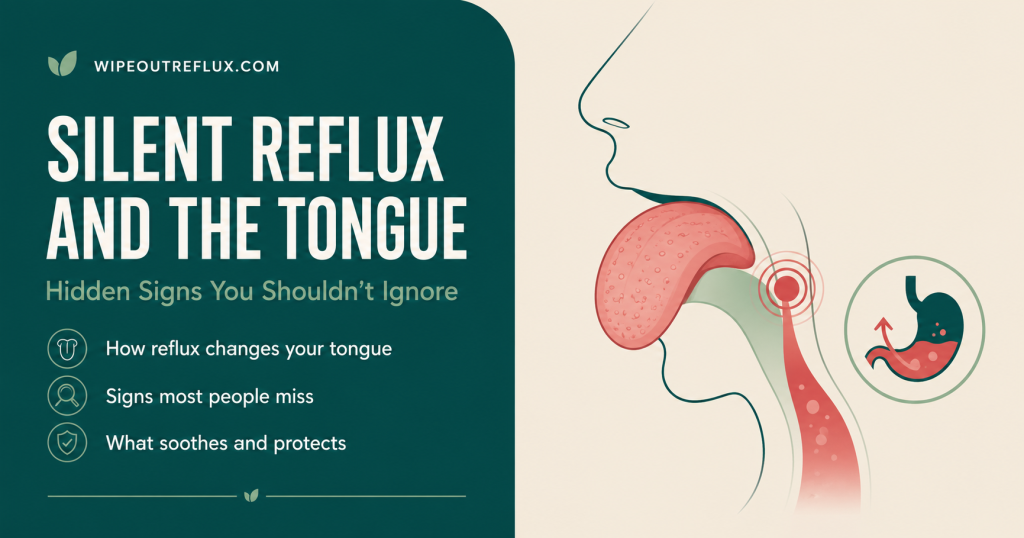
If you have silent reflux and you have noticed a white coating on your tongue, a burning or scalded feeling, or food suddenly tasting bitter or metallic, you are not imagining a connection. The tongue sits right in the firing line of laryngopharyngeal reflux (LPR), and after more than eight years living with silent reflux myself, tongue changes are one of the symptoms I get asked about most.
Here is the honest short answer: silent reflux can affect the tongue, but tongue changes are not the most reliable sign of it, and they have plenty of other causes. So the tongue is a useful clue rather than a diagnosis on its own.
In this guide I will walk through what silent reflux actually does to the tongue, why it happens on a mechanism level, how to tell reflux-related changes apart from thrush or a deficiency, and what genuinely helps.
Key takeaways
- Silent reflux (LPR) can reach the mouth and irritate the tongue, but tongue changes are an uncommon and non-specific sign, not a diagnosis.
- The most reported changes are a white/coated tongue, a burning or scalded feeling, and altered taste (bitter, sour or metallic).
- A white coated tongue is more common and more severe in people with reflux, and its extent tracks with symptom severity in research.
- Pepsin, not just acid, is the key player — it binds to tissue and reactivates in acidic conditions.
- Many tongue changes are not reflux: oral thrush, dry mouth, poor oral hygiene, smoking, and B12, iron, folate or zinc deficiency all look similar.
- Burning tongue overlaps with burning mouth syndrome, which is a diagnosis of exclusion — reflux is one possible contributor, not a proven cause.
- Reducing how much refluxate reaches the mouth is the real fix; scraping the tongue only treats the surface.
- See a doctor or dentist for white patches that will not wipe off, one-sided lesions, or ulcers lasting more than two to three weeks.
Can silent reflux affect the tongue?
Yes. The three changes people report most often are a white or coated tongue, a burning or raw sensation (frequently worse as the day goes on), and altered taste such as a bitter, sour or metallic background flavour.
The reason silent reflux reaches the tongue at all comes down to how LPR differs from ordinary heartburn. In classic GERD, acid mostly troubles the oesophagus. In LPR, small amounts of refluxate travel higher, past the upper valve, into the throat and sometimes into the mouth itself. Because the throat and oral tissues are far more delicate than the oesophagus and lack its protective mechanisms, even brief, low-volume exposure can cause irritation. That is why so many people have throat and mouth symptoms without ever feeling classic heartburn.
The other half of the story is pepsin. Pepsin is a stomach enzyme that hitches a ride in the refluxate and binds to the tissues it lands on. It stays put and can be reactivated whenever the local environment turns acidic again, for example when you eat or drink something acidic. This pepsin-reactivation idea is central to understanding LPR, and it is why I keep coming back to clearing and neutralising pepsin in the throat as a priority rather than only thinking about acid.
Why silent reflux causes a white or coated tongue
A coated tongue is essentially a build-up on the tongue’s surface made of shed skin cells, bacteria, and debris trapped between the tiny papillae. Anything that increases that build-up, or slows down its natural clearance, can leave you with a visible white or yellowish layer.
With reflux there appear to be two things going on. First, when irritating stomach contents reach the mouth and throat, the body ramps up mucus production to try to protect the lining — and that extra mucus gives coating something to cling to. Second, the refluxate itself may alter the tongue’s surface cells and the local environment, encouraging a thicker layer to form.
This is not just anecdote. A case-control study comparing people with reflux to healthy controls found white tongue was considerably more common in the reflux group, and — importantly — the extent of the coating correlated with how severe the reflux symptoms were [Jamali et al., Advanced Biomedical Research, 2023]. A separate study using an objective computerised tongue-imaging system also picked up measurable differences in the tongues of people with reflux versus those without [Wu et al., Medicine, 2020].
The practical takeaway: if your coating gets thicker during a bad reflux spell and eases when your reflux is calmer, that pattern is a reasonable hint that the two are linked for you.
Why silent reflux can make your tongue burn
A burning, scalded, or raw tongue is one of the more distressing symptoms, partly because there is often nothing obvious to see. The mechanism is thought to be irritation of the nerve endings and surface tissue of the tongue by acid and pepsin that has reached the mouth, sometimes leaving the area sensitised so that ordinary foods sting.
Here is where I want to be straight with you, because a lot of content online overstates this. Persistent tongue burning with a normal-looking tongue is often labelled burning mouth syndrome (BMS), and BMS is officially a diagnosis of exclusion — meaning doctors reach it only after ruling out other causes, and its exact cause frequently stays unknown. Reflux is listed as one possible contributor, not a confirmed trigger.
That said, the reflux link is real enough to take seriously. In a case series of atypical LPR presentations, nearly half of the unusual cases involved recurrent mouth ulcers or burning mouth, and those symptoms resolved after proper antireflux treatment [Lechien et al., Journal of Clinical Medicine, 2021]. So for a subset of people, treating the reflux does seem to settle the burning — but not for everyone, which is exactly why chasing the reflux is worth doing while keeping realistic expectations.
Silent reflux and altered taste
Plenty of people with silent reflux describe a lingering bitter, sour or metallic taste, or find that flavours seem off. When refluxate reaches the mouth, it can leave an acidic or bitter residue directly, and it may also interfere with how the taste receptors on the tongue behave.
A 2025 study looking at people with burning mouth symptoms found that altered taste and a thickened tongue coating were both significantly more common in those who also scored high for reflux — with a bitter taste being the most frequently reported [Li et al., Cephalalgia, 2025]. It is another reminder that tongue coating, burning and taste changes often travel together, and reflux can sit underneath all three.
Silent reflux tongue vs other causes (this matters)
Before you pin everything on reflux, it is worth knowing that several very common conditions cause almost identical tongue changes. Getting this wrong means treating the wrong thing.
Oral thrush
Thrush is a fungal (Candida) overgrowth that produces creamy white patches which can often be gently scraped off, sometimes leaving a red or sore area underneath. It needs antifungal treatment, not reflux management. If your white coating comes off in patches or your mouth is genuinely sore, get it checked — this is a big one to rule out, especially if you have used inhaled steroids or antibiotics.
Dry mouth
Reduced saliva lets debris and bacteria accumulate, causing coating and a burning feeling. Mouth-breathing, certain medications, and dehydration all contribute. Confusingly, reflux and dry mouth can coexist.
Nutrient deficiencies
Low vitamin B12, iron, folate or zinc can inflame the tongue, alter taste, and cause soreness or burning. A simple blood test settles this, and it is well worth doing if your symptoms are persistent.
Poor oral hygiene, smoking and alcohol
All three thicken tongue coating and irritate the surface. Alcohol-based mouthwashes can make a sensitive tongue worse rather than better.
Geographic tongue
This is a benign condition with map-like patches that is not caused by reflux — but the bare areas are sensitive to acidic foods, so it can feel reflux-related when it is not.
The overlap is exactly why I treat the tongue as one data point among many. If you also have the more typical silent reflux signs — throat clearing, a lump-in-throat feeling, hoarseness, post-nasal drip or bad breath — the reflux explanation gets a lot more likely. My full rundown of LPR symptoms is a good place to sense-check the bigger picture.
How to help a silent reflux tongue
Mechanism first: scraping your tongue clean feels productive, but if reflux is the driver you are only wiping away a symptom while the cause keeps refilling it. The real work is reducing how much acid and pepsin reach your mouth in the first place, then giving the tissue a chance to settle.
1. Cut down the refluxate reaching your mouth
This is the foundation. Leave a solid gap between your last food and lying down (I aim for three to four hours), keep upright after meals, avoid late eating, and work on the dietary triggers and acidic foods that provoke reflux and reactivate pepsin. This is the core of an LPR-focused approach and where most people see the biggest shift.
2. Use an alginate to cap reflux
An alginate such as Gaviscon Advance forms a raft on top of the stomach contents, which can physically reduce how much refluxate travels upward. Taken after meals and before bed, it is one of the more practical tools for cutting the exposure that irritates the tongue and throat.
3. Look after the tongue gently
Clean your tongue softly rather than aggressively scraping it, stay well hydrated to support saliva, and skip harsh alcohol-based mouthwashes that dry and sting. If your tongue is sensitive, ease off very acidic foods and drinks while it recovers.
4. Rule out the impostors
Ask your GP about a blood test for B12, iron, folate and zinc, and get any persistent white patches assessed for thrush. Fixing a deficiency or clearing a fungal infection can resolve tongue symptoms that no amount of reflux management would have touched.
5. Be patient with burning
If burning is your main issue, give reflux measures a fair trial of several weeks. For some people it settles as the reflux calms; for others the burning has a separate, neuropathic cause and needs a different route. Either way, you will have ruled reflux in or out, which is progress.
Frequently asked questions
Can silent reflux cause a white tongue?
Yes, it can. Reflux increases protective mucus in the mouth and throat and may alter the tongue’s surface cells, both of which encourage a white or yellowish coating. Research shows white tongue is more common and more severe in people with reflux, with the extent of coating tracking symptom severity. It is not proof of reflux on its own, though, since thrush, dry mouth and poor hygiene look similar.
Why does my tongue burn with silent reflux?
The likely mechanism is acid and pepsin reaching the mouth and irritating the nerve endings and surface tissue of the tongue, sometimes leaving it sensitised so ordinary foods sting. Persistent burning with a normal-looking tongue overlaps with burning mouth syndrome, which is a diagnosis of exclusion. Reflux is one possible contributor rather than a guaranteed cause.
Will reflux tongue go away if I treat the reflux?
Often, yes — but not always. In studies of atypical reflux, burning mouth and mouth ulcers resolved once the reflux was properly treated. For other people the tongue symptoms have a separate cause, so they persist despite good reflux control. A fair trial of several weeks usually tells you which camp you are in.
Can acid reflux change your sense of taste?
It can. Refluxate reaching the mouth can leave a bitter, sour or metallic residue and may interfere with how taste receptors work. A persistent bitter taste is one of the more commonly reported taste changes linked to reflux, and it frequently appears alongside a coated or burning tongue.
Is a coated tongue always caused by reflux?
No — and this is important. Oral thrush, dry mouth, nutrient deficiencies (B12, iron, folate, zinc), poor oral hygiene, smoking and alcohol all cause coating too. Reflux becomes a more likely explanation when you also have other silent reflux signs like throat clearing, a lump-in-throat sensation, hoarseness or post-nasal drip.
How do I clean a reflux-coated tongue?
Gently. Use a soft tongue cleaner or your toothbrush lightly, stay hydrated, and avoid alcohol-based mouthwashes that irritate. But remember cleaning only removes the surface layer — if reflux keeps sending acid and pepsin up, the coating returns. Reducing the reflux itself is what makes the difference long term.
When should I see a doctor or dentist about tongue changes?
Get checked promptly if you have white patches that will not wipe off, a lesion or sore on one side only, an ulcer lasting more than two to three weeks, unexplained pain, or any lump. These need professional assessment to exclude thrush, other oral conditions and, rarely, more serious causes. Tongue changes should never be self-diagnosed as reflux without ruling these out.
Conclusion
Silent reflux and the tongue are genuinely connected, but the relationship is more nuanced than most articles let on. Reflux can leave you with a white coating, a burning or scalded feeling, and taste that seems off — and the mechanism makes sense, because LPR carries acid and pepsin all the way up to the mouth where the tissue simply is not built to cope with it. At the same time, tongue changes are non-specific, so thrush, dry mouth and nutrient deficiencies always deserve to be ruled out before you settle on reflux as the answer.
The most useful mindset is to treat your tongue as a signal rather than the target. Cleaning it helps the surface, but lasting relief comes from cutting how much refluxate reaches your mouth in the first place — through meal timing, trigger management, an alginate, and taking the pepsin angle seriously. If you want a structured way to do that, my Wipeout Diet Plan is the in-depth programme I built to bring silent reflux under control step by step, covering the full picture rather than just the tongue.
And if your first question is simply which foods and drinks are safe, the Wipeout Food Reference Guide is the essential quick-reference companion — it lays out the foods and drinks allowed on an acid reflux and LPR diet along with their pH values, so you can stop guessing and start reducing the exposure that keeps your tongue irritated. Between the two, you have both the day-to-day reference and the deeper roadmap. Your tongue, and the rest of your throat, will thank you for it.
Research sources
- [Jamali et al., Advanced Biomedical Research, 2023] — A case-control study finding white tongue was significantly more prevalent in people with reflux than controls, with the extent of coating correlating with reflux symptom severity.
- [Wu et al., Medicine, 2020] — Using an objective computerised tongue-imaging system, this study identified measurable tongue differences between people with and without reflux, supporting tongue changes as a potential non-invasive indicator.
- [Lechien et al., Journal of Clinical Medicine, 2021] — A 5-year case series of atypical LPR in which recurrent mouth ulcers and burning mouth featured prominently and resolved after appropriate antireflux treatment.
- [Li et al., Cephalalgia, 2025] — A cross-sectional study showing altered taste and thickened tongue coating were significantly more common in burning-mouth patients who also scored high for reflux, with bitter taste most frequently reported.

David Gray
12 years living with LPR · Consultant & researcher
I've lived with LPR for twelve years — the misdiagnoses, the PPI courses that did nothing, the slow work of figuring out what actually helps. Wipeout Reflux is where I translate the research into plain terms for people stuck in the same place. Every claim here is sourced to peer-reviewed work, and I consult one-to-one with LPR sufferers.