
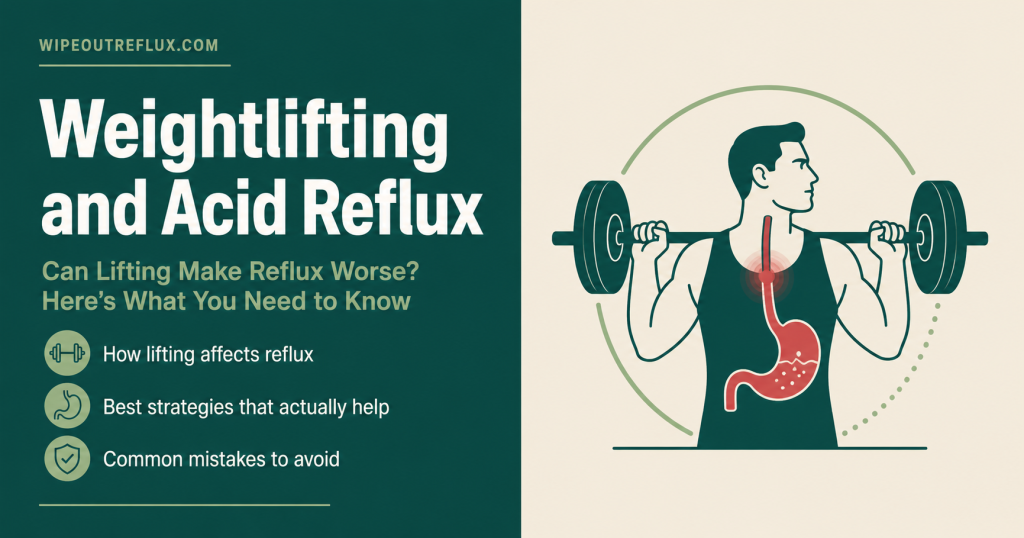
If lifting weights sets off heartburn, a burning throat, or that acid-in-the-chest feeling, you’re not imagining it and you’re not doing anything wrong. Weightlifting is one of the most reliable exercise triggers for reflux because straining under a heavy load spikes the pressure inside your abdomen and pushes stomach contents up past a valve that’s only designed to hold back so much.
The good news: you almost never have to quit lifting. In most cases you can train hard and keep reflux quiet by changing how and when you lift, not whether you lift at all. Below I’ll explain exactly why weights trigger reflux, what the research actually shows, and the practical adjustments that let you keep training without paying for it later.
Key Takeaways
- Heavy lifting raises intra-abdominal pressure, which can force stomach acid past the lower esophageal sphincter and into your throat.
- In head-to-head research, weightlifters had the highest acid exposure of any athletes tested — more than runners or cyclists.
- Breath-holding (the Valsalva maneuver) and a too-tight lifting belt both make reflux worse under load.
- Training on a full stomach dramatically increases reflux, so meal timing is one of your biggest levers.
- You rarely need to stop lifting — adjusting timing, breathing, exercise selection, and diet is usually enough.
- If reflux is silent (throat symptoms, cough, hoarseness rather than heartburn), the same rules apply but the fix leans heavily on diet.
Why Weightlifting Triggers Acid Reflux
To fix the problem it helps to understand the mechanism, because once you see what’s happening the solutions become obvious.
Intra-abdominal pressure is the main culprit
Every time you brace and push against a heavy load — a squat, a deadlift, a leg press, even a hard set of sit-ups — the pressure inside your abdomen climbs sharply. Your stomach sits right in the middle of that pressurized space. When the pressure gets high enough, it overwhelms the lower esophageal sphincter, the ring of muscle that’s supposed to keep acid down where it belongs. Acid gets squeezed upward, and you feel it.
Breath-holding makes it worse
Most lifters unconsciously hold their breath and bear down during a hard rep — the Valsalva maneuver. It’s great for spinal stability, but it also cranks abdominal pressure even higher and encourages the sphincter to relax at exactly the wrong moment. This is a big reason grinding, maximal-effort sets tend to provoke more reflux than lighter, smoother ones.
Body position and jostling
Bending forward, lying flat on a bench, or getting into positions where your torso folds all make it easier for acid to travel the wrong way. Exercises that combine high pressure with a bent-over or flat position — think bent-over rows, decline movements, or heavy ab work — stack two triggers on top of each other.
What the Research Actually Shows
This isn’t just theory. Vigorous exercise has been shown to induce measurable reflux even in healthy people with no history of the problem, and the effect is proportional to how intense and jarring the activity is Clark et al., JAMA, 1989.
The most telling study compared conditioned runners, cyclists, and weightlifters directly. Weightlifters came out worst by a wide margin: their esophagus sat below pH 4 (the acid threshold) for about 18% of the time on an empty stomach, and a striking 36% of the time after eating — far more acid exposure than runners or cyclists Collings et al., Medicine & Science in Sports & Exercise, 2003. In other words, of the common training styles, lifting is the one most likely to give you reflux.
Reviews of the topic also confirm that reflux episodes tend to track with the length and intensity of the exercise, which is why your hardest, longest sessions are usually the ones that bother you most Jozkow et al., Sports Medicine, 2006.
Do You Need to Stop Lifting?
Almost certainly not. Exercise-induced reflux is uncomfortable and worth taking seriously, but for most people it’s a mechanical, temporary event — acid gets pushed up during the session and settles afterward. That’s very different from constant, untreated reflux that bathes the throat and esophagus in acid all day. It’s also worth knowing that not all training is equal here; my broader guide on exercise and acid reflux covers how cardio and other activities compare.
Staying active is actually on your side in the long run. Keeping your weight down is one of the most consistent ways to reduce reflux, and lifting helps you do exactly that Ness-Jensen et al., American Journal of Gastroenterology, 2013. So the goal isn’t to give up training — it’s to train in a way that doesn’t provoke symptoms.
How to Lift Weights Without Triggering Reflux
Here are the adjustments that make the biggest difference, roughly in order of impact.
1. Train on a near-empty stomach
This is the single biggest lever. A full stomach has more content to push up and puts more pressure on the sphincter, which is exactly why acid exposure roughly doubled after eating in the research above. Leave 2–3 hours between a proper meal and a heavy session. If you need fuel, keep it small and low-fat — something like a banana or a little oatmeal rather than a big, greasy pre-workout meal.
2. Fix your breathing and ease off the grind
You don’t have to abandon bracing, but avoid prolonged breath-holding across multiple reps. Brace, complete the rep, and breathe. Leaving a rep or two in the tank instead of grinding to failure keeps abdominal pressure lower and is often enough on its own to calm things down.
3. Loosen the belt (or ditch it for lighter work)
A lifting belt cinched tight around your midsection adds external pressure on the stomach on top of everything else. Only wear it for genuinely heavy sets, and don’t strap it down harder than you need to.
4. Choose exercises that keep you upright
Upright, well-supported movements are gentler on the sphincter than bent-over or flat positions. If a movement reliably triggers you, swap it:
- Gentler swaps: machine or supported rows instead of heavy bent-over rows; incline press instead of flat or decline; goblet or front-loaded squats instead of maximal back squats.
- Common triggers: heavy deadlifts, maximal back squats, decline bench, and high-rep ab work like weighted sit-ups and crunches, which crank abdominal pressure hard.
5. Mind your hydration and what you drink
Sip water rather than gulping a large volume mid-set, which adds to stomach pressure. Skip carbonated drinks and acidic pre-workouts around training. If you’re not sure what’s safe to sip, this guide on what to drink for acid reflux is a good reference.
6. Don’t lie down right after
Reflux is worst when acid doesn’t have to fight gravity. Stay upright for a while after your session instead of collapsing onto the couch, and avoid stacking a heavy meal immediately onto a workout.
A Note for Silent Reflux (LPR)
If your main symptoms are in your throat — hoarseness, a lump sensation, constant throat-clearing, or a nagging cough — rather than classic heartburn, you may be dealing with silent reflux (LPR). The mechanics under load are the same, but the throat tissues are far more sensitive to even small amounts of acid and pepsin. The timing and breathing tips still apply, but for LPR the diet piece does most of the heavy lifting, so that’s where I’d focus first — a structured plan like the 2-week acid reflux diet is a solid starting point.
When to See a Doctor
Adjust your training first, but get checked out if reflux is frequent and not improving, if you have trouble or pain when swallowing, unexplained weight loss, vomiting, black stools, or any chest pain you’re unsure about. Chest pressure during exertion should always be evaluated to rule out your heart before it’s blamed on reflux.
Frequently Asked Questions
Why do I get acid reflux only when I lift heavy?
Heavy lifting spikes the pressure inside your abdomen, which can overpower the valve at the top of your stomach and push acid up. Lighter sets generate less pressure, so they often cause no symptoms at all.
Is it bad to work out with acid reflux?
Not usually. Exercise-induced reflux is typically a temporary, mechanical event, and staying active helps with weight control, which reduces reflux over time. The aim is to train smarter — timing, breathing, and exercise choice — not to stop.
Should I eat before lifting if I have reflux?
Leave 2–3 hours after a full meal before training, since a full stomach roughly doubles acid exposure during exercise. If you need something, keep it small and low-fat.
Which exercises are worst for acid reflux?
Movements that combine high abdominal pressure with a bent-over or flat position tend to be the biggest triggers: heavy deadlifts, maximal back squats, decline bench, bent-over rows, and high-rep weighted ab work.
Does holding my breath during lifts make reflux worse?
Yes. Prolonged breath-holding and bearing down (the Valsalva maneuver) drive abdominal pressure even higher and can relax the sphincter at the wrong moment. Brace, complete the rep, then breathe.
Can weightlifting cause silent reflux (LPR)?
It can aggravate it. The pressure mechanism is the same, but throat tissues react to much smaller amounts of acid, so symptoms show up as hoarseness, throat-clearing, or a lump sensation rather than heartburn.
The Bottom Line
Weightlifting deserves its reputation as a reflux trigger — of the common training styles, it produces the most acid exposure, thanks to the pressure you generate every time you brace under a load. But that reputation comes with a big caveat: for most people, reflux while lifting is a fixable mechanical problem, not a reason to hang up your gym shoes.
Start with the levers that matter most. Train on a near-empty stomach, ease off maximal grinding and breath-holding, loosen that belt, favor upright movements over bent-over or flat ones, and stay upright afterward. Those changes alone resolve the problem for a lot of people. And because keeping your weight down is one of the most reliable ways to reduce reflux long term, the training itself is working in your favor.
If reflux keeps flaring despite good training habits — especially if your symptoms are in your throat — the missing piece is almost always diet, because what you eat determines how much acid and pepsin are there to be pushed up in the first place. A great place to start is the Wipeout Food Reference Guide, an essential reference covering which foods and drinks are safe for acid reflux and LPR along with their pH values, so you can build reflux-friendly meals around your training. And if you want the complete, step-by-step system for actually calming reflux down for good, the Wipeout Diet Plan goes far deeper — it’s the ultimate guide to healing the underlying problem so you can get back to lifting the way you want to.
Research & References
- Clark et al., JAMA, 1989 — In healthy volunteers, vigorous exercise induced measurable gastroesophageal reflux, with running (high body agitation) causing the most and gentler activities causing less.
- Collings et al., Medicine & Science in Sports & Exercise, 2003 — Among conditioned runners, cyclists, and weightlifters, weightlifters had the highest esophageal acid exposure (pH ≤ 4 about 18% of the time fasted and 36% fed).
- Jozkow et al., Sports Medicine, 2006 — Review concluding that intense exercise exacerbates GERD and that reflux episodes are associated with the length and intensity of the activity.
- Ness-Jensen et al., American Journal of Gastroenterology, 2013 — Prospective population-based (HUNT) cohort showing that weight loss is dose-dependently associated with a reduction in reflux symptoms.

David Gray
12 years living with LPR · Consultant & researcher
I've lived with LPR for twelve years — the misdiagnoses, the PPI courses that did nothing, the slow work of figuring out what actually helps. Wipeout Reflux is where I translate the research into plain terms for people stuck in the same place. Every claim here is sourced to peer-reviewed work, and I consult one-to-one with LPR sufferers.