
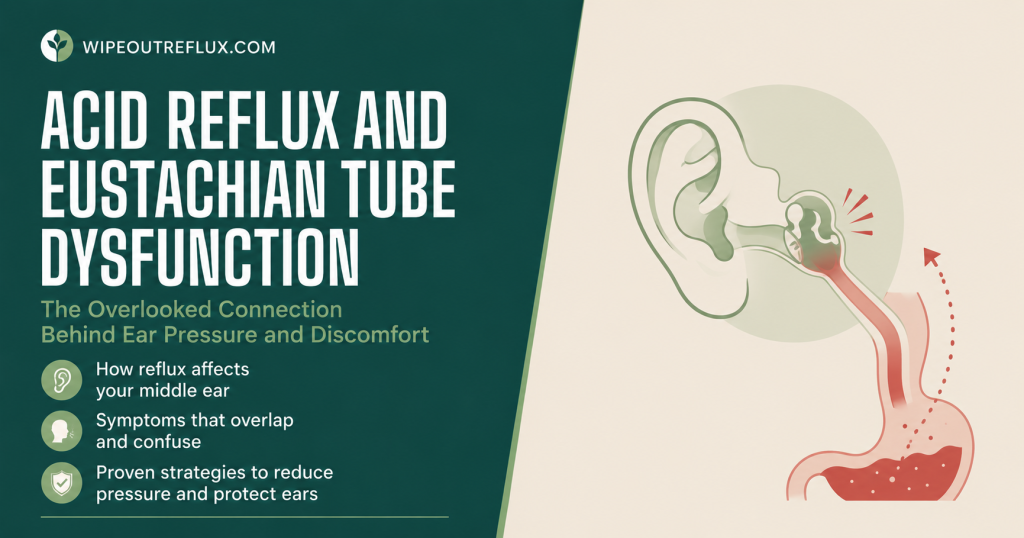
If your ears feel constantly full, blocked, or crackly, they pop when you swallow, and no amount of yawning quite clears them, acid reflux is a cause worth taking seriously. It sounds like an unlikely connection — the stomach and the ears are a long way apart — but the plumbing links them. Reflux that travels all the way up to the back of your nose can inflame the opening of the Eustachian tube, the tiny channel that keeps your middle ear pressure balanced, and leave you with that stubborn stuffed-up feeling.
This isn’t a fringe idea. Researchers have repeatedly found pepsin, a stomach enzyme, inside the middle-ear fluid of people with ear problems — in one landmark study, in the large majority of samples Tasker et al., The Lancet, 2002. If your ear symptoms come without an infection and won’t settle, silent reflux may be the missing piece. Here’s exactly how reflux reaches your ears, and what to do about it.
Key Takeaways
- The Eustachian tube connects your middle ear to the back of your nose — the same area reflux reaches when it travels up past the throat.
- Acid and pepsin can inflame and swell the tube’s opening, stopping it from equalizing pressure and draining the middle ear properly.
- Typical symptoms are ear fullness, popping or crackling, muffled hearing, and mild ear discomfort — often without heartburn.
- Pepsin has been found in the middle-ear fluid of most people with glue ear, and simulated reflux measurably impairs Eustachian tube function in the lab.
- This is a major suspected cause of glue ear (otitis media with effusion) in children, and it affects adults too.
- Acid-suppressing pills alone often don’t fix it, because pepsin can keep irritating tissue even when reflux isn’t very acidic.
- Controlling reflux through diet, night-time habits, and posture is the most reliable way to settle reflux-related ear trouble.
How Acid Reflux Affects the Eustachian Tube
To see the connection, it helps to picture the route reflux takes and what it lands on when it gets there.
The tube and the stomach share a doorway
Your Eustachian tube runs from your middle ear down to the nasopharynx — the space behind your nose and above your soft palate. Its job is to open briefly when you swallow or yawn, letting air in to equalize pressure and letting fluid drain out. That opening sits in exactly the region that silent reflux reaches when stomach contents travel up past your throat. So when reflux comes up that high, it washes over the very doorway your ears depend on.
Acid and pepsin inflame the opening
The lining around the Eustachian tube is delicate and, like your throat, has few defenses against stomach contents. When acid and pepsin reach it, they irritate and swell the tissue, narrowing or effectively blocking the tube. A blocked tube can’t equalize pressure or drain, so the middle ear develops a vacuum and starts to fill with fluid — the mechanism behind that full, muffled, underwater feeling.
This has been shown directly. In an animal model, repeatedly exposing the middle-ear end of the Eustachian tube to simulated reflux (acid plus pepsin) significantly raised the pressure needed to open the tube and impaired its ability to clear pressure and mucus White et al., The Laryngoscope, 2002. In other words, reflux doesn’t just correlate with tube problems — it can actively cause them.
Pepsin is the part that lingers
As with the throat, pepsin is what makes ear reflux so persistent. It’s the stomach’s protein-digesting enzyme, and when it settles into middle-ear tissue it can keep causing irritation and reactivate whenever the local environment turns acidic again. Pepsin has been detected in the middle-ear fluid of children with ear effusions in study after study He et al., Otolaryngology–Head and Neck Surgery, 2007, and its presence in chronic ear fluid points to reflux as a real driver rather than a coincidence Crapko et al., The Laryngoscope, 2007. It’s also why acid-blocking pills often aren’t enough on their own — they lower acid, but they don’t remove the pepsin. There’s more on calming it in this guide to neutralizing pepsin in the throat.
It usually comes without heartburn
Reflux that reaches the ears is coming up very high, which means it’s the silent kind — silent reflux (LPR) rather than classic heartburn. Many people with reflux-related ear fullness have no burning in the chest at all, just throat and ear symptoms, which is exactly why the ear connection gets overlooked. If your ears block up alongside a hoarse voice, throat-clearing, or post-nasal drip, that cluster is a strong hint that reflux is involved.
Symptoms of Reflux-Related Eustachian Tube Dysfunction
Reflux-driven ear trouble has a recognizable feel. The common signs include:
- A constant sense of fullness or pressure, like your ears need to “pop.”
- Popping, clicking, or crackling when you swallow or yawn.
- Muffled or underwater hearing that comes and goes.
- Mild ear discomfort or an ache, rather than the sharp pain of an infection — more on acid reflux and ear pain.
- Symptoms that are often worse in the morning after a night lying flat.
- Frequently, throat and sinus symptoms too, such as post-nasal drip or sinus congestion.
The tell-tale difference from an ear infection is the lack of fever and severe pain, and the way the fullness lingers or keeps returning rather than resolving in a few days. Persistent ear symptoms should always be checked by a doctor, both to confirm the cause and to rule out anything else.
Is Reflux Really Behind Glue Ear?
In children, the evidence is strongest. Glue ear (otitis media with effusion) is the most common cause of childhood hearing trouble, and reflux is one of the leading suspected contributors. Pepsin turns up in the great majority of glue-ear samples: a systematic review found it present in an average of around 85% of otitis media effusions studied Miura et al., Otolaryngology–Head and Neck Surgery, 2012. That same review is careful to note that finding pepsin doesn’t by itself prove cause and effect, and that anti-reflux treatment isn’t yet a proven fix for glue ear — so the honest position is a strong, well-supported association rather than a closed case.
Adults get this too. In a study of adults with middle-ear fluid, those with more reflux symptoms showed measurably poorer Eustachian tube function on objective testing Zhen et al., Frontiers in Neurology, 2022. So if you’re an adult with unexplained, stubborn ear fullness, reflux belongs on the list of things to investigate.
How to Settle Reflux-Related Ear Symptoms
Because the problem starts with reflux reaching your upper airway, the fix is to stop it getting there and give the inflamed tube time to recover. These are the levers that matter most.
1. Tighten the diet driving the reflux
This is the foundation. Reducing the acidity and trigger load of what you eat and drink directly cuts how much acid and pepsin travel up toward your ears. Easing off fatty and fried food, large late meals, alcohol, and acidic drinks takes real pressure off the whole system. A structured reset like the 2-week acid reflux diet is a practical way to test how much of your ear trouble is reflux-driven.
2. Protect your upper airway overnight
A lot of high reflux happens while you’re lying flat and swallowing rarely, which is why ear fullness is often worst in the morning. Finish eating two to three hours before bed and raise the head of your bed or use a wedge so gravity keeps stomach contents down — see the best sleeping position for reflux. An alginate raft after your evening meal can help form a barrier against night-time reflux reaching that high; here’s more on using Gaviscon Advance.
3. Help the tube open and drain
While you calm the reflux, simple measures can help the tube do its job: swallowing, yawning, chewing sugar-free gum, and gentle pressure-equalizing techniques all encourage it to open. Staying well hydrated keeps mucus thinner and easier to clear. These don’t fix the cause, but they ease the symptoms while the underlying reflux settles.
4. Treat the whole silent-reflux picture
Ear symptoms rarely travel alone — they usually come bundled with throat and sinus symptoms because it’s all the same reflux hitting the same upper airway. Treating the reflux as one problem, rather than chasing the ear in isolation, is what works. This guide to silent reflux treatment walks through how the pieces fit together, and the complete guide to LPR covers the bigger picture.
5. Don’t lean on acid pills alone
Acid-suppressing medication has a role, but because pepsin can keep irritating the Eustachian tube even without much acid, pills often don’t fully resolve reflux-related ear symptoms — a common source of frustration. The diet-and-habits foundation is what addresses the pepsin side. And any persistent ear fullness or hearing change deserves a proper ENT assessment to confirm the cause and check for anything else.
The Bottom Line
The stomach-to-ear connection sounds far-fetched until you follow the plumbing. Your Eustachian tube opens into the exact patch of your upper airway that silent reflux reaches, and when acid and pepsin wash over that opening they inflame and swell it, leaving the tube unable to balance pressure or drain the middle ear. The result is that maddening blocked, full, crackly, underwater feeling — and because it usually arrives without heartburn, it’s one of the most overlooked effects of reflux.
The evidence behind it is real: pepsin turns up in the middle-ear fluid of most people with glue ear, simulated reflux clearly damages Eustachian tube function in the lab, and adults with more reflux show poorer tube function on testing. What’s still being worked out is exactly how much reflux causes versus contributes — but for anyone with stubborn, unexplained ear fullness, especially alongside throat or sinus symptoms, it’s well worth treating reflux as a likely factor.
Since that comes down to what and when you eat more than anything else, a great place to start is the Wipeout Food Reference Guide, an essential reference covering which foods and drinks are safe for acid reflux and LPR along with their pH values — so you can build a reflux-friendly diet with confidence. And if you want the complete, step-by-step system for calming the underlying reflux for good, the Wipeout Diet Plan goes far deeper — it’s the ultimate guide to settling reflux at the source so your ears can finally clear.
Frequently Asked Questions
Can acid reflux really cause Eustachian tube dysfunction?
Yes. When reflux travels up past the throat to the back of the nose, acid and pepsin can inflame and swell the opening of the Eustachian tube, stopping it from equalizing pressure and draining the middle ear. Pepsin has been found in most glue-ear fluid samples, and simulated reflux impairs tube function in lab studies.
Why do my ears feel full but I don’t have an infection?
Reflux-related ear fullness comes from a swollen, poorly functioning Eustachian tube rather than a bacterial infection, so there’s usually no fever or severe pain — just persistent fullness, popping, and muffled hearing. It often comes bundled with throat or sinus symptoms and is frequently worse in the morning.
Does reflux ear trouble come with heartburn?
Often not. Reflux that reaches the ears is coming up very high, which is the silent (LPR) kind. Many people have no chest burning at all — just ear, throat, and sinus symptoms — which is why the reflux link is so easily missed.
Will acid reflux medication fix my blocked ears?
Not always on its own. Pepsin, the enzyme that comes up with reflux, can keep irritating the Eustachian tube even when reflux isn’t very acidic, so acid-suppressing pills alone often fall short. Diet and lifestyle changes that reduce the overall reflux and pepsin load usually make the bigger difference.
Is reflux a cause of glue ear in children?
It’s one of the leading suspected causes. Pepsin is found in the great majority of glue-ear effusions, and reflux is common in children with chronic middle-ear fluid. That said, researchers stress this is a strong association rather than fully proven cause and effect, so any child with glue ear should be managed by their doctor.
How long does it take for reflux-related ear symptoms to improve?
It varies with how long the tube has been inflamed and how consistently you control the reflux, but many people notice fullness easing over a few weeks once acid and pepsin stop reaching the upper airway. Persistent symptoms should be followed up with an ENT.
Research & References
- Tasker et al., The Lancet, 2002 — Found pepsin/pepsinogen in 83% of middle-ear effusions from children with glue ear, at concentrations up to 1,000-fold higher than in serum, suggesting reflux could be a major cause.
- White et al., The Laryngoscope, 2002 — Animal model showing repeated exposure of the Eustachian tube to simulated reflux (acid and pepsin) significantly raised its opening pressure and impaired its ability to clear pressure and mucus.
- He et al., Otolaryngology–Head and Neck Surgery, 2007 — Detected gastric pepsin in the middle-ear fluid of children with otitis media, supporting reflux of gastric contents into the middle-ear space.
- Crapko et al., The Laryngoscope, 2007 — Found pepsin in a majority of effusions from children with chronic otitis media with effusion, implicating extra-esophageal reflux in the condition.
- Zhen et al., Frontiers in Neurology, 2022 — In 105 adults with otitis media with effusion, greater laryngopharyngeal reflux symptoms were associated with measurably poorer Eustachian tube function on tubomanometry.
- Miura et al., Otolaryngology–Head and Neck Surgery, 2012 — Systematic review reporting pepsin/pepsinogen in an average of about 85% of otitis media effusions, while noting a definitive cause-and-effect link is not yet established.

David Gray
12 years living with LPR · Consultant & researcher
I've lived with LPR for twelve years — the misdiagnoses, the PPI courses that did nothing, the slow work of figuring out what actually helps. Wipeout Reflux is where I translate the research into plain terms for people stuck in the same place. Every claim here is sourced to peer-reviewed work, and I consult one-to-one with LPR sufferers.