
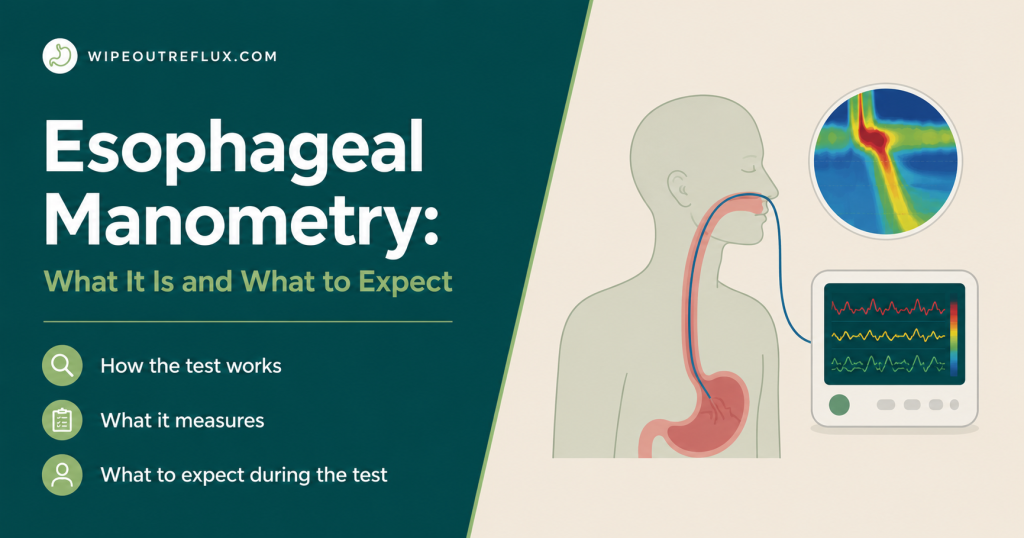
Esophageal manometry is a test that measures how well the muscles of your esophagus are working — how strongly it squeezes to push food down, and how well the valve at the bottom (the lower esophageal sphincter) opens and closes. A thin, flexible tube goes through your nose and down your esophagus while you take small sips of water, and pressure sensors along it map out each swallow. The whole thing usually takes 15 to 30 minutes, and you’re awake for it, with no sedation needed.
It’s important to understand what this test is not: it doesn’t measure acid, and on its own it doesn’t diagnose reflux. Instead, it checks the plumbing — the muscle function and coordination of your swallowing pipe. That’s exactly why doctors order it when swallowing is difficult, when symptoms don’t add up, and, most commonly in the reflux world, before any anti-reflux surgery, to make sure the muscles are up to it and to rule out conditions that can masquerade as reflux.
Here’s what to expect, why it’s done, and what your results actually tell you.
Key Takeaways
- Esophageal manometry measures the muscle function of your esophagus and the pressure of the lower esophageal sphincter (LES) — not acid levels.
- A thin catheter is passed through the nose while you swallow sips of water; the test takes about 15 to 30 minutes and you stay awake.
- It’s most often done to investigate difficulty swallowing, unexplained chest pain, or as a required step before anti-reflux surgery.
- A key job is ruling out motility disorders like achalasia that can mimic reflux but need very different treatment.
- Modern high-resolution manometry produces a detailed color pressure map of every swallow, interpreted using the Chicago Classification.
- Discomfort is usually mild — some gagging as the tube goes in and watery eyes — and there’s no recovery time; you can drive and eat straight afterward.
- It’s frequently paired with pH testing, because together they answer two different questions: how the muscles work, and how much acid refluxes.
What Esophageal Manometry Actually Measures
Swallowing isn’t passive. When you swallow, a wave of coordinated muscle contraction — called peristalsis — travels down your esophagus and squeezes food into your stomach. At the bottom sits the lower esophageal sphincter, a ring of muscle that relaxes to let food through and then clamps shut to keep stomach contents from coming back up. Manometry measures both of these things: the strength and timing of those peristaltic waves, and how well the LES relaxes and how tightly it closes.
That LES is central to reflux. A weak or poorly-timed sphincter is one of the main reasons acid escapes upward in the first place — there’s more on how this valve works in this guide to the stomach sphincter and reflux. Manometry is the test that actually quantifies how that valve, and the muscle above it, are performing.
Today most centers use high-resolution manometry, which packs many closely-spaced sensors along the catheter to build a detailed, color-coded pressure map of your entire esophagus during each swallow. Specialists read these maps using a standardized system called the Chicago Classification, which turns the pressure patterns into specific diagnoses Yadlapati et al., Neurogastroenterology & Motility, 2021.
Why Manometry Is Different From a pH Test
This trips a lot of people up, so it’s worth being clear. A pH test (like the catheter or wireless capsule studies) measures acid — how much reflux is reaching your esophagus and whether it matches your symptoms. Manometry measures muscle function — how well the esophagus squeezes and how the valve behaves. One tells you about the acid; the other tells you about the machinery.
They answer different questions, which is why they’re often done together. In fact, manometry is routinely used to precisely locate the LES so that a pH sensor can be positioned correctly for a reflux study. So if your doctor has ordered both, they’re not being redundant — they’re building a complete picture from two different angles.
Why It’s Done
There are a handful of common reasons manometry lands on your schedule.
Difficulty or pain when swallowing
If food feels like it sticks, or swallowing is painful, manometry checks whether the muscle wave is doing its job or whether something like a motility disorder is interfering.
Unexplained chest pain
Once the heart has been cleared, esophageal spasm and other motility problems can cause gripping chest pain. Manometry can catch these abnormal contraction patterns that other tests miss.
Before anti-reflux surgery — the big one
This is where manometry matters most for reflux patients. Before an operation like a fundoplication, surgeons need to know that your esophagus can still push food through effectively once the valve is tightened, and — critically — that you don’t have a hidden motility disorder that would make the surgery the wrong choice. High-resolution manometry has become a routine and valuable part of this pre-operative workup van Hoeij & Bredenoord, Neurogastroenterology & Motility, 2015. If you’re weighing up an operation, it’s worth understanding where testing fits in the bigger picture of reflux surgery.
Ruling out conditions that mimic reflux
Some serious esophageal problems feel like reflux but aren’t. The most important is achalasia, where the LES fails to relax and the esophagus loses its ability to push food down. Manometry is the gold-standard test for diagnosing it — and catching it matters enormously, because treating achalasia as if it were ordinary reflux (including operating on it the wrong way) can make things worse Chuah, JGH Open, 2025. This is a big reason the test exists: to make sure the diagnosis is right before anyone commits to treatment.
How to Prepare
Preparation is simple. You’ll usually be asked not to eat or drink for about six to eight hours beforehand so your stomach and esophagus are empty. Your doctor may also ask you to pause certain medications that affect esophageal muscle activity — things like some reflux drugs, muscle relaxants, calcium channel blockers, and certain pain medications — but only stop anything if your clinic specifically tells you to. Let them know about any nasal problems, since the tube goes in through your nose, and mention allergies or bleeding issues as usual.
What Happens During the Test
Manometry is done awake, without sedation, because you need to be able to swallow on cue. Here’s the sequence most people experience.
First, a nurse or technician numbs one nostril with a gel or spray to make the tube more comfortable. Then the thin, flexible catheter is gently passed through your nose, down the back of your throat, and into your esophagus and stomach. As it goes past the throat there’s often a brief gagging feeling and your eyes may water — this is the least pleasant moment, and it passes quickly. You’ll usually be asked to take a few sips of water as the tube advances, because swallowing helps it slide into place.
Once the catheter is positioned, the actual measurements begin. You’ll be asked to lie back and take small, measured sips of water while staying still between swallows. Each swallow triggers the sensors to record the pressure wave traveling down your esophagus and how the sphincter responds. This is repeated maybe ten times or so. The whole recording takes around 15 to 30 minutes, after which the tube is smoothly withdrawn — which most people find takes just a second and is a relief.
What It Feels Like — and Afterward
Honestly, the anticipation is usually worse than the reality. Most people describe mild discomfort rather than pain: the tube going in is the tricky bit, with some gagging and watery eyes, but once it’s in place the sipping part is easy and many people relax quickly. Because there’s no sedation, there’s no grogginess and no recovery period.
Afterward you might have a slightly sore throat or a stuffy or runny nose for a little while, both of which settle on their own. You can eat, drink, drive, and return to normal activities right away. It’s one of the more straightforward tests in this area, even though it sounds intimidating on paper.
What Your Results Mean
Your doctor interprets the pressure maps to describe how your esophagus is functioning. A few of the things they’re looking at:
- LES pressure and relaxation: Is the valve too weak (which can allow reflux), too tight, or failing to relax properly (a hallmark of achalasia)?
- Peristalsis: Are the muscle waves strong and well-coordinated, weak and ineffective, or disordered and spastic?
- Overall pattern: Using the Chicago Classification, these findings are grouped into recognized diagnoses — from a normal study, to ineffective esophageal motility, to spastic disorders, to achalasia.
For reflux specifically, weak peristalsis or a low-pressure sphincter helps explain why acid is escaping and can influence which type of surgery (if any) is appropriate. A normal motility study, on the other hand, is reassuring and clears the way for a standard anti-reflux operation if that’s the plan. Either way, the result is a piece of the puzzle your doctor combines with your symptoms and any acid testing to reach a confident diagnosis. If your reflux has been stubborn despite treatment, this kind of objective testing is often what finally explains why — here’s more on what to do when reflux medication isn’t working.
The Bottom Line
Esophageal manometry sounds daunting, but it’s a quick, awake, sedation-free test that measures something no acid study can: how well your esophageal muscles and valve actually work. It’s the test that tells your doctor whether the machinery of swallowing is normal, whether a weak sphincter is letting acid up, and — crucially — whether a hidden condition like achalasia is masquerading as reflux. That’s why it’s such a standard step before anti-reflux surgery, and such a useful tool when the usual reflux story doesn’t quite fit. The tube going in is the uncomfortable moment; after that, most people are surprised how manageable it is, with no recovery time at all.
Whatever your manometry shows, remember that testing is about getting the diagnosis right — it’s not the treatment itself. For the vast majority of people with reflux, the real day-to-day difference comes from reducing how much acid and pepsin your body produces and refluxes, which is largely driven by what and when you eat. A great place to start is the Wipeout Food Reference Guide, the essential reference to which foods and drinks are safe for acid reflux and LPR along with their pH values, so you can build a low-reflux diet with confidence. And if you want the complete, step-by-step system for calming reflux at its source, the Wipeout Diet Plan goes much deeper — it’s the ultimate guide to healing the underlying reflux so that, test results aside, you actually feel better.
Frequently Asked Questions
Does esophageal manometry hurt?
For most people it’s uncomfortable rather than painful. The trickiest moment is when the thin tube passes through the back of the throat, which can trigger brief gagging and watery eyes. Numbing gel in the nose helps, and once the catheter is in place the sipping part is easy. There’s no sedation and no recovery time.
How long does the test take?
The recording itself usually takes about 15 to 30 minutes. With check-in and setup you might be at the clinic for around an hour, but because you’re awake the whole time and don’t need sedation, you can leave and resume normal activities immediately afterward.
Am I asleep or sedated for it?
No. Unlike an endoscopy, manometry is done fully awake, because you need to swallow sips of water on cue so the sensors can measure each swallow. That also means no grogginess afterward — you can drive yourself home and eat right away.
What’s the difference between manometry and a pH (acid) test?
Manometry measures muscle function — how your esophagus squeezes and how the lower valve opens and closes. A pH test measures acid — how much reflux reaches your esophagus and whether it matches your symptoms. They answer different questions, so doctors often do both, and manometry is even used to position the pH sensor correctly.
Why do I need manometry before reflux surgery?
Surgeons need to confirm your esophagus can still push food through once the valve is tightened, and to rule out a motility disorder like achalasia that would make standard reflux surgery the wrong choice. That’s why high-resolution manometry is a routine part of the pre-operative workup before an operation such as a fundoplication.
Can manometry diagnose acid reflux by itself?
Not directly. Manometry can reveal a weak or poorly functioning lower esophageal sphincter, which helps explain why reflux happens, but it doesn’t measure acid. Confirming reflux itself usually requires pH monitoring. The two tests are complementary rather than interchangeable.
Research & References
- Yadlapati et al., Neurogastroenterology & Motility, 2021 — The Chicago Classification version 4.0, the international standard for interpreting high-resolution esophageal manometry and defining motility disorders including achalasia.
- van Hoeij & Bredenoord, Neurogastroenterology & Motility, 2015 — Review of the predictive value and clinical role of routine high-resolution manometry in evaluating gastroesophageal reflux disease and planning anti-reflux surgery.
- Chuah, JGH Open, 2025 — Editorial on the role of esophageal manometry in diagnosing achalasia and other motility disorders, underscoring its importance in distinguishing these conditions from reflux before treatment.

David Gray
Content Researcher & Author
David Gray founded Wipeout Reflux to address a critical gap in reflux management. His research synthesizes over 100 peer-reviewed studies on laryngopharyngeal reflux (LPR), pepsin biology, and GERD pathophysiology. For LPR specifically—a condition most physicians misdiagnose—his work focuses on pepsin reactivation and why standard PPI therapy fails most patients. He develops evidence-based protocols targeting root causes of both LPR and GERD, integrating emerging research on sphincter dysfunction, dietary interventions, and newer clinical approaches. Wipeout Reflux represents practical application of clinical science for patients seeking real solutions.