
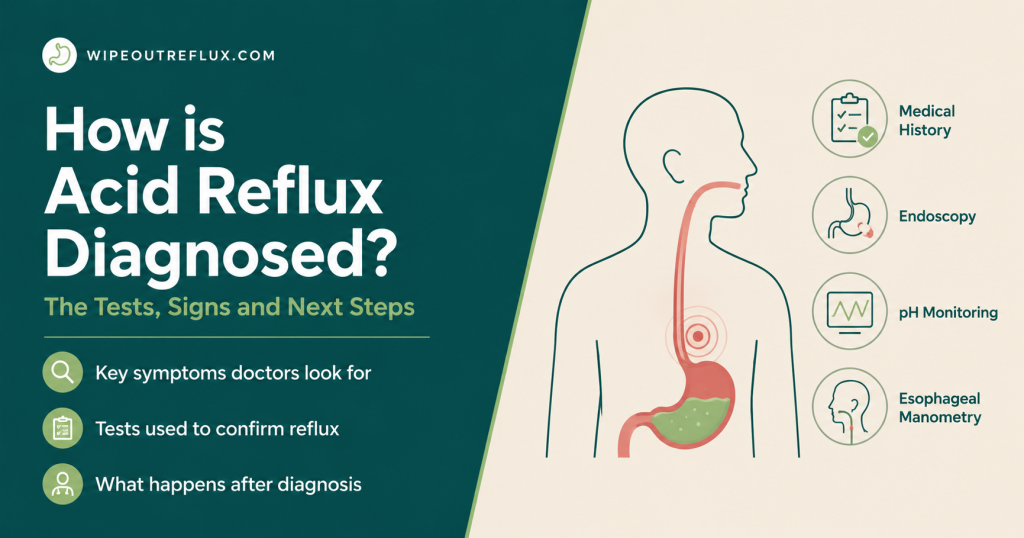
Here’s the honest answer most people don’t expect: acid reflux usually isn’t diagnosed with a test at all. If you have classic symptoms like heartburn and regurgitation and no warning signs, doctors typically diagnose reflux from your symptoms and a trial of acid-suppressing medication — no camera, no probe required. Testing enters the picture when the diagnosis is unclear, symptoms don’t improve, there are alarm features, or you’re considering surgery.
When testing is needed, the two you’ll hear about most are endoscopy and pH monitoring, and they answer completely different questions. An endoscopy is a camera that looks for damage — inflammation, a hiatal hernia, Barrett’s esophagus. pH monitoring measures acid — how much reflux actually reaches your esophagus and whether it lines up with your symptoms. That second one is the closest thing to a definitive reflux test, while endoscopy is more about checking for complications.
Below I’ll walk through each test, when doctors use it, and how to think about “endoscopy vs pH monitoring” — plus the extra tests that matter if your reflux is the throat-based, silent kind.
Key Takeaways
- Most people with typical reflux symptoms are diagnosed clinically — from symptoms plus a response to a proton pump inhibitor (PPI) trial — without any test.
- Endoscopy uses a camera to look for damage and complications, but it’s often completely normal in reflux, so a normal result doesn’t rule reflux out.
- pH monitoring measures how much acid reaches your esophagus over 24 to 96 hours and is the most definitive way to confirm or exclude reflux.
- Endoscopy and pH monitoring aren’t rivals — they answer different questions and are often used together.
- Esophageal manometry measures muscle function and is mainly used before surgery or to rule out conditions that mimic reflux.
- Throat-based silent reflux (LPR) is diagnosed differently, using symptom scores and specialized throat or saliva tests rather than a standard esophageal probe.
- Testing is usually reserved for unclear cases, persistent symptoms, alarm features, or pre-surgical planning.
Step One: Symptoms and the PPI Trial
For most people, diagnosis starts — and often ends — here. If you have the classic combination of heartburn and acid regurgitation, without any alarm symptoms, guidelines recommend simply trying an 8-week course of a once-daily PPI before your meal Katz et al., American Journal of Gastroenterology, 2022. If your symptoms clear up, that response effectively confirms reflux and treats it at the same time. It’s practical, cheap, and avoids unnecessary procedures.
The catch is that this approach isn’t perfect. Some people respond partially, some not at all, and a lack of response doesn’t always mean it isn’t reflux — it might mean the reflux isn’t acidic enough for a PPI to help, or that something else is going on. If you’re in that group, it’s worth reading why reflux medication sometimes doesn’t work — and that’s usually the point where objective testing becomes worthwhile.
Endoscopy: Looking for Damage
An upper endoscopy (also called an EGD or gastroscopy) is a thin camera passed down your throat, usually under sedation, so your doctor can look directly at your esophagus, stomach, and the top of your small intestine. It’s very good at spotting the consequences of reflux: inflammation and erosions (esophagitis), a hiatal hernia, narrowing (strictures), and precancerous changes called Barrett’s esophagus. It also allows biopsies to be taken.
But here’s the crucial thing people misunderstand: a normal endoscopy does not rule out reflux. The majority of people with genuine reflux symptoms have a completely normal-looking esophagus on the camera — a pattern called non-erosive reflux disease (NERD). Depending on the study, somewhere between half and 85% of symptomatic reflux patients have no visible erosions at all Chen & Hsu, Gastroenterology Research and Practice, 2013. So endoscopy is excellent for finding damage and complications, but it’s a poor tool for confirming reflux itself.
Because of that, endoscopy isn’t the first step for everyone. Guidelines reserve it mainly for people with alarm features — difficulty swallowing, unintended weight loss, gastrointestinal bleeding, anemia, or vomiting — and for those with risk factors for Barrett’s esophagus Katz et al., American Journal of Gastroenterology, 2022. If you have those symptoms, endoscopy moves to the front of the line.
pH Monitoring: Measuring the Acid
This is the test that actually answers “is acid really refluxing, and how much?” A pH study records the acidity inside your esophagus over one to four days and calculates your acid exposure time — the percentage of the recording spent below pH 4. Under the modern international standard (the Lyon Consensus), an acid exposure time above 6% is considered conclusive evidence of reflux disease Gyawali et al., Gut, 2024. It also links your symptoms to actual reflux events, so you learn whether that cough or chest twinge really coincides with acid.
There are two main ways to do it. A catheter study threads a thin tube through your nose for 24 hours. A wireless capsule study (the Bravo test) clips a tiny sensor to the esophageal wall during an endoscopy and records for 48 to 96 hours with nothing hanging out of your nose — and the longer recording catches more, which is why the Lyon update leans toward extended wireless studies Gyawali et al., Gut, 2024. A more advanced version, impedance-pH monitoring, can also detect non-acid reflux, which matters if you’re already on medication or your reflux isn’t strongly acidic.
One important preparation note: because these tests measure acid, you’re often asked to stop PPIs for about a week beforehand so the acid isn’t artificially suppressed — but only ever on your doctor’s instruction. Coming off them can cause a temporary acid rebound, which this guide on getting off PPIs explains.
Endoscopy vs pH Monitoring: Which Do You Need?
This is the question that trips people up, and the answer is that it’s usually not either/or — because they do different jobs.
You lean toward endoscopy when the concern is damage or complications: alarm symptoms, long-standing reflux, screening for Barrett’s, or trouble swallowing. You lean toward pH monitoring when the concern is confirming the diagnosis itself: symptoms that persist despite treatment, an unclear picture, atypical symptoms, or working out whether reflux is truly the cause before committing to long-term medication or surgery. In practice, guidelines suggest that when reflux is suspected but there’s no objective endoscopic evidence, off-medication pH monitoring is the way to nail the diagnosis Katz et al., American Journal of Gastroenterology, 2022.
Often you’ll have the endoscopy first — if it shows clear reflux damage, that alone can confirm the diagnosis and you may not need a pH study at all. If the endoscopy is normal but symptoms persist, pH monitoring becomes the logical next step. So rather than choosing one, think of endoscopy as ruling complications in or out, and pH monitoring as measuring the reflux itself.
Esophageal Manometry: Checking the Muscles
Manometry is a third test that measures how well your esophageal muscles squeeze and how the lower valve (the lower esophageal sphincter) works. It doesn’t measure acid and isn’t used to diagnose reflux on its own. Its two main jobs are to rule out conditions that mimic reflux — especially achalasia, a serious muscle disorder — and to check that your esophagus works well enough before any anti-reflux surgery. It’s also used to position the sensor correctly for a pH catheter study. If surgery is on the table, manometry is almost always part of the workup.
The Other Tests — Especially for Silent Reflux
Standard endoscopy and esophageal pH monitoring are built around classic, heartburn-type reflux. But if your problem is silent reflux (LPR) — the throat-based kind that causes hoarseness, throat clearing, a lump sensation, and cough without much heartburn — the usual tests can miss it, because the damage is happening higher up. It’s worth understanding the difference between GERD and LPR, because it changes which tests make sense.
For suspected LPR, doctors may add:
- A laryngoscopy — an ENT looks at your throat and voice box for signs of reflux irritation, often scored using symptom questionnaires.
- Restech pharyngeal pH monitoring — a slim probe that measures acid up at throat level, where a standard esophageal probe doesn’t reach.
- A Peptest — a saliva sample checked for pepsin, the stomach enzyme, as a marker that reflux is reaching your throat.
- A barium swallow — an X-ray test where you drink a contrast liquid, sometimes used to check anatomy and swallowing.
The Bottom Line
How acid reflux is diagnosed depends entirely on your situation. For most people with typical symptoms, no news is good news: a PPI trial confirms the diagnosis and treats it in one step. When testing is needed, it’s important to understand that the tests aren’t interchangeable. Endoscopy looks for damage and complications but is frequently normal in reflux, so it can’t rule reflux out. pH monitoring measures the acid itself and is the most definitive way to confirm or exclude reflux. Manometry checks the muscles and matters most before surgery or to catch conditions that impersonate reflux. And if your reflux is the silent, throat-based kind, a different set of tests aimed higher up gives a clearer answer. The right test is simply the one that answers the question your doctor actually needs answered.
Whatever the tests reveal, they’re a means to an end — and for the vast majority of people, the thing that actually changes how you feel day to day is reducing how much acid and pepsin you produce and reflux, which comes down mostly to what and when you eat. A great starting point is the Wipeout Food Reference Guide, the essential reference to which foods and drinks are safe for acid reflux and LPR along with their pH values, so you can build a low-reflux diet with confidence. And if you want the complete, step-by-step system for calming reflux at its source, the Wipeout Diet Plan goes much deeper — it’s the ultimate guide to healing the underlying reflux, whatever your test results show.
Frequently Asked Questions
Do I need a test to be diagnosed with acid reflux?
Usually not. If you have classic symptoms like heartburn and regurgitation without alarm features, doctors typically diagnose reflux based on your symptoms and how you respond to a trial of acid-suppressing medication. Tests are reserved for unclear cases, persistent symptoms, warning signs, or surgical planning.
Can an endoscopy rule out acid reflux?
No. This is one of the most common misunderstandings. Most people with genuine reflux symptoms have a completely normal endoscopy — a pattern called non-erosive reflux disease. Endoscopy is great for finding damage and complications, but a normal result does not mean you don’t have reflux.
What’s the most accurate test for acid reflux?
pH monitoring — either a nasal catheter for 24 hours or a wireless capsule for 48 to 96 hours — is the most definitive way to confirm reflux. It measures how much acid actually reaches your esophagus and whether it correlates with your symptoms, which no other test does directly.
Should I get an endoscopy or pH monitoring?
It depends on the question. Endoscopy is the choice when the concern is damage or complications, or when you have alarm symptoms. pH monitoring is the choice when the goal is to confirm reflux itself, especially if symptoms persist despite treatment or the diagnosis is unclear. They’re often used together, not as alternatives.
How is silent reflux (LPR) diagnosed?
Silent reflux affects the throat and often doesn’t show up on standard esophageal tests. Doctors may use a laryngoscopy with symptom scoring, throat-level pH monitoring (such as Restech), or a saliva pepsin test (Peptest) to detect reflux reaching the upper airway. The approach is different from classic heartburn-type reflux.
Do I have to stop my reflux medication before testing?
Often yes, for pH monitoring, because the test measures acid and medication suppresses it. Doctors commonly ask you to pause PPIs for about a week beforehand — but only on their instruction. For endoscopy the requirements differ, and in some impedance-based studies you deliberately stay on medication, so always follow your own clinic’s plan.
Research & References
- Katz et al., American Journal of Gastroenterology, 2022 — The ACG clinical guideline for diagnosing and managing GERD, recommending an empiric PPI trial for typical symptoms, endoscopy for alarm features, and off-therapy reflux monitoring when the diagnosis is unclear.
- Gyawali et al., Gut, 2024 — The Lyon Consensus 2.0, the modern international standard for GERD diagnosis, defining acid exposure time above 6% as conclusive evidence of reflux and supporting extended wireless pH monitoring.
- Chen & Hsu, Gastroenterology Research and Practice, 2013 — Review of non-erosive reflux disease showing that a large majority of symptomatic reflux patients have a normal endoscopy, which is why a normal camera exam cannot rule out reflux.

David Gray
Content Researcher & Author
David Gray founded Wipeout Reflux to address a critical gap in reflux management. His research synthesizes over 100 peer-reviewed studies on laryngopharyngeal reflux (LPR), pepsin biology, and GERD pathophysiology. For LPR specifically—a condition most physicians misdiagnose—his work focuses on pepsin reactivation and why standard PPI therapy fails most patients. He develops evidence-based protocols targeting root causes of both LPR and GERD, integrating emerging research on sphincter dysfunction, dietary interventions, and newer clinical approaches. Wipeout Reflux represents practical application of clinical science for patients seeking real solutions.