
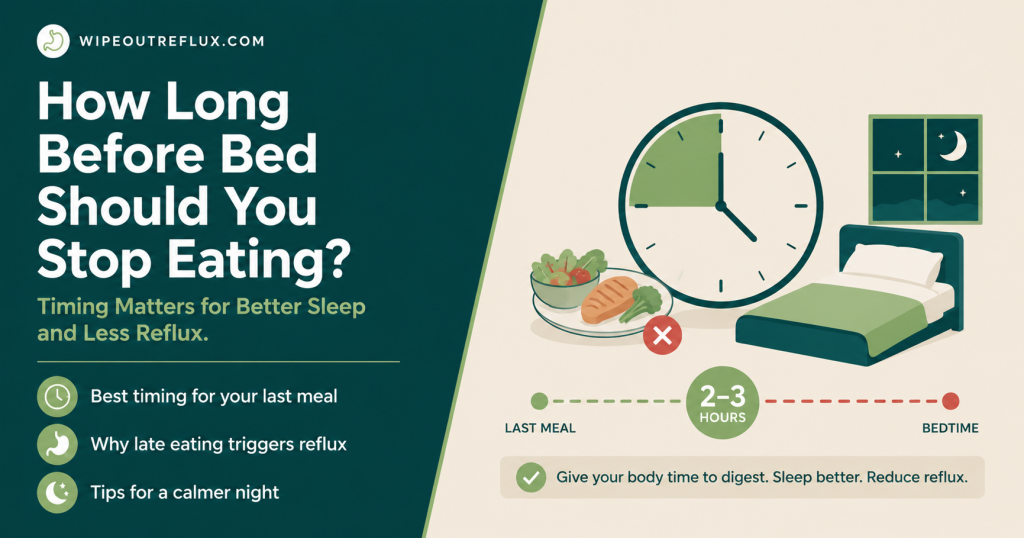
If you have acid reflux, the simple rule is to stop eating at least 3 hours before you lie down — and if your reflux is stubborn, pushing that to 3 to 4 hours is better still. That window gives your stomach time to empty most of its contents before gravity stops helping you, which is exactly when reflux tends to strike.
The reason this matters so much is that lying down with a full stomach removes your body’s main defense against reflux: gravity. During the day, gravity helps keep stomach contents where they belong. Lie down too soon after eating and a full, acidic stomach is now level with your esophagus, free to wash back up — and at night your body is worse at clearing it. That’s why the last meal of the day is, for many people, the single biggest driver of nighttime symptoms.
Below I’ll explain the mechanism, what the research actually shows about meal timing, who needs an even longer gap, and how to handle the nights when eating late is unavoidable.
Key Takeaways
- Aim to finish eating at least 3 hours before bed; 3 to 4 hours is better if your reflux is persistent.
- Lying down with a full stomach removes gravity’s help and lets acid wash back into your esophagus.
- Research links a dinner-to-bed gap under 3 hours with a much higher risk of reflux-related esophageal damage.
- Nighttime reflux is especially harmful because acid sits in your esophagus longer while you sleep, and you swallow and produce saliva less.
- Larger and fattier meals empty more slowly, so they need an even longer gap before lying down.
- People who are overweight, have a hiatal hernia, or have silent reflux (LPR) often benefit from a longer window.
- When you must eat late, keep it small and light, stay upright, and lean on other nighttime defenses like sleeping position and bed elevation.
Why Eating Before Bed Triggers Reflux
To see why timing matters, it helps to picture what’s happening in your stomach after a meal. Food doesn’t leave your stomach instantly — it’s released gradually into your small intestine over a few hours. In the meantime, your stomach is full and producing acid to digest that meal. As long as you’re upright, gravity keeps everything pointing downward, and the valve at the top of your stomach (the lower esophageal sphincter) only has to hold back so much.
Lie down, and the equation changes completely. Now your full, acidic stomach is on the same level as your esophagus, and any weakness in that valve lets acid flow back with no gravity to stop it. On top of that, a full stomach physically pushes up on the valve, making leaks more likely. It’s a perfect storm — and it explains why so many people are fine all day but wake with heartburn, a cough, or a sour taste.
Nighttime reflux is also more damaging than daytime reflux, not just more annoying. When you’re asleep, you swallow far less often and produce much less saliva — and swallowing and saliva are two of the main ways your body clears and neutralizes acid. So any acid that refluxes at night lingers in contact with your esophagus and throat for much longer. If you already wake with symptoms, this guide to acid reflux at night digs into why.
What the Research Actually Shows
This isn’t just folk wisdom — the timing effect is well documented. In a study comparing people with and without reflux, having a dinner-to-bed gap of less than 3 hours was strongly associated with erosive esophagitis (actual acid damage to the esophagus) compared with a gap of 4 hours or more — even after accounting for smoking, alcohol, and body weight Fujiwara et al., American Journal of Gastroenterology, 2005. In other words, the short gap wasn’t just linked to symptoms, but to visible harm.
A randomized crossover trial made the point even more directly. Reflux patients ate the same standardized meal either 2 hours or 6 hours before bed, and their nighttime acid exposure was measured. Eating the late meal produced significantly more acid reflux while lying down than eating the early meal — and the effect was especially pronounced in people who were overweight or had a hiatal hernia Piesman et al., American Journal of Gastroenterology, 2007. Same meal, same person — the only thing that changed was the timing, and the reflux followed.
It’s no surprise, then, that a systematic review of lifestyle factors in reflux lists a short dinner-to-bed interval among the modifiable habits worth changing to reduce symptoms Zhang et al., Therapeutic and Clinical Risk Management, 2021.
The 3-Hour Rule — and When to Make It Longer
Three hours is the widely recommended minimum, and for good reason: it’s roughly how long it takes an average meal to clear the bulk of its volume from your stomach. For a lot of people, simply protecting that 3-hour window before bed is the single most effective change they can make for nighttime symptoms.
But 3 hours is a floor, not a guarantee. Several things mean you should aim for a longer gap — ideally 4 hours:
- Large or fatty meals. Fat slows stomach emptying dramatically, so a heavy dinner sits far longer than a light one. A big, greasy meal three hours before bed can still leave plenty behind.
- Being overweight. Extra abdominal pressure pushes stomach contents upward, which is why the research showed a stronger late-meal effect in overweight people.
- A hiatal hernia. This weakens the barrier at the top of the stomach, making lying-down reflux more likely.
- Silent reflux (LPR). If your reflux reaches your throat, even small amounts overnight can cause hoarseness, cough, and that lump sensation, so a generous gap really helps — more in this guide to silent reflux treatment.
It’s Not Only About Timing — It’s What and How Much
The clock is only half the story. Because fatty, fried, and very large meals empty slowly and relax the valve at the top of the stomach, what you eat at dinner changes how long that food lingers — and therefore how risky lying down becomes. A smaller, lower-fat evening meal clears faster and puts less pressure on the valve, effectively making your 3-hour gap safer.
Acidic and trigger foods at dinner add insult to injury, since they can provoke symptoms directly. If you want a structured way to sort the safe dinners from the troublesome ones, a reset like the 2-week acid reflux diet is a good place to start, and this list of foods to avoid helps you spot the usual evening offenders. As a rule of thumb: the lighter and earlier your dinner, the quieter your night.
Beyond Timing: Your Other Nighttime Defenses
Even with good meal timing, a few extra habits stack the odds further in your favor overnight:
- Sleep on your left side and raise the head of the bed. Both use anatomy and gravity to keep acid down — see the best sleeping position for reflux.
- Consider an alginate at night. Taken after your evening meal, an alginate raft can form a physical barrier on top of the stomach contents to help block reflux while you sleep — here’s more on using Gaviscon Advance.
- Go easy on late fluids too. A very full stomach of liquid can also promote reflux, so keep big drinks away from bedtime; this covers what to drink with reflux.
What If You Have to Eat Late?
Life doesn’t always cooperate — late shifts, social dinners, and travel happen. On nights when you can’t get a full 3 hours, you can still limit the damage. Keep the meal small and low in fat so it clears faster. Stay upright afterward — sit, walk, or potter around rather than heading straight to the sofa or bed, since even staying vertical for a while lets gravity do its job. Avoid the classic triggers (fried food, big portions, alcohol, chocolate, mint) when you know you’ll be lying down soon. And lean harder on your other defenses that night: left-side sleeping, an elevated head, and an alginate after eating. It’s not as good as a proper gap, but it’s far better than a heavy meal straight to bed.
The Bottom Line
For acid reflux, the last meal of the day carries the most weight, because lying down with a full stomach takes away gravity — your main line of defense — right when your body is least able to clear acid. The evidence is clear and consistent: a dinner-to-bed gap under 3 hours is linked to more reflux and even visible esophageal damage, while simply eating earlier reduces nighttime acid exposure. So the practical target is to finish eating at least 3 hours before bed, stretch it toward 4 if your reflux is stubborn or your dinner is large, and remember that a lighter, earlier meal makes that window far more protective. Combine good timing with left-side sleeping, a raised bed, and sensible food choices, and most people see their nights get noticeably quieter.
Since so much of nighttime reflux comes down to what and when you eat, the fastest way to take control is to get your evening food dialed in. A great starting point is the Wipeout Food Reference Guide, the essential reference to which foods and drinks are safe for acid reflux and LPR along with their pH values, so you can plan a low-reflux dinner with confidence. And if you want the complete, step-by-step system for calming reflux at its source — including exactly how to structure your meals and evenings — the Wipeout Diet Plan goes much deeper, as the ultimate guide to healing the underlying reflux so your nights finally settle.
Frequently Asked Questions
How long before bed should I stop eating if I have acid reflux?
Aim for at least 3 hours between finishing your last meal and lying down, and ideally 3 to 4 hours if your reflux is persistent or your dinner is large or fatty. This gives your stomach time to empty most of its contents before you lose the help of gravity.
Why is eating right before bed so bad for reflux?
Lying down with a full stomach puts your acidic stomach on the same level as your esophagus and removes gravity, which normally keeps acid down. A full stomach also presses up on the valve at its top, making leaks more likely. On top of that, you swallow and produce saliva less while asleep, so any acid that refluxes lingers longer.
Is 2 hours enough time between eating and sleeping?
It’s better than nothing, but 2 hours is generally not enough for reflux. Studies show meaningfully more nighttime acid reflux with a 2-hour gap than with a longer one. If you can only manage 2 hours, keep the meal small and light and rely more on left-side sleeping and an elevated bed.
Does what I eat at dinner matter as much as when?
Almost as much. Fatty, fried, and large meals empty from the stomach slowly and relax the valve at its top, so they stay risky for longer. A smaller, lower-fat dinner clears faster and makes your 3-hour gap far more protective, so timing and food choices work best together.
I get reflux at night even when I don’t eat late — why?
Meal timing is a major factor but not the only one. A hiatal hernia, excess weight, trigger foods, sleeping flat, or lying on your right side can all promote nighttime reflux independently. Combining an early, light dinner with left-side sleeping, a raised bed, and sometimes an alginate usually makes the biggest difference.
Can a bedtime snack ever be okay?
If you’re genuinely hungry, a very small, low-fat, non-acidic snack eaten while staying upright for a while is lower risk than a full meal — but it’s still better to keep the last 3 hours before bed food-free when you can. If late hunger is a pattern, eating a bit more at an earlier dinner often solves it.
Research & References
- Fujiwara et al., American Journal of Gastroenterology, 2005 — Case-control study finding that a dinner-to-bed interval under 3 hours was strongly associated with erosive esophagitis compared with 4 hours or more, independent of smoking, alcohol, and body weight.
- Piesman et al., American Journal of Gastroenterology, 2007 — Randomized crossover trial showing that eating a standardized meal 2 hours before bed caused significantly more supine acid reflux than eating it 6 hours before, especially in overweight patients and those with hiatal hernia.
- Zhang et al., Therapeutic and Clinical Risk Management, 2021 — Systematic review of dietary and lifestyle factors in GERD, identifying a short dinner-to-bed interval among the modifiable habits associated with reflux.

David Gray
12 years living with LPR · Consultant & researcher
I've lived with LPR for twelve years — the misdiagnoses, the PPI courses that did nothing, the slow work of figuring out what actually helps. Wipeout Reflux is where I translate the research into plain terms for people stuck in the same place. Every claim here is sourced to peer-reviewed work, and I consult one-to-one with LPR sufferers.