
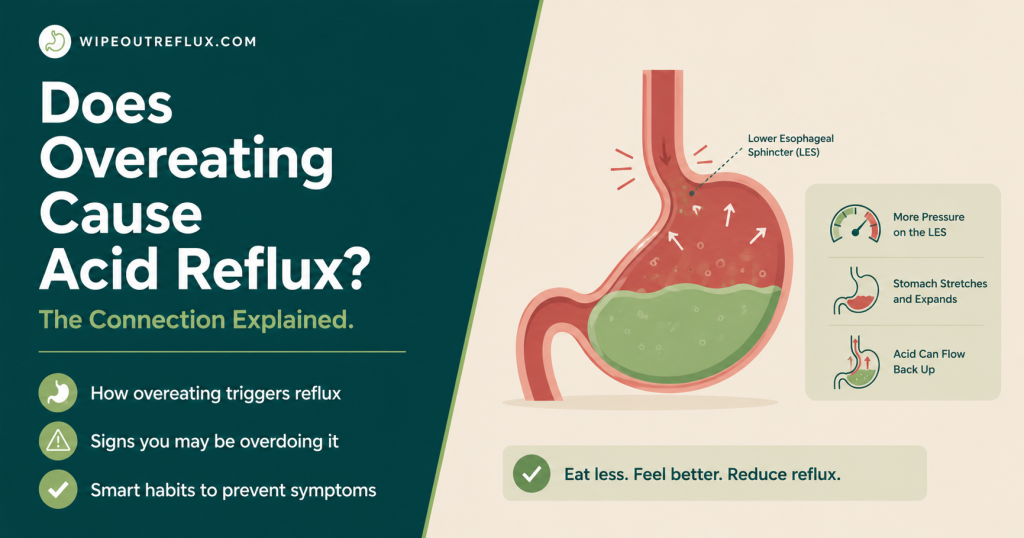
Yes — overeating is one of the most direct and reliable triggers of acid reflux there is. When you eat a large meal, you overfill and stretch your stomach, and that does two things at once: it physically raises the pressure inside your stomach, and it prompts the valve at the top of your stomach to relax more often. Both push stomach acid up into your esophagus, which is exactly what reflux is.
The encouraging flip side is that portion size is one of the most controllable levers you have. Unlike your anatomy or your genetics, how much you put on your plate is entirely up to you — and for a lot of people, simply eating smaller meals is one of the single most effective changes they can make. You don’t necessarily have to eat different foods; sometimes you just have to eat less of them at once.
Below I’ll explain exactly how a big meal sets off reflux, why volume matters so much, how much is realistically “too much,” and the practical portion habits that keep your stomach calm.
Key Takeaways
- Overeating is a major, well-established trigger of acid reflux — big meals reliably produce more reflux than small ones.
- A large meal stretches the stomach, which triggers the valve at its top to relax and let acid escape upward.
- A full stomach also raises internal pressure, pushing against that valve and widening the gap for reflux.
- Portion size is one of the most controllable reflux triggers, so smaller meals are a high-impact change.
- It’s not only volume — fatty meals and eating too fast make a given portion worse.
- Eating several smaller meals instead of a few large ones keeps stomach pressure and reflux lower.
- Overeating stacks dangerously with lying down and being overweight, so portion control matters most in the evening.
How a Big Meal Triggers Reflux
To understand why portion size matters so much, it helps to know that reflux after a meal happens mainly through two connected mechanisms — and overeating makes both worse.
Mechanism 1: A stretched stomach opens the valve
At the top of your stomach sits the lower esophageal sphincter, a ring of muscle that’s supposed to stay shut and keep acid down. But it isn’t shut all the time — it briefly relaxes now and then, and these “transient relaxations” are the main way acid escapes into the esophagus. The key point: these relaxations are triggered by the stomach being stretched. When you fill your stomach with a large meal, stretch receptors in the stomach wall fire off, and the valve relaxes far more often.
This has been measured directly. When researchers gave reflux patients a standard meal, it produced a four- to sevenfold increase in reflux — driven largely by a four- to fivefold jump in how often that valve transiently relaxed Holloway et al., Digestive Diseases and Sciences, 1991. And the trigger really is the physical stretch: simply distending the stomach reliably provokes these relaxations and the reflux that follows Holloway et al., Gastroenterology, 1985. The bigger the meal, the more the stomach stretches, and the more often the door swings open.
Mechanism 2: A full stomach raises the pressure
The second mechanism is simple physics. A stomach packed with food and drink has higher pressure inside it, and that pressure pushes upward against the valve. Think of it like overfilling a water balloon — the fuller it gets, the more it strains at any weak point. When the pressure inside the stomach exceeds what the valve can hold back, acid is forced up.
This is also why reflux and excess weight are so linked: abdominal fat presses on the stomach and raises internal pressure even further, straining the junction between the stomach and esophagus Pandolfino et al., Gastroenterology, 2006. Add a large meal on top of that pressure, and you’ve stacked two forces that both work against you.
Why Portion Size Is Such a Powerful Lever
Put those two mechanisms together and the takeaway is clear: the volume of a meal, on its own, is a major determinant of how much reflux it causes. A smaller meal stretches the stomach less, keeps internal pressure lower, and clears faster — so the valve relaxes less often and has less pressure to hold back. A big meal does the opposite on every count.
That’s genuinely good news, because it means you can reduce reflux without necessarily overhauling what you eat — just how much at a sitting. Many people find that the exact same foods, eaten in smaller portions, cause far fewer symptoms. Portion control is one of the few reflux strategies that’s both highly effective and completely within your control.
It’s Not Only Volume — Composition and Speed Matter Too
Volume is the headline, but two other factors decide how much trouble a given portion causes.
Fat. Fatty and fried foods empty from the stomach slowly and can relax the valve directly, so a greasy meal sits longer and refluxes more than a lighter one of the same size. That’s why a large, fatty dinner is close to a worst case — big volume plus slow emptying. This guide on fried food and reflux explains why, and the broader list of foods to avoid covers the usual culprits.
Speed. Eating quickly makes it easy to overshoot fullness before your body signals you to stop, so you end up more distended than you intended. Slowing down gives your stomach time to tell your brain it’s had enough — and it means less air swallowed, too. Eating slowly is an underrated way to make any portion gentler on your stomach.
How Much Is “Too Much”? Practical Portion Guidance
There’s no single magic number, since stomachs and appetites differ, but a few practical rules of thumb work well for reflux:
- Aim to stop at comfortably satisfied, not stuffed. A useful target is eating until you’re about 80% full — the point where you’re no longer hungry but could still eat more. That “I’m pleasantly done” feeling is roughly where reflux risk stays low.
- Eat smaller meals more often. Splitting your food into four or five smaller meals rather than two or three large ones keeps your stomach from ever getting overfilled, so pressure and reflux stay lower throughout the day.
- Downsize the evening meal especially. Dinner is the riskiest meal to overeat, because you’ll be lying down within a few hours, when reflux is at its most damaging — more on that in this guide to acid reflux at night.
- Watch liquids too. Large volumes of drink also fill and stretch the stomach, so a huge drink with a big meal adds to the distension.
Turning This Into a Routine
The practical version of all this is straightforward. Serve yourself a slightly smaller plate than usual and eat it slowly, pausing partway to check whether you’re actually still hungry. Keep the biggest, heaviest meals for earlier in the day when you’ll be upright afterward, and keep dinner lighter. If you tend to get very hungry between meals, that’s usually a sign to add a small snack rather than to load up at the next big one — going a long time without eating and then overeating is a classic reflux trap. Some people also find that spacing meals well and not constantly grazing helps their stomach settle; there’s more on meal spacing in this look at fasting for acid reflux.
And remember that overeating rarely acts alone. A large meal, eaten fast, high in fat, late at night, followed by lying down, is the reflux equivalent of a perfect storm. Fix any one of those and you help; fix the portion size and you’ve addressed the mechanism at its root.
The Bottom Line
Overeating causes acid reflux through two clear, well-documented mechanisms: a stretched stomach triggers the valve at its top to relax and let acid up, and a full stomach raises the internal pressure that pushes against that valve. The bigger the meal, the more both forces work against you — which is exactly why large meals reliably produce far more reflux than small ones in study after study. The genuinely empowering part is that portion size is one of the most controllable triggers you have. You can often keep the foods you enjoy and dramatically cut your symptoms simply by eating less at a sitting, eating more slowly, and splitting your food into smaller, more frequent meals — with an especially light hand at dinner.
If you want to go beyond portions and get the whole picture of what calms reflux — which foods, in what amounts, and when — a great place to start is the Wipeout Food Reference Guide, the essential reference to which foods and drinks are safe for acid reflux and LPR along with their pH values. And if you’re ready for the complete, step-by-step system for healing reflux at its source — including exactly how to structure your meals and portions — the Wipeout Diet Plan goes much deeper, as the ultimate guide to calming the underlying reflux for good.
Frequently Asked Questions
Can eating too much really cause acid reflux?
Yes. A large meal stretches the stomach, which triggers the valve at its top to relax and let acid up, and it raises the pressure inside the stomach that pushes against that valve. Studies show a meal can increase reflux several-fold, largely because of these stretch-triggered valve relaxations, so portion size is a genuine and major trigger.
Why do I get reflux even after healthy meals?
Because volume matters as much as content. Even a “healthy” meal, if it’s large, stretches the stomach and raises pressure enough to provoke reflux. If wholesome meals still trigger symptoms, try eating a smaller portion of the same food and eating it more slowly — the amount is often the real problem.
Is it better to eat smaller meals more often?
For reflux, usually yes. Splitting your food into four or five smaller meals rather than two or three big ones keeps your stomach from becoming overfilled at any point, so internal pressure and valve relaxations stay lower. Just keep the total sensible and avoid making the last meal a large, late one.
How full should I feel after eating with acid reflux?
Aim for comfortably satisfied rather than stuffed — roughly 80% full, the point where you’re no longer hungry but could still eat a bit more. Eating past that into feeling full or bloated is where stomach stretching and reflux risk climb sharply.
Does eating fast make reflux worse?
It can. Eating quickly makes it easy to overeat before your body registers fullness, leaving your stomach more distended than intended, and it tends to mean more swallowed air. Slowing down helps you stop at the right point and puts less strain on the valve, making the same meal gentler.
Why is overeating at dinner especially bad?
Because you’ll usually lie down within a few hours, and lying down with a full, high-pressure stomach removes gravity’s help right when your body clears acid least well. A large evening meal combines the worst of overeating and poor timing, so keeping dinner smaller and earlier pays off the most.
Research & References
- Holloway et al., Digestive Diseases and Sciences, 1991 — Found that a standard meal produced a four- to sevenfold increase in gastroesophageal reflux in symptomatic patients, driven mainly by a large rise in the rate of transient lower esophageal sphincter relaxations.
- Holloway et al., Gastroenterology, 1985 — Demonstrated that gastric distention is a mechanism for postprandial reflux, with stretching of the stomach provoking the transient sphincter relaxations that allow acid to escape.
- Pandolfino et al., Gastroenterology, 2006 — Showed that increased intragastric pressure and the gastroesophageal pressure gradient rise with body mass and waist size, straining the esophagogastric junction and predisposing to reflux.

David Gray
12 years living with LPR · Consultant & researcher
I've lived with LPR for twelve years — the misdiagnoses, the PPI courses that did nothing, the slow work of figuring out what actually helps. Wipeout Reflux is where I translate the research into plain terms for people stuck in the same place. Every claim here is sourced to peer-reviewed work, and I consult one-to-one with LPR sufferers.