
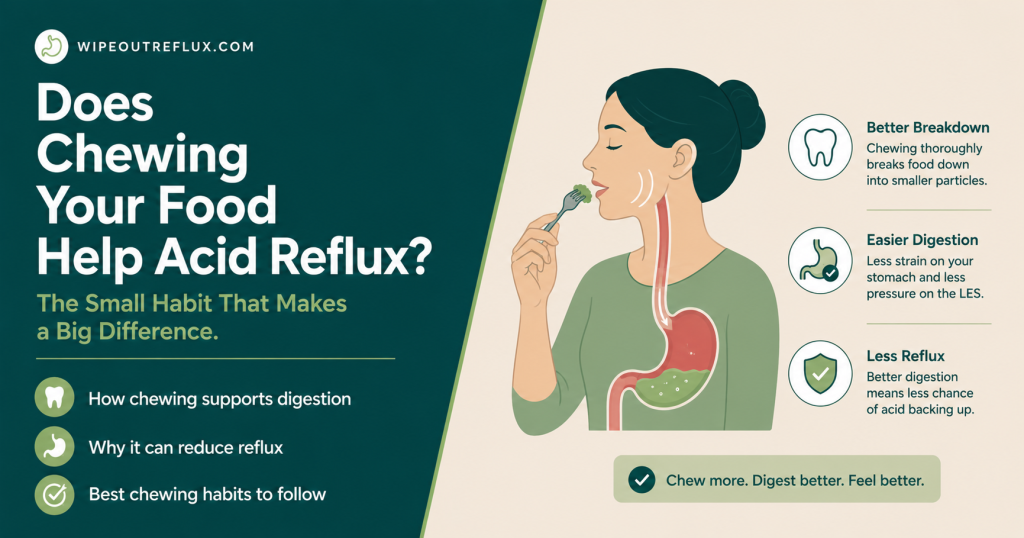
Chewing your food thoroughly can help acid reflux — but mostly in indirect ways, and it’s fair to be clear about that from the start. The single biggest benefit is saliva. The more you chew, the more saliva you produce, and saliva is essentially your body’s own natural antacid: it contains bicarbonate that neutralizes acid and helps wash it back down out of your esophagus. Chewing thoroughly also breaks food into smaller pieces that are gentler on your stomach and naturally slows you down, which makes it easier not to overeat.
What chewing won’t do is act as a cure or cancel out the bigger triggers — a large, fatty, late-night meal is still a large, fatty, late-night meal no matter how well you chew it. So think of chewing as a simple, free habit that supports the things that genuinely reduce reflux, rather than a fix on its own.
Here’s exactly how chewing helps, where the evidence is strong and where it’s thinner, and how to make the habit work for you.
Key Takeaways
- Chewing’s main reflux benefit is saliva — a natural, bicarbonate-rich antacid that neutralizes and clears acid from the esophagus.
- More chewing means more saliva and more swallowing, both of which help push refluxed acid back down.
- Thorough chewing breaks food into smaller particles that are easier for the stomach to process.
- Chewing slows eating, which helps you avoid overeating — and overeating is a proven, direct reflux trigger.
- The evidence for chewing is strongest for saliva; eating speed by itself hasn’t been shown to change reflux much.
- Chewing is a helpful supporting habit, not a cure — it won’t undo trigger foods, big portions, or late meals.
- Chewing sugar-free gum after meals is a related, evidence-backed way to use the same saliva effect.
What Chewing Actually Does
Chewing has two jobs. The obvious one is mechanical: your teeth break food into smaller pieces so it’s easier to swallow and digest. The less obvious one — and the more important for reflux — is that chewing triggers your salivary glands to pour out saliva. The longer and more thoroughly you chew, the more saliva you generate, and the more times you swallow. Both of those turn out to matter a lot for keeping acid where it belongs.
The Saliva Connection: Your Natural Antacid
This is where chewing genuinely earns its keep. Saliva isn’t just water — it’s mildly alkaline and rich in bicarbonate, the same acid-neutralizing compound found in many over-the-counter antacids. When you swallow saliva, it does two helpful things: it physically helps clear refluxed material back down your esophagus, and it neutralizes the acid that’s left clinging to the lining.
The classic research on this showed the two-step way your esophagus clears acid: a wave of muscle contraction sweeps out most of the volume, and then swallowed saliva neutralizes the acidic residue that remains. Crucially, when researchers stimulated extra saliva, acid cleared faster — and when they removed saliva from the mouth entirely, acid clearance essentially stopped Helm et al., New England Journal of Medicine, 1984. In other words, saliva is a real and necessary part of how your body protects the esophagus from acid.
Chewing is one of the most effective ways to switch that saliva on. The clearest demonstration comes from chewing gum: chewing sugar-free gum for half an hour after a meal significantly reduced the amount of acid in the esophagus afterward, precisely because it boosted saliva and swallowing Moazzez et al., Journal of Dental Research, 2005. The same mechanism applies when you chew your food thoroughly — you’re producing more of your body’s natural antacid exactly when you need it. There’s more on this trick in this guide to chewing gum for acid reflux.
Smaller Particles, Easier Digestion
The mechanical side helps too. When food is well chewed into small, soft pieces, your stomach has an easier time breaking it down and moving it along. Large, poorly chewed chunks sit longer and take more work to process — and the longer food lingers in a full stomach, the more opportunity there is for reflux. Chewing thoroughly is a small way to help your stomach empty more smoothly, especially with denser, tougher foods.
Does Eating Slowly Help? An Honest Answer
You’ll often read that eating slowly cures reflux, and it’s worth being straight about this. Chewing more does naturally slow your eating, and slowing down has a real, indirect benefit: it gives your body time to register fullness, so you’re less likely to overeat — and overeating is a well-established, direct reflux trigger because it stretches the stomach and raises pressure. If you want the mechanism, see this piece on whether overeating causes acid reflux.
That said, the speed of eating by itself hasn’t been shown to move the needle much on measured reflux. In a controlled study where people ate the same meal quickly or slowly, the pace alone didn’t change the number of reflux episodes Bor et al., Diseases of the Esophagus, 2017. The practical takeaway: slowing down helps mainly because it stops you overeating, not because slow chewing is magic. So the real win from chewing well is the saliva plus the portion control it encourages — not the speed on its own.
What Chewing Won’t Do
It’s important to keep expectations realistic. Chewing is a supporting habit, not a treatment. It won’t neutralize a genuinely acidic or high-fat trigger meal, it won’t rescue you from eating a big dinner right before bed, and it won’t repair a weak valve at the top of your stomach. If your reflux is being driven by fried and fatty foods, oversized portions, or late meals, no amount of chewing will offset those. Chewing helps most when it’s layered on top of the changes that actually matter — and it can’t substitute for them.
How to Put It Into Practice
Making the most of chewing is refreshingly simple:
- Chew thoroughly and unhurriedly. Aim to chew each mouthful well before swallowing, and put your utensils down between bites. You’ll produce more saliva and find it easier to stop at comfortably full.
- Pair it with smaller portions. Chewing supports portion control, so lean into it — smaller, well-chewed meals are gentler on your stomach than large, gulped ones.
- Try sugar-free gum after meals. Chewing gum for 20–30 minutes after eating uses the same saliva effect to reduce post-meal acid. Avoid mint flavors if mint is a trigger for you.
- Stay hydrated but sensible. A well-hydrated mouth makes better saliva, but avoid washing meals down with huge volumes of liquid, which adds to stomach fullness.
Combine these with the bigger levers — sensible portions, calmer food choices, and not eating too close to bedtime — and chewing becomes a genuinely useful part of the picture. For a structured way to get the foundations right, a reset like the 2-week acid reflux diet is a good place to start.
The Bottom Line
So, does chewing your food help acid reflux? Yes — modestly, and mostly through saliva. Chewing thoroughly floods your mouth with saliva, your body’s own bicarbonate-rich antacid, which neutralizes acid and helps clear it from the esophagus; the research is clear that saliva is a real part of your esophageal defenses. Chewing also breaks food down for easier digestion and naturally slows you down, which helps you avoid the overeating that so reliably provokes reflux. What it isn’t is a cure: it won’t cancel out trigger foods, big portions, or late-night meals, and eating speed on its own doesn’t appear to change reflux much. Treat chewing as a free, easy habit that quietly supports the changes that do the heavy lifting.
And those changes come back, as ever, to what and how much you eat. If you want to get the foundations right, a great place to start is the Wipeout Food Reference Guide, the essential reference to which foods and drinks are safe for acid reflux and LPR along with their pH values. And if you’re ready for the complete, step-by-step system for calming reflux at its source, the Wipeout Diet Plan goes much deeper — it’s the ultimate guide to healing the underlying reflux, so good habits like chewing have something solid to build on.
Frequently Asked Questions
Does chewing food more actually reduce acid reflux?
It can help, mainly by increasing saliva. Saliva is rich in bicarbonate, which neutralizes acid and helps clear it from the esophagus, and chewing is one of the best ways to stimulate it. Chewing also encourages smaller bites and less overeating. It’s a helpful supporting habit rather than a standalone treatment.
How does saliva help with reflux?
Saliva is mildly alkaline and contains bicarbonate, so swallowing it both neutralizes acid in the esophagus and physically helps wash refluxed material back down. Research shows that stimulating saliva speeds up acid clearance, while removing saliva almost stops it — making saliva a genuine part of your body’s defense against reflux.
Is chewing gum as good as chewing food thoroughly?
They work through the same mechanism — more saliva and more swallowing. Chewing sugar-free gum for 20 to 30 minutes after a meal has been shown to reduce post-meal esophageal acid, so it’s a handy way to extend the saliva benefit beyond the meal itself. Just avoid mint gum if mint triggers your symptoms.
Does eating slowly stop acid reflux?
Not directly. Studies suggest the speed of eating on its own doesn’t significantly change the number of reflux episodes. The real benefit of slowing down is that it helps you avoid overeating, which is a proven reflux trigger. So slow, thorough chewing helps mostly by supporting portion control.
Can chewing food well cure my acid reflux?
No. Chewing is a useful supporting habit, but it won’t cure reflux or offset the bigger drivers like trigger foods, large portions, and late meals. Use it alongside those more powerful changes — sensible portions, calmer food choices, and good meal timing — rather than in place of them.
Should I drink water while eating to help?
A well-hydrated mouth supports healthy saliva, so sipping water is fine. But avoid washing meals down with very large volumes of liquid, since that adds to stomach fullness and can promote reflux. Moderate sips are better than gulping down a big drink with your meal.
Research & References
- Helm et al., New England Journal of Medicine, 1984 — Landmark study showing esophageal acid is cleared in two steps, with swallowed saliva neutralizing residual acid; stimulating saliva sped clearance while removing it abolished clearance.
- Moazzez et al., Journal of Dental Research, 2005 — Found that chewing sugar-free gum after a meal significantly reduced postprandial esophageal acid exposure, via increased saliva production and swallowing.
- Bor et al., Diseases of the Esophagus, 2017 — Controlled study finding that the speed of food intake by itself did not change the number of reflux episodes, indicating the benefit of eating slowly comes mainly from avoiding overeating.

David Gray
12 years living with LPR · Consultant & researcher
I've lived with LPR for twelve years — the misdiagnoses, the PPI courses that did nothing, the slow work of figuring out what actually helps. Wipeout Reflux is where I translate the research into plain terms for people stuck in the same place. Every claim here is sourced to peer-reviewed work, and I consult one-to-one with LPR sufferers.