
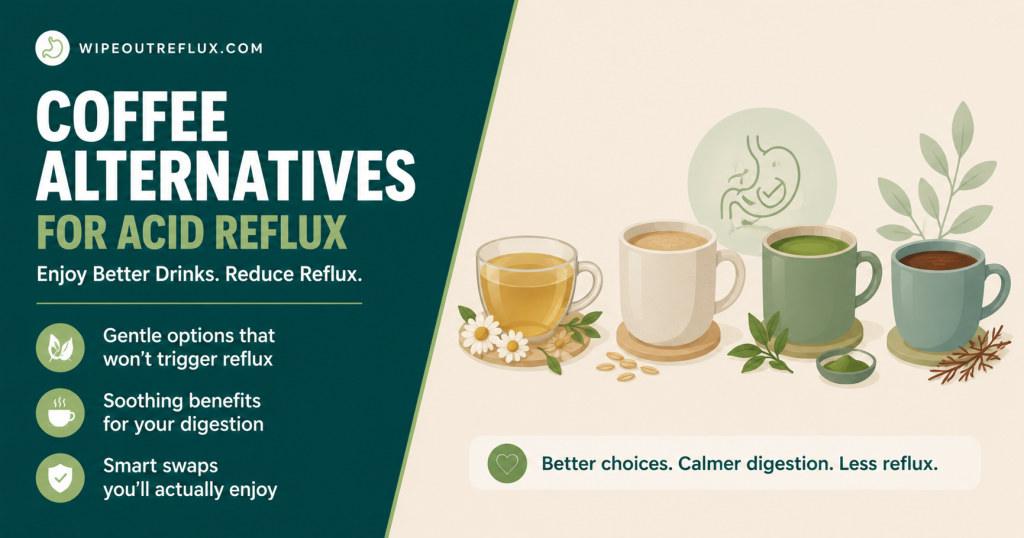
If coffee sets off your reflux, the good news is you don’t have to give up a warm morning drink — you just need better swaps. The gentlest options fall into two camps: lower-acid ways to keep drinking coffee (cold brew, dark roast, low-acid or dewaxed beans, or decaf), and naturally soothing coffee alternatives like chamomile, ginger tea, rooibos, and chicory “coffee.” The right choice depends on whether it’s the acid, the caffeine, or both that bothers you.
It’s worth saying up front that coffee isn’t a universal villain. Population studies don’t show a strong across-the-board link between coffee and reflux — but coffee does measurably relax the valve at the top of your stomach and stimulate acid, which is exactly why it’s such a common personal trigger. If you’re one of the people it bothers, swapping it out often brings noticeable relief.
Below I’ll explain why coffee triggers reflux, how to tell whether it’s the acid or the caffeine, and the best low-acid alternatives to reach for — plus how to switch without a caffeine-withdrawal headache.
Key Takeaways
- Coffee can trigger reflux by lowering the pressure of the valve at the top of your stomach and stimulating acid, though it isn’t a trigger for everyone.
- Both the caffeine and the natural acidity of coffee play a role, which is why low-acid and lower-caffeine swaps help.
- To keep coffee: try cold brew, dark roast, low-acid or dewaxed beans, a smaller cup, and never on an empty stomach.
- Soothing caffeine-free swaps include chamomile tea, ginger tea, rooibos, and chicory-root “coffee.”
- Decaf is gentler on acid but still relaxes the valve a little, so it’s better than regular for many but not risk-free.
- Skip peppermint tea — it relaxes the same valve and often makes reflux worse.
- Switch gradually to avoid caffeine-withdrawal headaches, and watch add-ins like cream and sugar.
Why Coffee Can Trigger Reflux
There are a few overlapping reasons coffee gets blamed for heartburn, and understanding them helps you pick the right alternative.
The biggest is its effect on the lower esophageal sphincter — the ring of muscle that’s supposed to stay shut and keep acid down. Coffee relaxes it. In classic research, drinking coffee measurably lowered resting sphincter pressure in both healthy people and reflux patients, which makes it easier for acid to escape upward Thomas et al., Gastroenterology, 1980. On top of that, caffeine also stimulates your stomach to produce more acid while reducing the competence of that valve — a double hit Cohen & Booth, New England Journal of Medicine, 1975. And coffee itself is acidic, which can directly irritate an already-sensitive esophagus or throat.
Here’s the honest nuance, though: at a population level, the evidence is mixed. A meta-analysis of many studies found no significant overall association between coffee intake and reflux disease Kim et al., Diseases of the Esophagus, 2014. The takeaway isn’t that coffee is harmless — it’s that coffee is a strong trigger for some people and a non-issue for others. If it reliably gives you symptoms, that’s your answer, regardless of the averages.
Is It the Caffeine or the Acid?
This matters because it points you to the right swap. If caffeine is your problem, you’ll likely react to strong coffee, energy drinks, and even some teas, and decaf will treat you better. If acidity is the issue, you may find that low-acid coffee or cold brew sits fine while a sharp, light-roast cup burns. Many people are sensitive to both, in which case a low-acid and low-caffeine option is the sweet spot. A little trial and error — changing one variable at a time — usually reveals which camp you’re in. There’s more background in this look at whether coffee is acidic.
If You Want to Keep Drinking Coffee
You don’t necessarily have to quit. Several tweaks make coffee gentler:
- Cold brew. Brewing with cold water produces coffee that’s noticeably less acidic than hot-brewed, and many reflux sufferers tolerate it far better.
- Dark roast. Darker roasts tend to be lower in certain acids than light roasts, so a dark-roast cup is often easier on the stomach.
- Low-acid or dewaxed beans. Specially processed low-acid beans exist for exactly this reason, and early research on dewaxed coffee suggests it can reduce symptoms and improve tolerability for people with reflux.
- Smaller cup, with food. A smaller serving alongside or after a meal — never on an empty stomach — blunts the acid hit considerably.
- Go easy on add-ins. Large amounts of cream, whole milk, or sugar can worsen reflux for some; a splash rather than a flood is safer.
The Best Low-Acid Coffee Alternatives
If coffee just doesn’t agree with you, these swaps give you warmth, ritual, and in some cases a gentle lift — without the acid and caffeine punch.
Chamomile tea
Caffeine-free and traditionally used to calm the digestive system, chamomile is one of the most reflux-friendly hot drinks and a natural bedtime swap. More in this guide to chamomile tea for acid reflux.
Ginger tea
Ginger has a long history as a settling remedy for the gut and can be soothing in modest amounts — just don’t overdo it, as very large doses can be counterproductive. See ginger for acid reflux for how much is sensible.
Rooibos (red bush) tea
Naturally caffeine-free and low in tannins, rooibos gives you a rich, malty, almost coffee-adjacent flavor without the acid or stimulant load. It’s an easy everyday swap for people who miss a robust hot drink.
Chicory-root “coffee”
Roasted chicory root brews into a dark, bitter drink that genuinely tastes coffee-like, but it’s caffeine-free and less acidic. It’s a favorite substitute for people chasing the coffee experience without the trigger.
Decaffeinated options
Decaf coffee removes most of the caffeine, which helps — but remember it still lowers the valve pressure somewhat and remains mildly acidic, so it’s gentler rather than risk-free; here’s the detail on decaf coffee and reflux. Decaffeinated green tea is another light, low-acid choice — see decaf green tea for reflux.
Warm water and other simple options
Sometimes the ritual is what you miss more than the coffee. Plain warm water, or warm water with a tiny bit of honey, is about as gentle as it gets — more on whether hot water helps reflux.
One Swap to Avoid: Peppermint Tea
It’s a common mistake, so it’s worth flagging. Peppermint feels soothing and is often marketed as a digestive aid, but it relaxes the lower esophageal sphincter in much the same way coffee does — which means it can actually worsen reflux rather than help it. If you’re swapping away from coffee, peppermint tea is not the answer for most reflux sufferers; here’s why peppermint tea and reflux don’t mix well.
How to Make the Switch Without a Headache
If you drink a lot of coffee, going cold turkey can bring on caffeine-withdrawal headaches and fatigue for a few days. The easy fix is to taper. Try mixing regular with decaf and shifting the ratio over a week or two, or step down one cup at a time. Move your gentler swaps into the slots where reflux hits hardest first — usually the empty-stomach morning cup and anything close to bedtime. And whatever you land on, drink it with or after food rather than on an empty stomach, and keep portions modest. For the bigger picture of reflux-friendly drinks, this guide on what to drink with acid reflux pulls it together.
The Bottom Line
Coffee triggers reflux for a lot of people because it relaxes the valve at the top of the stomach and stimulates acid — even though, at a population level, it isn’t a problem for everyone. If it’s a problem for you, you have plenty of gentler paths. You can often keep coffee by switching to cold brew, dark roast, or low-acid beans and drinking a smaller cup with food; or you can swap to naturally soothing, caffeine-free drinks like chamomile, ginger tea, rooibos, or chicory. Decaf is a reasonable middle ground, while peppermint tea is the one “healthy” swap to skip. Change one thing at a time, taper to dodge withdrawal, and let your own symptoms be the judge — that feedback matters more than any average.
Drinks are just one piece of the reflux puzzle, of course. To see how your whole diet fits together — which foods and drinks are safe and their pH values — a great starting point is the Wipeout Food Reference Guide. And if you want the complete, step-by-step system for calming reflux at its source, the Wipeout Diet Plan goes much deeper — it’s the ultimate guide to healing the underlying reflux, so your morning cup (or its replacement) stops being a daily gamble.
Frequently Asked Questions
What can I drink instead of coffee with acid reflux?
Good low-acid, caffeine-free swaps include chamomile tea, ginger tea, rooibos, and roasted chicory-root “coffee,” which gives a coffee-like taste without the caffeine or acidity. If you want to keep coffee, cold brew, dark roast, or low-acid beans in a smaller cup with food are gentler options.
Is decaf coffee better for acid reflux than regular?
Usually yes, but it’s not risk-free. Decaf removes most of the caffeine, which reduces acid stimulation, but coffee still slightly relaxes the valve at the top of the stomach and remains mildly acidic. Many people tolerate decaf better than regular, especially in a smaller cup taken with food.
Does coffee cause acid reflux for everyone?
No. Coffee measurably lowers the pressure of the lower esophageal sphincter and stimulates acid, but population studies don’t show a strong across-the-board link, meaning it’s a significant trigger for some people and not for others. The best test is your own response — if coffee reliably gives you symptoms, treat it as a trigger.
Is cold brew coffee better for reflux?
Often, yes. Cold-brewed coffee is generally less acidic than hot-brewed, so people who react to coffee’s acidity tend to tolerate it better. It still contains caffeine, though, so if caffeine is your main problem, choose a decaf cold brew or a caffeine-free alternative instead.
Is peppermint tea a good coffee alternative for reflux?
No — this is a common trap. Despite its soothing reputation, peppermint relaxes the lower esophageal sphincter, which can worsen reflux. If you’re moving away from coffee, choose chamomile, ginger, or rooibos instead of peppermint.
Will I get a headache if I switch off coffee?
You might, if you currently drink a lot, because caffeine withdrawal can cause headaches and fatigue for a few days. Avoid this by tapering — blend regular with decaf and shift the ratio over a week or two, or cut back one cup at a time rather than stopping abruptly.
Research & References
- Thomas et al., Gastroenterology, 1980 — Showed that drinking coffee lowered resting lower esophageal sphincter pressure in both healthy volunteers and reflux patients, supporting coffee’s role in promoting reflux.
- Cohen & Booth, New England Journal of Medicine, 1975 — Found that coffee and caffeine stimulate gastric acid secretion and reduce the competence of the lower esophageal sphincter, a combination that can provoke heartburn.
- Kim et al., Diseases of the Esophagus, 2014 — Meta-analysis finding no significant overall association between coffee intake and reflux disease, indicating coffee is a trigger for some individuals rather than a universal cause.

David Gray
12 years living with LPR · Consultant & researcher
I've lived with LPR for twelve years — the misdiagnoses, the PPI courses that did nothing, the slow work of figuring out what actually helps. Wipeout Reflux is where I translate the research into plain terms for people stuck in the same place. Every claim here is sourced to peer-reviewed work, and I consult one-to-one with LPR sufferers.