
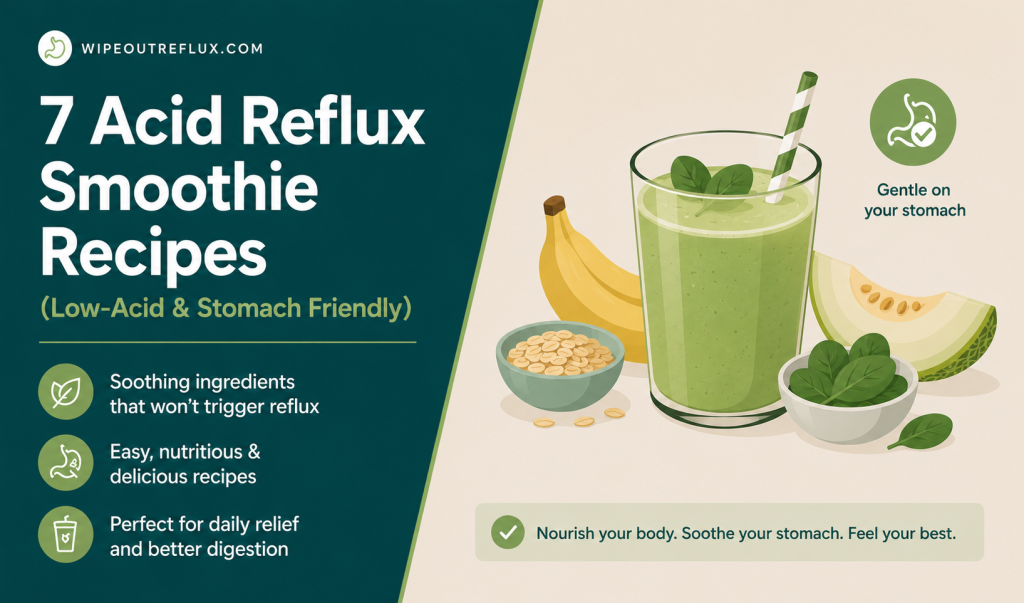
Smoothies can be one of the easiest, most soothing things to have when you’re managing acid reflux — but only if you build them the right way. The usual smoothie staples are a reflux minefield: orange juice, pineapple, lots of berries, mango, and full-fat dairy are all common triggers. Swap those for gentle, low-acid ingredients — banana, melon, pear, papaya, leafy greens, oats, and a non-dairy milk — and a smoothie becomes a genuinely reflux-friendly meal or snack.
The seven recipes below are all deliberately low in acid and low in fat, built to fill you up without setting your chest or throat on fire. They also sneak in fiber, which research links to fewer reflux symptoms. Blend, sip slowly, and keep the portion sensible — here’s how to do it right.
Key Takeaways
- Reflux-friendly smoothies are built from low-acid fruit (banana, melon, pear, papaya), leafy greens, oats, and a non-dairy or low-fat base.
- Avoid the usual triggers: citrus, pineapple, most berries, tomato, chocolate, mint, and full-fat dairy.
- Adding fiber — from oats, chia, greens, and low-acid fruit — is linked to fewer reflux symptoms.
- Keep portions moderate; an oversized smoothie overfills the stomach and can trigger reflux just like a big meal.
- Sip slowly rather than gulping through a straw, which swallows air and adds to bloating and pressure.
- These seven recipes are all low-acid, low-fat, and easy to adapt to what you have on hand.
What Makes a Smoothie Reflux-Friendly
Three things decide whether a smoothie soothes or triggers: the acidity of the fruit, the fat content of the base, and the total volume. Low-acid fruits like banana, melon, pear, and papaya are gentle on an irritated esophagus, while citrus, pineapple, and most berries are acidic enough to provoke symptoms. Keeping the base low in fat matters too, because high-fat ingredients slow stomach emptying and relax the valve at the top of the stomach — which is why a non-dairy milk like oat or almond usually sits better than full-fat dairy. Dietary reviews consistently point people with reflux toward exactly this kind of low-fat, low-acid pattern Newberry & Lynch, Journal of Thoracic Disease, 2019.
There’s a bonus, too: fiber. Smoothies are an easy way to work in oats, chia, greens, and fiber-rich fruit, and a fiber-enriched diet has been shown to reduce heartburn and improve esophageal function in people with reflux Morozov et al., World Journal of Gastroenterology, 2018. So a well-built smoothie doesn’t just avoid triggers — it can actively help.
Favor these
Banana, cantaloupe, honeydew, watermelon, pear, papaya, avocado, spinach, kale, cucumber, oats, chia and flax, almond and oat milk, a little almond butter, and a touch of ginger or honey.
Skip these
Orange and other citrus, pineapple, most berries, mango, tomato, chocolate/cacao, mint, full-fat dairy and cream, and fruit juices. For where any given food sits, this acidity of fruits chart is a handy reference, and the fuller foods to eat and foods to avoid lists help too.
The 7 Low-Acid Smoothie Recipes
Each makes one sensible serving. Blend until smooth, adding a little extra milk or water to reach the texture you like.
1. Creamy Banana & Oat
A filling, breakfast-worthy classic that’s about as gentle as it gets.
Why it works: banana and oats are both low-acid and rich in fiber, making this creamy, satisfying, and easy on the stomach.
2. Green Soother
Mild greens plus avocado give you a creamy green smoothie with none of the citrus most recipes rely on.
- 1 handful baby spinach
- 1 ripe banana
- 1/4 avocado
- 1 cup almond milk
- 1 teaspoon chia seeds
Why it works: spinach is very low-acid, and avocado adds healthy creaminess without the trigger effect of full-fat dairy.
3. Melon Refresher
Light, hydrating, and perfect for warm mornings.
- 1 cup cubed watermelon or cantaloupe
- 1/2 banana
- 1/2 cup coconut water
- A few ice cubes
Why it works: melons are among the most alkaline, reflux-friendly fruits, so this is a refreshing option that rarely triggers symptoms.
4. Pear & Ginger
Naturally sweet with a gentle, settling warmth from ginger.
- 1 ripe pear, cored
- 1/2 banana
- 1/2 inch fresh ginger, peeled
- 1 cup oat milk
Why it works: pears are low-acid and easy to digest, and a small amount of ginger can be soothing — just don’t overdo the ginger.
5. Papaya Sunrise
Silky, tropical-tasting, and famously kind to digestion.
- 1 cup ripe papaya
- 1/2 banana
- 1 cup almond milk
Why it works: papaya is low-acid and contains papain, an enzyme traditionally valued for easing digestion, making this a gentle choice.
6. Almond Butter Protein
The most filling of the bunch — a good post-workout or meal-replacement option.
- 1 banana
- 1 tablespoon almond butter
- 3 tablespoons rolled oats
- 1 cup almond milk
- 1 teaspoon honey (optional)
Why it works: banana, oats, and a modest amount of almond butter give you staying power and fiber without a heavy load of trigger-inducing fat.
7. Cucumber-Melon Green
Crisp, hydrating, and barely sweet — great when you want something light.
- 1/2 cucumber
- 1 cup honeydew melon
- 1 handful baby spinach
- 1/2 cup coconut water
Why it works: cucumber, honeydew, and spinach are all very low-acid and water-rich, making this one of the gentlest blends you can drink.
Tips to Keep Your Smoothie Reflux-Safe
Even a low-acid smoothie can backfire if the details are off. A few pointers:
- Watch the size. A giant smoothie overfills the stomach and raises pressure, which can trigger reflux just like a big meal. A sensible glass beats a jug.
- Sip, don’t gulp. Drinking fast (especially through a straw) swallows air and adds to bloating and pressure. Take your time.
- Skip the citrus “boost.” Resist the urge to add orange juice, lemon, or pineapple — they undo the low-acid effort. Use banana or a splash of oat milk for sweetness and creaminess instead.
- Go easy on high-fat add-ins. A teaspoon of almond butter is fine; several tablespoons plus coconut cream turns a gentle drink into a fatty one.
- Don’t drink it right before bed. As with any meal, leave time upright before lying down.
The Bottom Line
A smoothie doesn’t have to be a reflux trigger — in fact, built well, it can be one of the easiest wins in a reflux-friendly diet. The formula is simple: start with low-acid fruit like banana, melon, pear, or papaya, add greens and fiber-rich oats or chia, use a low-fat non-dairy base, and steer clear of citrus, pineapple, most berries, and full-fat dairy. Keep the portion moderate and sip it slowly, and you’ve got a filling, soothing option that won’t leave your chest or throat burning. The seven recipes here are a starting point — once you know which ingredients are gentle, you can mix and match with confidence.
If you’d like a clear reference for which fruits, vegetables, and drinks are safe — along with their pH values — so you can build your own blends without guesswork, the Wipeout Food Reference Guide is the essential companion for exactly this. And if you want the complete, step-by-step system for calming reflux at its source — meals, timing, and all — the Wipeout Diet Plan goes much deeper, as the ultimate guide to healing the underlying reflux so your whole diet, smoothies included, works for you.
Frequently Asked Questions
Are smoothies good or bad for acid reflux?
It depends entirely on what’s in them. Smoothies made from low-acid fruit, greens, oats, and a low-fat non-dairy base are gentle and can even help, thanks to their fiber. Smoothies loaded with citrus, pineapple, lots of berries, or full-fat dairy are common triggers. Build them thoughtfully and they’re a great option.
What fruits are best in a low-acid smoothie?
Banana, melon (watermelon, cantaloupe, honeydew), pear, and papaya are among the most reflux-friendly. Avocado adds creaminess without acidity. Avoid citrus, pineapple, mango, and most berries, which are more acidic and more likely to trigger symptoms.
Can I use milk in a reflux smoothie?
Low-fat or non-dairy milks like oat and almond usually sit better than full-fat dairy, because high-fat ingredients slow stomach emptying and can worsen reflux. If you tolerate dairy, choose low-fat versions and keep the portion modest.
Are green smoothies OK for acid reflux?
Yes, as long as the greens are mild (spinach, kale, cucumber) and you don’t add acidic fruit or citrus to “balance” them. Pair greens with banana and a non-dairy base for a creamy, low-acid green smoothie that’s easy on reflux.
Why does my smoothie give me heartburn?
Usually one of three reasons: acidic ingredients like citrus, pineapple, or berries; too much fat from full-fat dairy or lots of nut butter; or simply too large a portion overfilling your stomach. Adjust those three factors — low-acid fruit, low-fat base, moderate size — and most people find the problem disappears.
Is it better to have a smoothie instead of a meal with reflux?
A well-built smoothie can be a fine meal or snack, and because it’s already broken down, it may feel easier on some stomachs. Just make sure it’s balanced and not oversized, and don’t drink it right before lying down, since any meal too close to bedtime can trigger reflux.
Research & References
- Newberry & Lynch, Journal of Thoracic Disease, 2019 — Review of the role of diet in GERD, supporting a low-fat, low-acid dietary pattern and examining how specific food components affect reflux.
- Morozov et al., World Journal of Gastroenterology, 2018 — Found that supplementing the diet with fiber significantly reduced heartburn and improved esophageal function in patients with non-erosive reflux disease.

David Gray
12 years living with LPR · Consultant & researcher
I've lived with LPR for twelve years — the misdiagnoses, the PPI courses that did nothing, the slow work of figuring out what actually helps. Wipeout Reflux is where I translate the research into plain terms for people stuck in the same place. Every claim here is sourced to peer-reviewed work, and I consult one-to-one with LPR sufferers.