
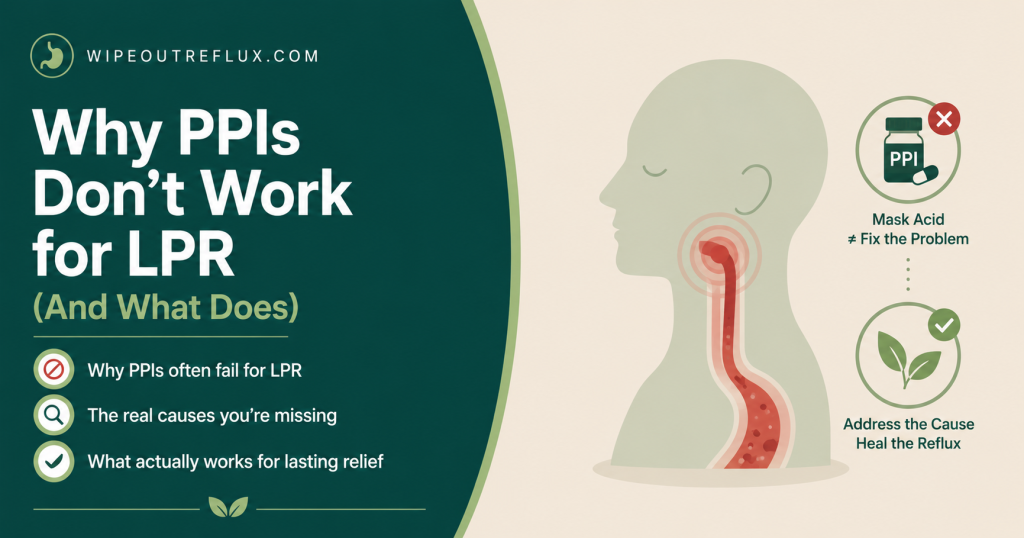
If you’ve taken a proton pump inhibitor for months and your throat still feels the same, you’re in very ordinary company. PPIs work far less reliably for LPR than they do for heartburn, and the reason is mechanical rather than mysterious: they change the acidity of what refluxes, not whether it refluxes — and the main agent damaging your larynx is pepsin, which stays active well above the pH those drugs target.
The strongest trial on this is worth knowing about. In a multicentre randomised study, 16 weeks of esomeprazole 40 mg twice daily resolved the primary laryngeal symptom in 14.7% of patients, compared with 16.0% on placebo — a difference of essentially nothing Vaezi et al., The Laryngoscope, 2006.
That said, I want to be straight with you: this isn’t a case of “PPIs are useless.” Some trials are positive, and some people genuinely improve on them. What’s true is that they fail often enough in LPR that failure should be treated as expected rather than as a sign your diagnosis was wrong. Below are the five reasons they underperform, what the trial evidence actually shows on both sides, and the interventions with better evidence behind them.
Key Takeaways
- PPIs reduce stomach acid production but don’t stop reflux events — and in LPR the refluxate still reaches your throat.
- Pepsin, not acid alone, causes most laryngeal damage, and it remains active up to around pH 6.5 and can injure tissue even at neutral pH.
- In the largest negative trial, 16 weeks of twice-daily esomeprazole was statistically indistinguishable from placebo.
- Other trials are positive, and meta-analyses show a modest symptom benefit — but no improvement in objective laryngeal findings versus placebo.
- Most reflux events reaching the throat are daytime, upright and weakly acidic, which doesn’t match how PPIs are usually dosed for LPR.
- Laryngeal tissue heals slowly, so an 8-week trial is often too short to judge anything.
- Some people diagnosed with LPR have laryngeal hypersensitivity instead, which no acid drug will touch.
- A strict low-acid diet, alginate therapy, and meal timing all have better supporting evidence in LPR than acid suppression alone.
- Never stop a PPI abruptly — acid rebound is real. Any change should be tapered and discussed with your doctor.
Reason 1: PPIs Reduce Acid, But Pepsin Does the Damage
This is the central problem, and everything else follows from it.
A PPI works by shutting down the proton pumps in your stomach lining, which lowers the acidity of your stomach contents. What it does not do is strengthen the valve at the top of your stomach, reduce the number of reflux events, or stop stomach contents travelling up to your throat. Reflux still happens. It’s just less acidic when it arrives.
For GERD, that’s often enough, because acid is what burns the esophagus. For LPR it isn’t, because the primary agent injuring laryngeal tissue is pepsin — the digestive enzyme that rides up with the refluxate, binds to your throat lining, and stays there.
Human pepsin remains enzymatically active at a pH as high as 6.5, is stable at neutral pH, and isn’t irreversibly inactivated until around pH 8 Johnston et al., The Laryngoscope, 2007. Your larynx sits at roughly pH 6.8. A PPI might raise your gastric pH to 4 or 5 — well above the level that causes heartburn, but nowhere near the level that would deactivate pepsin.
So the drug is doing exactly what it’s designed to do, and the pepsin arriving in your throat carries on regardless. I’ve written more about the practical side of this in how to neutralize pepsin in the throat.
Reason 2: Non-Acid Reflux Still Injures Tissue
A natural follow-up question is whether making the refluxate non-acidic is at least harmless. It isn’t.
Researchers showed that pepsin in a non-acidic refluxate still damages hypopharyngeal epithelial cells. Pepsin is taken up into laryngeal cells by receptor-mediated endocytosis, producing mitochondrial and Golgi damage even at neutral pH Johnston et al., Annals of Otology, Rhinology & Laryngology, 2009.
This is the finding that most cleanly explains the clinical picture people describe to me: on maximum acid suppression, no heartburn at all, and a throat that’s exactly as bad as it was. The heartburn is gone because the acid is gone. The throat symptoms persist because the pepsin never was the acid’s fault.
Reason 3: The Dosing Pattern Doesn’t Match When LPR Actually Happens
Standard LPR advice is twice-daily PPIs, one of them before dinner, often with a bedtime alginate — a protocol imported wholesale from nighttime GERD.
But when researchers reviewed hypopharyngeal-esophageal impedance-pH monitoring in LPR patients, they found reflux events reaching the throat occur predominantly during the daytime and in the upright position, and are more often gaseous and weakly or non-acidic than the liquid acidic events typical of GERD. The authors noted directly that this pattern does not support the routine use of double-dose PPIs or bedtime alginate Lechien et al., Journal of Clinical Medicine, 2022.
In other words, a protocol built around suppressing overnight acid is being applied to a condition that largely happens while you’re awake and upright. That’s not the whole explanation for PPI failure, but it’s a real part of it — and it’s why I push daytime food and drink choices so hard. More on the distinction in GERD vs LPR.
Reason 4: You Probably Weren’t Given Long Enough
Esophageal erosions heal in weeks. Laryngeal tissue does not.
The larynx is delicate, constantly in use, and being re-exposed every day, so improvement is measured in months. An eight-week PPI trial — the standard for GERD — frequently ends before anything would have shown up, and gets recorded as a failure.
This cuts both ways, and it’s worth being honest about it. Some people are told PPIs don’t work when they simply weren’t given a fair trial. Others stay on them for two years on the basis that “it might still kick in.” Neither is good. A reasonable position: give any intervention here three months of genuine consistency, track symptoms weekly, and then judge it on the trend rather than on how you feel today. Realistic timelines are covered in how long an acid reflux sore throat takes to heal.
Reason 5: Some People Diagnosed With LPR Don’t Have Reflux
This one is uncomfortable but important. LPR is usually diagnosed on symptoms and the appearance of the larynx, both of which are non-specific. That means the population labelled “LPR” almost certainly includes people whose throat symptoms have a different cause entirely.
The main alternative is laryngeal hypersensitivity — a sensitised, over-reactive larynx that produces cough, globus, throat clearing and voice change in response to stimuli that shouldn’t provoke anything. In patients who don’t respond to PPIs, factors such as hypervigilance, elevated anxiety, allodynia and hyperalgesia may be driving symptoms, and clinicians are advised to suspect laryngeal hypersensitivity in non-responders Krause et al., Annals of the New York Academy of Sciences, 2022.
No amount of acid suppression will help a hypersensitive larynx, because there’s nothing acidic to suppress. It often follows a viral illness, a period of heavy throat clearing, or a stretch of high stress — and it can also develop after genuine reflux, with the original problem resolved and the sensitised nerve endings still firing. I’ve covered this in laryngeal sensory neuropathy and, for the stress dimension, can LPR be caused by anxiety.
What the Trials Actually Show (Both Sides)
It would be easy to cherry-pick here, so here’s the honest picture.
The strongest negative result: 146 patients, esomeprazole 40 mg twice daily versus placebo for 16 weeks. Primary symptom resolved in 14.7% on the drug and 16.0% on placebo — p = 0.799. The authors concluded there was no evidence of therapeutic benefit Vaezi et al., The Laryngoscope, 2006.
A positive result: 62 patients on esomeprazole 20 mg twice daily versus placebo for three months showed significantly greater reductions in both Reflux Symptom Index and Reflux Finding Score Reichel et al., Otolaryngology–Head and Neck Surgery, 2008. Trials in this area genuinely disagree with each other.
What pooling them shows: meta-analysis of randomised controlled trials found PPI therapy produced a significantly higher response rate than placebo — a risk difference of about 0.15 — and improved total symptom index scores. But it showed no advantage over placebo in the reflux finding score, the objective measure of what the larynx looks like Guo et al., Journal of Clinical Gastroenterology, 2016. Other meta-analyses reach similarly equivocal conclusions Wei, European Archives of Oto-Rhino-Laryngology, 2016.
A risk difference of 0.15 means roughly one in seven people gets a benefit attributable to the drug. That’s not nothing — but it’s a long way from the near-universal response you’d expect from a first-line treatment, and it explains why so many people end up feeling like the odd one out when it doesn’t work. You’re not the exception. You’re closer to the majority.
One more thing worth knowing: placebo response rates in LPR trials are unusually high, and laryngeal symptoms often improve spontaneously. That means feeling better on a PPI isn’t proof that acid was the problem — which is exactly why a supervised trial off the drug is often more informative than staying on it indefinitely.
What Actually Works
This is the more useful half. None of the following is a magic bullet, but each has better evidence in LPR specifically than acid suppression alone.
1. A genuinely low-acid diet
This has the strongest supporting evidence of anything here, and it directly targets the mechanism. Because pepsin sitting in your throat tissue is reactivated by acid, the acid you swallow matters as much as the acid you produce.
Testing exactly that, a strict low-acid diet — avoiding anything below roughly pH 5 — produced meaningful improvement in patients whose LPR had failed to respond to twice-daily PPIs plus a bedtime H2 blocker Koufman, Annals of Otology, Rhinology & Laryngology, 2011. These were the people PPIs had already failed.
The broader dietary approach performs comparably to medication head-to-head: a 90–95% whole-food, plant-based, Mediterranean-style diet with alkaline water produced a six-point Reflux Symptom Index reduction in 62.6% of patients, versus 54.1% on PPI therapy Zalvan et al., JAMA Otolaryngology–Head & Neck Surgery, 2017.
The catch is that doing this properly is harder than it sounds, because acidity isn’t something you can taste reliably and it hides in places people never suspect — citric acid in packaged foods, vinegar in dressings and sauces, carbonation, most fruit, anything marketed as a healthy drink. That’s what the Wipeout Food Reference Guide exists for — the essential reference of which foods and drinks are safe for acid reflux and LPR along with their actual pH values, so you’re working from numbers instead of guesswork. Start with the LPR diet and the foods to avoid list if you want the free version.
2. Alginate therapy
Alginate is the intervention most often overlooked, and mechanically it makes far more sense for LPR than acid suppression does. Rather than reducing acid, it forms a physical gel raft on top of the stomach contents, blocking the refluxate from travelling upward — and it inhibits pepsin activity directly.
In a controlled study, patients taking liquid alginate suspension four times daily had significantly better Reflux Symptom Index scores at both two and six months, and significantly better Reflux Finding Scores at six months, compared with controls McGlashan et al., European Archives of Oto-Rhino-Laryngology, 2009. Note the RFS improvement — the objective measure that PPIs failed to shift in meta-analysis.
The practical points matter: it needs to be taken after meals and at bedtime rather than as needed, and the specific formulation matters. I’ve compared the options in Gaviscon Advance and Gaviscon vs Reflux Raft.
3. Alkaline water as an adjunct
Water at pH 8.8 instantly and irreversibly denatures human pepsin in vitro, and buffers acid substantially better than ordinary water Koufman & Johnston, Annals of Otology, Rhinology & Laryngology, 2012. Given that pepsin is the core problem, something that deactivates it on contact is worth using — sipped through the day, not gulped.
Two caveats: that was laboratory work rather than a clinical trial, and the pH threshold genuinely matters. Details in alkaline water for LPR.
4. Meal timing, size and the daytime window
Given that reflux events are largely provoked by eating, reducing the number and size of those events is a direct lever. Smaller meals, no grazing, and finishing at least three to four hours before lying down all help — and because LPR events skew daytime and upright, what you consume at 11am matters as much as what you eat at 9pm. See acid reflux at night and snacks for an LPR diet.
5. The unglamorous basics
Losing excess abdominal weight, cutting alcohol, stopping smoking, and raising the head of the bed all have supporting evidence and all cost nothing. They’re boring, which is why they get skipped — but they work on the frequency of reflux events, which is the variable that matters most here.
6. Treating the throat itself, if that’s the real problem
If you’ve done everything above properly for three months with no change, take the hypersensitivity possibility seriously. That’s a different treatment pathway — speech and language therapy, cough suppression techniques, and in some cases neuromodulator medication — and it’s worth raising with an ENT rather than escalating acid suppression further. Stopping the constant throat clearing is often the first practical step; see how to stop constant throat clearing from reflux.
If You Want to Come Off Your PPI
An important caution first: don’t stop abruptly, and don’t change prescribed medication without talking to your doctor. Stopping a PPI suddenly causes rebound acid hypersecretion — a genuine physiological effect where acid production temporarily overshoots — which produces a wave of symptoms that feels like proof you needed the drug all along.
The sensible sequence is to get the diet, alginate and timing changes properly in place first, give them a few weeks to take effect, and only then taper — slowly, with your doctor’s input, typically stepping the dose down over weeks rather than stopping outright. I’ve set out the process in getting off PPIs and acid rebound, and covered what to do when nothing’s working in acid reflux medication not working.
The Bottom Line
PPIs underperform in LPR for a reason that makes complete sense once you see it: they change how acidic your reflux is, not whether it happens — and the pepsin doing the damage to your throat doesn’t need acid to be there. Add in a dosing pattern built for nighttime GERD when LPR is mostly a daytime problem, trial lengths too short for laryngeal tissue to heal, and a diagnosis that sometimes captures people whose throats aren’t refluxing at all, and the high failure rate stops being surprising. The evidence isn’t that PPIs never work — roughly one in seven people gets a real benefit — it’s that they shouldn’t be the whole plan, and their failure isn’t your fault or a sign you were misdiagnosed.
What does move the needle is less pharmacological and more practical: cutting the acid you swallow, putting a physical barrier between your stomach and your throat, and reducing how often reflux happens at all. The hardest of those to get right on your own is dietary acidity, because it’s invisible — which is why the Wipeout Food Reference Guide is the essential companion here, giving you the safe and avoid lists with their real pH values rather than vague advice about “acidic foods.”
And if you want the whole thing sequenced properly rather than assembled piece by piece, the Wipeout Diet Plan goes considerably deeper — the full step-by-step system for calming reflux at the source, including what to do in what order, how long to give each stage, and how to widen your diet again once the tissue has healed. I built it specifically for LPR and silent reflux, because that’s the form that most often defeats standard medication, though since it works on the same root mechanisms it does just as much for GERD and ordinary heartburn. If PPIs haven’t worked for you, that’s not the end of the road — it’s usually a sign you’ve been aiming at the wrong target.
Frequently Asked Questions
Why don’t PPIs work for silent reflux?
Because they reduce stomach acid rather than stopping reflux, and in LPR the damaging agent is pepsin, not acid alone. Pepsin stays active up to around pH 6.5 and can injure throat tissue even at neutral pH, so making the refluxate less acidic doesn’t make it harmless. Reflux events also continue at the same frequency on a PPI.
Do PPIs ever work for LPR?
Yes, for some people. Trials genuinely disagree: one large study found no benefit over placebo at 16 weeks, while a smaller one found significant improvement at three months. Pooled analysis suggests roughly one in seven people gains a benefit attributable to the drug, with no measurable improvement in objective laryngeal findings.
How long should I take a PPI before deciding it isn’t working?
Laryngeal tissue heals slowly, so the eight-week trial used for GERD is often too short. Around three months of consistent use is a fairer test. Beyond that, continuing in the hope it will eventually work is rarely productive — and any change to prescribed medication should be discussed with your doctor.
What works better than PPIs for LPR?
A strict low-acid diet has the best evidence, including in patients who had already failed PPI therapy. Alginate therapy is next — it forms a physical barrier and inhibits pepsin directly, and improved both symptom and objective laryngeal scores in a controlled study. Alkaline water, smaller meals and better meal timing all help further.
Should I stop taking my PPI if it isn’t helping?
Not on your own, and not abruptly. Stopping suddenly causes rebound acid hypersecretion, which produces a wave of symptoms that can feel like proof you needed it. Get your diet, alginate and timing changes in place first, then taper gradually with your doctor’s guidance.
Is doubling my PPI dose worth trying?
It’s the standard next step, but the evidence is unconvincing for LPR. Impedance monitoring shows reflux events reaching the throat are mostly daytime, upright and weakly acidic — a pattern researchers have noted does not support routine double dosing. If a standard dose hasn’t helped, more acid suppression is unlikely to be the answer.
What if nothing works at all?
If a genuinely low-acid diet, alginate and timing changes have had three consistent months with no effect, it’s worth considering that the problem may not be reflux. Laryngeal hypersensitivity produces near-identical symptoms and doesn’t respond to any acid treatment. That’s an ENT conversation, and the treatment pathway is completely different.
Can diet alone replace medication for LPR?
For many people, largely yes. In a direct comparison, a plant-based Mediterranean-style diet with alkaline water performed at least as well as PPI therapy. That said, this is a decision to make with your doctor rather than unilaterally, particularly if you’re being treated for oesophageal damage as well as throat symptoms.
Research & References
- Vaezi et al., The Laryngoscope, 2006 — Multicentre randomised trial of esomeprazole 40 mg twice daily versus placebo for 16 weeks in 146 patients; the primary laryngeal symptom resolved in 14.7% on esomeprazole versus 16.0% on placebo (p = 0.799), showing no evidence of therapeutic benefit.
- Reichel et al., Otolaryngology–Head and Neck Surgery, 2008 — Double-blind placebo-controlled trial of esomeprazole 20 mg twice daily in 62 patients, finding significantly greater reductions in Reflux Symptom Index and Reflux Finding Score than placebo at three months.
- Guo et al., Journal of Clinical Gastroenterology, 2016 — Meta-analysis of randomised controlled trials finding PPI therapy produced a modestly higher response rate than placebo (risk difference 0.15) and improved symptom index scores, but showed no advantage over placebo in the objective reflux finding score.
- Wei, European Archives of Oto-Rhino-Laryngology, 2016 — Further meta-analysis of PPI therapy in laryngopharyngeal reflux, reporting symptom improvement but continuing uncertainty about clinical benefit given substantial heterogeneity between trials.
- Johnston et al., The Laryngoscope, 2007 — Human pepsin remains enzymatically active at a pH as high as 6.5, is stable at neutral pH, and is not irreversibly inactivated until around pH 8, meaning acid suppression alone does not deactivate it.
- Johnston et al., Annals of Otology, Rhinology & Laryngology, 2009 — Pepsin in non-acidic refluxate damaged hypopharyngeal epithelial cells via receptor-mediated endocytosis, causing mitochondrial and Golgi damage at neutral pH.
- Lechien et al., Journal of Clinical Medicine, 2022 — Review of hypopharyngeal-esophageal impedance-pH monitoring finding that reflux events reaching the throat are predominantly daytime, upright, gaseous and weakly or non-acidic, a pattern the authors note does not support routine double-dose PPIs or bedtime alginate.
- Krause et al., Annals of the New York Academy of Sciences, 2022 — Review of treatment strategies for laryngopharyngeal reflux symptoms, advising a high index of suspicion for laryngeal hypersensitivity, hypervigilance, allodynia and hyperalgesia in patients who do not respond to acid suppression.
- McGlashan et al., European Archives of Oto-Rhino-Laryngology, 2009 — Controlled study of liquid alginate suspension four times daily, showing significantly better Reflux Symptom Index scores at two and six months and significantly better Reflux Finding Scores at six months compared with controls.
- Koufman, Annals of Otology, Rhinology & Laryngology, 2011 — A strict low-acid diet avoiding foods and drinks below roughly pH 5 produced meaningful improvement in patients whose laryngopharyngeal reflux had not responded to twice-daily PPIs plus a bedtime H2 blocker.
- Zalvan et al., JAMA Otolaryngology–Head & Neck Surgery, 2017 — A plant-based, Mediterranean-style diet with alkaline water performed at least as well as PPI therapy, with 62.6% of the diet group achieving a six-point Reflux Symptom Index reduction versus 54.1% on medication.
- Koufman & Johnston, Annals of Otology, Rhinology & Laryngology, 2012 — Water at pH 8.8 instantly and irreversibly denatured human pepsin in vitro and showed acid-buffering capacity far exceeding conventional-pH waters.

David Gray
Content Researcher & Author
David Gray founded Wipeout Reflux to address a critical gap in reflux management. His research synthesizes over 100 peer-reviewed studies on laryngopharyngeal reflux (LPR), pepsin biology, and GERD pathophysiology. For LPR specifically—a condition most physicians misdiagnose—his work focuses on pepsin reactivation and why standard PPI therapy fails most patients. He develops evidence-based protocols targeting root causes of both LPR and GERD, integrating emerging research on sphincter dysfunction, dietary interventions, and newer clinical approaches. Wipeout Reflux represents practical application of clinical science for patients seeking real solutions.