
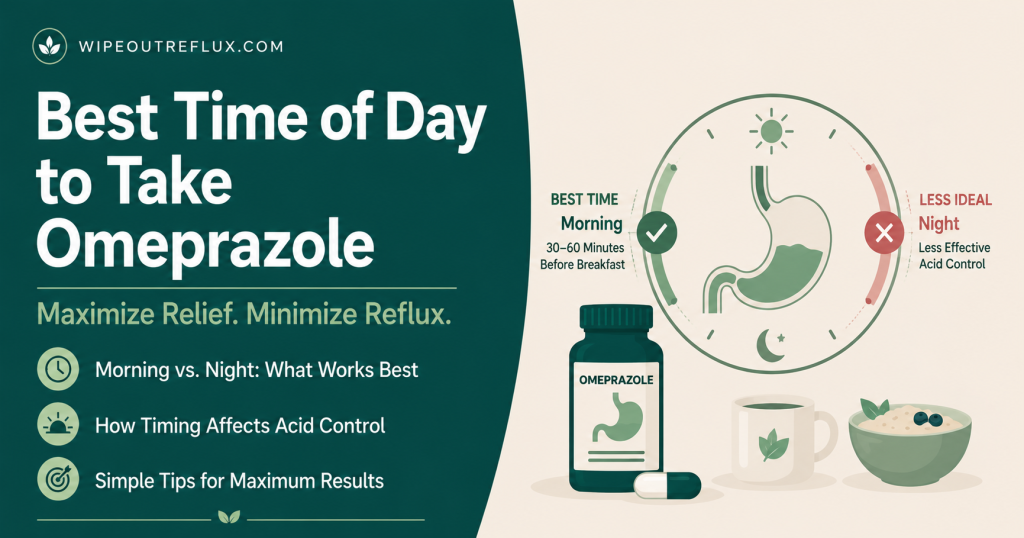
Take omeprazole 30 to 60 minutes before your first meal of the day — on an empty stomach, with water, and then eat. Not with food, not after food, and not at bedtime on an empty stomach. If your symptoms are mainly at night, take it 30 to 60 minutes before your evening meal instead. What matters is that the drug is peaking in your bloodstream at the moment a meal switches your acid pumps on.
This isn’t a technicality. Omeprazole can only disable proton pumps that are actively pumping, and pumps are switched on by eating. Get the timing wrong and much of your dose is metabolised and gone before the pumps it was meant to block ever wake up. In healthy volunteers, taking omeprazole or lansoprazole before breakfast cut the time spent with a gastric pH below 4 to a median of 17.2% of the day, versus 42.0% when the same dose was taken at the same hour with no meal until midday Hatlebakk et al., Alimentary Pharmacology & Therapeutics, 2000. Same drug, same dose, roughly half the acid control.
What makes this worth writing about is how ordinary the mistake is — and that fixing it costs nothing and can be done tomorrow morning.
Key Takeaways
- Take omeprazole 30–60 minutes before your first meal of the day, on an empty stomach, then eat.
- It only blocks pumps that are actively secreting acid, and a meal is what activates them — so peak drug levels and the meal must coincide.
- With food, after food, or at bedtime on an empty stomach all waste much of the dose. Bedtime is the worst of the three.
- Morning before breakfast is standard; before the evening meal suits mainly nocturnal symptoms.
- A second daily dose belongs before the evening meal, not at bedtime — and only if a properly timed single dose has failed.
- Nocturnal acid breakthrough is common on PPIs; a bedtime H2 blocker helps for days, then tolerance sets in within about a week.
- For throat-based symptoms (LPR), timing alone rarely fixes things, because pepsin stays active at pH levels omeprazole never reaches.
- Shift workers and breakfast-skippers should anchor the dose to their first meal, not to the clock.
- Never change a prescribed dose or stop omeprazole abruptly without talking to your doctor.
The Mechanism: Why Omeprazole Has to Meet a Meal
Every timing rule here follows from one piece of biology, so it’s worth understanding rather than memorising.
Your stomach lining contains parietal cells, and inside them sit the proton pumps — H+/K+-ATPase molecules — that push hydrogen ions into your stomach to make acid. Crucially, they aren’t all switched on all the time. At rest, most sit dormant inside the cell in membrane vesicles. When you eat, gastrin, histamine and acetylcholine recruit them to the cell surface and activate them.
Omeprazole is built to attack pumps in exactly that active state. It’s a prodrug: it circulates inertly, concentrates in the acidic space next to an actively secreting pump, converts there into its reactive form, and binds irreversibly. A dormant pump sitting in a vesicle is essentially invisible to it.
Now add a second fact: omeprazole leaves your bloodstream quickly, with a plasma half-life of roughly an hour. Its effect lasts far longer, because the binding is permanent — but the window in which it can do any binding is short.
So the only way to get value from a dose is to line those two things up: swallow the capsule, wait 30 to 60 minutes for it to peak, then eat. The researchers who ran the definitive test framed it the same way, noting that PPIs inactivate the parietal cell pumps “but possibly only those that are actively secreting acid” — and in their crossover trial, 15 of 21 volunteers had better acid control simply because they ate afterwards Hatlebakk et al., Alimentary Pharmacology & Therapeutics, 2000.
What wrong timing looks like
- With food. Food slows gastric emptying, delaying the enteric-coated capsule, so peak levels arrive after the meal has triggered its acid surge.
- After the meal. The pumps have already fired. You’re arriving as everyone leaves.
- At bedtime on an empty stomach. No meal to recruit pumps, and by the time overnight secretion picks up, the drug has largely cleared.
- Hours before eating. Taking it at 6am and eating at 10am means the drug peaks and fades before breakfast happens.
None of this is obscure — yet when researchers questioned 100 people with poorly controlled reflux already taking a PPI, only 46% were dosing optimally. The rest took it more than 60 minutes before meals, after meals, as needed, or at bedtime Gunaratnam et al., Alimentary Pharmacology & Therapeutics, 2006. If you’ve concluded your medication doesn’t work, rule this out first — I’ve covered that whole situation in what to do when acid reflux medication isn’t working.
Morning or Night? How to Choose
Once you accept that the dose must precede a meal, “morning or night” becomes a simpler question: which meal?
Before breakfast is the default, and for good reason. It gives strong acid control across the working day, when most people eat most of their food and generate most of their reflux, and it’s the easiest habit to build. If your symptoms are daytime heartburn, discomfort after meals, or reflux triggered by bending and activity, morning is almost certainly your answer.
Before the evening meal is better if your worst symptoms come after you lie down — burning chest, acid taste, coughing, choking, a raw throat in the morning. Acid control then peaks through the evening and into the early night.
This isn’t just theory. In a crossover study of 17 GERD patients given omeprazole 40 mg for 14 days in the morning and 14 days in the evening, morning dosing raised gastric pH through the working day while evening dosing raised it during the supine period. Pathological reflux was abolished in four patients only by morning dosing and in three only by evening dosing, and those with activity-induced reflux preferred mornings while those with nocturnal reflux preferred evenings Hendel et al., Alimentary Pharmacology & Therapeutics, 1995. Match the dose to your symptom pattern, not to a rule.
One catch matters: “evening dose” means before your evening meal, not at bedtime. If you eat at 7pm, take it at 6pm.
To decide, spend a week noting when symptoms are worst. If more than half the trouble happens after you get into bed, try the evening slot; otherwise stay with breakfast. Give any change three to four weeks — the effect builds over several days of consistent dosing, as covered in how long omeprazole takes to work. And if nights are the problem, don’t rely on the tablet alone: raising the head of your bed and the best sleeping position for silent reflux stack with medication.
Once a Day or Twice a Day?
Most people are prescribed omeprazole once daily, and for most that’s enough — provided the timing is right. The mistake I see constantly is someone escalating to twice daily while still taking both doses badly. Two badly timed doses are not better than one well-timed dose.
If a properly timed once-daily dose genuinely hasn’t worked after four to eight weeks, twice daily is the usual next step: one dose 30–60 minutes before breakfast, one 30–60 minutes before your evening meal. Both sit in front of a meal; neither goes at bedtime. That second dose exists to cover the evening pump activation, and it can’t do that with no meal behind it.
Doubling up isn’t a guaranteed upgrade, though. In a randomised trial of 132 patients with throat-based reflux, splitting the same total daily PPI dose into twice-daily administration was no better than taking it once daily — both regimens improved symptom and laryngoscopy scores, with no significant difference between them Ji et al., Journal of Neurogastroenterology and Motility, 2024. Any move to twice daily should be your doctor’s decision; the trade-offs of higher exposure are covered in omeprazole side effects.
Nocturnal Acid Breakthrough: Why Nights Are Still Bad
Here’s the pattern that confuses people most. You take your omeprazole perfectly before breakfast, your days are fine, and then at 2am you wake up with acid in your throat.
That’s nocturnal acid breakthrough: at least an hour overnight when gastric pH drops below 4 despite treatment. It isn’t a sign the drug has stopped working — it’s predictable pharmacology. Your morning dose cleared hours ago, so pumps activated later were never exposed to it; your body keeps building fresh pumps that the drug never met; and overnight secretion is driven substantially by histamine rather than by a meal, so it rises without the trigger omeprazole is designed to exploit.
The traditional fix is a bedtime H2 blocker — famotidine, for instance — which works through a different mechanism and needs neither active pumps nor a meal. It works, briefly. The problem is that it stops working, and that was tested prospectively: volunteers and GERD patients on omeprazole twice daily before meals were given 28 days of added bedtime H2 blocker, with pH monitoring on days 1, 7 and 28. It significantly reduced overnight acid on day one. By day seven, and again at one month, there was no difference at all between PPI alone and PPI plus H2 blocker Fackler et al., Gastroenterology, 2002. Tolerance develops fast.
So it’s a legitimate short-term tool — a bad fortnight, a flare-up, a few nights a week with gaps between — but not a permanent fix. If you’re weighing the two drug classes, I’ve compared them in famotidine vs omeprazole.
What works better for nights
Because the drug options run out quickly, the mechanical ones matter more. The biggest single lever is your last meal: in a randomised crossover study, reflux patients who ate a standard meal two hours before bed had significantly more supine reflux than when they ate the same meal six hours before bed Piesman et al., The American Journal of Gastroenterology, 2007. A full stomach at bedtime supplies both the volume and the acid; an empty one supplies neither. Specifics in how long before bed you should stop eating and acid reflux at night.
The second is a bedtime alginate. Alginates aren’t acid-suppressing drugs at all — they form a physical gel raft on top of your stomach contents and block reflux mechanically, which is precisely the gap omeprazole leaves. Taken after your evening meal and again at bedtime, an alginate covers the hours your PPI can’t. More in alginates for acid reflux and Gaviscon Advance.
If Your Symptoms Are in Your Throat
Many people reading about omeprazole timing are dealing with a throat rather than a chest — hoarseness, a lump sensation, constant clearing, a cough that won’t settle. That’s laryngopharyngeal reflux, or silent reflux. Fix your timing anyway, but expect it not to be enough on its own.
The agent doing most of the damage to laryngeal tissue isn’t acid — it’s pepsin, the digestive enzyme that travels up with the refluxate and sticks to your throat lining. Human pepsin is maximally active at pH 2 and inactive only at pH 6.5 and above — but critically, it stays stable up to pH 8, survives at neutral pH for at least 24 hours, and regains around 79% of its activity as soon as the pH falls again Johnston et al., The Laryngoscope, 2007. Omeprazole might lift your gastric pH to 4 or 5 — plenty to stop heartburn, and still comfortably inside the range where pepsin works. Acid suppression also does nothing to reduce the number of reflux events; it only changes what’s in them.
Which is why perfect dosing so often produces someone with no heartburn at all and a throat that’s exactly as bad as it was — I’ve unpacked this in why PPIs don’t work for LPR. What to combine it with:
- Alginate after every meal and at bedtime. In a randomised study, liquid alginate suspension taken four times daily after meals and at bedtime produced significantly better Reflux Symptom Index scores at two and six months, and better objective laryngeal findings at six months, than no treatment McGlashan et al., European Archives of Oto-Rhino-Laryngology, 2009. Note the timing: after food, the opposite rule to omeprazole. Pepcid vs Gaviscon covers the comparison.
- A hard stop on eating three to four hours before bed. Fewer overnight events means less pepsin deposited in the throat.
- Cutting dietary acid. Pepsin already sitting in your throat tissue is dormant rather than gone, and acidic food and drink reactivate it — so what you swallow matters as much as what your stomach makes.
Practical Scenarios
You skip breakfast or fast intermittently
Anchor the dose to your first meal, not to the morning. If you eat at 1pm, take it around 12:15pm. Taking it at 7am and not eating until the afternoon is close to a wasted dose — essentially the condition the Hatlebakk crossover tested, where acid control was roughly halved. Long fasting windows also have their own relationship with reflux, and it isn’t always friendly: see intermittent fasting and acid reflux.
You work shifts
Same rule, different clock: 30 to 60 minutes before the first substantial meal of your waking period, whether that starts at 6am or 8pm. Consistency of sequence matters more than consistency of clock time. Rotating shifts are genuinely harder on reflux — in a UK Biobank analysis of 262,722 people, shift workers had a 1.10-fold greater risk of developing GERD than non-shift workers, with sleep patterns mediating about a quarter of the association Li et al., Frontiers in Public Health, 2023. More in shift work and acid reflux.
You’re on twice-daily dosing
Before breakfast and before your evening meal, roughly 10 to 12 hours apart. Don’t take both together in the morning — that turns a twice-daily regimen into a once-daily one at double strength, which isn’t the same thing.
You missed a dose
If you remember before your next meal, take it then and eat 30 to 60 minutes later. If you’ve already eaten, the dose has lost its opportunity — take it before your next meal instead, or resume normally the next day. Don’t double up. And don’t crush the capsule if you struggle to swallow it: the enteric coating is what protects the drug from your stomach acid, though most brands can be opened and the intact granules swallowed on soft food. Check the leaflet or ask your pharmacist.
Interactions Worth Flagging
Clopidogrel. Omeprazole has a high affinity for CYP2C19, the enzyme that converts clopidogrel into its active form, and that interaction is real at the pharmacokinetic level Wedemeyer & Blume, Drug Safety, 2014. The randomised outcome trial is more reassuring: in 3,761 patients on aspirin and clopidogrel, omeprazole produced no increase in cardiovascular events versus placebo (4.9% vs 5.7%) alongside a sharp reduction in upper gastrointestinal bleeding Bhatt et al., The New England Journal of Medicine, 2010 — though the authors noted it stopped early and couldn’t rule out a smaller effect. Not a crisis, but a conversation to have with your doctor rather than a decision to make alone.
Drugs that need stomach acid to be absorbed. Omeprazole raises gastric pH by design, and some medicines depend on an acidic stomach to be taken up properly — documented examples include mycophenolate mofetil and several HIV protease inhibitors Wedemeyer & Blume, Drug Safety, 2014. Few of these interactions are clinically important, but if you take several regular medications, ask your pharmacist to check the combination once.
A Simple Daily Schedule
- 7:00am — Omeprazole with a glass of water, nothing else.
- 7:45am — Breakfast.
- 6:30pm — Evening meal, finished by 7:00pm.
- 7:30pm — Alginate after the meal.
- 10:30pm — Alginate again, immediately before lying down.
- 11:00pm — Bed, head end raised, at least four hours since your last food.
Shift the sequence earlier or later as your life requires — the relationships matter, the absolute times don’t.
The Bottom Line
Omeprazole is a genuinely effective drug that gets routinely undermined by a detail nobody explains at the pharmacy counter. It can only switch off pumps that are actively working, and only a meal switches them on — so the capsule goes in 30 to 60 minutes before you eat, on an empty stomach, every time. Morning before breakfast for daytime symptoms; before dinner if your nights are worse. If you change one thing after reading this, change that.
What timing can’t do is stop reflux happening. It changes what’s in the refluxate, not whether it travels — which is why nights, throats and stubborn cases need the mechanical levers too: the last meal three to four hours before bed, an alginate raft after eating and at bedtime, the head of the bed raised, and a serious look at how much acid you’re swallowing. That last one is where most people quietly lose, because dietary acidity is invisible and hides in things that look innocent. The Wipeout Food Reference Guide exists for exactly that — the essential list of foods and drinks that are safe for acid reflux and LPR, with their real pH values, so you’re working from numbers rather than guesswork.
And if you’d rather have the whole thing sequenced than assemble it piece by piece, the Wipeout Diet Plan goes considerably deeper. I built it around LPR and silent reflux first, since that’s the version that most reliably defeats standard medication, but it targets the same mechanisms as GERD and everyday heartburn, so it does just as much for those. Dose timing is the fastest win available to you; getting the rest right is what makes it stick.
None of this is a reason to change a prescribed dose on your own, and omeprazole should never be stopped abruptly — acid rebound is real. Timing changes are safe to make yourself; dose changes are a conversation with your doctor.
Frequently Asked Questions
What is the best time of day to take omeprazole?
Thirty to sixty minutes before your first meal of the day, on an empty stomach with water. The drug can only block proton pumps that are actively secreting acid, and eating is what activates them — so the dose needs to peak in your bloodstream just as the meal switches the pumps on. If your symptoms are mainly nocturnal, take it before your evening meal instead.
Should I take omeprazole in the morning or at night?
Morning before breakfast suits most people, because it covers the day when you eat most and reflux most. Evening dosing — before your evening meal, not at bedtime — suits people whose symptoms are predominantly nocturnal. Crossover pH studies show individuals genuinely differ, so match the dose to when your symptoms actually happen.
What if I don’t eat breakfast?
Take the dose 30 to 60 minutes before whatever your first meal is, even if that’s lunch or later. Taking it in the morning and not eating until the afternoon roughly halves the acid control you get from the same dose.
Why do I still get reflux at night on omeprazole?
That’s usually nocturnal acid breakthrough — at least an hour overnight when gastric pH falls below 4 despite treatment. Your dose has cleared, newly built pumps were never exposed to the drug, and overnight secretion is driven by histamine rather than a meal. Meal timing, alginate and bed elevation help more than extra acid suppression.
Does adding a bedtime H2 blocker help?
Only briefly. In a prospective study, adding a bedtime H2 blocker to twice-daily PPI therapy significantly reduced overnight acid on the first day, but by one week and again at one month there was no difference from the PPI alone, because tolerance develops quickly. Short-term or intermittent use is reasonable; nightly indefinite use is unlikely to keep working. Discuss it with your doctor first.
Should I take omeprazole twice a day?
Only if a properly timed once-daily dose has genuinely failed, and only on your doctor’s advice. If you do, take one dose before breakfast and one before your evening meal — not at bedtime. A randomised trial in patients with throat-based reflux found splitting the same total dose into twice-daily administration was no better than once-daily dosing.
Will fixing my dose timing cure my throat symptoms?
Usually not on its own. Throat symptoms are largely driven by pepsin, which is active below pH 6.5 and stays stable and reactivatable well above that — far beyond anything omeprazole achieves — and acid suppression doesn’t reduce how often reflux happens. Correct timing still helps, but it needs pairing with alginate after meals and at bedtime, a long gap between your last meal and bed, and a genuinely low-acid diet.
Research & References
- Hatlebakk et al., Alimentary Pharmacology & Therapeutics, 2000 — Randomised crossover trial in 21 healthy volunteers: omeprazole or lansoprazole taken before breakfast produced a median 17.2% of the day with gastric pH below 4, versus 42.0% when the same dose was taken with no meal until midday.
- Gunaratnam et al., Alimentary Pharmacology & Therapeutics, 2006 — Survey of 100 patients with persistent reflux symptoms on a PPI: only 46% dosed optimally, the rest taking it more than 60 minutes before meals, after meals, at bedtime or as needed.
- Hendel et al., Alimentary Pharmacology & Therapeutics, 1995 — Crossover study of omeprazole 40 mg morning versus evening in 17 GERD patients: morning dosing raised daytime gastric pH, evening dosing raised supine pH, and optimal timing varied by symptom pattern.
- Fackler et al., Gastroenterology, 2002 — Prospective study adding a bedtime H2 blocker to twice-daily omeprazole: overnight acid fell significantly only on day one, with no difference from PPI alone at one week or one month, because of tolerance.
- Ji et al., Journal of Neurogastroenterology and Motility, 2024 — Randomised trial in 132 patients with laryngopharyngeal reflux comparing the same total PPI dose twice daily versus once daily; both improved symptom and laryngoscopy scores, with no significant difference.
- Piesman et al., The American Journal of Gastroenterology, 2007 — Randomised crossover trial of a standardised meal eaten two hours versus six hours before bed, finding significantly more supine reflux following the late meal.
- Johnston et al., The Laryngoscope, 2007 — Human pepsin is maximally active at pH 2 and inactive only at pH 6.5 and above, but remains stable to pH 8, survives 24 hours at neutral pH, and regains around 79% of its activity after re-acidification.
- McGlashan et al., European Archives of Oto-Rhino-Laryngology, 2009 — Randomised study of liquid alginate suspension four times daily after meals and at bedtime, showing significantly better Reflux Symptom Index scores at two and six months and better Reflux Finding Scores at six months than control.
- Li et al., Frontiers in Public Health, 2023 — UK Biobank cohort analysis of 262,722 participants finding shift workers had a 1.10-fold greater risk of incident gastro-oesophageal reflux disease, with sleep patterns mediating around a quarter of the association.
- Bhatt et al., The New England Journal of Medicine, 2010 — COGENT randomised trial of omeprazole versus placebo in 3,761 patients on clopidogrel and aspirin: cardiovascular event rates of 4.9% versus 5.7%, with a significant reduction in gastrointestinal events and upper gastrointestinal bleeding.
- Wedemeyer & Blume, Drug Safety, 2014 — Review of proton pump inhibitor drug interactions, covering absorption changes caused by raised gastric pH and omeprazole’s high CYP2C19 affinity underlying its clopidogrel interaction.

David Gray
12 years living with LPR · Consultant & researcher
I've lived with LPR for twelve years — the misdiagnoses, the PPI courses that did nothing, the slow work of figuring out what actually helps. Wipeout Reflux is where I translate the research into plain terms for people stuck in the same place. Every claim here is sourced to peer-reviewed work, and I consult one-to-one with LPR sufferers.