
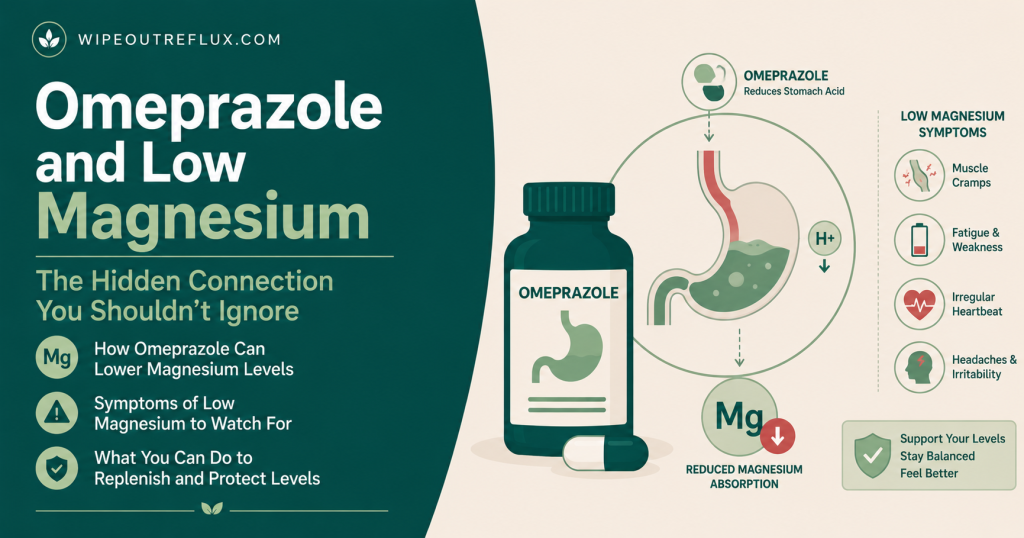
Omeprazole can lower magnesium levels by impairing how much of it you absorb from food, and it’s a slow, cumulative effect — it’s been reported after as little as three months, but most cases surface after at least a year of continuous use. It’s uncommon in absolute terms, but when it happens it’s genuinely serious: symptoms range from fatigue and muscle cramps up to tremor, palpitations, and in severe cases seizures. It’s also one of the few PPI risks where the evidence is unusually strong, because in a number of reported cases stopping the drug resolved it and restarting brought it straight back.
The mechanism is different from the one behind low B12, which I’ve covered separately in omeprazole and B12 deficiency. B12 loss is about acid, not this. Magnesium loss is about a specific gut transporter that omeprazole interferes with, and it’s why oral magnesium supplements alone often fail to fix the problem while you’re still taking the drug.
If you’ve been on omeprazole for years and you’re dealing with unexplained fatigue, twitchy muscles, or heart palpitations that never get pinned on the drug, this is worth reading properly. I’ve written more broadly about the drug’s other long-term effects in omeprazole side effects; this article goes deep on magnesium specifically.
Key Takeaways
- Omeprazole impairs active magnesium absorption in the gut via TRPM6/TRPM7 channels — a completely different mechanism from the one behind low B12.
- It has been reported after as little as three months, but most cases occur after at least a year of continuous PPI use — and some of the documented cases involved six to eleven years.
- Symptoms escalate roughly in this order: fatigue, muscle cramps and twitching, tremor, numbness, palpitations and arrhythmia, and in severe cases tetany or seizures.
- Low magnesium drags potassium and calcium down with it — and those won’t correct with potassium or calcium supplements alone until magnesium is replaced.
- Serum magnesium is an insensitive test: only about 1% of the body’s magnesium is in the bloodstream — the rest sits in bone and inside cells — so blood levels can look normal even when tissue stores are genuinely depleted.
- Higher-risk groups include long-term users, people on diuretics or digoxin, older adults, heavy alcohol use, and poor dietary intake.
- Oral magnesium repletion frequently fails while the PPI continues; the reliable fix is reducing or stopping the drug under medical supervision.
- The FDA issued a specific safety communication about this in 2011, after reviewing dozens of cases — it’s one of the few PPI risks with genuinely strong causal evidence, since a number of those cases showed the problem resolving on stopping and returning on restarting.
How Omeprazole Causes Low Magnesium — A Different Mechanism From B12
It’s easy to lump every PPI-related nutrient problem together, but low magnesium doesn’t work the same way as low B12. B12 deficiency happens because you need stomach acid to strip B12 off food protein before you can absorb it — suppress the acid, and less B12 gets freed up. Magnesium is a different story. Acid still matters, but for a different reason and in a different place — and the main casualty appears to be a transporter further down the gut.
Most of your dietary magnesium is absorbed passively, simply diffusing between the cells lining the small intestine wherever there’s enough of it around. But when intake is lower or absorption needs to be more efficient, the large intestine tops things up using active transport — magnesium being pulled through specific channels called TRPM6 and TRPM7. These channels are the fine-tuning system that keeps magnesium absorption adequate even when passive diffusion alone wouldn’t cut it.
Here’s where the acid comes back in, and it’s worth being precise because it’s easy to get wrong. Magnesium has to be dissolved to be absorbed, and it dissolves better in an acidic environment. Raise the pH inside the gut — which is exactly what a PPI does — and less magnesium is available in soluble form to cross the gut wall in the first place. So the acid does matter; it just isn’t about prising a nutrient off food protein the way it is with B12.
On top of that, PPIs appear to reduce the activity of the TRPM6 and TRPM7 channels themselves, and there’s evidence the passive route is compromised too, with changes to the proteins that control how much leaks between cells. The honest position is that the exact mechanism is still unknown — the leading explanation is the solubility problem, with reduced transporter activity as a likely contributor, and the effect seems to compound with how long the drug has been used Gommers et al., Acta Physiologica, 2022. What matters practically is that both routes are affected at once, so there’s no spare capacity to pick up the slack. That’s why this is a genuine absorption problem, not something you can out-eat by adding a bit more spinach to your diet.
The Timeline: Why This Is Mainly a Long-Term-User Problem
This is not something that shows up in the first weeks or months of taking omeprazole, and that timing matters for how you think about your own risk. The FDA’s review of cases found hypomagnesaemia had been reported in patients taking a PPI for as little as three months, but most cases occurred after at least a year of continuous treatment U.S. Food and Drug Administration, Drug Safety Communication, 2011. The two illustrative cases the agency singled out involved patients who had been taking a PPI for six and eleven years respectively before symptoms appeared — a reminder that the long tail here can be very long indeed, even if two cases don’t set a typical figure.
That slow build is exactly why it gets missed. Magnesium stores decline gradually as the TRPM6/TRPM7 impairment chips away at absorption month after month, and the body buffers the loss for a long time by drawing on bone and intracellular stores before serum levels or symptoms shift noticeably. If you’ve only been on omeprazole for a few months, this specific risk isn’t something to lose sleep over. If you’ve been on it continuously for a year or more without a magnesium check, it’s worth asking for one.
Symptoms: How Low Magnesium Actually Feels
What makes PPI-induced hypomagnesaemia tricky is that it doesn’t announce itself. It tends to progress through recognisable stages, and most people never connect the early ones to a drug they’ve been taking uneventfully for years.
- Fatigue. Often the first and vaguest sign — easy to blame on poor sleep, stress, or just getting older.
- Muscle cramps and twitching. Calf cramps at night, twitchy eyelids, or fasciculations in the hands and forearms. Magnesium is essential for normal nerve and muscle signalling, so this is usually one of the first physical clues.
- Tremor. A fine shake in the hands, sometimes mistaken for anxiety or too much caffeine.
- Numbness and tingling. Pins and needles in the fingers, toes or around the mouth, from disrupted nerve conduction.
- Palpitations and arrhythmia. Magnesium stabilises the heart’s electrical rhythm, so deficiency can produce a racing or irregular heartbeat — including, in the FDA’s case reviews, atrial fibrillation and abnormal QT intervals.
- Tetany and seizures. In severe, advanced cases, sustained muscle spasm (tetany), carpopedal spasm, or convulsions. One published case describes a man who arrived at hospital with days of severe vomiting and then generalised tonic-clonic seizures, on a background of a year of over-the-counter PPI use, with nobody having checked his magnesium Krishnan et al., Cureus, 2024. The vomiting almost certainly compounded the losses — but it took a seizure for anyone to measure the magnesium at all.
Very few people on omeprazole reach the severe end of that list. But the earlier symptoms — fatigue, cramps, twitching, palpitations — are common enough, and vague enough, that they get absorbed into everyday life without anyone questioning them. That’s the real-world risk here, not the seizures.
The Critical Complication: Potassium and Calcium Won’t Correct Without Magnesium
This is the point I’d want every long-term PPI user to understand, because it changes how a low magnesium problem actually gets treated. Magnesium deficiency doesn’t stay contained to magnesium. It drags potassium and calcium down with it, through two separate mechanisms: magnesium is needed for normal potassium channel function in the kidney, so low magnesium causes the kidney to waste potassium even when intake is adequate; and magnesium is required for the parathyroid gland to release and respond to parathyroid hormone, so deficiency can blunt PTH secretion and produce hypocalcaemia alongside it.
In the FDA’s review of severe cases, most patients with comprehensive lab work had low calcium alongside their low magnesium, with parathyroid hormone levels that were normal rather than raised — which is itself the giveaway, because a falling calcium should be driving PTH up — a pattern that confirmed magnesium, not calcium, as the root problem U.S. Food and Drug Administration, Drug Safety Communication, 2011.
The practical consequence: if you’re being treated for stubbornly low potassium or low calcium and it isn’t responding to potassium or calcium supplements the way it should, magnesium is the thing to check next. Replacing potassium or calcium in isolation, without correcting the underlying magnesium deficiency, tends to be a losing battle — the kidney keeps leaking potassium and the parathyroid gland keeps underperforming until magnesium stores are rebuilt.
Who’s at Higher Risk
Hypomagnesaemia from omeprazole isn’t evenly distributed. Certain factors stack the odds considerably:
- Duration of use. The single biggest factor — risk climbs the longer you’ve been on a PPI, especially past the one-year mark.
- Diuretics. Both loop diuretics (like furosemide) and thiazide diuretics independently lower magnesium, and combined with a PPI the effect compounds.
- Digoxin. Low magnesium increases the risk of digoxin toxicity and dangerous arrhythmias, which is why the FDA specifically flagged this combination for monitoring.
- Older age. Magnesium intake tends to fall, kidney handling of magnesium changes, and polypharmacy becomes more common — a combination I’ve covered more broadly in acid reflux in older adults.
- Heavy alcohol use. Alcohol independently increases urinary magnesium loss.
- Poor dietary intake. Diets low in leafy greens, nuts, seeds and whole grains start from a lower baseline, leaving less margin before deficiency becomes symptomatic.
A pooled analysis of observational studies found PPI users had meaningfully higher odds of hypomagnesaemia than non-users, though the size of the effect varied considerably between studies — consistent with the idea that background risk factors like these do a lot of the work Srinutta et al., Medicine (Baltimore), 2019.
How It’s Diagnosed — and Why Serum Magnesium Can Mislead You
The obvious answer — get a blood test — is only partly reliable here, and it’s worth understanding why. Only around 1% of the body’s total magnesium sits in the bloodstream. The vast majority is stored inside cells and in bone. A standard serum magnesium test measures only that small circulating fraction, and the body works hard to keep it within a normal range by pulling magnesium out of cells and bone to prop up blood levels for as long as it can.
The result is that serum magnesium can read as “normal” even when someone is genuinely, significantly magnesium-depleted at the tissue level — it’s a late-appearing marker, not an early one. By the time serum magnesium actually drops below the normal range, intracellular stores are often already substantially depleted. Magnesium also isn’t part of a standard metabolic panel; it has to be specifically requested, and most GPs won’t order it unless there’s a reason to suspect it.
Practically, this means two things. First, if you’ve been on omeprazole for years and have symptoms that fit, ask for serum magnesium specifically — it won’t happen automatically. Second, don’t be reassured by a single normal result if the clinical picture still fits; some clinicians will repeat testing or trial magnesium replacement based on symptoms alone, given how insensitive the test can be.
What Actually Helps
Treatment here has a genuine hierarchy, and skipping straight to a supplement bottle is usually the least effective option on its own.
Dietary sources
Leafy greens, nuts (especially almonds and cashews), seeds (pumpkin and chia in particular), legumes, whole grains, and dark chocolate are all solid dietary magnesium sources. For anyone managing reflux alongside this, most of these fit comfortably within a reflux-friendly way of eating, though nuts and seeds are worth introducing in modest portions if fat content tends to trigger your symptoms.
Supplement forms — not all magnesium is equal
If supplementation is recommended, the form matters. Magnesium oxide is the cheapest and most common form on pharmacy shelves, but it’s also poorly absorbed — a large share of it simply passes through the gut unabsorbed and tends to cause diarrhoea rather than raise magnesium levels meaningfully. Magnesium glycinate and magnesium citrate are generally better absorbed and gentler on the gut, which is why they’re usually the preferred choices when a clinician recommends supplementation for a genuine deficiency rather than just “some extra magnesium.”
The important caveat: the PPI is usually the real problem
Here’s the part that gets missed constantly: oral magnesium repletion often fails, or only partially works, while the PPI keeps suppressing the same absorption pathway that’s causing the deficiency in the first place. The FDA’s own review found that in roughly a quarter of the cases it examined, magnesium supplementation alone did not correct low serum magnesium levels, and the PPI had to be stopped before levels normalised U.S. Food and Drug Administration, Drug Safety Communication, 2011. Trying to out-supplement an impaired absorption pathway is fighting the mechanism itself.
This is why the real fix, when hypomagnesaemia is confirmed and linked to the drug, is usually reducing the dose or stopping the PPI under medical supervision — not simply adding a magnesium tablet and continuing as before. That doesn’t mean stopping unsupervised or abruptly; sudden discontinuation carries its own problems, which I’ve laid out fully in getting off PPIs and acid rebound. It means having the magnesium result as part of the conversation with your doctor about whether you still need the drug, and building the rest of your reflux management — diet, alginates, timing — so that stopping is realistic. I’ve covered the broader supplement landscape for reflux, including where magnesium fits alongside other nutrients worth checking, in supplements for LPR.
The FDA’s 2011 Safety Communication
In March 2011, the FDA issued a specific drug safety communication after reviewing 38 cases from its adverse event reporting system and 23 cases from the published literature U.S. Food and Drug Administration, Drug Safety Communication, 2011. A few details from that review are worth knowing directly. The FDA found “positive dechallenge” in many cases — magnesium normalising after the PPI was stopped, at a median of about one week — and “positive rechallenge” in some, where restarting the PPI brought the deficiency back within a median of about two weeks.
That dechallenge-rechallenge pattern is exactly the kind of evidence that makes a causal link hard to dispute. Most of the associations discussed around long-term PPI use — fractures, kidney disease, dementia — rest on observational data that can’t rule out confounding. This one doesn’t have that problem in the same way: in a meaningful number of reported cases, removing the drug resolved the problem and reintroducing it brought the problem back, on a fairly consistent timescale. It’s one of the few PPI risks where “the drug did this” is about as solid as the evidence gets.
Since 2011, the FDA has required this risk to be included in the warnings section of prescription PPI labels, and clinicians are advised to consider checking magnesium levels before starting long-term treatment and periodically afterward — particularly in patients also taking digoxin or diuretics.
Why This Gets Missed in Reflux Patients Specifically
If you’re dealing with acid reflux or LPR, there’s a particular reason this deficiency slips through unnoticed: its symptoms overlap almost perfectly with things reflux patients already blame on their reflux, or on anxiety. Palpitations get chalked up to reflux irritating the vagus nerve — a real phenomenon in its own right, covered in acid reflux and heart palpitations. Muscle twitching and tremor get filed under stress. Fatigue gets filed under “living with a chronic condition is exhausting,” which, fairly enough, it often is. Anxiety-like symptoms in particular get misread in both directions — genuine anxiety can worsen reflux, and reflux can be misdiagnosed as anxiety, a loop I’ve unpacked in can LPR be caused by anxiety.
The upshot is that long-term omeprazole users with reflux are, if anything, less likely to get their palpitations or fatigue investigated for a magnesium cause than the general population, because there’s already a convenient explanation sitting right there. If you’ve been on the drug for years and any of these symptoms have crept in gradually, it’s worth explicitly asking your doctor to rule magnesium out rather than assuming it’s “just the reflux.”
Putting the Risk in Proportion
None of this is a reason to panic if you’re on omeprazole. This remains an uncommon complication in absolute terms — the FDA itself noted that under-recognition and under-reporting make it impossible to pin down a precise incidence rate, but nothing in the data suggests this happens to most long-term users. The honest summary is that it’s rare, genuinely serious when it does occur, unusually well-supported as a real drug effect rather than a coincidental association, and almost entirely a long-term-use issue rather than something to worry about after a few weeks or months on the drug.
What it does justify is the same thing that runs through every long-term PPI conversation: if you’ve been on omeprazole for years, get the relevant bloods checked periodically, including magnesium specifically since it won’t happen by default, and have an honest conversation with your doctor about whether you still need the drug at all.
Conclusion
PPI-induced hypomagnesaemia is a slow-building, easily-missed problem with a clean mechanism behind it: omeprazole impairs the active transport channels your gut relies on to pull in magnesium, passive absorption can’t make up the difference, and stores quietly deplete over years rather than weeks. The symptoms — fatigue, cramps, twitching, palpitations, and in rare severe cases tetany or seizures — are easy to misattribute to reflux, stress or simply getting older, especially since a normal serum magnesium result doesn’t rule out real tissue-level depletion. The part worth remembering above all is that magnesium takes potassium and calcium down with it, and that oral supplements often can’t out-run the drug that’s causing the loss in the first place — which is why the real fix, when this is confirmed, is usually reviewing the PPI itself rather than just adding a tablet.
If you’re managing reflux long-term and trying to reduce how much you depend on acid suppression in the first place, working on the underlying frequency of reflux — rather than only its acidity — is what actually creates room to cut back. That’s the deeper work the Wipeout Diet Plan is built around; it was designed first for LPR, the stubborn throat-based form of reflux, but the same mechanisms mean it works just as well for GERD and everyday heartburn. And because so much of what worsens reflux hides in foods you wouldn’t suspect, the Wipeout Food Reference Guide is the quickest way to check what’s actually safe, with real pH values rather than guesswork. Whatever you decide about your medication, make it a decision made with your doctor — never stop a prescribed PPI abruptly on the strength of an article.
Frequently Asked Questions
How long does it take for omeprazole to cause low magnesium?
Usually a year or more of continuous use. Cases have been reported as early as three months, but that’s the exception rather than the rule, and some of the documented cases involved six to eleven years of treatment before anything showed up. This isn’t a short-term risk — it’s specifically a long-term-use issue.
What are the first signs of low magnesium from a PPI?
Fatigue is typically the earliest and vaguest sign, followed by muscle cramps and twitching, and sometimes a fine tremor. These are easy to dismiss or blame on other things, which is exactly why the deficiency tends to go unrecognised for a long time.
Can a normal blood test rule out low magnesium?
Not reliably. Only about 1% of the body’s magnesium circulates in blood, so serum levels can stay in the normal range even when intracellular stores are significantly depleted. If your symptoms fit but the test looks normal, it’s reasonable to ask your doctor whether repeat testing or a trial of replacement makes sense.
Will taking a magnesium supplement fix it while I’m still on omeprazole?
Sometimes, but often only partially. Because the PPI is actively impairing the absorption pathway, oral supplements frequently fail to fully correct the deficiency while the drug continues. In the FDA’s review of cases, about a quarter required stopping the PPI in addition to magnesium replacement before levels normalised.
Which magnesium supplement absorbs best?
Magnesium glycinate and magnesium citrate are generally better absorbed and gentler on digestion than magnesium oxide, which is cheap and common but poorly absorbed and more likely to cause diarrhoea without meaningfully raising magnesium levels.
Does low magnesium affect potassium and calcium too?
Yes, and this is one of the most important things to know. Low magnesium causes the kidney to waste potassium and blunts the parathyroid gland’s ability to maintain normal calcium. Both tend to stay low, or resist correction, until the underlying magnesium deficiency is treated.
Should I stop taking omeprazole if my magnesium is low?
Not on your own. If hypomagnesaemia is confirmed and linked to the drug, reducing or stopping the PPI under medical supervision is often the most effective fix, but it needs to be planned with your doctor, alongside magnesium replacement and support for the reflux itself, rather than stopped abruptly.
Research & References
- U.S. Food and Drug Administration, Drug Safety Communication, 2011 — FDA safety review of 38 adverse event reports and 23 published cases of PPI-associated hypomagnesaemia; found the risk was concentrated in patients on treatment for a year or more, documented positive dechallenge (median one week to normalise after stopping) and positive rechallenge (median two weeks to recur after restarting), noted concomitant hypocalcaemia in most cases with full lab data, and found that magnesium supplementation alone failed to correct levels in roughly a quarter of cases reviewed.
- Gommers et al., Acta Physiologica, 2022 — Review of the mechanisms behind PPI-induced hypomagnesaemia, concluding the exact mechanism remains unknown but that raised luminal pH reducing magnesium solubility is the leading explanation, with possible reductions in TRPM6/TRPM7 active transport and in paracellular absorption as contributing factors.
- Srinutta et al., Medicine (Baltimore), 2019 — Meta-analysis of observational studies finding PPI use associated with increased odds of hypomagnesaemia compared with non-use, with substantial variation in effect size between individual studies.
- Krishnan et al., Cureus, 2024 — Case report of a 49-year-old man with severe hypomagnesaemia (serum magnesium 0.1 mmol/L) after roughly a year of over-the-counter pantoprazole, presenting with severe vomiting complicated by generalised tonic-clonic seizures; illustrates the severe end of the symptom spectrum.

David Gray
12 years living with LPR · Consultant & researcher
I've lived with LPR for twelve years — the misdiagnoses, the PPI courses that did nothing, the slow work of figuring out what actually helps. Wipeout Reflux is where I translate the research into plain terms for people stuck in the same place. Every claim here is sourced to peer-reviewed work, and I consult one-to-one with LPR sufferers.