
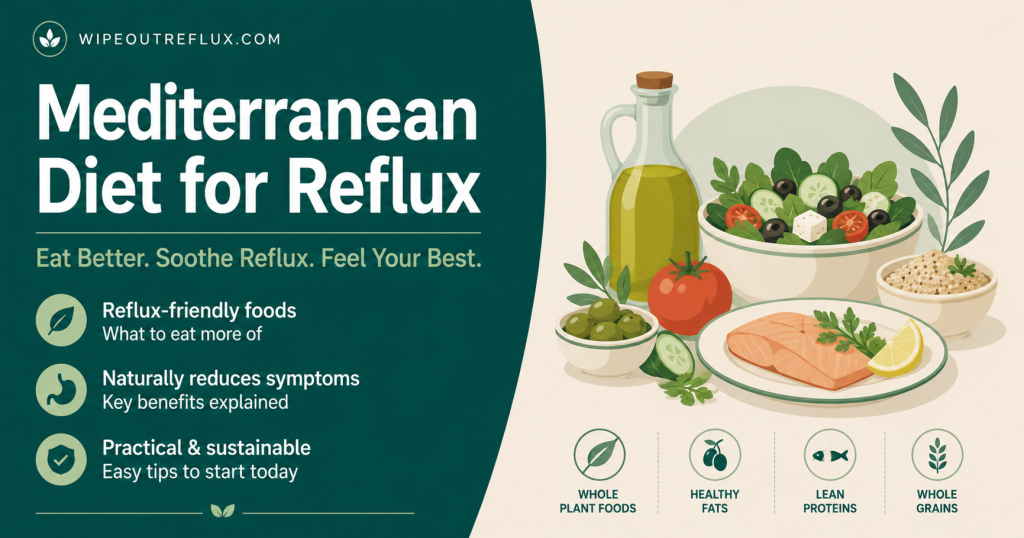
If you’ve read anything about diet and acid reflux, you’ve probably seen the Mediterranean diet mentioned as the evidence-backed option. That reputation is earned, but it comes with a catch nobody explains clearly: the Mediterranean diet, eaten the way it’s traditionally served, is full of reflux triggers. Tomatoes, citrus, garlic, onion, olive oil poured generously, red wine, and vinegar dressings are all Mediterranean staples — and all common causes of heartburn and LPR flares.
The best evidence we have comes from a 2017 study that compared a plant-based Mediterranean-style diet plus alkaline water against standard PPI therapy for laryngopharyngeal reflux (LPR), and found the diet performed at least as well as medication. It’s a genuinely important study, and I’ll walk through its exact numbers below — along with its real limitations, because it was retrospective, not randomized, and it changed two things (diet and alkaline water) at once, so we can’t cleanly separate their individual effects.
This article covers what the Mediterranean diet actually is, the mechanisms that plausibly explain why it helps reflux, which of its signature foods you need to modify or avoid, and a practical reflux-safe framework you can actually follow — plus how it fits alongside medication rather than replacing it.
Key Takeaways
- The strongest evidence for diet-based LPR treatment comes from a 2017 study comparing a plant-based Mediterranean-style diet plus alkaline water against PPI therapy.
- That study was a retrospective chart review, not a randomized trial — and diet and alkaline water changed together, so their separate effects can’t be isolated.
- Even with those limits, the diet-based approach matched or outperformed medication on the study’s primary symptom measure.
- Higher fiber intake is independently linked to lower reflux risk across several separate studies, including a large prospective cohort.
- Weight loss, lower calorie density and gut microbiome changes are the more plausible mechanisms — dietary fat itself performs worse as an explanation than most advice assumes.
- Several classic Mediterranean staples — tomatoes, citrus, garlic, onion, red wine, and vinegar dressings — are common reflux triggers and need real modification, not just portion control.
- Olive oil is the exception: it needs portion sense because of calorie density, not because fat itself drives reflux.
- A reflux-safe Mediterranean framework keeps the whole-food, plant-forward, fish-forward structure while swapping out the acidic and fat-heavy trigger foods.
- This is a legitimate complement to medical care, not a substitute for it if you have erosive disease, Barrett’s esophagus, or symptoms that haven’t been properly evaluated.
What the Mediterranean Diet Actually Is
“Eat healthier” isn’t a diet, and neither is “Mediterranean” in the loose way it gets used on menus. The pattern researchers study has a specific structure: vegetables, fruit, legumes, and whole grains form the base of most meals; olive oil is the primary added fat; fish and seafood appear several times a week; poultry, eggs, and dairy show up in moderate amounts; red meat and sweets are occasional rather than daily; and wine, typically red, is included in modest amounts with meals in many versions of the pattern.
What makes it different from generic “healthy eating” advice is that it’s defined by the overall pattern, not by individual “good” or “bad” foods, and it isn’t low-fat or low-carb in the way many popular diets are. Most of the original evidence base was built around cardiovascular disease and metabolic health, which is worth knowing, because the reflux research is a newer and smaller offshoot of a much larger body of work.
The Anchor Study: Diet vs. Medication for LPR
The most important study on this topic is a retrospective cohort comparison run out of New York Medical College. Researchers identified two groups of LPR patients treated at the same clinic in different periods: 85 patients treated from 2010 to 2012 with a proton pump inhibitor plus standard reflux precautions, and 99 patients treated from 2013 to 2015 with alkaline water (pH above 8.0), a roughly 90% plant-based Mediterranean-style diet, and the same standard reflux precautions. The outcome measured was change in Reflux Symptom Index (RSI) after six weeks of treatment Zalvan et al., JAMA Otolaryngology–Head & Neck Surgery, 2017.
Here are the actual numbers. Of the 184 total patients, 54.1% of the PPI group achieved a clinically meaningful reduction in RSI (six points or more), compared with 62.6% of the diet-and-alkaline-water group — a difference of 8.05 percentage points, with a confidence interval that crossed zero (-5.74 to 22.76), meaning that particular comparison wasn’t statistically significant on its own. But on the mean percentage reduction in RSI, the diet group did significantly better: 39.8% average reduction versus 27.2% for the PPI group, a difference of 12.10 points with a confidence interval that stayed above zero (1.53 to 22.68).
I want to be straightforward about what this study is and isn’t, because overselling it would do more harm than good. It was a retrospective chart review, not a randomized controlled trial — patients weren’t randomly assigned to a group, they were treated according to whichever protocol the clinic was using during that period of time. That means the two cohorts differ not just by treatment but by era, and anything else that changed at the clinic between 2012 and 2013 is a potential confounder. There was no blinding, symptom scores were self-reported, and because the alkaline water and dietary changes were introduced together as a package, this study cannot tell you how much of the benefit came from the diet itself versus the water. It’s also a single specialty clinic’s patient population, which may not generalize to everyone with reflux symptoms.
None of that erases the result. A diet-based approach, in a population where medication often underperforms, matched a PPI on the primary measure and beat it on a secondary one — without drug costs or the side effects that come with long-term acid suppression, a subject I’ve covered in detail in why PPIs don’t work for LPR and omeprazole side effects. That’s a genuinely strong finding even with the honest caveats attached, and it’s why this study anchors the case for diet as a serious reflux intervention rather than a wellness add-on.
Does a Mediterranean Diet Lower GERD Risk More Broadly?
Outside the LPR-specific research, there’s supporting evidence from general GERD populations. A cross-sectional study of 817 adults in Tirana, Albania, assessed dietary patterns against GERD symptoms using the Montreal definition, splitting participants into predominantly Mediterranean eaters (frequent traditional dishes, fresh produce, olive oil, and fish) versus a largely non-Mediterranean pattern (frequent red meat, fried food, sweets, and fast food). A non-Mediterranean dietary pattern was associated with more than twice the odds of GERD, even after adjustment for other factors Mone et al., Diseases of the Esophagus, 2016.
Like most cross-sectional research, this can’t prove the diet directly caused lower GERD rates — people who eat this way may differ in other health habits too. But it points the same direction as the Zalvan data, in an entirely different population and study design, which is exactly the kind of convergent evidence that makes a finding more trustworthy.
The Fiber Evidence
Fiber has its own, more direct line of research, and it’s one of the more mechanistically clean parts of this story.
A large cross-sectional study of volunteers found that high dietary fat intake was associated with a greater risk of GERD symptoms and erosive esophagitis, while high fiber intake was independently associated with a reduced risk of GERD symptoms El-Serag et al., Gut, 2005. That’s an association, not an intervention, but it lines up with a small clinical trial that actually tested adding fiber: 36 patients with non-erosive reflux disease and low baseline fiber intake were enrolled and given psyllium fiber three times daily for ten days, with complete data available for 30 of them. Before-and-after testing with manometry and 24-hour pH-impedance monitoring showed minimal lower esophageal sphincter resting pressure rise from 5.4 to 11.3 mmHg, fewer reflux episodes, and a drop in the proportion reporting heartburn from 93.3% at baseline to 40% by the end of the study Morozov et al., World Journal of Gastroenterology, 2018.
The largest and most recent piece of this puzzle is a prospective analysis from the Nurses’ Health Study II, following a large cohort of women over time. Across 48,868 women and 10,674 new cases of reflux symptoms, those in the highest category of total fibre intake had a hazard ratio of 0.75 (95% CI 0.68–0.83) compared with the lowest — a quarter lower risk. The effect was concentrated in fibre from fruit and vegetables; cereal fibre showed no significant association Samuthpongtorn et al., Clinical Gastroenterology and Hepatology, 2024.
The mechanism is more interesting than the usual “fibre keeps things moving” explanation. Morozov’s own hypothesis is that dietary fibre binds nitric oxide in the gut — a compound that relaxes the lower oesophageal sphincter — so more fibre means less of that relaxing signal reaching the valve. That fits what he measured: minimal resting sphincter pressure roughly doubled over the ten days. It’s worth noting that psyllium actually slows gastric emptying rather than speeding it, so the benefit here isn’t about clearing the stomach faster. And the type of fibre the Mediterranean diet emphasises — from vegetables, legumes and fruit rather than processed cereal products — is precisely the type the cohort data singles out.
The Fat Question: Why the Usual Advice Is Wrong
Fat is where most reflux advice gets sloppy, so it’s worth being careful. The intuitive story — fat relaxes the sphincter, therefore fat causes reflux — has actually been tested directly, and it didn’t hold up. Healthy subjects and reflux patients ate either a high-fat meal (52% of calories from fat) or a balanced one (24%), matched for total energy. Increasing the fat content changed nothing measurable: no increase in reflux episodes, no increase in oesophageal acid exposure, no change in the rate of transient sphincter relaxations or in basal sphincter pressure Penagini et al., Gut, 1998. The authors’ conclusion was blunt: raising fat intake doesn’t affect reflux for at least three hours after a meal.
So what does? Calorie load appears to matter more than fat percentage. In a controlled crossover study that separated the two variables deliberately, oesophageal acid exposure was significantly higher after high-calorie meals than low-calorie ones — while the frequency of reported symptoms tracked with fat percentage instead Fox et al., Clinical Gastroenterology and Hepatology, 2007. Those are two different things: how much acid actually reaches your oesophagus, versus how much you notice it. Fat seems to influence perception and symptom frequency more than it drives the mechanics of reflux itself.
The practical upshot is more forgiving than the usual advice, and it changes how you should think about olive oil. You don’t need to fear fat as a category. You do need to watch total meal size, because a large, calorie-dense meal is the thing most reliably associated with more acid exposure — and a Mediterranean plate loaded with oil, cheese and bread gets calorie-dense quickly, regardless of how virtuous the ingredients are.
There’s also a plausible, if less directly tested, benefit from simply eating fewer processed and cured foods. The Mediterranean pattern is built around whole ingredients rather than processed meats, packaged sauces, and refined grains, all of which tend to carry more of the additives, preservatives, and irritant compounds that can aggravate a sensitive esophagus or larynx. This part of the picture is more of a reasonable hypothesis than a proven mechanism, and I’d rather say that plainly than dress it up as settled science.
Weight: The Overlooked Variable
Weight loss deserves its own section because it’s easy to underrate and the Mediterranean diet happens to be one of the better-evidenced approaches for achieving it sustainably.
A randomized clinical trial put this to a direct test in GERD patients, most of whom were overweight. One group received six months of individualized dietary counseling; the other received only general written advice at baseline. The counseling group lost an average of 4.4 kg and reduced BMI by 1.7, while the control group actually gained an average of 2.1 kg. Along with the weight change, the intervention group’s GERD-related quality-of-life score improved by 6.8 points, while the control group’s symptoms worsened by 3.3 points Valentini et al., Clinical Obesity, 2023.
Excess abdominal weight increases intra-abdominal pressure, which pushes directly against the lower esophageal sphincter and worsens reflux mechanically, independent of what you’re actually eating. That means some of the benefit attributed to “the Mediterranean diet” in observational studies may really be a weight effect — which doesn’t make the diet less useful, since sustainable weight loss is exactly what it’s good at, but it does mean the food choices and the weight change are probably working together rather than the food alone doing all the work. More on this connection in acid reflux and weight loss.
The Gut Microbiome Angle
The newest and least direct piece of evidence involves the gut microbiome. A study of adults linked greater adherence to a Mediterranean diet with a healthier gut microbial composition and significantly higher total levels of short-chain fatty acids, compounds produced when gut bacteria ferment fiber Garcia-Mantrana et al., Frontiers in Microbiology, 2018.
Short-chain fatty acids support gut barrier integrity and are associated with lower systemic inflammation, and a healthier gut generally supports better motility throughout the digestive tract. I want to be careful here, though: this is the most indirect line of evidence in this article. There isn’t yet a study that directly measures microbiome changes against reflux symptom outcomes the way the fiber and weight-loss research does. It’s a plausible contributing mechanism worth knowing about, not a proven one. I’ve written more on the broader connection in gut health and acid reflux.
The Catch: Which Mediterranean Staples You Have to Modify
This is the part most articles on this topic skip entirely, and it’s the reason you can’t just start cooking traditional Mediterranean recipes and expect your reflux to improve. Several defining ingredients of the Mediterranean pattern are also well-known reflux triggers.
Tomatoes. Tomato sauce is everywhere in Mediterranean cooking, and tomatoes sit around pH 4, acidic enough to aggravate both classic heartburn and LPR for most people. This is one of the single biggest modifications required — sauces need to be built around something else, or used sparingly and well-cooked rather than raw.
Citrus. Lemon juice is a constant presence in Mediterranean dressings and marinades, and it’s acidic in exactly the way that provokes symptoms. See is lemon acid or alkaline for the specifics.
Garlic and onion. Neither is particularly acidic, but both are common direct triggers for reflux symptoms in sensitive people, likely through a lower esophageal sphincter effect rather than an acidity effect. They’re foundational to Mediterranean cooking’s flavor base, which makes them easy to overlook as a problem. More detail in is garlic acidic or alkaline and is onion good for acid reflux.
Olive oil, in quantity. This one deserves defending more than the others. Olive oil isn’t acidic, and as covered above, fat percentage on its own doesn’t appear to drive measurable reflux. The problem with pouring it liberally is calorie density — oil is the most energy-dense thing on the table, and it’s meal size and calorie load that track most reliably with acid exposure. A drizzle over vegetables is fine for most people; half a cup in the pan is a different meal entirely. I’ve covered the nuance in does olive oil cause acid reflux.
Red wine. It’s part of the traditional pattern, but alcohol relaxes the lower esophageal sphincter and wine itself is acidic, a combination that makes it one of the more reliable trigger drinks for reflux patients. See is red wine good for acid reflux.
Vinegar-based dressings. Balsamic vinaigrette is a Mediterranean-salad default, and vinegar is one of the most acidic common condiments on the table. Details in is vinegar acid or alkaline, and best salad dressings for acid reflux if you want reflux-safe swaps.
It’s worth noting that the Zalvan study’s “90% plant-based Mediterranean-style diet” was already a diet built with reflux in mind, delivered by clinicians treating LPR — it wasn’t a green light to cook unmodified Mediterranean recipes. The framework below is what that modification actually looks like in practice.
A Reflux-Safe Mediterranean Framework
The goal is to keep the structure — plant-forward, fish-forward, whole-food, modest healthy fat — while swapping out the trigger ingredients rather than the whole approach.
- Build meals around non-citrus vegetables, whole grains, legumes, fish, and lean poultry.
- Replace tomato-based sauces with roasted red pepper, squash, or carrot-based sauces.
- Replace lemon-and-vinegar dressings with herb-and-oil dressings, or dilute acidic components heavily with alkaline water.
- Use garlic- and onion-infused oil for flavor instead of the whole cloves themselves, if you’re sensitive to them.
- Keep olive oil to a modest drizzle per meal rather than pouring it liberally.
- Treat red wine as optional rather than routine, and skip it during a flare.
- Favor simply prepared fish — grilled or baked, not fried — several times a week. See what fish is good for acid reflux.
For the specifics of which foods are safe versus risky day to day, the free LPR foods to eat and LPR foods to avoid lists are a good starting reference, and the Wipeout Food Reference Guide goes further, listing the actual pH values behind these calls rather than just labeling foods safe or unsafe.
One habit worth adding alongside the swaps: sip alkaline water steadily through the day rather than gulping it, since it was part of the protocol that produced the results above — see alkaline water for LPR for why the pH threshold matters.
How This Compares to the Koufman Low-Acid Approach
If you’ve read about the Koufman diet, you’ll notice real overlap with what’s described here, along with some real differences. The Koufman approach is stricter and shorter-term by design: a two-to-four week induction period that avoids essentially anything below roughly pH 5, with very limited fat and no wine, vinegar, citrus, or tomato at all during that window. It’s built as a reset, not a permanent way of eating.
The Mediterranean-style approach tested by Zalvan and colleagues is more moderate and more sustainable as a long-term pattern: roughly 90% plant-based, paired with alkaline water and standard reflux precautions, without a strict universal pH cutoff. In practice, many people do best combining the two: a Koufman-style induction to calm an active flare, covered in the 2-week acid reflux diet, followed by a longer-term reflux-safe Mediterranean pattern once symptoms have settled. Both are a world away from a diet like keto, which trades carbohydrates for a much higher fat load — often the opposite of what the fat-and-LES-relaxation evidence above would recommend. If you want the general dietary starting point rather than either extreme, the LPR diet and alkaline diet and GERD cover that middle ground.
Where This Fits Alongside Medical Care
I want to be clear that none of this replaces medical evaluation. For uncomplicated GERD or LPR, a reflux-safe Mediterranean approach is a legitimate, well-supported first step, and the evidence above suggests it can be as effective as medication for many people, tracked with something like the Reflux Symptom Index.
But if you have erosive esophagitis, Barrett’s esophagus, or symptoms that haven’t been properly diagnosed, diet is an adjunct to medical management, not a replacement for it. If you’re currently on a PPI and considering a dietary approach instead, that’s a conversation to have with your doctor rather than a decision to make alone — particularly given what’s known about acid rebound if a PPI is stopped abruptly.
Conclusion
The honest version of this story is still a strong one. A plant-based, Mediterranean-style diet paired with alkaline water matched PPI therapy on the primary measure in a real LPR population, and beat it on a secondary one — in a retrospective study with real limitations, but a real result nonetheless. Layer on the fiber research, the weight-loss trial, the fat-and-sphincter mechanism, and the early microbiome findings, and you get a genuinely evidence-backed case for eating this way. The part that gets left out everywhere else is that you can’t just eat traditional Mediterranean food unmodified: tomatoes, citrus, garlic, onion, heavy olive oil, red wine, and vinegar dressings all need adjusting if you actually want the reflux benefit rather than a flare.
This is exactly the territory the Wipeout Diet Plan was built for — think of it as a refined, reflux-safe version of the Mediterranean pattern described here, with the trigger foods already worked out and a clear sequence for introducing them back once your symptoms have settled. I built it primarily around LPR and silent reflux, the throat-based form that medication so often fails, but because it targets the same underlying mechanisms, it works just as well for GERD and everyday heartburn. And because dietary acidity and fat content aren’t things you can judge by taste alone, the Wipeout Food Reference Guide is worth having alongside it — the essential list of safe foods and drinks for acid reflux and LPR with their actual pH values, so your Mediterranean-style meals are built on numbers rather than guesswork.
Frequently Asked Questions
Does the Mediterranean diet actually help acid reflux or LPR?
The best available evidence says yes, at least for LPR. A study comparing a plant-based Mediterranean-style diet plus alkaline water against PPI therapy found the diet performed at least as well as medication on the main outcome measure. It’s a retrospective study, so it isn’t the final word, but it’s a genuinely strong result.
What exactly did the Zalvan study find?
Comparing 85 patients on PPI therapy to 99 patients on a 90% plant-based Mediterranean diet with alkaline water, 54.1% of the medication group achieved a clinically meaningful symptom reduction versus 62.6% of the diet group. The diet group also had a significantly greater average percentage reduction in symptoms. It was a retrospective chart review, not a randomized trial, and diet and alkaline water changed together.
Can I eat tomatoes and garlic on a reflux-friendly Mediterranean diet?
In small, well-cooked amounts, some people tolerate them fine, but both are common triggers — tomatoes because they’re acidic, garlic and onion because they seem to provoke reflux through a different mechanism. A reflux-safe version of this diet typically limits or replaces both rather than assuming “Mediterranean” automatically means safe.
Is olive oil bad for acid reflux?
Not inherently, and the evidence is friendlier to olive oil than most advice suggests — a controlled trial found that raising the fat content of a meal didn’t increase reflux or sphincter relaxations at all. What does track with acid exposure is total calorie load, and oil is the most calorie-dense thing you can add to a plate. So use it as a drizzle rather than a pour, and watch overall meal size rather than fearing fat itself.
Can this diet replace my reflux medication?
For many people with uncomplicated GERD or LPR, the evidence suggests diet can perform comparably to medication. That said, this is a decision to make with your doctor, not on your own — especially if you have erosive damage, Barrett’s esophagus, or you’re already on a PPI, since stopping one abruptly can cause rebound symptoms.
How is this different from the Koufman low-acid diet?
The Koufman diet is a stricter, shorter-term reset that avoids nearly everything below roughly pH 5 for two to four weeks. The Mediterranean-style approach is more moderate and designed as a long-term pattern. Many people use the stricter approach first to calm a flare, then move to a reflux-safe Mediterranean pattern for the long run.
Is red wine ever okay on this diet?
It’s part of the traditional pattern, but alcohol relaxes the lower esophageal sphincter and wine is acidic, making it one of the more reliable trigger drinks. Treat it as optional rather than routine, and skip it entirely during an active flare.
How long before I’d notice improvement?
In the Zalvan study, outcomes were measured at six weeks, and the fiber trial showed measurable change in just ten days. Give a consistent reflux-safe eating pattern at least four to six weeks before judging whether it’s working, since laryngeal tissue in particular heals more slowly than the esophagus.
Research & References
- Zalvan et al., JAMA Otolaryngology–Head & Neck Surgery, 2017 — Retrospective cohort study of 184 LPR patients comparing PPI therapy with standard precautions (n=85) against alkaline water plus a 90% plant-based Mediterranean-style diet with standard precautions (n=99); the diet group matched the PPI group on clinically meaningful RSI reduction (62.6% vs 54.1%) and significantly outperformed it on mean percentage RSI reduction (39.8% vs 27.2%).
- Mone et al., Diseases of the Esophagus, 2016 — Cross-sectional study of 817 adults in Albania finding a non-Mediterranean dietary pattern was associated with more than double the odds of GERD compared with a predominantly Mediterranean pattern.
- El-Serag et al., Gut, 2005 — Cross-sectional study of volunteers finding high dietary fat intake was associated with increased risk of GERD symptoms and erosive esophagitis, while high fiber intake was independently associated with reduced GERD symptom risk.
- Morozov et al., World Journal of Gastroenterology, 2018 — Trial of psyllium fibre supplementation over 10 days in non-erosive reflux patients with habitually low fibre intake (36 enrolled, 30 with complete data), showing minimal lower oesophageal sphincter resting pressure rising from 5.4 to 11.3 mmHg, fewer reflux episodes, and heartburn prevalence dropping from 93.3% to 40%.
- Samuthpongtorn et al., Clinical Gastroenterology and Hepatology, 2024 — Prospective analysis of 48,868 women in the Nurses’ Health Study II with 10,674 incident cases, finding the highest category of total fibre intake associated with a hazard ratio of 0.75 (95% CI 0.68–0.83) for weekly reflux symptoms versus the lowest; the association held for fruit and vegetable fibre but not cereal fibre.
- Fox et al., Clinical Gastroenterology and Hepatology, 2007 — Randomised crossover study separating dietary fat content from calorie density. Oesophageal acid exposure was significantly greater after high-calorie meals than low-calorie ones, while the frequency of reflux symptoms was driven by fat percentage rather than calorie load.
- Penagini et al., Gut, 1998 — Controlled study in 13 healthy subjects and 14 reflux patients finding that increasing meal fat content (52% versus 24% of calories, matched for energy load) did not increase reflux episodes, oesophageal acid exposure, the rate of transient lower oesophageal sphincter relaxations, or basal sphincter pressure; the authors concluded fat intake does not affect reflux for at least three hours after a meal.
- Valentini et al., Clinical Obesity, 2023 — Randomized clinical trial finding six months of individualized dietary counseling produced significant weight loss and significant improvement in GERD-related quality of life compared with a control group given only general dietary advice.
- Garcia-Mantrana et al., Frontiers in Microbiology, 2018 — Study linking greater Mediterranean diet adherence to a healthier gut microbiota composition and significantly higher total short-chain fatty acid levels.

David Gray
12 years living with LPR · Consultant & researcher
I've lived with LPR for twelve years — the misdiagnoses, the PPI courses that did nothing, the slow work of figuring out what actually helps. Wipeout Reflux is where I translate the research into plain terms for people stuck in the same place. Every claim here is sourced to peer-reviewed work, and I consult one-to-one with LPR sufferers.