
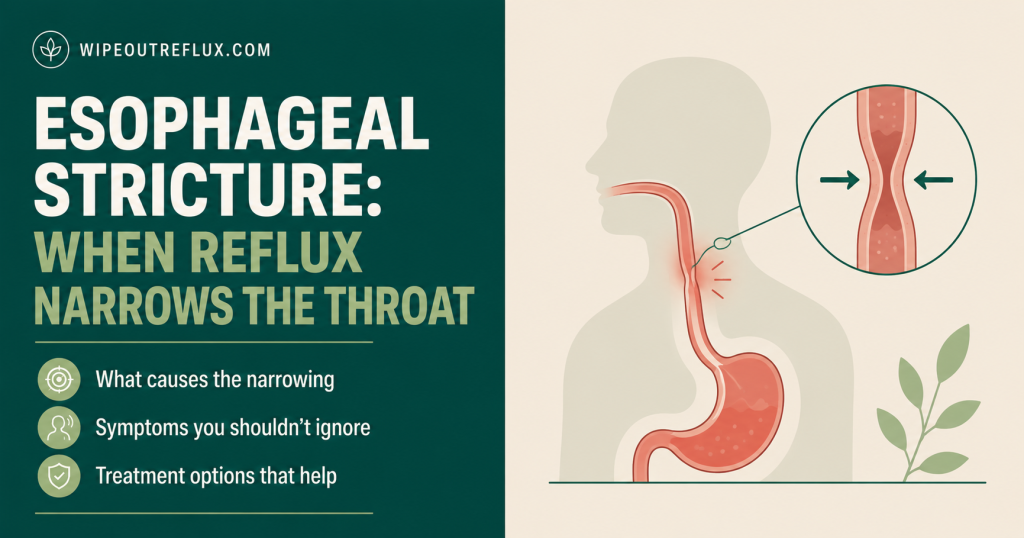
An esophageal stricture is a narrowing of the esophagus — the muscular tube that carries food from your throat to your stomach. When it’s caused by acid reflux, it happens because years of acid burning the lower esophagus leave scar tissue behind, and scar tissue shrinks and tightens, squeezing the passage narrower over time.
The tell-tale symptom is trouble swallowing solids. Food — bread, meat, dry rice — feels like it sticks partway down or won’t go past a certain point in your chest. It usually creeps in gradually, which is exactly why so many people ignore it until a piece of food actually lodges.
Here’s the reassuring part: a peptic (reflux-related) stricture is treatable. It’s stretched open during an endoscopy and kept open by controlling the acid that caused it in the first place. But it’s also a signal you shouldn’t brush off — it means reflux has been doing structural damage, and the swallowing symptom deserves prompt attention. Here’s what’s happening and what to do about it.
Key Takeaways
- An esophageal stricture is an abnormal narrowing of the esophagus; the reflux-caused type is called a peptic stricture.
- It forms when chronic acid exposure inflames the lower esophagus and heals with fibrous scar tissue that tightens the channel.
- Peptic strictures make up the majority of benign esophageal strictures and develop in a meaningful share of people with longstanding reflux esophagitis.
- The classic symptom is slowly progressive difficulty swallowing solid foods — a feeling of food sticking mid-chest.
- Diagnosis is by endoscopy (often with a barium swallow), which also lets doctors rule out cancer as a cause of narrowing.
- Treatment is endoscopic dilation to stretch the stricture open, plus a PPI to suppress acid and stop it re-forming.
- PPIs beat older acid reducers at preventing recurrence — but strictures still come back in a substantial minority within a year, especially if heartburn persists.
- Any new or worsening trouble swallowing needs medical assessment promptly, not self-treatment.
What an esophageal stricture actually is
Your esophagus is normally a soft, stretchy tube a couple of centimetres wide. A stricture is a segment where that tube has narrowed, so food can no longer pass freely. When the cause is acid reflux, it forms right where you’d expect — in the lower esophagus, just above the stomach, where refluxed acid pools and does the most damage.
A quick note on the word “throat.” People — and search engines — often say reflux is “narrowing my throat,” but a peptic stricture is really in the esophagus (the food pipe), below the throat proper. The sensation can feel like it’s in the throat or mid-chest, which is why the language blurs. If your symptoms are genuinely higher up — a lump-in-the-throat feeling without food actually sticking — that’s often something different, which I’ll touch on below.
How reflux narrows the esophagus
This is worth understanding, because it explains both the treatment and why controlling acid afterwards is non-negotiable.
It’s a slow, three-stage process. First, repeated reflux inflames the lining of the lower esophagus — this is erosive esophagitis. Second, if that inflammation carries on for months or years, the healing process lays down fibrous scar tissue deeper in the esophageal wall. Third — and this is the key — scar tissue contracts as it matures. Like a scar tightening across skin, the fibrosis pulls the esophageal walls inward, and the once-wide tube becomes a bottleneck.
Certain factors make this more likely: a weak lower esophageal sphincter that lets more acid through, poor esophageal clearance so acid lingers, and a hiatal hernia. Peptic strictures account for the large majority of benign (non-cancerous) esophageal strictures, and they develop in a notable minority of people with longstanding reflux esophagitis Desai & Aspinall, StatPearls, National Library of Medicine, 2023.
Symptoms: what a stricture feels like
The hallmark is dysphagia — difficulty swallowing — and it has a very characteristic pattern:
- Solids first, gradually. Dry, dense foods like bread, steak or rice are the earliest to stick. Liquids and soft foods still go down fine. This solids-before-liquids pattern is a classic clue to a physical narrowing.
- A sticking point. Food feels like it stops or hangs up at a specific spot in your mid-chest or lower breastbone.
- Slowly progressive. Over months, the range of foods you can comfortably swallow shrinks, and you may start cutting food smaller, chewing longer or avoiding certain textures without quite realising it.
- Food impaction. Sometimes the first dramatic sign is a bolus of food getting genuinely stuck, needing water, regurgitation or occasionally a trip to A&E to clear.
- Reflux history — but not always. Interestingly, heartburn can actually ease as a stricture forms, because the scarred segment partly blocks acid from splashing up. Don’t take reduced heartburn as good news if swallowing is getting harder.
If you want the fuller picture on swallowing trouble and its causes, I go into it in can acid reflux make it hard to swallow. But the short rule: new, progressive difficulty swallowing solids is never something to sit on.
Why swallowing trouble always needs a check
Dysphagia is what doctors call an alarm symptom. The reason is simple and important: reflux isn’t the only thing that narrows an esophagus. A stricture can look, on symptoms alone, much like a tumour, and only a proper look inside can tell them apart.
That’s not meant to frighten you — the great majority of reflux-related strictures are entirely benign. But it is exactly why you shouldn’t try to manage new swallowing difficulty yourself with over-the-counter remedies. Longstanding reflux can also cause Barrett’s oesophagus and, rarely, progress toward esophageal cancer, and evaluating a stricture is partly about ruling those out. Prompt assessment is reassurance as much as treatment.
How a stricture is diagnosed
Two tests do most of the work:
Endoscopy. A thin camera passed down the esophagus lets the doctor see the narrowing directly, measure it, and — crucially — take biopsies to confirm it’s benign scar tissue rather than something that needs different treatment. It’s the cornerstone of diagnosis, and I explain what to expect in endoscopy for acid reflux. Very often the stricture is stretched during the same procedure.
Barium swallow. You drink a chalky contrast liquid and X-rays capture it moving down, outlining the narrowing and showing how tight and how long it is. It’s often used alongside endoscopy, particularly to map a stricture before dilation.
If swallowing is difficult but no physical narrowing is found, doctors may look at how the esophagus is moving rather than its shape — a motility problem rather than a structural one. That’s assessed with esophageal manometry, and it’s a different pathway from a stricture.
Treatment: stretch it, then keep it open
Treatment has two halves, and both matter. Skipping the second is the commonest reason strictures come back.
1. Dilation — opening the narrowing
The stricture is physically widened during endoscopy, either with a balloon that’s inflated inside the narrowed segment or with tapered dilators passed through it. Relief of swallowing can be immediate. Sometimes a tight stricture needs more than one session, spaced out, to reach a comfortable diameter without overstretching.
2. Acid suppression — stopping it re-forming
Dilation opens the channel, but it does nothing about the reflux that scarred it. Without ongoing acid control, the inflammation resumes and the stricture tightens again. This is where proton pump inhibitors (PPIs) come in, and the evidence for them here is strong.
In a large randomised, double-blind trial, patients kept on omeprazole after dilation were significantly less likely to need re-stretching than those on the older acid reducer ranitidine — 30% versus 46% needing redilation by 12 months, and fewer redilations overall Smith et al., Gastroenterology, 1994. That’s why a PPI is standard after a peptic stricture — and why getting the most out of it matters. Timing makes a real difference, as I cover in the best time to take omeprazole.
Will it come back?
Sometimes, yes. Recurrence is a genuine problem for a substantial minority — and the biggest warning sign is telling. In a study of predictors, the persistence of heartburn after dilation, along with a hiatal hernia, significantly predicted early recurrence of peptic strictures Said et al., American Journal of Gastroenterology, 2003. The message is clear: if heartburn is still breaking through after your stricture is treated, your acid control isn’t tight enough yet — and that’s worth raising with your doctor rather than accepting.
Living with and preventing a stricture
Beyond dilation and medication, the day-to-day habits that reduce reflux also protect a treated esophagus:
- Eat to swallow safely. Smaller bites, thorough chewing, and sitting upright while eating all help food pass a narrowed or recently dilated segment.
- Stay on top of acid control. Take your PPI consistently and as directed; sporadic use is a common reason strictures recur.
- Attack reflux at the source. The less acid reaches your lower esophagus, the less scarring pressure there is. That means the familiar levers — not eating close to bedtime, raising the head of the bed, weight if relevant, and above all removing the dietary triggers driving your reflux.
- Report changes early. Returning difficulty swallowing means the stricture may be tightening again — get it looked at rather than waiting for food to stick.
Conclusion
An esophageal stricture is what chronic reflux can build over time: acid inflames the lower esophagus, healing lays down scar tissue, and that scar tightens the food pipe until swallowing solids becomes a struggle. It’s a benign, treatable problem — stretched open with dilation and held open with acid suppression — but it’s also a clear structural marker that reflux has been left to do damage. And because progressive difficulty swallowing can occasionally point to something more serious, it always warrants a prompt look inside rather than guesswork at home.
The part worth sitting with is recurrence. Dilation fixes today’s narrowing; it does nothing to stop tomorrow’s if acid keeps reaching the scar. The research is blunt about it — persistent heartburn after treatment is the strongest predictor that a stricture will come back. A PPI does the heavy lifting on acid, but it caps the damage rather than removing the cause. What actually reduces how much reflux your esophagus faces, day after day, is what and how you eat.
That’s the gap the Wipeout Food Reference Guide is built to close — the essential reference for which foods and drinks are safe with acid reflux and LPR, and their pH values, so you’re removing the triggers that keep acid burning your lower esophagus rather than just medicating the aftermath. And for the full structured approach, the Wipeout Diet Plan goes considerably deeper. It was designed first around LPR — the stubborn, throat-based form of reflux — but because it works on the same underlying mechanisms, it’s just as effective for the classic acid reflux and heartburn that drive stricture formation. Keep your acid controlled with your doctor’s plan, take the pressure off at the source with the diet, and you give a treated esophagus its best chance of staying open.
Frequently Asked Questions
Is an esophageal stricture serious?
A reflux-related (peptic) stricture is benign and very treatable, but it should be taken seriously. It signals that reflux has caused structural damage, and the difficulty-swallowing symptom needs prompt evaluation — partly to treat the narrowing and partly to rule out other causes. Left unchecked, it can worsen to the point where food regularly gets stuck.
Can an esophageal stricture be cured?
It can be effectively treated. Dilation stretches the narrowing open, often with immediate relief, and a PPI helps keep it from re-forming. Whether it stays open long-term depends heavily on controlling the underlying reflux. Some strictures need occasional repeat dilation.
What does a stricture feel like when you swallow?
Typically like solid food — bread, meat, dry rice — sticking or hanging up at a spot in your mid-chest, while liquids still go down easily. It usually develops gradually, so people often adapt by chewing more and eating smaller pieces before they recognise the problem.
Does acid reflux really narrow your throat?
Reflux narrows the esophagus (the food pipe), not the throat itself, though the sticking sensation can feel like it’s in the throat or chest. A true throat sensation without food actually sticking — like a persistent lump — is often a different issue, such as globus from silent reflux, rather than a stricture.
Will a PPI stop my stricture coming back?
PPIs substantially reduce recurrence compared with older acid reducers, but they don’t guarantee it — a meaningful minority of strictures still recur within a year, particularly when heartburn persists or a hiatal hernia is present. Consistent PPI use plus reducing reflux at the source gives the best odds.
How is a stricture different from achalasia or a motility problem?
A stricture is a physical narrowing, so it typically causes trouble with solids first. Motility disorders like achalasia are problems with the esophagus’s movement and often cause trouble with both solids and liquids. They’re distinguished by tests — endoscopy and barium swallow for a stricture, manometry for motility.
Research & References
- Clinical reference on esophageal stricture describing the pathophysiology of peptic stricture — chronic acid exposure leading to inflammation, fibrosis and luminal narrowing — and its epidemiology as the leading cause of benign esophageal strictures Desai & Aspinall, StatPearls, National Library of Medicine, 2023.
- Large randomised, double-blind trial showing omeprazole was more effective than ranitidine at preventing recurrence of benign esophageal stricture after dilation, with fewer patients requiring redilation at 12 months (30% vs 46%) Smith et al., Gastroenterology, 1994.
- Study of predictors of early stricture recurrence finding that, for peptic strictures, persistence of heartburn after dilation and the presence of a hiatal hernia were significant predictors of recurrence within a year Said et al., American Journal of Gastroenterology, 2003.

David Gray
12 years living with LPR · Consultant & researcher
I've lived with LPR for twelve years — the misdiagnoses, the PPI courses that did nothing, the slow work of figuring out what actually helps. Wipeout Reflux is where I translate the research into plain terms for people stuck in the same place. Every claim here is sourced to peer-reviewed work, and I consult one-to-one with LPR sufferers.