
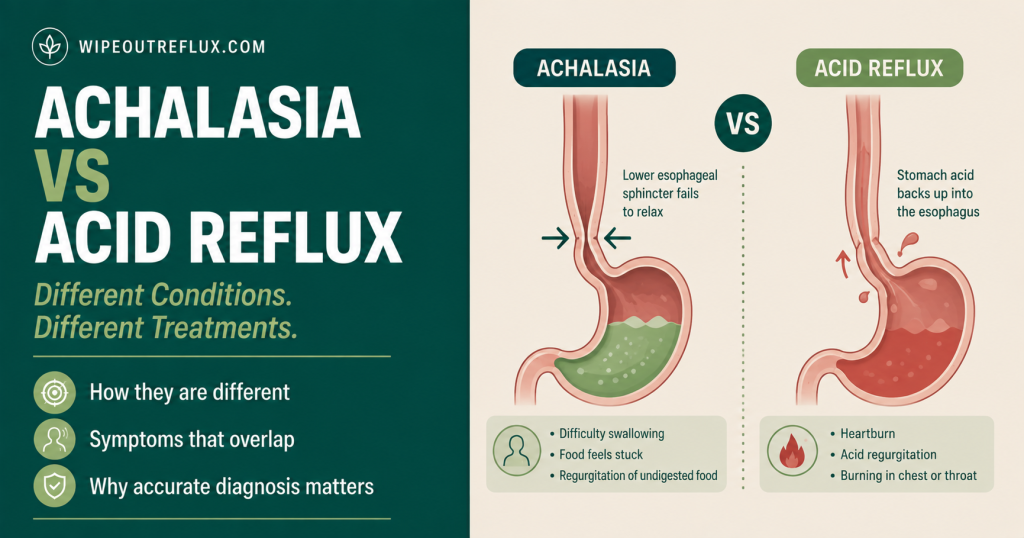
Achalasia and acid reflux can look almost identical from the outside — heartburn, regurgitation, chest discomfort, food coming back up — which is exactly why achalasia is so often mistaken for stubborn GERD. But underneath, they’re opposites. Reflux is a valve that’s too loose, letting stomach contents escape upward. Achalasia is a valve that won’t open, trapping food in the esophagus above it.
That difference is everything, because it changes the treatment completely. Acid-suppressing drugs help reflux; they do almost nothing for achalasia, since there’s no acid problem to suppress. The single most useful clue is right there: if you’ve been told you have acid reflux but PPIs haven’t touched your symptoms, achalasia is one of the conditions worth ruling out.
The test that settles it is esophageal manometry, which measures how your esophagus actually moves. Here’s how to tell the two apart, why the mix-up happens so often, and when to push for the right test.
Key Takeaways
- Acid reflux is a lower esophageal valve that’s too loose; achalasia is a valve that fails to relax and open, plus an esophagus that loses its ability to push food down.
- They share symptoms — heartburn, regurgitation and chest pain all occur in achalasia, which is why it’s frequently misdiagnosed as GERD.
- In one study of untreated achalasia, 59% of patients had heartburn and 77% had regurgitation — classic “reflux” symptoms.
- The biggest red flag is difficulty swallowing both solids and liquids, and reflux symptoms that don’t respond to PPIs.
- Achalasia regurgitation is often undigested, bland food or saliva — not the sour, acidic taste of true reflux.
- Misdiagnosis matters: anti-reflux surgery in an undiagnosed achalasia patient can make things worse.
- High-resolution manometry is the gold-standard test that distinguishes them, supported by endoscopy and barium swallow.
- If “reflux” isn’t improving on treatment, ask whether your swallowing has been properly evaluated.
What each condition actually is
Understanding the mechanism is the whole game here, because the symptoms overlap but the plumbing is reversed.
Acid reflux (GERD) is a problem of a weak or overly relaxed lower esophageal sphincter — the ring of muscle between esophagus and stomach. It opens when it shouldn’t, and acidic stomach contents flow back up into the esophagus, causing heartburn and the familiar sour regurgitation.
Achalasia is nearly the mirror image. The nerves that control the lower esophageal sphincter degenerate, so the valve fails to relax and open when you swallow. On top of that, the muscle of the esophagus body loses its coordinated squeeze (peristalsis), so it can’t push food down effectively. The result is food and liquid backing up above a valve that won’t let them through — a mechanical traffic jam, not an acid problem.
So while reflux is stomach contents coming up too easily, achalasia is swallowed food that can’t get down. That distinction explains every difference that follows.
Why achalasia gets misdiagnosed as reflux
Two things conspire here. First, achalasia is rare and GERD is extremely common, so “reflux” is the natural first guess for a busy clinician. Second — and this is the real trap — achalasia genuinely produces reflux-like symptoms.
When food and saliva stagnate in the esophagus above a closed valve, they ferment and can irritate the lining, producing heartburn, chest pain and regurgitation that feel exactly like GERD. The numbers bear this out: in a study of patients with untreated achalasia, 59.4% reported heartburn and 76.6% reported regurgitation, symptoms so classically “reflux” that the diagnosis is easily missed Jeon et al., Journal of Neurogastroenterology and Motility, 2017.
It goes deeper than symptoms. Achalasia patients can even show heartburn, esophagitis and abnormal acid exposure on testing — features usually taken as proof of GERD — which is precisely why the misdiagnosis is so persistent and why some patients are treated for reflux for years before the truth emerges Kessing et al., Clinical Gastroenterology and Hepatology, 2011. It’s the same reason genuine non-response to acid suppression should always prompt a rethink rather than just a higher dose.
The tells: how to distinguish achalasia from reflux
A handful of clues separate them, and if several ring true for you, it’s worth raising achalasia specifically.
1. PPIs don’t work
This is the loudest signal. Reflux symptoms usually respond, at least partly, to proton pump inhibitors. Achalasia symptoms don’t, because there’s no excess acid to suppress — the problem is mechanical. If you’ve been diagnosed with reflux but your medication simply isn’t working, that’s a reason to look further.
2. Trouble swallowing solids and liquids
Reflux doesn’t usually cause difficulty swallowing on its own, and when a reflux-related narrowing (stricture) does, it typically affects solids first. Achalasia classically causes difficulty swallowing both solids and liquids from fairly early on — because the valve won’t open for anything. That solids-and-liquids pattern is a strong pointer away from simple reflux.
3. The regurgitation tastes different
True reflux regurgitation is sour or acidic — that’s stomach acid. Achalasia regurgitation is often bland, undigested food or foamy saliva that never reached the stomach, sometimes brought up hours after eating or when lying down. If what comes up tastes of the meal rather than of acid, that’s telling. It’s a different phenomenon from the water brash and regurgitation seen in reflux.
4. Slow weight loss
Because eating becomes genuinely difficult, many people with achalasia gradually lose weight, eat more slowly, or develop tricks to force food down (standing, drinking water, throwing back the shoulders). Unintended weight loss is never a typical feature of uncomplicated reflux and should always be investigated.
5. Chest pain and night-time regurgitation
Achalasia can cause chest discomfort and, characteristically, regurgitation of food onto the pillow at night as the full esophagus empties when horizontal. That nocturnal, non-acidic regurgitation is more suggestive of achalasia than of ordinary reflux.
Why getting it right matters so much
This isn’t an academic distinction. Treating achalasia as reflux doesn’t just waste time — it can cause harm.
The clearest danger is surgery. If someone with undiagnosed achalasia is given anti-reflux surgery (fundoplication) for their presumed GERD, the operation tightens the very junction that’s already failing to open — potentially worsening the obstruction. This is exactly why experts insist that esophageal manometry be performed before anti-reflux surgery, to make sure achalasia isn’t hiding underneath the “reflux” label Kessing et al., Clinical Gastroenterology and Hepatology, 2011. Beyond that, untreated achalasia lets the esophagus progressively dilate and can lead to serious complications over time, so years lost to a wrong label genuinely count.
How the two are told apart: the tests
Three tests establish the diagnosis, and they’re often complementary.
High-resolution manometry is the gold standard. A thin catheter measures the pressure and coordination of your esophageal muscles as you swallow, showing directly whether the lower sphincter relaxes and whether the esophagus contracts normally. In achalasia it reveals the signature pattern: a valve that won’t relax and absent normal peristalsis. Manometry is the definitive test for distinguishing achalasia from reflux and other motility disorders Vaezi et al., ACG Clinical Guidelines, American Journal of Gastroenterology, 2020. If you want the full walk-through of what it involves, that’s exactly what my esophageal manometry guide covers — and it’s the single test most worth asking about if achalasia is on the table.
Endoscopy looks inside to rule out other causes of a stuck-feeling esophagus (including tumours and strictures) and may show retained food above a tight valve. It’s the same procedure used to assess reflux, explained in endoscopy for acid reflux.
Barium swallow captures X-ray images as you drink contrast, and in achalasia produces a classic picture — a dilated esophagus tapering to a narrow “bird’s beak” at the closed valve.
Achalasia also sits within a family of esophageal motility problems, and manometry is what separates it from cousins like esophageal spasm too.
Conclusion
Achalasia and acid reflux feel alike on the surface — the heartburn, the regurgitation, the chest discomfort overlap enough that achalasia is routinely filed under “GERD” for years. But they’re mechanical opposites: reflux is a valve too loose to stay shut, achalasia a valve too stiff to open. The clues that give it away are consistent — reflux symptoms that don’t respond to PPIs, difficulty swallowing liquids as well as solids, bland rather than sour regurgitation, and unexplained weight loss. Any of those, especially in combination, is a reason to ask whether your swallowing has actually been measured, not just assumed.
The stakes are real. Mislabelling achalasia as reflux doesn’t only delay the right treatment; it risks the wrong one, since anti-reflux surgery can worsen a valve that already won’t open. That’s why manometry — the test that reads how your esophagus truly moves — is the one to push for when the reflux story doesn’t add up.
If you’re reading this because genuine, PPI-resistant reflux is your problem rather than achalasia, the same principle applies from the other side: chasing acid alone often isn’t the answer. The Wipeout Food Reference Guide is the essential reference for which foods and drinks are safe with acid reflux and LPR, and their pH values, so you can tackle real reflux at its source. And the Wipeout Diet Plan goes further still — it was designed first around LPR, the stubborn throat-based form of reflux, but because it works on the same underlying mechanisms it’s just as effective for classic GERD and heartburn. Just make sure you’re treating the condition you actually have: if swallowing is the problem and acid drugs aren’t helping, get the manometry first.
Frequently Asked Questions
Can achalasia be mistaken for acid reflux?
Yes, very commonly. Achalasia produces heartburn, regurgitation and chest pain that closely mimic GERD, and because reflux is far more common it’s often the first diagnosis. Many patients are treated for reflux for years before achalasia is identified, usually when acid-suppressing treatment fails to help.
How do I know if it’s achalasia and not reflux?
The strongest clues are reflux symptoms that don’t improve with PPIs, difficulty swallowing both solids and liquids, regurgitation of bland undigested food rather than sour acid, and unexplained weight loss. Only esophageal manometry can confirm it, so if these fit, ask about that test.
Why don’t reflux medications work for achalasia?
Because achalasia isn’t an acid problem. PPIs reduce stomach acid, but achalasia symptoms come from a valve that won’t open and an esophagus that can’t push food down — a mechanical obstruction. Suppressing acid does little for that, which is why non-response is such a useful warning sign.
What test diagnoses achalasia?
High-resolution esophageal manometry is the gold standard. It measures whether your lower esophageal sphincter relaxes and whether the esophagus contracts in a coordinated way. Endoscopy and a barium swallow support the diagnosis and rule out other causes, but manometry is definitive.
Is achalasia dangerous if treated as reflux?
It can be. Delay lets the esophagus progressively dilate, and critically, anti-reflux surgery performed on an undiagnosed achalasia patient can worsen the obstruction by tightening a junction that already won’t open. This is why manometry is recommended before any anti-reflux operation.
Can you have both achalasia and acid reflux?
The picture can be muddled — achalasia patients may show acid exposure and esophagitis from fermenting retained food, which looks like reflux on testing. True simultaneous GERD is less common because the tight valve limits actual acid reflux. Sorting it out reliably requires manometry rather than symptoms alone.
Research & References
- Study of clinical characteristics in untreated achalasia reporting that 59.4% of patients had heartburn and 76.6% had regurgitation, symptoms easily misinterpreted as gastroesophageal reflux and contributing to diagnostic delay Jeon et al., Journal of Neurogastroenterology and Motility, 2017.
- Analysis showing that typical GERD features — heartburn, retrosternal pain, esophagitis and pathologic acid exposure — can occur in achalasia, causing erroneous GERD diagnoses, and recommending esophageal manometry before anti-reflux surgery Kessing et al., Clinical Gastroenterology and Hepatology, 2011.
- American College of Gastroenterology clinical guidelines establishing high-resolution manometry as the gold-standard test for diagnosing achalasia, complemented by endoscopy and barium esophagram Vaezi et al., American Journal of Gastroenterology, 2020.

David Gray
12 years living with LPR · Consultant & researcher
I've lived with LPR for twelve years — the misdiagnoses, the PPI courses that did nothing, the slow work of figuring out what actually helps. Wipeout Reflux is where I translate the research into plain terms for people stuck in the same place. Every claim here is sourced to peer-reviewed work, and I consult one-to-one with LPR sufferers.