
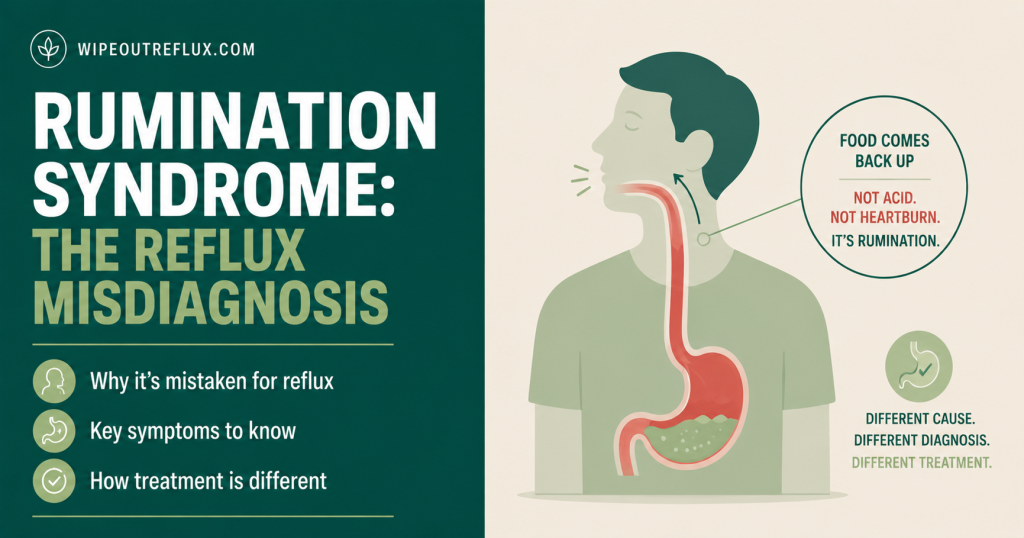
Rumination syndrome is a condition where food comes back up into your mouth effortlessly within minutes of eating — not vomited, not forced, just quietly rising back up to be re-chewed, re-swallowed or spat out. It feels like reflux or regurgitation, so that’s almost always what it gets called first. But it isn’t reflux at all, and that mislabelling is why so many people spend years on acid medication that was never going to work.
The reason it slips past so often is that it hides in plain sight. There’s no acid burn, no retching, no nausea beforehand — the food simply appears in the mouth, tasting bland and undigested rather than sour. Doctors reasonably reach for the common answer (GERD), tests come back unremarkable, and the real cause — an unconscious, learned contraction of the abdominal muscles — goes unrecognised.
Here’s what rumination syndrome actually is, how to tell it apart from genuine reflux, and why the treatment is a breathing technique rather than a pill.
Key Takeaways
- Rumination syndrome is the effortless return of recently eaten food into the mouth, usually within minutes of a meal, without nausea or retching.
- It’s caused by an unconscious contraction of the abdominal wall that raises pressure in the stomach and pushes food back up — a learned habit, not an acid problem.
- It’s routinely misdiagnosed as reflux (GERD) or a vomiting disorder, leading to long delays and unnecessary tests.
- It’s more common than assumed — worldwide prevalence is around 1% of people by strict diagnostic criteria.
- The regurgitated food is bland and undigested, not sour or acidic, and episodes stop once the food turns acidic in the stomach.
- Acid-suppressing drugs and anti-reflux surgery don’t fix it, because the mechanism isn’t reflux.
- Diagnosis is clinical, based on Rome IV criteria and the classic history — often no invasive testing is needed.
- First-line treatment is postprandial diaphragmatic breathing, which retrains the reflex and is highly effective.
What rumination syndrome actually is
Rumination syndrome is classed as a functional gastrointestinal disorder — meaning the gut structure is normal, but its function has gone awry. The defining feature is effortless regurgitation: within minutes of eating, recently swallowed food travels back up into the mouth, where it’s either re-chewed and swallowed again, or spat out.
The word “effortless” is doing a lot of work. This isn’t vomiting. There’s no wave of nausea, no heaving, no retching, no unpleasant build-up beforehand. The food just rises — often described as food “coming up on its own.” And because it hasn’t been in the stomach long, it still tastes like the meal: recognisable, bland, not the acrid sourness of true reflux.
Far from being obscure, it’s reasonably common. A systematic review and meta-analysis put the worldwide prevalence of rumination syndrome at around 1% of people under strict Rome IV criteria — roughly one in a hundred — and found it’s actually more common in adults than children, and associated with anxiety and depression Haworth et al., Neurogastroenterology & Motility, 2024. It’s not that it’s rare — it’s that it’s rarely recognised.
The mechanism: it’s pressure, not acid
This is the part that makes everything else make sense. Rumination isn’t your stomach’s acid escaping — it’s your own abdominal muscles squeezing food back up without you realising.
After a meal, people with rumination syndrome unconsciously contract the muscles of the abdominal wall. That contraction raises the pressure inside the stomach sharply, and when that pressure overcomes the lower esophageal sphincter, the recently eaten food is pushed back up into the esophagus and mouth. It’s a reflex the body has learned — entirely involuntary and unperceived, but a behaviour nonetheless, not a disease of the stomach lining. On specialised testing, these episodes show up as sudden spikes in gastric pressure that coincide with the regurgitation Halland et al., Clinical Gastroenterology and Hepatology, 2018.
Contrast that with reflux, where a weak valve lets acidic stomach contents leak upward on their own. In rumination, the valve is fine — it’s being overpowered from below by a pressure surge. Different cause, different fix. This is also why rumination is fundamentally unlike the water brash and regurgitation that genuine reflux produces.
Why it gets misdiagnosed as reflux
On the surface, “food keeps coming back up” sounds exactly like reflux, and GERD is common while rumination is under-recognised — so reflux is the default guess. Rumination syndrome is frequently misdiagnosed as refractory reflux or a vomiting disorder, which delays proper care and sends patients through rounds of avoidable testing Halland et al., Clinical Gastroenterology and Hepatology, 2018.
The trap tightens because the standard reflux work-up doesn’t rule rumination out. An endoscopy looks normal. Acid tests may be unremarkable. So the patient is told their reflux is “mild” or “functional,” prescribed a stronger PPI, and sent away — and when that medication doesn’t work, the cycle simply repeats. The clue everyone misses is that acid drugs were never going to help a pressure-driven, non-acidic problem, the same way they underperform when the diagnosis isn’t really acid.
How to tell rumination from reflux
A few features separate them cleanly. If most of these describe you, rumination syndrome is worth raising by name with your doctor.
- Timing. Rumination happens within minutes of eating, and typically stops once the meal has been in the stomach long enough to turn acidic (often within an hour). Reflux can strike at any time, including on an empty stomach or overnight.
- Effort. Rumination is effortless and painless — no nausea, no retching, no heaving. Vomiting and even reflux regurgitation usually involve some discomfort or urge; rumination doesn’t.
- Taste. Ruminated food is bland and recognisable — it tastes like what you ate. Reflux regurgitation is sour or bitter from stomach acid.
- What happens next. People with rumination often re-chew and re-swallow the food, or discreetly spit it out. That re-chewing behaviour is highly characteristic and essentially never happens with reflux.
- Triggers. Rumination isn’t strongly tied to the “trigger foods” or lying-down positions that provoke reflux. It follows meals fairly indiscriminately.
There’s often an emotional dimension too. Rumination is linked with stress, anxiety and low mood, and can begin after a period of upheaval — a thread it shares with how stress influences digestive symptoms more broadly, and worth mentioning if it fits your story.
How rumination syndrome is diagnosed
Here’s the good news: in most cases it doesn’t need invasive testing at all. The diagnosis is clinical — based on the pattern of symptoms against the established Rome IV criteria, which centre on repeated, effortless regurgitation of recently eaten food that’s re-chewed or spat out, without nausea preceding it. A careful history is often enough to make the call.
Where confirmation is needed — usually in stubborn or unclear cases — high-resolution esophageal manometry with impedance, done after a test meal, can capture the tell-tale gastric-pressure spikes driving each episode. It’s the same technology used to sort out other confusing swallowing and motility pictures, and it can be diagnostic here. But the headline is that recognising the story is what unlocks the diagnosis; the testing mostly confirms what the history already suggests.
Treatment: retraining the reflex
Because rumination is a learned, unconscious behaviour rather than an acid or structural problem, the treatment is behavioural — and it works remarkably well.
The first-line therapy is postprandial diaphragmatic breathing: slow, deliberate belly-breathing after meals. It works by a beautifully direct mechanism — when the diaphragm is gently engaged and the abdomen relaxed in a controlled way, it becomes physically incompatible with the abdominal-wall contraction that squeezes food back up. In effect, you retrain the reflex out. In a randomised controlled trial, diaphragmatic breathing significantly reduced regurgitation episodes in rumination syndrome, confirming both its efficacy and how it works Halland et al., Neurogastroenterology & Motility, 2016.
The technique is simple to learn: place one hand on your chest and one on your belly, and breathe so that only the belly hand moves — slow breaths in through the nose, letting the abdomen rise, chest still. Practising it during and after meals is where the benefit comes. If you’ve explored breathing exercises for reflux, the mechanics are familiar, though here it’s aimed squarely at the rumination reflex. Where anxiety is a strong driver, biofeedback or psychological support alongside the breathing can help. What generally doesn’t help is escalating acid suppression or resorting to anti-reflux surgery — because there’s no reflux to fix.
Conclusion
Rumination syndrome is one of the great mimics of acid reflux — food returning to the mouth after meals, so easily labelled GERD that many people carry the wrong diagnosis for years. But it’s a different beast entirely: not acid escaping a weak valve, but an unconscious squeeze of the abdominal muscles pushing recently eaten food back up. The signs that give it away are consistent — effortless, painless regurgitation within minutes of eating, bland undigested food rather than sour acid, re-chewing, and a complete lack of response to acid medication. Spotting that pattern is what ends the diagnostic wandering, because the condition is diagnosed on the story more than on any scan.
And once it’s recognised, it’s genuinely treatable — not with stronger pills or surgery, but by retraining the reflex through diaphragmatic breathing, which the evidence shows works. If that’s your picture, the single most useful step is to raise rumination syndrome by name with your doctor and ask whether your symptoms fit the Rome IV criteria.
If, on the other hand, you’ve landed here and it turns out your regurgitation really is acidic, reflux-driven — sour, tied to trigger foods and worse lying down — then the task is different: tackling the reflux at its source. The Wipeout Food Reference Guide is the essential reference for which foods and drinks are safe with acid reflux and LPR, and their pH values, so you can strip out the triggers. And the Wipeout Diet Plan goes deeper still — built first around LPR, the stubborn throat-based form of reflux, but just as effective for classic GERD because it targets the same underlying mechanisms. The key, as with rumination, is making sure you’re treating the condition you actually have.
Frequently Asked Questions
How is rumination syndrome different from acid reflux?
Reflux is acidic stomach contents leaking up through a weak valve, often with a sour taste and heartburn. Rumination is recently eaten, bland food pushed back up by an unconscious abdominal-muscle contraction, without nausea or acid taste, usually within minutes of eating. Reflux responds to acid medication; rumination doesn’t, because it isn’t an acid problem.
Is rumination syndrome the same as vomiting?
No. Vomiting is forceful and preceded by nausea and retching. Rumination is effortless and painless — the food simply rises into the mouth with no warning or discomfort, and is often re-chewed and swallowed again or spat out.
Why don’t reflux medications help rumination syndrome?
Because the mechanism isn’t acid. PPIs reduce stomach acid, but rumination is driven by a pressure surge from abdominal-muscle contraction that overpowers the valve. Suppressing acid doesn’t change that pressure, which is why symptoms persist despite treatment — and why non-response is a clue to the real diagnosis.
How is rumination syndrome diagnosed?
Primarily clinically, using the Rome IV criteria and the characteristic history of effortless, repeated regurgitation of recently eaten food. Invasive testing usually isn’t required, though high-resolution esophageal manometry with impedance after a meal can confirm it in unclear cases by capturing the gastric-pressure spikes.
Can rumination syndrome be cured?
It responds very well to treatment. Postprandial diaphragmatic breathing is the first-line therapy and is effective at reducing or stopping episodes by retraining the reflex. Where anxiety contributes, psychological support and biofeedback can help further. Most people improve significantly once it’s correctly identified.
Is rumination syndrome caused by stress or anxiety?
Stress and anxiety are strongly associated with it and can play a role in triggering or maintaining the behaviour, though the immediate mechanism is the physical abdominal-muscle contraction. Addressing psychological factors alongside diaphragmatic breathing often improves results.
Research & References
- Systematic review and meta-analysis estimating the worldwide prevalence of rumination syndrome at around 1% under Rome IV criteria, and finding it more common in adults than children and associated with anxiety and depression Haworth et al., Neurogastroenterology & Motility, 2024.
- Review of the diagnosis and treatment of rumination syndrome, describing its mechanism (postprandial abdominal-wall contraction raising gastric pressure), its frequent misdiagnosis as refractory reflux or a vomiting disorder, and diaphragmatic breathing as first-line therapy Halland et al., Clinical Gastroenterology and Hepatology, 2018.
- Randomised controlled trial demonstrating that postprandial diaphragmatic breathing significantly reduced regurgitation episodes in rumination syndrome, and clarifying its mechanism of action Halland et al., Neurogastroenterology & Motility, 2016.

David Gray
12 years living with LPR · Consultant & researcher
I've lived with LPR for twelve years — the misdiagnoses, the PPI courses that did nothing, the slow work of figuring out what actually helps. Wipeout Reflux is where I translate the research into plain terms for people stuck in the same place. Every claim here is sourced to peer-reviewed work, and I consult one-to-one with LPR sufferers.