
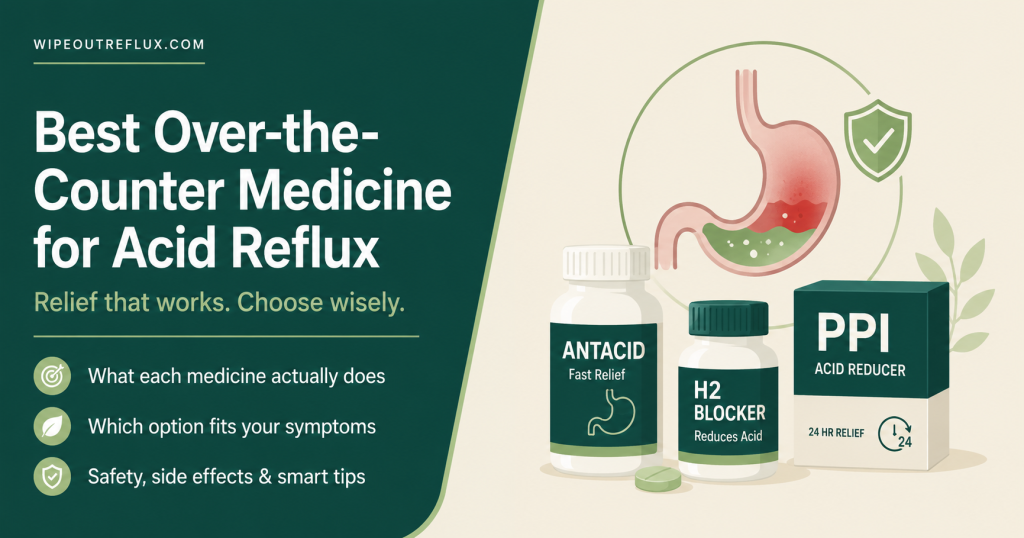
There isn’t one “best” over-the-counter medicine for acid reflux — there’s a best one for your pattern of symptoms. The four OTC options work in completely different ways, and picking the right one comes down to how often you get symptoms and what they feel like.
Here’s the short version. For an occasional flare you want gone in the next minute, an antacid like Tums is your fastest option. For reflux you can feel rising into your chest or throat, an alginate like Gaviscon physically blocks it in a way antacids can’t. For predictable or night-time heartburn, an H2 blocker like famotidine (Pepcid) works slower but lasts many hours. And if you’re getting heartburn two or more days a week, a 14-day course of an OTC proton pump inhibitor (omeprazole or esomeprazole) is the most effective choice by a clear margin.
Below I’ll break down exactly how each one works, who it suits, and how to match the medicine to your symptoms — because reaching for the wrong type is the single most common reason people think “nothing works.”
Key Takeaways
- There are four OTC drug classes for reflux: antacids, alginates, H2 blockers, and proton pump inhibitors (PPIs). Each solves a different problem.
- Antacids (Tums, Rolaids) neutralise acid on contact — fastest relief, but they wear off in about an hour and don’t prevent the next flare.
- Alginates (Gaviscon) form a floating raft that physically blocks reflux, making them the standout choice for regurgitation and throat symptoms.
- H2 blockers (famotidine/Pepcid) reduce acid production — slower onset (around 90 minutes) but hours of cover, good for predictable or night-time reflux.
- PPIs (omeprazole, esomeprazole) are the most effective for frequent heartburn and are the only class both indicated and proven for symptoms two or more days a week.
- PPIs are meant as a 14-day course, not a “take one when it hurts” tablet — and stopping abruptly can cause a temporary acid rebound.
- None of these fix the cause. They’re rescues and short-term controllers, not cures.
- If you mainly have throat symptoms — hoarseness, throat clearing, a lump sensation — the picture changes, because acid-neutralising isn’t the whole story with silent reflux.
The four types of OTC reflux medicine (and what each actually does)
Almost every heartburn product on the shelf falls into one of four categories. They get lumped together as “reflux tablets,” but they don’t do the same job, and that’s the crux of choosing well. A large review of OTC heartburn treatment lays out the core distinction cleanly: antacids and H2 blockers have real limitations for frequent heartburn, while PPIs are the class built to control it McRorie et al., Journal of the American Association of Nurse Practitioners, 2014.
The useful way to think about it: antacids and alginates act on acid already in your stomach right now, so they work in minutes but fade fast. H2 blockers and PPIs reduce how much acid your stomach makes, so they take longer to kick in but cover far more time. Match that timing to your symptoms and you’ve basically solved the “which one” question.
Antacids (Tums, Rolaids): fastest relief for the occasional flare
Antacids are usually calcium carbonate or a magnesium/aluminium mix. When the tablet meets stomach acid, it neutralises it on contact and raises the pH of whatever’s already there. It’s a chemical buffer, and it’s quick — in a randomised trial, an OTC calcium carbonate antacid buffered acid almost immediately after a meal Feldman, Journal of the American Medical Association, 1996.
The trade-off is that it doesn’t last. Your stomach keeps making acid once the tablet is spent, so relief runs out in roughly an hour, and antacids don’t stop the next episode from happening McRorie et al., Journal of the American Association of Nurse Practitioners, 2014.
Best for: the odd bout of heartburn after a heavy meal, when you want relief right now and won’t need it again for a while. If you’re reaching for them most days, that’s a sign you’ve outgrown antacids and need something that prevents flares rather than just mopping them up. One quick note: baking soda works on the same buffering principle but comes with a big sodium load, so I’d treat it as an emergency-only option — I go into why in my guide to baking soda for heartburn.
Alginates (Gaviscon): the best pick for reflux you can feel rising
Alginates are the underrated hero here, and they’re often mislabelled as “just another antacid.” An alginate (from brown seaweed) reacts with stomach acid to form a gel, and bicarbonate in the formula releases gas that makes the gel float — creating a low-density raft that sits on top of your stomach contents.
That raft does something buffers can’t: it physically covers the acid pocket, a layer of unbuffered acid that pools at the top of the stomach after meals, right where reflux draws from. Using imaging, an alginate raft was shown to co-localise with that acid pocket and push it back below the diaphragm, significantly reducing reflux episodes Rohof et al., Clinical Gastroenterology and Hepatology, 2013. And the class holds up in the evidence: a meta-analysis of 14 randomised trials found alginates markedly increased the odds of reflux symptom resolution compared with placebo or antacids Leiman et al., Diseases of the Esophagus, 2017.
Because a raft targets the volume and reach of reflux rather than just its acidity, alginates are my go-to recommendation for anyone whose main complaint is regurgitation, a sour taste coming up, or throat-based symptoms. One catch worth knowing: US Gaviscon is formulated mostly as an antacid with a little alginate, while UK Gaviscon Advance packs about ten times the alginate and has the strongest evidence for throat reflux. I cover the whole class in more depth in my guide to alginates for acid reflux.
H2 blockers (famotidine/Pepcid): steady cover for predictable reflux
H2 blockers like famotidine reduce the amount of acid your stomach produces by blocking histamine’s signal to the acid-producing cells. They don’t work on contact the way an antacid does — onset is slower, around 90 minutes — but the payoff is duration: a single dose can quieten acid for several hours Feldman, Journal of the American Medical Association, 1996.
That timing profile makes famotidine genuinely useful for reflux you can anticipate. Take it ahead of a meal you know will trigger you, or before bed if night-time symptoms are your problem, and it’s working when you need it. There is one limitation worth knowing: H2 blockers tend to lose some punch with daily continuous use as your body develops tolerance, so they suit intermittent or predictable use better than round-the-clock control McRorie et al., Journal of the American Association of Nurse Practitioners, 2014.
Best for: predictable triggers and night-time reflux, or as a step up from antacids when a flare tends to outlast a single chewable. If you’re weighing famotidine against a PPI, I compare them directly in famotidine vs omeprazole.
PPIs (omeprazole, esomeprazole): the most effective option for frequent heartburn
Proton pump inhibitors shut down acid production at the source — the “pumps” in the stomach lining — and they do it far more completely and durably than H2 blockers. For frequent heartburn, they’re simply the most effective OTC class: the same major review concluded PPIs are superior to both antacids and H2 blockers for controlling acid and treating frequent heartburn, and are the only OTC class actually indicated for it McRorie et al., Journal of the American Association of Nurse Practitioners, 2014.
Here’s the part people miss: an OTC PPI is designed as a 14-day course taken once daily, not a tablet you pop when it hurts. In two randomised placebo-controlled trials, a 14-day regimen of esomeprazole 20 mg resolved frequent heartburn and kept symptoms controlled even in the week after the course ended Peura et al., BMC Gastroenterology, 2018. Omeprazole (Prilosec OTC) works the same way. Take it in the morning, about 30–60 minutes before your first meal — timing genuinely matters, which I explain in the best time to take omeprazole.
Two honest caveats. First, PPIs are slow starters — they build effect over a few days, so they’re for control, not rescue. Second, stopping abruptly after a longer stretch can trigger a temporary surge of acid known as rebound, which I unpack in getting off PPIs and acid rebound. Used as directed for a couple of weeks, they’re the strongest tool on the shelf; used indefinitely without a plan, they come with their own side effects to keep an eye on.
How to choose: match the medicine to your symptoms
Forget “strongest” — think “right for the pattern.” Here’s how I’d map it out:
- Occasional heartburn, want it gone now: antacid (Tums, Rolaids).
- Reflux you feel rising, regurgitation, sour taste, throat symptoms: alginate (Gaviscon, ideally Gaviscon Advance).
- Predictable triggers or night-time reflux: H2 blocker (famotidine/Pepcid), dosed ahead of the trigger.
- Heartburn two or more days a week: a 14-day course of an OTC PPI (omeprazole or esomeprazole).
You can also combine sensibly. It’s common and reasonable to run a 14-day PPI course for underlying control while keeping an antacid or alginate on hand for breakthrough flares in the first few days before the PPI ramps up. What’s not a great long-term plan is taking antacids ten times a day for months — that’s a symptom pattern that deserves a proper controller and, often, a look at diet and habits.
When OTC medicine isn’t the answer
Medication is only ever half the story, and there are situations where reaching for a stronger tablet is the wrong move. If your symptoms are mainly in your throat — hoarseness, chronic throat clearing, a lump sensation, post-nasal drip — you may be dealing with LPR (silent reflux) rather than classic heartburn, and acid suppression alone often underwhelms there. It’s a different beast, and I explain the split in GERD vs LPR and why PPIs often don’t work for LPR.
You should also stop self-treating and see a doctor if OTC medicine isn’t cutting it after a couple of weeks, or if you have any red-flag symptoms — difficulty swallowing, unintended weight loss, vomiting, black stools, or chest pain you’re unsure about. If your reflux medication isn’t working, that’s information, not failure, and it usually means the plan needs adjusting rather than just escalating the dose. Here’s my fuller take on when to see a doctor.
Conclusion
So, the best OTC medicine for acid reflux isn’t a single product — it’s the one that fits your pattern. Antacids win on speed for the occasional flare. Alginates like Gaviscon are the smartest pick when reflux is rising into your chest or throat. Famotidine gives you hours of cover for predictable or night-time symptoms. And for genuinely frequent heartburn, a 14-day OTC PPI is the most effective tool on the shelf. Get the match right and you’ll stop feeling like nothing helps.
But I want to be straight with you about what these medicines can and can’t do: every one of them manages symptoms, and none of them fixes why you’re refluxing in the first place. That’s the part that actually changes your life — and it’s mostly driven by what and how you eat. The quickest place to start is my Wipeout Food Reference Guide, the essential reference for which foods and drinks are safe for acid reflux and LPR, complete with their pH values, so you can stop guessing at triggers. When you’re ready to go deeper, the Wipeout Diet Plan is the full, in-depth system — I built it first and foremost around LPR, the stubborn throat-based kind, but because it works on the same underlying reflux mechanisms, it’s just as effective for GERD, heartburn and everyday acid reflux.
Think of the medicine as buying yourself relief while the real fix — calming the root cause — does its work. That combination is what finally gets people off the daily-tablet treadmill for good.
Frequently Asked Questions
What is the strongest OTC medicine for acid reflux?
For frequent heartburn, OTC proton pump inhibitors (omeprazole/Prilosec OTC and esomeprazole/Nexium 24HR) provide the most complete acid control and are the only class both indicated and proven for symptoms occurring two or more days a week McRorie et al., Journal of the American Association of Nurse Practitioners, 2014. “Strongest,” though, isn’t always “best” — for the odd flare, a fast antacid is the more sensible choice.
What works fastest for heartburn?
Antacids. Calcium carbonate neutralises acid within seconds to minutes, faster than any other OTC option. The catch is duration — relief typically fades within about an hour, so antacids are for putting out a fire, not preventing one.
Can I take an antacid and a PPI together?
Yes, and it’s a common approach. A PPI takes a few days to reach full effect, so keeping an antacid or alginate on hand for breakthrough symptoms during that ramp-up period is perfectly reasonable. Just don’t rely on antacids as your only strategy long-term if you’re getting heartburn several days a week.
Is it better to take famotidine or omeprazole?
It depends on how often you get symptoms. Famotidine (an H2 blocker) is great for predictable or night-time flares because it works for hours and can be dosed ahead of a trigger. Omeprazole (a PPI) is more effective for frequent, ongoing heartburn. I compare them head to head in famotidine vs omeprazole.
Why does my reflux medicine stop working?
A few reasons. H2 blockers can lose effectiveness with daily continuous use as tolerance develops. You may also be using the wrong class for your symptoms — antacids for what is really frequent heartburn, or acid suppressors for throat-based silent reflux, which responds differently. If nothing seems to help, it’s worth reading why acid reflux medication stops working and speaking to a doctor.
Research & References
- A large review of OTC heartburn treatment found PPIs are superior to antacids and H2 blockers for acid control and frequent heartburn, that antacids only transiently neutralise acid without preventing further episodes, and that H2 blockers develop tolerance with repeated dosing McRorie et al., Journal of the American Association of Nurse Practitioners, 2014.
- A randomised controlled trial comparing OTC famotidine with a calcium carbonate antacid showed the antacid buffered postprandial acid almost immediately, while famotidine had a slower onset but a longer duration of effect Feldman, Journal of the American Medical Association, 1996.
- Two randomised, placebo-controlled trials found a 14-day once-daily course of over-the-counter esomeprazole 20 mg resolved frequent heartburn and sustained symptom control into the week after treatment ended Peura et al., BMC Gastroenterology, 2018.
- A systematic review and meta-analysis of 14 randomised trials found alginate therapies significantly increased the odds of reflux symptom resolution compared with placebo or antacids Leiman et al., Diseases of the Esophagus, 2017.
- Imaging showed an alginate raft co-localises with the postprandial acid pocket and displaces it below the diaphragm, significantly reducing reflux episodes compared with an antacid alone Rohof et al., Clinical Gastroenterology and Hepatology, 2013.

David Gray
12 years living with LPR · Consultant & researcher
I've lived with LPR for twelve years — the misdiagnoses, the PPI courses that did nothing, the slow work of figuring out what actually helps. Wipeout Reflux is where I translate the research into plain terms for people stuck in the same place. Every claim here is sourced to peer-reviewed work, and I consult one-to-one with LPR sufferers.