
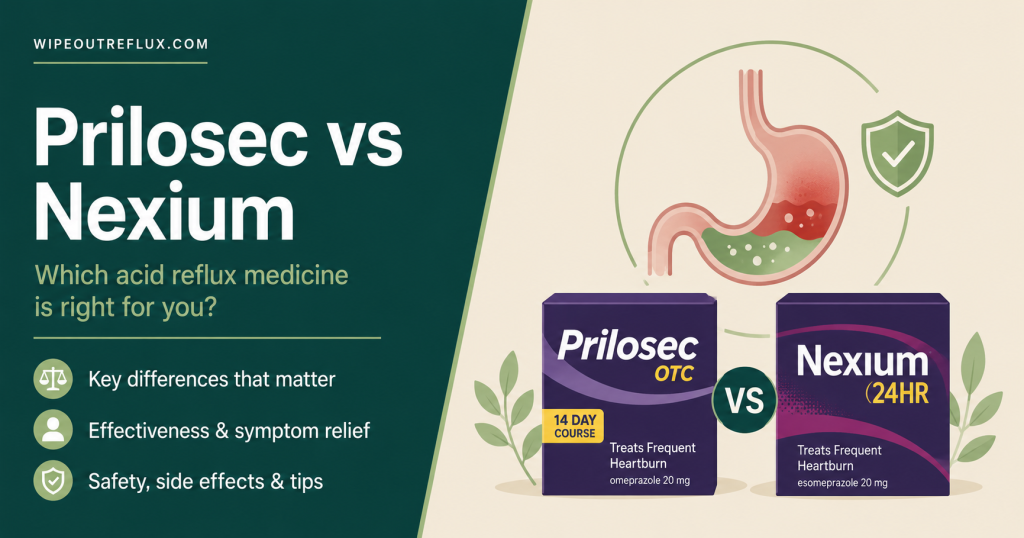
Prilosec and Nexium are far more alike than the marketing ever let on. Nexium (esomeprazole) is literally one half of Prilosec (omeprazole) — the same molecule, purified down to its more active mirror-image form. Both are proton pump inhibitors, both switch off acid production at the source, and both are now sold over the counter at the same 20 mg once-daily dose.
So which is better? At prescription strength, Nexium has a small, real edge for healing severe erosive esophagitis — but that edge came largely from testing Nexium at 40 mg against Prilosec at 20 mg. Over the counter, where both are 20 mg, the practical difference shrinks to almost nothing. For most people choosing between the two OTC boxes, cost and how your own body responds matter more than the name on the front.
Here’s the full picture — how they’re related, what the head-to-head trials actually showed, and how to pick between them without overpaying for a difference you may never feel.
Key Takeaways
- Nexium (esomeprazole) is the S-isomer of Prilosec (omeprazole) — the same drug family, isolated to its more active form.
- Both are PPIs that shut down acid production at the source, and both are the most effective OTC class for frequent heartburn.
- Prescription trials gave Nexium a modest edge, but those studies compared Nexium 40 mg against Prilosec 20 mg — an unequal, higher dose of Nexium.
- Over the counter, both are 20 mg once daily, so the real-world difference between the two boxes is small.
- A meta-analysis found esomeprazole’s advantage is negligible in mild reflux and only meaningful in more severe erosive disease.
- Both are designed as a 14-day course taken once daily before breakfast — not a tablet you take only when it hurts.
- Choose on price, individual response, and tolerability; there’s no strong reason to pay a premium for most people.
- Neither one fixes the cause of reflux — they control acid while it’s in your system, nothing more.
Prilosec and Nexium are the same drug family
This is the part that reframes the whole comparison. Omeprazole — the active ingredient in Prilosec — is what chemists call a racemic mixture: it contains two mirror-image versions of the same molecule, an “R” form and an “S” form. Esomeprazole, the active ingredient in Nexium, is simply the S-isomer isolated on its own. That’s it. Nexium is purified Prilosec.
The theory behind splitting it out is that the S-isomer is metabolised a little more predictably by the liver, so more of the drug stays in your system to do its job, giving slightly higher and more consistent acid suppression Richter et al., American Journal of Gastroenterology, 2001. It’s a real pharmacological difference — but as you’ll see, “real” and “big enough to feel” are two different things.
Both drugs work identically in principle: they block the stomach’s acid pumps, take a few days to reach full effect, and control acid rather than neutralise it on contact. If you want the mechanics of how a PPI actually works and how long it takes to kick in, I cover that in how long omeprazole takes to work.
What the head-to-head trials actually showed
Nexium’s reputation as the stronger pill comes from real studies — but the fine print matters. In a large 8-week randomised trial in patients with erosive esophagitis, esomeprazole 40 mg healed significantly more patients than omeprazole 20 mg by week 8 (93.7% versus 84.2%) Richter et al., American Journal of Gastroenterology, 2001. That’s the trial that built the “purple pill” brand.
Notice the doses: 40 mg of Nexium against 20 mg of Prilosec. You’d expect a double dose to win. The more honest question is what happens at equal doses — and that’s where the edge narrows sharply.
A meta-analysis pooling the randomised evidence found esomeprazole did give a statistically significant improvement in healing and symptom relief over other PPIs, but the clinical benefit was modest overall. Crucially, the number needed to treat for esomeprazole 20 mg versus omeprazole 20 mg at eight weeks was around 30, and the benefit was essentially negligible in mild reflux, only becoming meaningful in severe erosive disease Gralnek et al., Clinical Gastroenterology and Hepatology, 2006. In plain terms: at the same dose, you’d have to treat about 30 people with Nexium instead of Prilosec for one extra person to heal — and if your reflux is mild, closer to no one.
The OTC picture: both are 20 mg
Here’s what makes this easy for most people. Prilosec OTC and Nexium 24HR are both 20 mg once daily. The 40 mg advantage that powered Nexium’s trials doesn’t exist on the drugstore shelf — you can’t buy 40 mg Nexium over the counter. So the OTC comparison is esomeprazole 20 mg versus omeprazole 20 mg, exactly the match-up where the meta-analysis found the difference to be small Gralnek et al., Clinical Gastroenterology and Hepatology, 2006.
And both deliver what OTC PPIs are meant to: they’re the most effective non-prescription class for frequent heartburn, superior to antacids and H2 blockers for controlling acid McRorie et al., Journal of the American Association of Nurse Practitioners, 2014. In two randomised placebo-controlled trials, a 14-day course of OTC esomeprazole 20 mg resolved frequent heartburn and held symptoms in check even after the course ended Peura et al., BMC Gastroenterology, 2018 — and omeprazole 20 mg does the same job by the same mechanism.
How to actually choose
Since the clinical gap is small at OTC doses, base your decision on the things that genuinely differ for you:
- Price. Both are available as cheaper store-brand generics (omeprazole and esomeprazole). Compare the per-tablet cost — there’s rarely a strong reason to pay a premium for the brand name.
- Individual response. PPI metabolism varies from person to person based on liver enzymes, so some people simply do better on one than the other. If one isn’t controlling your symptoms after a full 14-day course, trying the other is reasonable.
- Tolerability. Side effects overlap heavily — headache, nausea and diarrhoea are the common ones for both — but if one bothers your stomach, the other may sit better.
- Timing over brand. Whichever you pick, take it about 30–60 minutes before your first meal; getting the timing right does more for your symptoms than the choice between these two ever will. I explain why in the best time to take omeprazole.
My honest take: for most people with typical heartburn, buy whichever 20 mg generic is cheaper and take it correctly. Save the brand-name premium for a difference you’re unlikely to notice.
What both of them share — including the downsides
Because they’re the same drug class, Prilosec and Nexium carry the same considerations. Both are slow starters, building effect over a few days, so they’re for control, not instant rescue. Both are meant as a defined course rather than an indefinite daily habit — and stopping abruptly after a longer stretch can trigger a temporary surge of acid known as rebound, which I unpack in getting off PPIs and acid rebound.
Long-term use of either also comes with the same watch-list, including effects on B12 and magnesium levels, which I cover alongside the broader omeprazole side effects (they apply to esomeprazole too). And if your symptoms are mainly in the throat — hoarseness, throat clearing, a lump sensation — be aware that PPIs of either brand often underperform for LPR, the silent, throat-based form of reflux, which I explain in why PPIs don’t work for LPR.
Conclusion
Prilosec versus Nexium isn’t really a contest — it’s a comparison of a drug against a purified piece of itself. Nexium’s much-marketed advantage came from trials that pitted its 40 mg dose against Prilosec’s 20 mg, and at the equal 20 mg doses you actually buy over the counter, the difference is modest at most and negligible for mild reflux. Pick on price, on how your own body responds, and on taking it correctly before breakfast — not on the colour of the box.
But I’d be doing you a disservice if I let the conversation end at “which pill.” Both of these medicines manage acid; neither one addresses why you’re refluxing in the first place, which is what actually determines whether you’re still reaching for tablets a year from now. That root cause is mostly driven by what and how you eat. The fastest place to start is my Wipeout Food Reference Guide, the essential reference for which foods and drinks are safe for acid reflux and LPR, with their pH values, so you can pin down your real triggers instead of guessing.
And when you want the complete system, the Wipeout Diet Plan goes far deeper — I built it first and foremost around LPR, the stubborn throat-based kind, but because it targets the same underlying reflux mechanisms, it works just as well for GERD, heartburn and classic acid reflux. Think of Prilosec or Nexium as buying you calm while the real fix does its work. That’s how people finally get off the daily-pill treadmill for good.
Frequently Asked Questions
Is Nexium stronger than Prilosec?
Slightly, at equal doses, but the gap is small. Nexium (esomeprazole) is the more active isomer of Prilosec (omeprazole), so milligram for milligram it gives modestly more acid suppression. However, a meta-analysis found this translates into a negligible benefit in mild reflux and only a meaningful one in severe erosive disease Gralnek et al., Clinical Gastroenterology and Hepatology, 2006. Over the counter, both are 20 mg, so there’s little practical difference.
Are Prilosec and Nexium the same thing?
Almost. Omeprazole (Prilosec) contains two mirror-image forms of the same molecule; esomeprazole (Nexium) is just one of those forms isolated on its own. They’re the same drug family working by the same mechanism — Nexium is essentially a purified version of Prilosec.
Which is cheaper, Prilosec or Nexium?
It varies by store and whether you buy brand or generic, but both are available as inexpensive store-brand generics (omeprazole and esomeprazole). Since the clinical difference at OTC doses is small, comparing the per-tablet price is a sensible way to decide.
Can I switch from one to the other?
Yes. Because PPI response varies from person to person, some people do better on one than the other. If a full 14-day course of one isn’t controlling your symptoms, trying the other is reasonable — though if neither works, it’s worth reading why reflux medication stops working and speaking to a doctor rather than just switching brands.
Do Prilosec and Nexium work for silent reflux (LPR)?
Often less well than people hope. Both are acid-suppressing PPIs, and throat-based silent reflux involves factors beyond stomach acid, so response is frequently disappointing. I explain the mismatch in why PPIs don’t work for LPR and what tends to help instead.
Research & References
- In an 8-week randomised trial in patients with erosive esophagitis, esomeprazole 40 mg healed significantly more patients than omeprazole 20 mg by week 8 (93.7% vs 84.2%), with a similar safety profile — the trial used a higher dose of esomeprazole than omeprazole Richter et al., American Journal of Gastroenterology, 2001.
- A meta-analysis of randomised trials found esomeprazole produced a statistically significant but modest improvement in healing and symptom relief versus other PPIs, negligible in mild erosive esophagitis and more important in severe disease, with a number needed to treat around 30 for esomeprazole 20 mg versus omeprazole 20 mg Gralnek et al., Clinical Gastroenterology and Hepatology, 2006.
- A review of over-the-counter heartburn treatment concluded that PPIs are superior to antacids and H2 blockers for acid control and are the OTC class indicated for frequent heartburn McRorie et al., Journal of the American Association of Nurse Practitioners, 2014.
- Two randomised, placebo-controlled trials found a 14-day once-daily course of over-the-counter esomeprazole 20 mg resolved frequent heartburn and sustained symptom control into the week after treatment ended Peura et al., BMC Gastroenterology, 2018.

David Gray
12 years living with LPR · Consultant & researcher
I've lived with LPR for twelve years — the misdiagnoses, the PPI courses that did nothing, the slow work of figuring out what actually helps. Wipeout Reflux is where I translate the research into plain terms for people stuck in the same place. Every claim here is sourced to peer-reviewed work, and I consult one-to-one with LPR sufferers.