
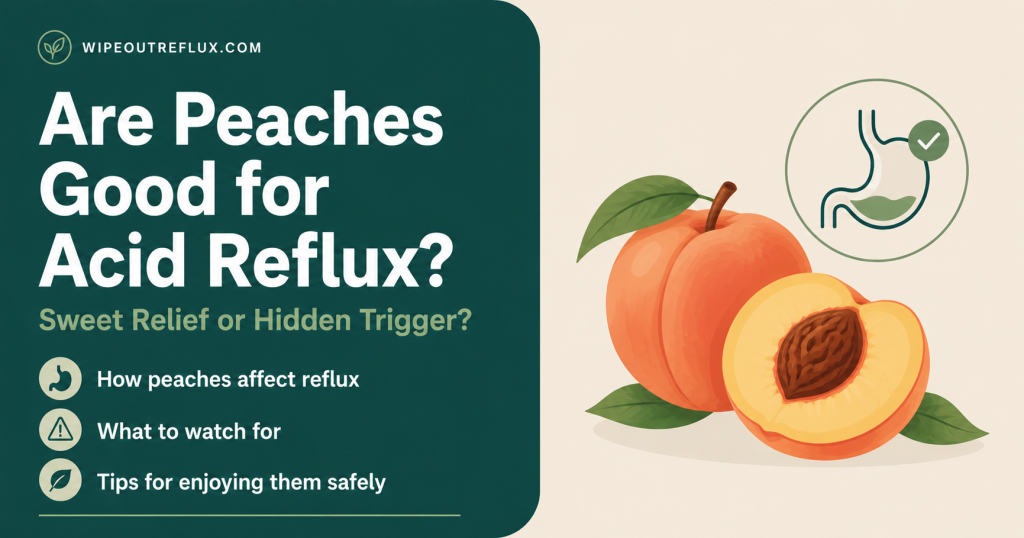
Peaches sit right in the middle of the road for acid reflux — gentler than citrus, but not one of the truly reflux-safe fruits either. A ripe peach lands at roughly pH 3.3 to 4.1, which makes it moderately acidic: nowhere near the pH 2 harshness of a lemon, but still on the sour side of neutral. So peaches aren’t a slam-dunk “yes,” and they’re not a hard “no.” The right answer depends on which kind of reflux you have and how you eat them.
If you have classic heartburn or GERD, a ripe peach in a sensible portion is usually tolerable — and a better choice than many sharper fruits. But if you have silent reflux (LPR), the calculation is stricter, because peaches fall below the pH cutoff that keeps throat symptoms calm, so they’re best kept occasional. There’s also a second, less-obvious factor with peaches: they’re a fruit that can cause bloating and gas in some people, which is its own reflux nudge.
Let me walk through where peaches really sit on the acid scale, how they behave for GERD versus LPR, why ripeness and preparation change things, and the best way to enjoy them if reflux is your issue.
Key Takeaways
- Peaches are moderately acidic (about pH 3.3–4.1) — gentler than citrus, but not a truly low-acid fruit like melon or banana.
- For classic heartburn (GERD), a ripe peach in moderation is usually fine and better than sharper fruits.
- For silent reflux (LPR), peaches sit below the pH-5 comfort line and are best limited or occasional.
- Ripeness matters: a fully ripe, soft peach is sweeter and gentler than a firm, under-ripe one.
- Fresh beats canned-in-syrup (added sugar) and dried (concentrated sugars); peach juice is the harshest form.
- Peaches contain fermentable sugars (sorbitol and excess fructose) that can cause gas and bloating, which can indirectly worsen reflux for some people.
- Eat them ripe, in modest portions, with food rather than on an empty stomach, and not right before bed.
So, are peaches acidic?
Yes — moderately. A fresh peach measures somewhere around pH 3.3 to 4.1 depending on variety and ripeness, which puts it firmly in the “mildly to moderately acidic” band. To give that some context: that’s more acidic than a banana or watermelon, but far gentler than lemons, limes or oranges, which sit down near pH 2 to 3.
So on the fruit spectrum, peaches are a middle child. They’re not the safe harbour that a watermelon or a banana is, but they’re nowhere near the trouble of citrus. If you like seeing exactly where different fruits land, I keep a full acidity of fruits chart that maps them out. Where peaches cause problems, it’s usually a question of quantity and timing rather than the fruit being outright “bad.”
Peaches and classic heartburn (GERD)
For the everyday burning kind of reflux, peaches are generally one of the safer fruit choices — in moderation. Their acidity is mild enough that a ripe peach, eaten as part of a meal rather than on an empty stomach, doesn’t tend to provoke symptoms the way a glass of orange juice or a bowl of pineapple would. The broad principle holds here: the more acidic something you eat is, the more likely it is to bring on heartburn Feldman & Barnett, Gastroenterology, 1995 — and peaches simply aren’t very acidic by fruit standards.
The catch is portion. A peach or two is very different from a big fruit salad heavy on stone fruit, or a peach dessert loaded with sugar. Keep it modest, keep it ripe, and most people with GERD tolerate peaches well. They’re a reasonable pick to include on a reflux-friendly food list in sensible amounts.
Peaches and silent reflux (LPR)
If your reflux is the throat-based kind — hoarseness, throat clearing, a lump sensation — the bar is higher, and peaches don’t quite clear it. In silent reflux (LPR), damage is driven by an enzyme called pepsin that lodges in the throat and reactivates whenever it meets acid. Because of that, the low-acid approach that calms LPR asks you to stick to foods above about pH 5 — and at pH 3.3 to 4.1, peaches fall below that line.
This isn’t hypothetical. A strict low-acid diet — cutting foods and drinks below roughly pH 5 — produced dramatic symptom improvement in patients with stubborn silent reflux Koufman, Annals of Otology, Rhinology & Laryngology, 2011. Peaches sit in the grey zone that approach trims back — not a dangerous food, but one to keep occasional rather than daily while your throat is healing. Once you’re more settled, a ripe peach now and then is usually fine. It’s exactly the kind of judgment call I help people navigate in my Wipeout Diet Plan, and you’ll find peaches flagged among the borderline items in my LPR foods to avoid guidance.
Does ripeness matter?
It does, and it’s an easy lever to pull. As a peach ripens, its starches turn to sugar and it softens, so a fully ripe peach tastes sweeter and less sharp than a firm, under-ripe one. While ripening doesn’t transform a peach into a low-acid food, the riper fruit is generally the gentler one on your stomach — and it’s more pleasant to eat, which naturally keeps portions reasonable.
So if you’re going to eat peaches with reflux, choose ones that are soft and fragrant rather than hard and tart. A rock-hard supermarket peach is both more acidic-tasting and less satisfying, which is the worst of both worlds.
Fresh vs canned vs dried
How a peach is prepared changes its reflux profile more than you’d think:
- Fresh, ripe peaches are the best option — moderate acidity, natural water content, no added sugar.
- Canned peaches in syrup add a heavy dose of sugar, and large amounts of sugar do reflux no favours; if you use canned, choose ones in water or natural juice and drain them well.
- Dried peaches concentrate both the sugars and the acids into a small, easy-to-overeat package — easy to have too many.
- Peach juice is the harshest form: all the acid, none of the fibre, and easy to drink a lot of quickly.
The pattern is the same one you’ll see across fruit: the closer to the whole, fresh food you stay, the gentler it tends to be. The same logic applies to something like applesauce — processing and added sugar shift the picture.
The bloating angle you might not expect
Acidity isn’t the only way peaches can nudge reflux. Peaches are relatively high in fermentable sugars — specifically sorbitol and more fructose than glucose — which are poorly absorbed in some people and get fermented in the gut, producing gas Muir et al., Journal of Agricultural and Food Chemistry, 2009. If you’re sensitive to that, a few peaches can leave you bloated — and a distended, gassy stomach pushes upward on the valve that keeps acid down, making reflux more likely.
This won’t affect everyone, but if you notice that peaches (or stone fruit generally) leave you gassy and then refluxy, this is probably why. Smaller portions usually keep it in check.
How to eat peaches if you have reflux
You don’t have to avoid peaches to manage reflux — just be a little deliberate about it:
- Pick ripe. Soft, fragrant peaches are sweeter and gentler than firm, tart ones.
- Keep portions modest. One peach is a snack; a big bowl of stone fruit is a trigger waiting to happen.
- Eat them with food, not on an empty stomach. A little buffer in the stomach softens the acid hit.
- Choose fresh over syrup, dried or juice. The whole fruit is the friendliest form.
- Not right before bed. Give yourself a few upright hours after eating.
- Blend smart. If you like them in a smoothie, pair them with low-acid partners rather than piling on other acidic fruits — my acid reflux smoothie recipes show the idea.
Gentler fruit alternatives
If peaches turn out to bother you, plenty of lower-acid fruits give you sweetness without the sting. Melon and banana are the classic safe picks, and papaya is another gentle, digestion-friendly option. Avocado works if you want something creamy and low-acid. On the flip side, if peaches feel fine to you, they’re a perfectly reasonable step up in flavour from the blandest safe fruits — just steer clear of the truly acidic ones like grapefruit when your symptoms are active.
Conclusion
So, are peaches good for acid reflux? They’re a fair-to-middling choice — moderately acidic, gentler than citrus, and usually fine for classic heartburn in ripe, sensible portions, but a bit too acidic to be a free pass for silent reflux. Choose them ripe, keep the portion reasonable, favour fresh over syrup or juice, and watch out for the bloating some people get. Do that, and peaches can absolutely have a place in a reflux-aware diet.
The deeper point is that no single fruit makes or breaks your reflux — what matters is the overall acid load and how calm your system is underneath it. Chasing one food at a time is a frustrating way to live; the real win is settling your reflux at the source so a ripe peach stops being a gamble. That’s exactly what my Wipeout Diet Plan is built to do — the complete, in-depth system for getting reflux under control for good. I designed it first and foremost around LPR, the stubborn throat-based kind that’s hardest to treat, but because it works on the same underlying reflux mechanisms, it’s just as effective for GERD, heartburn and everyday acid reflux.
And for the everyday question of which fruits are actually safe to reach for, the Wipeout Food Reference Guide is the essential companion — it lays out the real pH values of foods for acid reflux and LPR, so you can see at a glance where peaches and every other fruit actually fall instead of guessing. Calm the root cause, check the pH, and you can enjoy your fruit without the second-guessing.
Frequently Asked Questions
Are peaches good for acid reflux?
They’re a moderate choice. Peaches are mildly to moderately acidic (about pH 3.3–4.1) — gentler than citrus but not truly low-acid. For classic heartburn, a ripe peach in moderation is usually fine. For silent reflux (LPR), they sit just below the low-acid comfort zone, so keep them occasional.
Are peaches too acidic for GERD?
Not for most people, in sensible amounts. Peaches are far less acidic than oranges, lemons or pineapple, so a ripe peach eaten with food rarely triggers heartburn. Problems usually come from large portions, under-ripe fruit, or sugary canned versions rather than the peach itself.
Which is better for reflux, fresh or canned peaches?
Fresh, ripe peaches are best. Canned peaches in syrup add a lot of sugar, which doesn’t help reflux — if you use canned, pick ones in water or natural juice and drain them. Dried peaches concentrate the sugars and acids, and peach juice is the harshest form of all.
Can peaches cause bloating that worsens reflux?
They can for some people. Peaches contain fermentable sugars like sorbitol and excess fructose that can produce gas in sensitive individuals. A bloated, gassy stomach presses on the valve that keeps acid down, which can indirectly trigger reflux. Smaller portions usually prevent this.
What fruits are gentler than peaches for reflux?
Melon, banana and papaya are among the lowest-acid, most reflux-friendly fruits, and avocado is a good creamy, low-acid option. These sit higher on the pH scale than peaches and are the safer picks when your symptoms are flaring.
Research & References
- In a study measuring the acidity of numerous ingested items against heartburn reported by nearly 400 people, greater acidity correlated with more reported heartburn — supporting the general principle that lower-pH foods are more likely to provoke symptoms, and that moderately acidic peaches are gentler than sharply acidic fruits Feldman & Barnett, Gastroenterology, 1995.
- A strict low-acid diet (removing foods and drinks below about pH 5 for at least two weeks) improved symptoms in the majority of patients with stubborn, medication-resistant laryngopharyngeal reflux — the basis for treating peaches (pH ~3.3–4.1) as a borderline food for LPR Koufman, Annals of Otology, Rhinology & Laryngology, 2011.
- Laboratory analysis of common fruits found that peaches contain fermentable short-chain carbohydrates — including sorbitol and more fructose than glucose — which are poorly absorbed in some people and can produce gas and bloating Muir et al., Journal of Agricultural and Food Chemistry, 2009.

David Gray
12 years living with LPR · Consultant & researcher
I've lived with LPR for twelve years — the misdiagnoses, the PPI courses that did nothing, the slow work of figuring out what actually helps. Wipeout Reflux is where I translate the research into plain terms for people stuck in the same place. Every claim here is sourced to peer-reviewed work, and I consult one-to-one with LPR sufferers.