
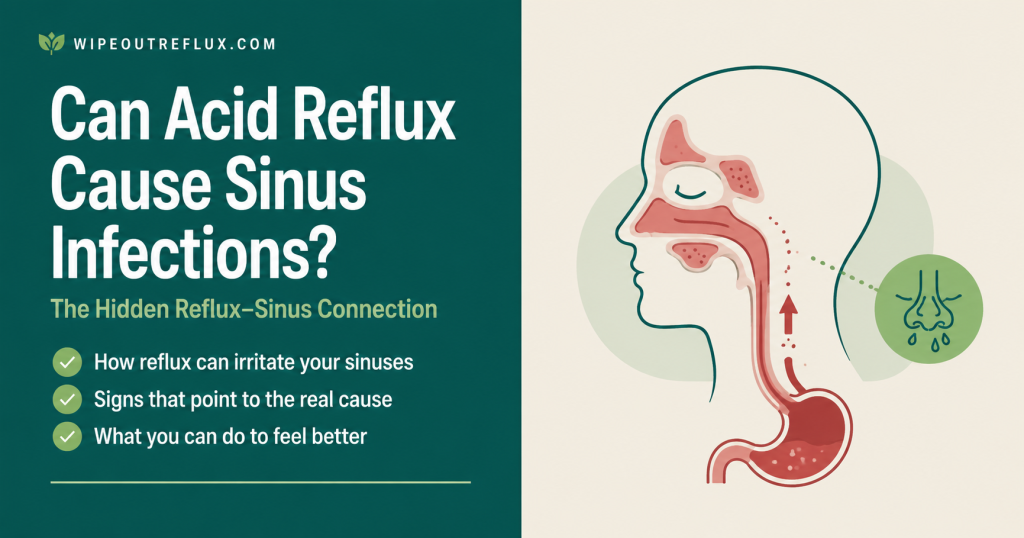
Here’s the honest, nuanced answer: acid reflux doesn’t usually cause a one-off sinus infection the way a cold does — but it can absolutely set the stage for recurring and chronic sinus problems, and it’s one of the most commonly missed reasons sinus infections keep coming back. If your sinuses never seem to fully clear, or round after round of antibiotics doesn’t hold, reflux is worth a hard look.
The real link runs through silent reflux (LPR), the throat-based form of reflux. Instead of causing heartburn in your chest, it sends stomach acid and a digestive enzyme called pepsin all the way up to the back of your nose and sinuses. There, they inflame the lining, swell the tissues, thicken your mucus and clog your sinus drainage — and a blocked, inflamed, poorly draining sinus is exactly the environment where infections take hold. Reflux can also mimic a sinus infection, producing congestion, facial pressure and post-nasal drip with no infection at all.
Let me walk through how reflux reaches your sinuses, how it fuels infections, how to tell reflux apart from a true sinus infection, and what to do if reflux is behind your recurring sinus trouble.
Key Takeaways
- Reflux rarely causes a single acute sinus infection directly, but it’s a well-documented contributor to chronic and recurrent sinus problems.
- Silent reflux (LPR) carries acid and pepsin up to the back of the nose and sinuses, where they inflame and irritate the lining.
- That inflammation swells tissues, thickens mucus and blocks sinus drainage — the perfect setup for infection.
- Pepsin has been found in the nasal secretions of chronic sinus sufferers and can directly damage the sinus lining.
- Reflux can also mimic a sinus infection — congestion, pressure and post-nasal drip without any actual infection.
- The tell-tale clue is sinus trouble that’s recurrent, chronic, or unresponsive to antibiotics, often alongside throat symptoms.
- If reflux is the driver, treating the sinuses alone won’t fix it — you have to calm the reflux at its source.
The short answer: can reflux cause sinus infections?
It’s worth being precise here, because “sinus infection” means different things. A typical acute sinus infection — the kind that follows a cold, with facial pain, fever and thick discoloured mucus — is usually caused by a virus or bacteria, not reflux. So no, reflux isn’t the usual culprit behind a single, short-lived sinus infection.
But chronic and recurrent sinus disease is a different story. When sinus problems drag on for weeks, keep returning, or don’t respond to the usual treatments, reflux moves up the list of suspects considerably. In that setting it acts as a contributing cause — inflaming and congesting the sinuses so they can’t drain and heal properly. That’s the “real link” the title promises: not a direct one-hit cause, but a persistent background irritant that keeps your sinuses primed for trouble.
The real link: how reflux reaches your sinuses
To see how reflux gets involved, you have to understand silent reflux (LPR). Unlike classic heartburn, which stays low in the chest, LPR lets stomach contents travel all the way up the throat and into the nasopharynx — the space behind your nose where the sinuses drain. And it doesn’t stop there for everyone: reflux can reach right up into the nasal and sinus passages.
This isn’t just theory. When researchers placed a pH probe at the back of the nose, patients with stubborn chronic sinusitis had significantly more acid reflux reaching the nasopharynx than healthy people — leading them to conclude that this direct nasopharyngeal reflux is likely an important causative factor in refractory chronic rhinosinusitis DelGaudio, The Laryngoscope, 2005. In other words, the acid really does get up there — and in people with persistent sinus disease, it gets up there more.
How reflux sets the stage for sinus infections
Once acid and pepsin reach your sinuses, they cause trouble through a few connected routes:
They inflame and swell the lining. Acid is caustic to the delicate nasal and sinus tissues, and the swelling it causes narrows the tiny drainage channels (the ostia) that your sinuses rely on to stay clear.
Pepsin damages the tissue directly. The enzyme pepsin hitches a ride with the reflux and lodges in the nasal lining. Laboratory work has shown that pepsin harms the cells of the nasal lining and switches on the same inflammatory signals seen in chronic sinus disease Southwood et al., Annals of Otology, Rhinology & Laryngology, 2015. This is the same enzyme behind reflux-driven excess mucus, and it’s why calming pepsin matters.
They thicken mucus and block drainage. The irritation drives your nose to produce thick, sticky mucus and post-nasal drip, while the swelling stops it draining away. That reflux-driven sinus congestion is a common complaint in its own right. Mucus that pools in a blocked, inflamed sinus is exactly what bacteria need to multiply — turning irritation into infection.
Put together, reflux doesn’t so much plant an infection as prepare the ground for one, over and over. The same acid can irritate neighbouring structures too, which is why reflux is linked to Eustachian tube and ear problems as well.
Reflux vs a true sinus infection: how to tell them apart
Because reflux can both cause sinus symptoms and mimic them, it helps to know the tells. Lean toward reflux being involved if:
- Your sinus problems are chronic or keep recurring rather than being a single episode that clears in a week or two.
- Antibiotics don’t really work, or the relief doesn’t last — a strong hint the problem isn’t primarily bacterial.
- You have throat symptoms too — hoarseness, throat clearing, a lump sensation, or a chronic cough — the classic signs of silent reflux.
- Symptoms are worse in the morning or after lying down, when reflux is easiest.
- There’s no fever or thick discoloured discharge of an acute bacterial infection — just congestion, pressure and drip that won’t quit.
It’s also easy to confuse reflux-driven congestion with allergies, which I compare in LPR vs allergies. And of course, the two can overlap — you can have genuine sinus disease that reflux is quietly making worse.
What to do about reflux-related sinus problems
If the pattern points to reflux, the key shift is to stop treating only the sinuses and start treating the cause. That usually means a two-pronged approach: manage the sinus symptoms with your doctor or an ENT as needed, while tackling the reflux that keeps re-inflaming them. It’s worth getting properly assessed — my guide on when to see a doctor covers the warning signs — because chronic sinus disease deserves a proper look, and because confirming reflux as the driver changes the whole treatment plan.
On the reflux side, the foundation is low-acid eating and anti-reflux habits that stop acid and pepsin travelling up to your sinuses in the first place. A strict low-acid diet dramatically improved symptoms in patients with stubborn silent reflux Koufman, Annals of Otology, Rhinology & Laryngology, 2011, and it’s the same foundation my Wipeout Diet Plan is built on.
Conclusion
So, can acid reflux cause sinus infections? Not usually as a direct, one-time cause — but as a contributor to chronic and recurrent sinus trouble, absolutely. Silent reflux carries acid and pepsin up to your nose and sinuses, inflames and swells the lining, thickens your mucus and blocks the drainage your sinuses need to stay healthy, leaving them primed for infection again and again. And when reflux is mimicking or fuelling your sinus symptoms, no course of antibiotics or nasal spray will fully fix a problem that’s really coming from your stomach.
That’s why, if your sinuses keep flaring, the most powerful move is to calm the reflux at its source so the acid stops reaching your sinuses at all. It’s exactly what my Wipeout Diet Plan is built to do: the complete, in-depth system for getting reflux under control for good. I designed it first and foremost around LPR, the stubborn throat-based kind that’s hardest to treat — and the kind most likely to be reaching your sinuses — but because it works on the same underlying reflux mechanisms, it’s just as effective for GERD, heartburn and everyday acid reflux.
And to make it easy day to day, the Wipeout Food Reference Guide is the essential companion — it lays out the real pH values of foods and drinks for acid reflux and LPR, so you can cut the acid that’s keeping your sinuses inflamed. Treat the sinuses and the reflux together, and those endless, recurring infections often finally break their cycle.
Frequently Asked Questions
Can acid reflux cause sinus infections?
Not usually as a direct, one-off cause — acute sinus infections are typically viral or bacterial. But reflux, especially silent reflux (LPR), is a recognised contributor to chronic and recurring sinus problems. It sends acid and pepsin up to the sinuses, where inflammation and blocked drainage create the conditions for repeated infections.
How does reflux affect the sinuses?
In silent reflux, stomach acid and pepsin travel up to the back of the nose and sinuses. There they inflame and swell the lining, thicken mucus, cause post-nasal drip and block the tiny channels the sinuses use to drain. A blocked, inflamed sinus can’t clear itself, which sets the stage for infection.
How do I know if my sinus problems are from reflux?
Suspect reflux if your sinus issues are chronic or keep recurring, don’t respond well to antibiotics, come with throat symptoms like hoarseness or throat clearing, and are worse in the morning or after lying down. A lack of fever and thick discoloured mucus, with persistent congestion and drip instead, also points toward reflux.
Will treating my reflux clear my sinus problems?
If reflux is a genuine driver, calming it often improves stubborn sinus symptoms that wouldn’t clear otherwise. The best approach is to treat both together — manage the sinuses with your doctor while addressing the reflux through low-acid eating and anti-reflux habits so acid stops reaching your sinuses.
Can silent reflux feel like a sinus infection without one?
Yes. Reflux can mimic a sinus infection, producing congestion, facial pressure and post-nasal drip with no actual infection present. This is one reason reflux-related sinus symptoms are so often missed — people are treated for infection after infection when the real trigger is acid reaching the nose.
Research & References
- Using a pH probe placed at the nasopharynx, patients with refractory chronic rhinosinusitis were found to have significantly more acid reflux reaching the back of the nose than controls, leading the author to conclude that direct nasopharyngeal reflux is likely an important causative factor in stubborn chronic sinus disease DelGaudio, The Laryngoscope, 2005.
- Laboratory research showed that pepsin — the reflux enzyme — damages human nasal lining cells and triggers the inflammatory signals associated with chronic rhinosinusitis, offering a direct mechanism by which reflux can harm the sinuses Southwood et al., Annals of Otology, Rhinology & Laryngology, 2015.
- A strict low-acid diet produced dramatic symptom improvement in patients with stubborn laryngopharyngeal reflux, supporting a dietary approach to reducing the acid and pepsin that can reach and irritate the sinuses Koufman, Annals of Otology, Rhinology & Laryngology, 2011.

David Gray
12 years living with LPR · Consultant & researcher
I've lived with LPR for twelve years — the misdiagnoses, the PPI courses that did nothing, the slow work of figuring out what actually helps. Wipeout Reflux is where I translate the research into plain terms for people stuck in the same place. Every claim here is sourced to peer-reviewed work, and I consult one-to-one with LPR sufferers.