
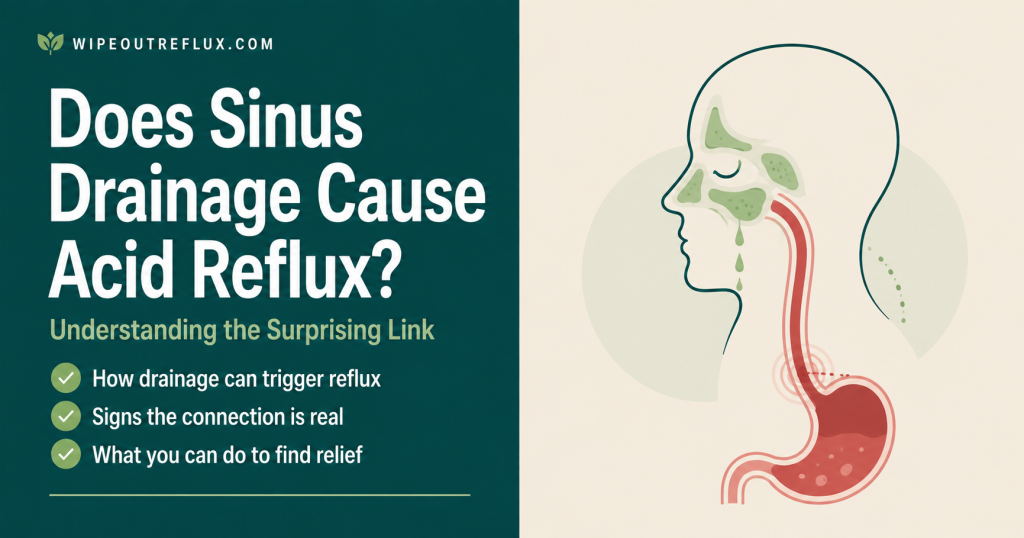
This is a real chicken-and-egg question, and the honest answer has two parts. Yes, sinus drainage — that constant post-nasal drip down the back of your throat — can nudge acid reflux in the wrong direction. But far more often, the arrow actually points the other way: reflux is causing what feels like sinus drainage in the first place. So when you ask “which comes first,” the answer, more times than not, is reflux.
Here’s the tangle. Post-nasal drip makes you swallow constantly, and all that swallowing draws in extra air that can trigger belching and reflux. The coughing and throat clearing that come with drip raise the pressure in your belly and push acid up. And the decongestants and antihistamines people take for sinus drainage can loosen the valve that holds acid down. So sinus drainage genuinely can aggravate reflux. But silent reflux (LPR) is also one of the most common hidden causes of chronic “post-nasal drip” — which means the two often feed each other in a self-reinforcing loop.
Let me untangle which comes first, how each one drives the other, and — most importantly — how to work out which is really behind your symptoms, because treating the wrong one is why so many people stay stuck.
Key Takeaways
- Sinus drainage can aggravate reflux indirectly — through constant swallowing and air intake, coughing, throat clearing, and the medications taken for it.
- But more often the reverse is true: silent reflux (LPR) is a common hidden cause of what feels like post-nasal drip.
- So “which comes first” is frequently reflux, quietly masquerading as a sinus problem.
- The two commonly form a two-way, self-reinforcing cycle rather than a one-way street.
- Swallowing extra air (aerophagia) is closely linked to reflux episodes, which is how drip-driven swallowing can feed reflux.
- Common sinus and allergy medications, like some antihistamines, can themselves worsen reflux.
- The big clue: if allergy and sinus treatments never fully fix your “drip,” reflux is likely the real driver.
Can sinus drainage actually cause acid reflux?
It can contribute to it, mostly through indirect routes rather than by directly creating acid. Here’s how sinus drainage can tip you toward reflux:
Constant swallowing and air intake. When mucus is dripping down your throat all day, you swallow far more often — and each swallow can draw air down with it. That swallowed air has to come back up, and this air-swallowing behaviour is tightly linked to reflux: in patients with reflux symptoms, nearly half of their “supragastric” belches — where air is sucked into the oesophagus and expelled — occurred in close association with reflux episodes Hemmink et al., American Journal of Gastroenterology, 2009. So the extra swallowing that drip forces on you can genuinely feed belching and reflux, as I discuss in acid reflux and burping.
Coughing and throat clearing. Post-nasal drip makes you cough and clear your throat repeatedly, and each of those sharply raises the pressure inside your abdomen — which can push stomach contents up past the valve. It’s a small shove each time, but done hundreds of times a day it adds up.
The medications you take for it. This one catches people out. Some antihistamines and decongestants taken to dry up sinus drainage can relax the lower oesophageal sphincter or slow digestion, quietly making reflux worse while you’re trying to fix your nose.
So yes — sinus drainage can aggravate reflux. But notice that all of these are indirect nudges, not a direct cause. Which raises the more important question.
But which comes first? Usually reflux
Here’s the twist that changes everything: in a great many people, the “sinus drainage” isn’t a sinus problem at all — it’s reflux in disguise. Silent reflux (LPR) sends acid and the enzyme pepsin up into the throat and the back of the nose, where they irritate the lining and trigger exactly the sensations of post-nasal drip: mucus, a need to clear your throat, and that trickle at the back of the throat.
This isn’t a fringe idea. When researchers measured reflux at the back of the nose, people with stubborn upper-airway symptoms had significantly more acid reaching the nasopharynx than healthy controls DelGaudio, The Laryngoscope, 2005. And in the lab, pepsin from reflux directly damages the cells of the nasal lining and switches on inflammation Southwood et al., Annals of Otology, Rhinology & Laryngology, 2015. In other words, reflux can manufacture the very “drip” you’re blaming for your reflux. That’s why silent reflux is so often mistaken for post-nasal drip and even allergies, and why it drives so much reflux-related mucus.
The two-way cycle
In reality, it’s often not either/or — it’s a loop. Reflux irritates your throat and nose, producing mucus and the feeling of drip. That drip makes you swallow more air and cough and clear your throat, which in turn aggravates the reflux. Round and round it goes, each half feeding the other.
This is why chronic throat and cough symptoms are so notoriously hard to pin on a single culprit. Doctors have long recognised that the top causes of a chronic cough — post-nasal drip (upper-airway cough syndrome), asthma and reflux — frequently coexist in the same person, so more than one may need treating at once. If you’ve been chasing just one half of the loop, that’s often why the symptoms never fully clear. The same throat irritation drives reflux-related cough and throat clearing, which then feed straight back into the cycle.
How to tell which is driving yours
Untangling the loop starts with looking at the pattern. Lean toward reflux being the driver if:
- Your symptoms are worse in the morning, after meals, or when lying down.
- You have other silent reflux signs — hoarseness, a lump-in-the-throat feeling, or a chronic cough.
- Allergy and sinus treatments — antihistamines, nasal sprays, decongestants — never really fix the “drip.”
- There’s no clear allergic or infectious trigger, and your nose itself looks fine to an ENT.
Lean toward a genuine sinus or nasal cause if the drip is seasonal or tied to obvious allergens, comes with clear nasal congestion and sneezing, and responds well to allergy treatment. And keep in mind you can have both — a real allergy and reflux amplifying it. If symptoms are persistent or you’re unsure, it’s worth getting properly assessed; my guide on when to see a doctor covers the warning signs.
What to do about it
The key is to treat the actual driver rather than firing blindly at symptoms. If allergies are genuinely behind your drip, treat those — but be aware that some of those very medications can worsen reflux, so it’s worth watching how you respond. And if the pattern points to reflux, the lasting fix is to calm the acid and pepsin that are irritating your throat and nose in the first place, which also stops the drip that’s feeding the cycle.
On the reflux side, the foundation is low-acid eating and anti-reflux habits. A strict low-acid diet dramatically improved symptoms in patients with stubborn silent reflux Koufman, Annals of Otology, Rhinology & Laryngology, 2011, and calming pepsin in the throat is a big part of breaking the loop. It’s the same foundation my Wipeout Diet Plan is built on.
Conclusion
So, does sinus drainage cause acid reflux? It can aggravate it — through the constant swallowing, air intake, coughing and medications that come with post-nasal drip. But when you ask which comes first, the more common answer by far is that reflux is causing the drip, not the other way around. Silent reflux is a master of disguise, and it’s forever being mistaken for a sinus problem. Most often the two settle into a two-way cycle, which is exactly why treating just one half leaves you stuck.
Breaking that cycle almost always starts at the same place: calming the reflux at its source so it stops irritating your throat and nose, which quiets the drip that’s feeding it. That’s exactly what my Wipeout Diet Plan is built to do — the complete, in-depth system for getting reflux under control for good. I designed it first and foremost around LPR, the stubborn throat-based kind that’s hardest to treat — and the kind most likely to be masquerading as sinus drainage — but because it works on the same underlying reflux mechanisms, it’s just as effective for GERD, heartburn and everyday acid reflux.
And to make it easy day to day, the Wipeout Food Reference Guide is the essential companion — it lays out the real pH values of foods and drinks for acid reflux and LPR, so you can cut the acid that’s keeping your throat and nose irritated. Work out which comes first, treat that driver, and the endless drip-and-reflux loop finally has somewhere to stop.
Frequently Asked Questions
Does sinus drainage cause acid reflux?
It can aggravate it indirectly. Constant post-nasal drip makes you swallow more (drawing in air that triggers belching and reflux), causes coughing and throat clearing that push acid up, and often leads to medications that can worsen reflux. But it’s usually an indirect contributor rather than a direct cause — and frequently reflux is actually causing the drip.
Which comes first, sinus drainage or acid reflux?
More often than people expect, reflux comes first. Silent reflux (LPR) sends acid and pepsin up to the throat and nose, producing exactly the sensations of post-nasal drip. So what feels like a sinus problem causing reflux is frequently reflux causing the “sinus” symptoms — and the two often reinforce each other in a cycle.
How do I know if my post-nasal drip is from reflux?
Suspect reflux if the drip is worse in the morning, after meals or lying down, comes with hoarseness, throat clearing or a lump sensation, and never fully clears despite allergy and sinus treatments. A genuinely allergic drip tends to be seasonal, tied to obvious triggers, and responds to allergy treatment. You can also have both at once.
Can allergy medications make reflux worse?
They can. Some antihistamines and decongestants used for sinus drainage can relax the valve that keeps acid down or slow digestion, which may worsen reflux. If you’re treating a “drip” with these and your reflux is getting worse, that connection is worth discussing with your doctor.
How do I break the drip-and-reflux cycle?
Treat the true driver. If reflux is behind it, calming the acid and pepsin with low-acid eating and anti-reflux habits stops the throat and nose irritation that produces the drip, which in turn reduces the swallowing and coughing that feed reflux. If genuine allergies are involved, treat those too — ideally without medications that aggravate reflux.
Research & References
- In patients with reflux symptoms, frequent supragastric belches (air drawn into the oesophagus and expelled) were identified, and 48% occurred in close temporal association with reflux episodes — showing how air-swallowing behaviour, as encouraged by constant post-nasal drip, is linked to reflux Hemmink et al., American Journal of Gastroenterology, 2009.
- Using a pH probe at the nasopharynx, patients with stubborn upper-airway symptoms had significantly more acid reflux reaching the back of the nose than controls, supporting reflux as a direct cause of nasal and post-nasal-drip symptoms DelGaudio, The Laryngoscope, 2005.
- Laboratory research showed that pepsin, the reflux enzyme, damages human nasal lining cells and triggers inflammation — a direct mechanism by which reflux can produce sinus and drip symptoms Southwood et al., Annals of Otology, Rhinology & Laryngology, 2015.
- A strict low-acid diet produced dramatic symptom improvement in patients with stubborn laryngopharyngeal reflux, supporting a dietary approach to breaking the reflux-and-drip cycle Koufman, Annals of Otology, Rhinology & Laryngology, 2011.

David Gray
12 years living with LPR · Consultant & researcher
I've lived with LPR for twelve years — the misdiagnoses, the PPI courses that did nothing, the slow work of figuring out what actually helps. Wipeout Reflux is where I translate the research into plain terms for people stuck in the same place. Every claim here is sourced to peer-reviewed work, and I consult one-to-one with LPR sufferers.