
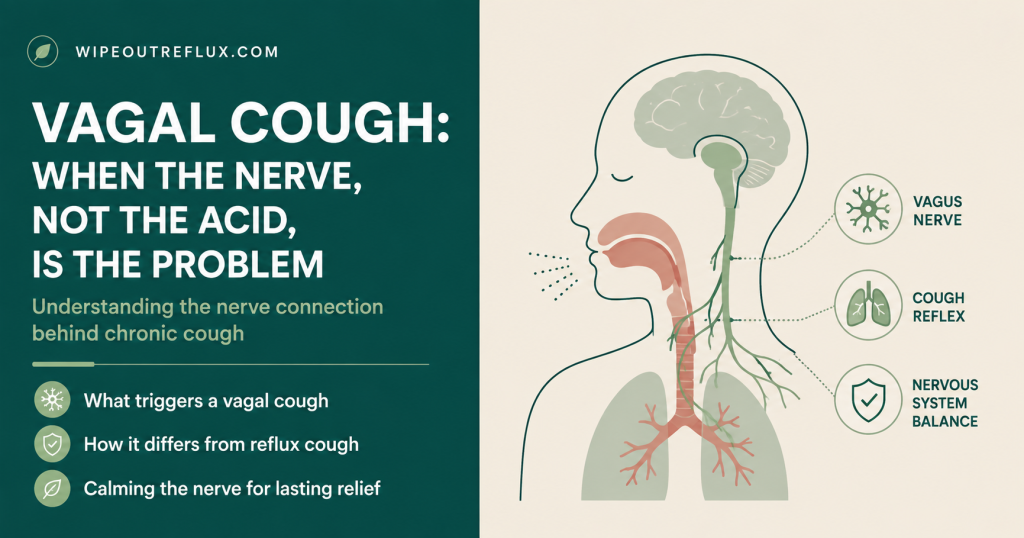
If you’ve had a dry, tickly cough for months, been tested for everything, tried reflux medication and inhalers, and still cough every time you talk, laugh or step into cold air — the problem may not be your lungs or your stomach acid at all. It may be your nerve.
A vagal cough — also called a neurogenic or sensory neuropathic cough — is a chronic cough driven by an oversensitive vagus nerve rather than by acid, infection or asthma. The nerve that senses your throat and airways becomes hair-trigger sensitive, so trivial things that should never make you cough suddenly do. It’s one of the most commonly missed explanations for a stubborn cough, and it’s constantly mistaken for silent reflux, because the two overlap so heavily and often start together.
Here’s the key idea that changes everything about how you treat it: once the nerve is sensitised, chasing the acid alone often won’t stop the cough. You have to calm the nerve too. Let me explain how a vagal cough works, why it gets confused with reflux, and what actually settles it.
Key Takeaways
- A vagal cough is a chronic cough caused by a hypersensitive or irritated vagus nerve — the nerve, not the acid, is driving it.
- It’s dry, tickly and non-productive, and it’s set off by trivial triggers: talking, laughing, cold air, strong smells, or a tickle in the throat.
- It’s part of what doctors now call cough hypersensitivity syndrome, and it behaves much like neuropathic pain — a nerve firing when it shouldn’t.
- The most common causes are a viral infection that injured the nerve (post-viral vagal neuropathy), reflux or LPR, and ACE inhibitor blood pressure drugs.
- It’s one of the most common misdiagnoses of silent reflux, because the symptoms and triggers overlap almost completely.
- Because it’s a nerve problem, it often responds to nerve-calming medication like gabapentin or amitriptyline — drugs that do nothing for acid.
- Behavioural cough-suppression and speech therapy has strong trial evidence and can retrain the reflex without any medication.
- If reflux was the original trigger, calming that reflux remains an important part of settling the nerve down.
What is a vagal cough?
Your cough reflex is supposed to protect you. When something threatens your airway — a crumb going down the wrong way, smoke, acid — sensory nerves fire and you cough to clear it. The main sensory nerve behind all of this is the vagus nerve, which wires up your throat, voice box and airways and carries the “cough now” signal to your brainstem.
A vagal cough is what happens when that alarm system gets stuck on high sensitivity. The nerve starts firing at things that shouldn’t bother it at all — a change in air temperature, the vibration of your own voice, a faint smell of perfume. Doctors call this cough hypersensitivity syndrome, and the modern understanding is that a chronic cough of this kind is essentially a neuropathic condition — sensory nerve damage or dysfunction that leaves the cough pathway over-reactive, much the way nerve injury can leave you with chronic pain Chung, Journal of Thoracic Disease, 2014.
When the problem is centred on the throat and voice box specifically, you’ll also hear it called laryngeal sensory neuropathy — the same idea, named for where the oversensitive nerve endings sit. Whatever the label, the defining feature is the same: the cough is out of proportion to any real threat, because the wiring, not the airway, is the problem.
How the vagus nerve turns a normal cough into a chronic one
Two things go wrong, and they feed each other. First, the sensory nerve endings in your throat and airways become more excitable — they fire off cough signals at a much lower threshold than they should. Second, the brainstem circuits that receive those signals get turned up too, amplifying every message that arrives. That combination — a jumpy nerve and an amplifier turned to maximum — is why a tiny tickle can trigger a coughing fit that won’t stop.
You can even see this hypersensitivity in a neat clinical sign: in many of these patients, poking gently in the ear canal makes them cough. That’s Arnold’s reflex, and it happens because a branch of the vagus nerve supplies the ear. A normal nerve ignores it; a sensitised one coughs. It’s a small window onto the bigger truth — the whole vagal system is on a hair trigger.
This is also where the vagus nerve’s role in reflux becomes relevant, because the same nerve runs between your gut and your airway. Irritation at one end can wind up sensitivity at the other, which is exactly why reflux and cough get so tangled together.
The reflux connection: why a vagal cough gets misdiagnosed as LPR
This is the part that matters most on a reflux site, because it trips up so many people. A vagal cough and a silent reflux cough can look completely identical from the outside. Both are dry and throat-based. Both come with constant throat clearing, a tickle, sometimes hoarseness. Both can be worse lying down. So it’s no surprise that a neurogenic cough is one of the most common things misdiagnosed as — or lumped in with — reflux cough.
And here’s the twist that makes it genuinely confusing: reflux is often the thing that started it. A stretch of silent reflux (LPR) can inflame and irritate the throat enough to sensitise the vagus nerve endings. So reflux lights the fire — but once the nerve is hypersensitive, it keeps burning on its own, long after the acid has been brought under control.
That explains one of the most frustrating experiences in all of reflux: you clean up your diet, you take the medication, your reflux genuinely improves — and the cough doesn’t budge. It’s also a big part of why acid-suppressing drugs so often fail for LPR cough. A proton pump inhibitor lowers stomach acid. It does absolutely nothing to a sensitised nerve. If the nerve has become the driver, no amount of acid control alone will fully switch the cough off — you have to treat the nerve directly. The nerve, not the acid, has become the problem.
What sets a vagal cough off
The trigger pattern is often the biggest clue that a cough is neurogenic. If your cough is provoked by things that have nothing to do with acid or infection, think nerve. The classic triggers are:
- Talking for a while, or talking on the phone
- Laughing or singing
- Cold air, or a sudden change in temperature
- Strong smells — perfume, cleaning products, aftershave
- A tickle or “crawling” sensation in the throat that demands a cough
- Eating certain textures, or the first bite of a meal
- Lying down or bending over
The cough itself is typically dry, non-productive (nothing comes up), and comes in fits that are hard to stop once they start. Many people describe an almost irresistible tickle right before, as if the throat is begging to be cleared. That tickle is the sensitised nerve firing — not phlegm, not acid, just a misfiring signal.
What causes the nerve to go haywire
There are three big culprits behind a vagal cough, and they can overlap.
A viral infection (post-viral vagal neuropathy). This is the classic story: you catch a cold, flu or other respiratory virus, everything else clears up — but the cough never leaves. The virus injured the nerve, and the cough outlives the infection by months. It’s the same pattern many people have reported after COVID and other viruses, and it’s exactly the population studied in the neurogenic cough trials.
Reflux and LPR. As above, chronic throat irritation from silent reflux can sensitise the nerve. This is where reflux and neurogenic cough become genuinely intertwined rather than either/or.
ACE inhibitor blood pressure drugs. The “-pril” medications can trigger a chronic dry cough of their own, and can lower the threshold for a hypersensitive one. If you take one of these, that needs ruling out first — I’ve covered it in detail in ACE inhibitor cough. Never stop a blood pressure drug on your own; that’s a conversation with your doctor.
How a vagal cough is diagnosed
There’s no single test that lights up and says “neurogenic cough.” It’s largely a diagnosis of exclusion, which is precisely why it takes so many people so long to get there. Doctors first work through and treat the usual suspects — asthma, post-nasal drip, reflux, and any ACE inhibitor — and it’s common to be misdiagnosed with asthma along the way.
When those are excluded or treated and the cough still won’t quit, and especially when the trigger pattern screams nerve — talking, laughing, cold air, a tickle — a neurogenic cough moves to the top of the list. An ENT may look at your larynx to rule out other causes and check for the subtle signs of sensory neuropathy. The tell-tale combination is a long-standing dry cough, trivial triggers, a normal or near-normal examination, and a history that often points back to a virus or a bout of reflux.
How a vagal cough is treated
Here’s the genuinely hopeful part, and the reason getting the right diagnosis matters so much: a vagal cough is treatable, but with tools aimed at the nerve rather than the airway or the stomach.
Nerve-calming medication (neuromodulators)
Because a neurogenic cough behaves like neuropathic pain, it often responds to the same drugs. In a randomised, placebo-controlled trial, gabapentin significantly improved cough and cough-related quality of life in people with refractory chronic cough, with a number-needed-to-treat of under four Ryan et al., The Lancet, 2012. Low-dose amitriptyline has performed even more dramatically in exactly the post-viral vagal neuropathy group — in a randomised comparison against a standard cough suppressant, most amitriptyline patients had a major or complete response while the suppressant group had essentially none Jeyakumar et al., The Laryngoscope, 2006.
These are prescription medicines with real side effects, used off-label for cough, so they’re very much a doctor’s decision — but they’re the clearest proof that the problem is the nerve, since they do nothing whatsoever to acid. On this site I’ve written more about amitriptyline and gabapentin for reflux-related cough.
Behavioural cough-suppression and speech therapy
You can also retrain the reflex without any drug at all. A randomised, placebo-controlled trial of a speech-pathology programme — education about the cough, techniques to suppress the urge, and vocal-hygiene changes to reduce throat irritation — significantly reduced chronic cough compared with a placebo intervention Vertigan et al., Thorax, 2006. The idea is to break the tickle-cough-irritation-tickle loop with deliberate suppression techniques, controlled breathing and sipping water at the first hint of a tickle. Gentle breathing exercises work along similar lines and are an easy thing to start on your own.
Treating the trigger that started it
If reflux was the original insult — and for a lot of people it was — then calming that reflux is still an essential part of the picture. A sensitised nerve doesn’t need much provocation, so removing the steady drip of acid and pepsin irritating your throat gives the nerve its best chance to settle rather than being constantly re-provoked. That’s exactly what the Wipeout Diet Plan is built to do. The most effective approach for a stubborn neurogenic cough is often a combination: settle the nerve and shut off the trigger at the same time.
Vagal cough vs reflux cough vs ACE inhibitor cough
Since these three are the ones that get muddled, here’s the quick way to separate them. An ACE inhibitor cough is the easiest to rule out — if you take a “-pril” drug, that’s the first suspect, and it clears within weeks of your doctor switching the medication. A pure reflux cough tends to track with meals, acidic or fatty foods, and posture, and it improves when the reflux is properly controlled. A vagal cough is the one that’s left standing when the others are treated and it still won’t stop — the one set off by talking, laughing and cold air, that ignores acid medication, and that responds to nerve-calming treatment. In real life, of course, people often have more than one at once, which is what makes this such detective work.
When to see a doctor
Any cough lasting more than about eight weeks deserves proper medical assessment, both to rule out serious causes and to open the door to the nerve-directed treatments above, most of which need a prescription. See a doctor promptly if you cough up blood, lose weight without trying, have worsening breathlessness, or feel a firm lump in your neck. A vagal cough is benign and treatable, but it’s a diagnosis to reach with a clinician after the serious causes are excluded — not one to settle on by yourself.
Conclusion
A vagal cough is a genuinely different animal from an ordinary cough, and understanding that is what finally unlocks it. It’s a nerve stuck on high alert, not acid, not infection, not asthma — which is why it laughs off the usual remedies and why so many people bounce between doctors for years before anyone names it. The two things that actually work are calming the nerve, with neuromodulator medication or behavioural cough therapy, and removing whatever keeps re-provoking it.
That second half is where reflux comes in, and it’s why I’d point anyone with a stubborn throat-based cough to the Wipeout Diet Plan as the foundation. If silent reflux was the spark that sensitised your vagus nerve — as it so often is — then shutting off that acid and pepsin irritation is what gives the nerve room to finally settle. I built the plan first and foremost around LPR and silent reflux, the stubborn throat-based kind that drives these coughs, but because it works on the same underlying reflux mechanisms it’s just as effective for GERD and everyday heartburn. Pair it with the nerve-directed treatments from your doctor and you’re hitting the problem from both sides at once, which is exactly what a sensitised cough needs.
To make the day-to-day simple, the Wipeout Food Reference Guide is the essential companion — a downloadable reference to which foods and drinks are safe for reflux and LPR and their pH values, so you can stop feeding your throat the very acids that keep the nerve irritated. Calm the nerve, cut the trigger, and give it time — that’s how a vagal cough finally goes quiet.
This article is for general information only and is not medical advice. A chronic cough should be assessed by a doctor, and medicines such as gabapentin and amitriptyline should only be started under medical supervision. Never stop or change a prescription — including blood pressure drugs — on your own.
Frequently Asked Questions
What does a vagal cough feel like?
It’s a dry, tickly cough with an almost irresistible urge to clear the throat, and nothing comes up when you cough. It arrives in fits that are hard to stop, and it’s set off by trivial things like talking, laughing, cold air or a strong smell rather than by exertion or lying in one position.
How do I know if my cough is nerve-related or reflux?
Look at the triggers and what helps. A reflux cough tends to flare after meals, acidic or fatty food, and when you bend or lie down, and it eases when reflux is controlled. A vagal cough is set off by talking, laughing and cold air, tends to ignore acid medication, and responds to nerve-calming treatment. Many people have both at once, so it isn’t always either/or.
Can acid reflux really cause a vagal cough?
Yes — and it’s one of the most common ways these coughs start. Chronic throat irritation from silent reflux can sensitise the vagus nerve endings, and once that happens the cough can keep going even after the reflux itself improves. That’s why treating the reflux and calming the nerve together works better than either alone.
What is the best treatment for a neurogenic cough?
There’s no single best treatment, but the two with the strongest evidence are nerve-calming medication — gabapentin or amitriptyline, prescribed and monitored by a doctor — and a behavioural speech-therapy programme that retrains the cough reflex. Removing any ongoing trigger, especially reflux, makes both work better.
Does gabapentin actually work for chronic cough?
In a randomised, placebo-controlled trial it did, meaningfully improving cough and quality of life in people with refractory chronic cough. It’s used off-label for this, has side effects like drowsiness and nausea, and isn’t right for everyone — so it’s a decision to make with your doctor, not a self-prescribed fix.
Will a vagal cough ever go away on its own?
Some post-viral coughs do fade over months as the nerve recovers. But many become self-sustaining and persist for years without treatment, which is the whole reason the nerve-directed approaches exist. If a dry cough has lasted more than eight weeks, it’s worth getting assessed rather than waiting it out indefinitely.
Research & References
- A review of the mechanisms of chronic cough concluded that cough hypersensitivity syndrome is best understood as a neuropathic condition — sensory nerve dysfunction driving an over-reactive cough reflex — supported by its response to neuropathic-pain drugs such as gabapentin and amitriptyline Chung, Journal of Thoracic Disease, 2014.
- In a randomised, double-blind, placebo-controlled trial in adults with refractory chronic cough, gabapentin significantly improved cough-specific quality of life compared with placebo, with a number-needed-to-treat of 3.58 Ryan et al., The Lancet, 2012.
- In a prospective randomised trial in patients with chronic cough from postviral vagal neuropathy, amitriptyline produced a significant or complete response in most patients, substantially outperforming a standard codeine/guaifenesin cough suppressant Jeyakumar et al., The Laryngoscope, 2006.
- A randomised, placebo-controlled trial of a speech-pathology programme — education, cough-suppression techniques and vocal hygiene — significantly reduced chronic cough and improved cough-related quality of life versus a placebo intervention Vertigan et al., Thorax, 2006.

David Gray
12 years living with LPR · Consultant & researcher
I've lived with LPR for twelve years — the misdiagnoses, the PPI courses that did nothing, the slow work of figuring out what actually helps. Wipeout Reflux is where I translate the research into plain terms for people stuck in the same place. Every claim here is sourced to peer-reviewed work, and I consult one-to-one with LPR sufferers.