
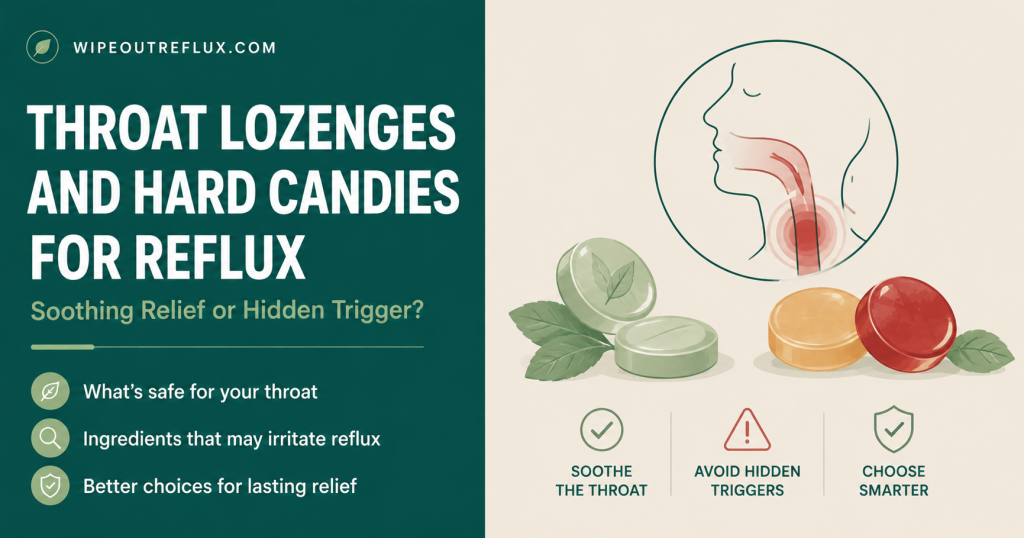
Reaching for a throat lozenge or a hard sweet when your throat feels raw is one of the most natural instincts there is — but with reflux, whether it helps or hurts depends entirely on which one you grab.
Here’s the honest answer up front. The act of sucking on something is genuinely good for a reflux-irritated throat, because it makes you produce more saliva, and saliva is one of your body’s best natural defences against acid. So a plain, non-acidic, non-minty lozenge or hard candy can soothe and even protect. The problem is that two of the most common types — menthol cough drops and sour or citrus sweets — do the opposite, and most people reach for exactly those.
So it’s not a simple yes or no. Let me explain why saliva helps, which lozenges and candies to avoid, and which ones are actually worth keeping in your pocket.
Key Takeaways
- Sucking on a lozenge or hard candy stimulates saliva, which neutralises acid and helps wash it out of your esophagus — a real, measured benefit.
- Saliva is especially soothing for a silent reflux (LPR) throat, where the raw, tickly feeling comes from acid and pepsin irritating delicate tissue.
- Avoid menthol and peppermint cough drops — mint can relax the valve at the top of your stomach and let more reflux through.
- Avoid sour, citrus and acidic hard candies — they sit below the pH that reactivates pepsin in your throat.
- The best options are plain, non-acidic hard sweets for saliva, or soothing demulcent lozenges like DGL licorice, slippery elm and marshmallow root.
- Watch the sugar, especially for your teeth, since reflux already puts your enamel under strain.
- Lozenges soothe the symptom — they don’t fix the reflux causing it, so they work best alongside actually calming the reflux.
Why sucking on something helps at all: the saliva effect
This is the mechanism that makes the whole question make sense, so it’s worth a moment. Saliva isn’t just water — it’s mildly alkaline and rich in bicarbonate, the same buffering ingredient in antacids. When you swallow saliva, it carries that bicarbonate down into your esophagus, neutralising leftover acid, and the swallowing itself helps physically clear acid back down into your stomach.
This has been demonstrated directly. In a classic experiment, stimulating saliva with an oral lozenge measurably shortened the time it took to clear acid from the esophagus, while removing saliva from the mouth almost abolished acid clearance altogether — and the neutralising power was shown to come primarily from bicarbonate Helm et al., New England Journal of Medicine, 1984. In other words, a lozenge speeding up acid clearance isn’t a folk remedy — it’s a documented effect.
You see the same thing with its close cousin, chewing gum. When reflux patients chewed sugar-free gum for half an hour after a meal, the amount of time their esophagus spent exposed to acid dropped significantly Moazzez et al., Journal of Dental Research, 2005. A hard candy or lozenge works through the very same route — more saliva, more swallowing, faster clearance. It’s essentially chewing gum for acid reflux without the chewing, and it draws on the same salivary bicarbonate defence your body already uses.
Why this matters even more for silent reflux (LPR)
If your reflux is the throat-based, silent kind, saliva is doing something you can actually feel. In LPR, the raw, scratchy, tickly sensation and the constant urge to clear your throat come from acid and the enzyme pepsin irritating the delicate lining of your throat and voice box. A steady flow of saliva coats and moistens that tissue, dilutes what’s sitting on it, and buffers the acid that keeps the pepsin active.
That’s why a good lozenge can genuinely take the edge off a reflux sore throat and quiet the throat clearing for a while. It won’t heal the underlying problem, but as symptom relief in the moment, keeping your throat wet is one of the simplest things that helps.
The lozenges and candies to avoid
Here’s where the wrong choice quietly undermines you. Three ingredients turn a soothing habit into a trigger.
Menthol and peppermint — the big trap
This is the catch most people miss: the majority of throat and cough lozenges are built around menthol, eucalyptus or peppermint. They feel like they’re helping because menthol creates a cooling, numbing sensation — but mint is a well-recognised reflux trigger. It can relax the lower esophageal sphincter, the valve meant to keep stomach contents down, and a looser valve means more reflux getting through. So the classic cough drop you’d instinctively reach for may cool your throat while letting more acid up behind the scenes. The same caution applies to peppermint tea and other mint products.
Sour, citrus and acidic hard candies
Sour sweets, lemon drops, citrus candies and anything with a sharp tang are usually acidic by design — they get that pucker from added citric or malic acid. That drops them well below pH 5, which is the threshold where acid starts reactivating the pepsin already lodged in your throat. So a lemon or sour candy can pour acid directly onto the tissue you’re trying to calm. If you want the science on why that specific number matters, it’s the same reason added citric acid is a problem for reflux.
Sugar and sugar alcohols
Plain sugar isn’t acidic, so it won’t reactivate pepsin, but heavy sugar loads aren’t ideal and are rough on teeth that reflux has already weakened. Sugar-free options solve the sugar issue but often use sorbitol, xylitol or mannitol, which in any quantity can cause gas and bloating — and extra gas pressure is its own reflux trigger. A little is fine; a steady stream all day isn’t. There’s more on where sugar sits for reflux if you want the detail.
The better options to keep in your pocket
Now the good news — there are lozenges and sweets that give you the saliva benefit without the triggers.
Plain, non-acidic hard candy
For pure saliva stimulation, a plain boiled sweet does the job: think butterscotch, honey drops, or simple fruit-flavoured hard candy that isn’t sour or citrus. The flavour barely matters — you’re after the sucking and swallowing, not the taste. Just keep it non-minty and non-sour and you get the clearance benefit with none of the downside.
Demulcent lozenges that coat and soothe
These are the real stars for a reflux throat, because they add a soothing, coating layer on top of the saliva effect. DGL (deglycyrrhizinated licorice) lozenges are a long-standing favourite and are designed to be chewed or sucked. Slippery elm and marshmallow root lozenges work by forming a slick, gel-like film that coats irritated tissue — genuinely calming when your throat is raw. These are the ones I’d reach for over a standard pharmacy cough drop.
Honey-based lozenges
Honey is soothing and mildly antibacterial, and a honey lozenge is a gentle, non-acidic option that also keeps saliva flowing. Manuka honey in particular has a following among reflux sufferers for coating and calming the throat.
How to use them well
A few practical rules keep lozenges on the helpful side of the ledger. Use them when your throat is actually raw or after meals, when saliva does the most good, rather than sucking constantly out of habit. Read the ingredients before you buy — check for menthol, peppermint, and citric or malic acid, which rules out a surprising number of standard cough drops. Favour the demulcent and plain options over medicated ones. And don’t let a bag of sweets become an all-day thing, both for the sugar and because no lozenge is meant to be a treatment.
That last point is the important one. A lozenge soothes the symptom; it does nothing about the reflux creating the symptom. If you’re going through packet after packet to keep your throat bearable, that’s a sign the reflux itself needs addressing — and that’s where real, lasting relief comes from. Building your days around a genuinely reflux-friendly, low-acid way of eating is the foundation, which is exactly what the Wipeout Diet Plan and the low-acid reflux diet are built around.
Conclusion
So, are throat lozenges and hard candies good or bad for acid reflux? Both, depending on what you pick. The saliva they trigger is genuinely protective — it neutralises acid, speeds its clearance, and coats a raw throat — so a plain, non-acidic, non-minty sweet or a soothing DGL, slippery elm or marshmallow lozenge can be a real comfort. What sabotages people is grabbing the menthol cough drop or the sour candy, both of which quietly make reflux worse even as they seem to help. Read the label, skip the mint and the sour, and you turn a small habit into a genuinely useful one.
Just remember what a lozenge can and can’t do. It buys you comfort in the moment; it doesn’t stop the reflux that’s irritating your throat in the first place. That’s the job of calming the reflux at its source, and it’s exactly what the Wipeout Diet Plan is built for — the complete, in-depth system for getting reflux under control so your throat stops needing rescuing. I designed it first and foremost around LPR and silent reflux, the stubborn throat-based kind that keeps you reaching for lozenges, but because it works on the same underlying mechanisms it’s just as effective for GERD, heartburn and everyday acid reflux.
And to make the daily choices easy, the Wipeout Food Reference Guide is the essential companion — a downloadable reference to which foods, drinks and sweets are safe for reflux and their pH values, so you can tell at a glance which lozenge or candy is soothing your throat and which is aggravating it. Keep a good lozenge in your pocket for the raw moments, but fix the reflux underneath — that’s how the throat finally settles.
Frequently Asked Questions
Are cough drops bad for acid reflux?
Many are, because most cough drops are based on menthol, peppermint or eucalyptus, and mint can relax the valve that keeps stomach acid down. They cool and numb the throat, which feels helpful, but they may let more reflux through. Look for non-menthol, demulcent lozenges instead.
Do throat lozenges help silent reflux (LPR)?
A well-chosen one can genuinely soothe an LPR throat. Sucking a lozenge boosts saliva, which coats and moistens the raw tissue and buffers the acid that keeps pepsin active. It’s real symptom relief — just not a cure — so pick non-minty, non-acidic ones and keep treating the underlying reflux.
Is hard candy bad for acid reflux?
Plain, non-sour hard candy is generally fine and can even help by stimulating saliva. The ones to avoid are sour and citrus candies, which are acidic enough to reactivate throat pepsin, and mint sweets, which can loosen the valve. Watch the sugar too, since reflux already stresses your tooth enamel.
Are menthol lozenges bad for reflux?
Menthol and peppermint are classic reflux triggers because they can relax the lower esophageal sphincter. If your reflux is stubborn, it’s worth switching from menthol cough drops to a non-mint, soothing lozenge such as DGL, slippery elm or marshmallow root.
What’s the best lozenge for a reflux sore throat?
Demulcent lozenges — DGL licorice, slippery elm or marshmallow root — are usually the best fit, because they add a soothing coating on top of the saliva benefit and contain no mint or acid. A plain honey lozenge is another gentle option. Standard menthol cough drops are the ones to skip.
Can I suck on candy instead of chewing gum for reflux?
Yes — a hard candy stimulates saliva through the same route as gum, so it offers a similar acid-clearing benefit if chewing isn’t for you. Just choose a plain, non-acidic, non-minty sweet, and don’t keep one going all day because of the sugar.
Research & References
- Stimulating saliva with an oral lozenge significantly shortened esophageal acid clearance time, while removing saliva from the mouth nearly abolished it; saliva’s acid-neutralising ability was shown to come primarily from bicarbonate Helm et al., New England Journal of Medicine, 1984.
- Reflux patients who chewed sugar-free gum for 30 minutes after a meal had significantly less postprandial esophageal acid exposure than when they did not, attributed to increased salivation and swallowing improving acid clearance Moazzez et al., Journal of Dental Research, 2005.
- A strict low-acid diet keeping foods and drinks above pH 5 improved symptoms in patients with stubborn laryngopharyngeal reflux, establishing the pH 5 threshold below which acidic items — including sour and citrus candies — can reactivate throat pepsin Koufman, Annals of Otology, Rhinology & Laryngology, 2011.

David Gray
12 years living with LPR · Consultant & researcher
I've lived with LPR for twelve years — the misdiagnoses, the PPI courses that did nothing, the slow work of figuring out what actually helps. Wipeout Reflux is where I translate the research into plain terms for people stuck in the same place. Every claim here is sourced to peer-reviewed work, and I consult one-to-one with LPR sufferers.