
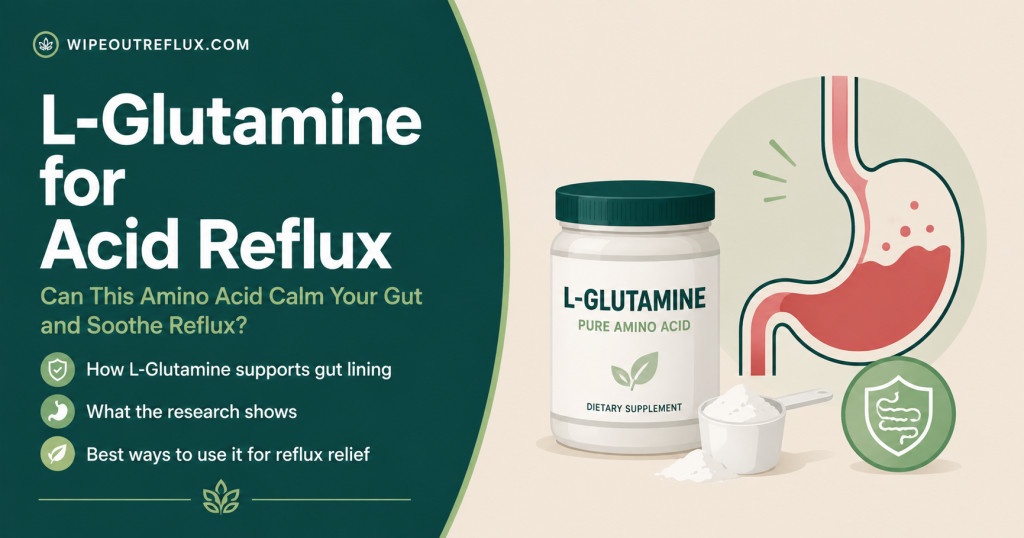
Here’s the honest version: L-glutamine is a genuine gut-lining nutrient, so the idea behind taking it for reflux isn’t nonsense — but the direct evidence that it heals the lining in acid reflux is thin. Glutamine is the main fuel your gut-lining cells run on, and it plays a real role in keeping the intestinal barrier intact and helping it repair. That’s why it shows up in every “heal your gut” protocol going.
The catch is where that evidence comes from. Almost all of it looks at the intestine and the stomach — not the oesophagus or the throat, and not in people with GERD or silent reflux. So when a supplement label promises L-glutamine will “repair your reflux-damaged lining,” it’s stretching solid gut-barrier science to cover tissue it was never really tested on. It might help as a supporting player, it’s low-risk to try, but it is not a proven reflux treatment, and it won’t stop the reflux that’s doing the damage in the first place.
Let me walk through what glutamine genuinely does, where the evidence runs out, how it stacks up against other “lining” supplements, and why no supplement can heal a lining that’s still under fire.
Key Takeaways
- L-glutamine is the primary fuel for the cells lining your gut and genuinely supports the intestinal barrier and its repair.
- But that evidence is from the intestine and stomach — not the oesophagus or throat, and not in reflux patients.
- There’s no solid clinical proof that L-glutamine heals the reflux-damaged lining or treats GERD or silent reflux.
- It won’t stop reflux happening, and no lining can heal while acid and pepsin keep hitting it.
- It’s low-risk at typical doses (often around 5 g), so trying it as an adjunct is reasonable — just don’t expect a cure.
- Other lining-support options like zinc-carnosine and soothing demulcents have more direct reflux relevance.
- The real fix is cutting the acid exposure so the lining can finally repair — that’s what diet does.
What is L-glutamine, and why the “gut lining” claim?
L-glutamine is an amino acid — a building block of protein — and it’s the single most abundant one in your bloodstream. It’s usually called “conditionally essential,” meaning your body makes plenty most of the time, but during illness, injury or major stress your demand can outstrip supply.
The reason it’s tied to the gut is genuinely interesting: the cells lining your intestine renew themselves every few days, and glutamine, not glucose, is their preferred fuel for that constant turnover. In a detailed review, glutamine was shown to be essential for the proliferation, integrity and repair of the intestinal lining, and to help maintain the tight junctions that seal the barrier between your gut and your bloodstream Wang et al., Amino Acids, 2015. So the underlying biology — glutamine feeds and helps rebuild a gut lining — is real. That’s the seed the reflux claims grew from.
What the evidence actually shows
Where glutamine has been tested, it does tend to support and protect mucosal tissue. Beyond the intestinal-barrier work above, an animal study found that supplemental dietary glutamine reduced inflammation and damage in the stomach lining during Helicobacter pylori infection Hagen et al., Journal of Nutrition, 2009. It’s also a staple of clinical nutrition for people with serious gut injury. So there’s a consistent thread: give the gut lining its favourite fuel, and it copes better with insults.
But notice what all of that is about — the intestine and the stomach, in animals or in critically ill patients. That’s a long way from the oesophagus and throat of someone with everyday reflux, and it’s the gap the marketing quietly skips over.
Does it actually help the reflux lining?
This is the honest heart of it: we don’t really know, because it hasn’t been properly tested. There’s no good clinical trial of L-glutamine for GERD, for silent reflux, or for healing the oesophageal or throat lining specifically. The case for it rests entirely on extrapolation — “it helps the gut lining, the oesophagus has a lining, therefore it should help” — and that’s a reasonable hypothesis, not a proven fact.
There’s also a biological wrinkle. The oesophagus and throat aren’t built like the intestine. Your gut lining is a rapidly renewing, absorptive surface that pulls glutamine straight from the blood; the oesophageal lining is a tougher, layered barrier that isn’t designed to soak up amino acids from whatever you swallow. So even the mechanism that makes glutamine so useful in the gut doesn’t obviously transfer to the tissue reflux actually damages. If you want to know whether your throat is genuinely recovering, the signs I describe in is my LPR healing will tell you far more than any supplement label.
The bigger issue: a lining can’t heal while it’s under fire
Even if L-glutamine does lend the tissue a hand, it runs into a wall that trips up every “healing” supplement for reflux: you can’t repair a lining that’s still being burned several times a day. In silent reflux especially, the damage is driven by an enzyme called pepsin that lodges in the throat and reactivates every time it meets acid, so the tissue never gets a clean break to recover. That’s the connection I explain in GERD versus silent reflux.
This is why cutting the acid exposure comes first. A strict low-acid diet produced dramatic symptom improvement in patients with stubborn silent reflux — precisely because it finally gave the inflamed lining a chance to heal Koufman, Annals of Otology, Rhinology & Laryngology, 2011. No amino acid can out-supplement a lining that keeps getting re-injured, which is why I always start people with the exposure, not the pill — and it’s the whole logic behind my Wipeout Diet Plan. Think of any lining supplement as a possible helper after you’ve stopped the acid, never instead of it. You can read more on the whole picture in gut health and acid reflux.
How L-glutamine compares to other “lining” supplements
If your goal is specifically to support a healing lining, a few options have more direct reflux relevance than glutamine:
- Zinc-carnosine has the most direct evidence for supporting the gut and oesophageal lining and is often a better first choice — I cover it in zinc-carnosine for acid reflux.
- Demulcents like slippery elm and marshmallow root form a soothing coat over irritated tissue, giving more immediate comfort.
- DGL (deglycyrrhizinated licorice) is traditionally used to support the stomach lining — see DGL for acid reflux and LPR.
None of these are cures either, but they sit on firmer ground for reflux than glutamine does. You’ll find how I rank the whole shelf in supplements for LPR.
If you want to try L-glutamine anyway
It’s a low-risk supplement, so trying it as an adjunct is reasonable — just keep your expectations realistic. It’s typically taken as a powder of a few grams (around 5 g is common) dissolved in water, and it’s generally well tolerated. A few sensible notes: treat it as a possible support while you fix the reflux itself, not as the treatment; give any lining-support approach weeks, not days; and if you have liver or kidney problems, or you’re on medication, check with your doctor first, since glutamine is metabolised by those organs. Above all, don’t let a supplement distract you from the change that actually moves the needle — reducing the acid.
Conclusion
So, does L-glutamine help the lining in acid reflux? It’s a real gut-lining nutrient with genuine evidence behind it — but that evidence is about the intestine and stomach, not the oesophagus or throat, and there’s no solid proof it heals reflux damage or treats GERD or LPR. It’s low-risk, and as a supporting player once your reflux is under control it may do no harm and might help a little. Just don’t mistake it for the fix, because it can’t stop the reflux that’s causing the damage.
That fix — cutting the acid and pepsin exposure so your lining finally gets the quiet it needs to repair — is exactly what my Wipeout Diet Plan is built to deliver. It’s the complete, in-depth system for getting reflux under control for good, so healing can actually happen rather than being endlessly undone. I designed it first and foremost around LPR, the stubborn throat-based kind that’s hardest to treat, but because it works on the same underlying reflux mechanisms, it’s just as effective for GERD, heartburn and everyday acid reflux.
And for the day-to-day question of which foods and drinks calm your symptoms versus feed them, the Wipeout Food Reference Guide is the essential companion — it lays out the real pH values of foods and drinks for acid reflux and LPR, so you always know what’s helping your lining and what’s hurting it. Stop the acid first, let the tissue recover, and you’ll get far more from any supplement you decide to add on top.
Frequently Asked Questions
Does L-glutamine heal the esophagus or throat in acid reflux?
There’s no solid clinical evidence that it does. Glutamine genuinely supports the intestinal and stomach lining, but that research hasn’t been extended to the oesophagus or throat, or to reflux patients. It may help as an adjunct, but it isn’t a proven treatment for reflux-damaged tissue.
Is L-glutamine safe to take for acid reflux?
For most people, yes — it’s a well-tolerated amino acid, usually taken as a few grams of powder in water. If you have liver or kidney problems or take regular medication, check with your doctor first, since those organs metabolise glutamine. Treat it as a low-risk experiment, not a guaranteed fix.
How much L-glutamine should I take for gut and reflux support?
Doses in gut research commonly land around 5 g, sometimes split through the day, but there’s no established dose for reflux specifically because it hasn’t been properly studied. Start conservatively, give it a few weeks, and judge it as one part of a plan that’s mainly built on reducing acid exposure.
Is L-glutamine or zinc-carnosine better for the reflux lining?
Zinc-carnosine has more direct evidence for supporting the gut and oesophageal lining, so it’s often the better first choice if lining repair is your goal. Glutamine’s evidence is strong for the intestine but doesn’t clearly transfer to reflux. Neither is a cure — both work best alongside cutting acid exposure.
Will L-glutamine stop my acid reflux?
No. Glutamine is a lining-support nutrient, not an anti-reflux treatment — it does nothing to stop acid and pepsin coming up in the first place. Any healing benefit is undone if the reflux continues, which is why reducing exposure through diet and lifestyle has to come first.
Research & References
- A detailed review found that glutamine is the preferred fuel for intestinal lining cells and is essential for their proliferation, integrity and repair, including maintaining the tight junctions that seal the gut barrier — the basis for glutamine’s “gut-lining” reputation Wang et al., Amino Acids, 2015.
- An animal study found that supplemental dietary glutamine reduced inflammation and damage in the stomach lining during Helicobacter pylori infection, showing a mucosal-protective effect — though in the stomach, in mice, not the oesophagus in reflux patients Hagen et al., Journal of Nutrition, 2009.
- A strict low-acid diet (keeping foods and drinks above about pH 5 for at least two weeks) improved symptoms in the majority of patients with stubborn, medication-resistant laryngopharyngeal reflux — underscoring that reducing acid exposure is what lets the lining heal Koufman, Annals of Otology, Rhinology & Laryngology, 2011.
- A study of patients with laryngopharyngeal reflux found that a plant-based, Mediterranean-style diet with alkaline water was about as effective as proton pump inhibitor medication at reducing symptoms — reinforcing that calming reflux at its source, not supplementing over it, is the priority Zalvan et al., JAMA Otolaryngology–Head & Neck Surgery, 2017.

David Gray
12 years living with LPR · Consultant & researcher
I've lived with LPR for twelve years — the misdiagnoses, the PPI courses that did nothing, the slow work of figuring out what actually helps. Wipeout Reflux is where I translate the research into plain terms for people stuck in the same place. Every claim here is sourced to peer-reviewed work, and I consult one-to-one with LPR sufferers.