
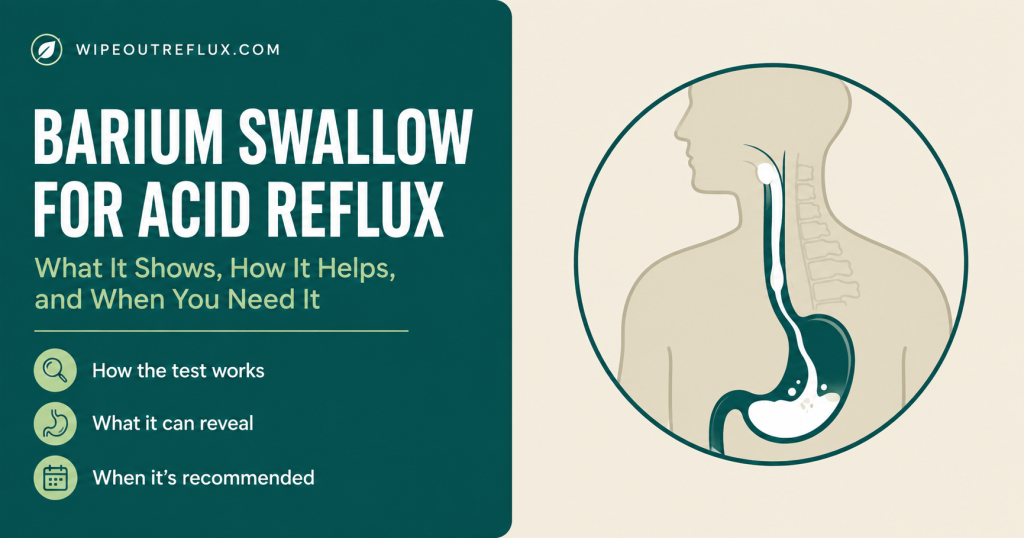
A barium swallow is an X-ray study, not a reflux test. It’s very good at showing the shape and plumbing of your oesophagus — a hiatal hernia, a stricture, a ring, a narrowing, a pouch, or a swallowing problem — and it’s the go-to test when something feels like it’s physically sticking or not going down. What it’s genuinely poor at is answering the question most people come in with: “do I have acid reflux?”
The reason is simple. A barium swallow captures a few minutes of your oesophagus in action. Reflux is an intermittent, all-day, all-night event. Catching a splash of barium washing back up during those few minutes is hit-and-miss, and not catching it tells you almost nothing. So a normal barium swallow doesn’t rule reflux out, and a bit of barium refluxing on the table doesn’t prove your symptoms are caused by acid either.
Below is the honest version of what this test does and doesn’t do — what the radiologist can actually see, why it’s a structural test rather than a reflux test, where it beats an endoscopy, and which test you probably want instead if the real question is whether reflux is driving your symptoms. It’s written US-first, with UK and NHS terms flagged where they differ.
Key Takeaways
- A barium swallow is a real-time X-ray (fluoroscopy) of you swallowing liquid barium — it images structure and movement, not acid.
- It’s excellent for hiatal hernias, strictures, Schatzki rings, webs, pouches, and motility problems like achalasia and oesophageal spasm.
- It’s a weak test for diagnosing acid reflux itself: spontaneous barium reflux is caught in only a minority of true refluxers, and provocation like the water-siphon test only lifts sensitivity to around 70% at the cost of specificity.
- It cannot take biopsies, so it can’t confirm Barrett’s oesophagus or eosinophilic oesophagitis — the two things a scope is really there to catch.
- It’s insensitive to mild inflammation; a lot of reflux damage that an endoscopy would see is invisible on barium.
- Major guidelines don’t recommend a barium swallow as a diagnostic test for GERD — it’s chosen to answer anatomical questions, not to confirm reflux.
- It’s the right first test when the main problem is difficulty swallowing or suspected obstruction, and it’s routine before anti-reflux surgery to map the anatomy.
- For silent reflux (LPR), a barium swallow rules out very little — the useful tests there are different.
- It involves a modest dose of radiation and no sedation, and you can eat and drive straight afterwards.
What a Barium Swallow Actually Is
Barium sulphate is a thick, chalky, radio-opaque liquid — it blocks X-rays, so anything it coats or fills shows up bright white on the screen. You stand (or lie) at a fluoroscopy unit, which is essentially a live X-ray video camera, and you drink the barium on cue while the radiologist watches it travel down in real time and takes still images along the way.
There are a few variants, and the names get muddled, so it’s worth separating them:
- Barium swallow / oesophagram — focused on the oesophagus itself. This is the one relevant to reflux and swallowing complaints.
- Upper GI series — the same idea extended down to the stomach and the first part of the small intestine.
- Double-contrast study — barium plus gas crystals that puff the oesophagus open, coating the lining so the radiologist can see finer surface detail. Better for mucosal detail than a plain single-contrast (full-column) study.
- Modified barium swallow (MBS) — a different test entirely, run with a speech therapist to study choking and aspiration in the throat during swallowing. If your issue is reflux, this usually isn’t the one you want, even though the name sounds identical.
The whole thing takes around 15 to 30 minutes, needs no sedation, and you walk out and carry on with your day. That convenience is a big part of why the test is still ordered so often, and why some radiologists argue it deserves a place as a quick, non-invasive first look Levine et al., American Journal of Roentgenology, 2016.
What a Barium Swallow CAN Show
This is where the test earns its keep. Because barium fills and coats the oesophagus, it renders the anatomy beautifully — often better than a camera can, for certain problems. Here’s what a good oesophagram picks up.
Hiatal hernia. When the top of the stomach slides up through the diaphragm, barium shows the pouch and the position of the junction clearly. It’s one of the things the test does best; in a preoperative series comparing methods, the barium swallow flagged hiatal hernias more often than either high-resolution manometry or endoscopy did Weitzendorfer et al., European Surgery, 2017. A hernia matters because it’s one of the mechanical reasons the anti-reflux barrier fails in the first place.
Strictures and narrowing. If reflux has scarred the lower oesophagus into a narrowed segment, barium outlines exactly where and how tight it is — useful information a scope has to bump into to find. Barium can also help sort a benign, smooth, reflux-related stricture from a more irregular, worrying one.
Rings and webs. A Schatzki ring — a thin band at the lower oesophagus that causes food to stick — is a classic case where barium beats endoscopy, especially when you swallow a solid bolus or barium tablet to provoke the hold-up. Subtle rings and webs that a camera glides straight past can be obvious on a well-performed study Levine et al., Clinical Gastroenterology and Hepatology, 2008.
Motility problems. Because fluoroscopy is a video, it captures movement. It can show the oesophagus failing to squeeze in a coordinated wave, the corkscrew pattern of oesophageal spasm, or the smoothly tapering “bird’s-beak” of achalasia, where the lower valve won’t relax. These are conditions that masquerade as reflux, and barium is often the test that first raises the flag before formal oesophageal manometry confirms it.
Pouches, ulcers and masses. Diverticula, deep ulcers, and larger tumours all distort the barium column in ways a radiologist recognises. It’s not the test for cancer screening — that’s endoscopy with biopsy — but a mass big enough to matter usually shows.
Put simply, if your symptom is food sticking or trouble swallowing, a barium swallow is a sensible, informative first step. The problem starts when it gets used to answer a different question.
Can a Barium Swallow Diagnose Acid Reflux? Not Really
Here’s the crux, and it’s where most of the confusion lives. Yes, a radiologist can sometimes watch barium wash back up from the stomach into the oesophagus during the study — that’s “reflux” on the report. But that single observation is a poor stand-in for the diagnosis of reflux disease, for two reasons.
First, the timing problem. Reflux happens dozens of times over a day, often after meals and lying down, and it comes and goes. The barium swallow watches for a handful of minutes while you’re upright and swallowing on command. Catching a reflux event in that window is largely luck. When radiologists relied on spontaneous reflux alone — just watching for barium to come back up — they detected it in only a small minority of people who genuinely had reflux on pH testing Thompson et al., American Journal of Roentgenology, 1994.
Second, the provocation trade-off. To improve the odds, radiologists use manoeuvres — coughing, straining, rolling, and the water-siphon test, where you sip water while lying down to try to trigger reflux. This does raise the hit rate: sensitivity climbs to somewhere around 70%. But it comes at a cost to specificity, which drops into the mid-70s or lower, meaning the test now also “finds” reflux in plenty of people who don’t have significant disease Dane et al., American Journal of Roentgenology, 2018. You can make the test more likely to say yes, but the yeses become less trustworthy.
So the two results people most want to lean on are the two that mislead most easily. A negative barium swallow does not mean you don’t have reflux — it very often just means the test didn’t happen to catch it. A positive one (some barium refluxing) doesn’t confirm that acid is the cause of your symptoms, because a little reflux on the table is common and doesn’t tell you how acidic it was or how long it lingers. This is exactly why major gastroenterology guidance doesn’t recommend a barium swallow as a diagnostic test for GERD, and steers reflux questions towards endoscopy and direct reflux monitoring instead Katz et al., The American Journal of Gastroenterology, 2022. If you want the full map of how reflux actually gets diagnosed, I’ve laid it out in how acid reflux is diagnosed.
What a Barium Swallow CAN’T Show
Beyond the reflux-detection weakness, there are whole categories of thing this test simply can’t reach.
Fine mucosal damage. Barium coats a surface; it doesn’t visualise it in colour and detail the way a camera does. Mild and moderate reflux oesophagitis — the early breaks and redness in the lining — are largely invisible on barium. Only more advanced damage, like deeper ulcers or gross narrowing, tends to show. So a clean barium swallow says nothing reassuring about inflammation.
Barrett’s oesophagus. Barium may hint at features that raise suspicion, but Barrett’s is defined by what the tissue looks like under a microscope. No barium study can confirm it, because there’s no way to take a sample. If Barrett’s is the concern — and it can be, even in longstanding silent reflux — you need a scope.
Eosinophilic oesophagitis. EoE is the great mimic of reflux that never responds to acid suppression. It can produce rings or a narrow-calibre oesophagus that barium sometimes shows, but the diagnosis absolutely requires counting a specific type of immune cell on biopsy. The oesophagus can look normal on barium and be full of these cells — so barium can’t rule EoE in or out. More on why this one matters in eosinophilic esophagitis vs acid reflux.
Actual acid exposure. This is the big one. A barium swallow never measures pH. It can’t tell you how much acid reaches your oesophagus, for how long, or whether your symptoms line up with reflux events in time. Those questions belong to pH or pH-impedance monitoring — a catheter or a wireless Bravo pH capsule that records over 24 to 96 hours. That’s the difference between a snapshot of the plumbing and a day-long log of what’s actually flowing through it.
Barium vs Endoscopy vs pH Testing — Which Answers What
It helps to stop thinking of these as competing tests and see them as answering different questions.
A barium swallow answers “what does the anatomy look like, and does it move properly?” — hernia, stricture, ring, pouch, motility. An endoscopy answers “what does the lining look like up close, and what does the tissue show?” — inflammation, Barrett’s, EoE, ulcers, and it can biopsy and even treat (dilating a stricture) in the same sitting. Reflux monitoring (pH or pH-impedance) answers the one thing neither of the others can: “is reflux actually happening, how much, and does it match the symptoms?”
Seen that way, ordering a barium swallow to confirm reflux is a bit like using a road map to check whether it’s raining. It’s a good map. It’s just not built to answer that question. For a proper comparison of the camera-based route, see endoscopy for acid reflux, and for the whole diagnostic toolkit including where each test fits, the Wipeout Diet Plan walks through the practical side of what a diagnosis actually changes about your day-to-day management.
When a Barium Swallow Is Actually the Right Test
None of this makes the test useless — it makes it specific. A barium swallow is a good choice when:
- Swallowing is the main problem. Food sticking, a sense of hold-up, or painful swallowing points to a structural or motility cause, and barium is a fast, low-risk first look before or alongside a scope.
- A ring, web or subtle stricture is suspected. These are exactly the lesions barium catches better than a camera, especially with a solid bolus or barium tablet to provoke the hold-up.
- A motility disorder is on the table. Suspected achalasia or spasm often shows first on barium, which then leads to confirmatory manometry.
- You’re being worked up for anti-reflux surgery. Surgeons routinely want a barium map of the anatomy — oesophageal length, hernia size and whether it reduces — before operating, because it shows things a scope can misjudge.
Notice that “confirming everyday heartburn” isn’t on that list. If your symptoms are classic reflux with no swallowing difficulty and no alarm features, guidelines generally favour a trial of treatment first, then endoscopy and reflux monitoring if needed — not a barium swallow Katz et al., The American Journal of Gastroenterology, 2022.
Barium Swallow and Silent Reflux (LPR): A Specific Warning
If your symptoms are throat-based — chronic throat clearing, a lump sensation, hoarseness, post-nasal drip, a nagging cough — a barium swallow is an especially weak test for what you have. Silent reflux, or LPR, involves small, often gaseous amounts of refluxate reaching the throat and voice box. That kind of brief, fine exposure barely disturbs the barium column, so the study is typically normal and rules out very little.
It’s still worth doing if there’s a swallowing component to exclude a structural cause — but it won’t confirm LPR. For that, the more informative tools are symptom scoring with the Reflux Symptom Index, pharyngeal pH monitoring such as Restech, or salivary pepsin testing like Peptest. Walk into a barium swallow expecting it to prove silent reflux and you’ll walk out frustrated; walk in knowing it’s there to exclude a physical obstruction and it’s doing its job.
What to Expect: Prep, the Test and Radiation
Prep. You’ll usually be asked not to eat or drink for around six hours beforehand so the oesophagus and stomach are empty. Check whether the clinic wants you off any specific medication — most can be taken with a small sip of water.
The test. You’ll drink the barium in mouthfuls on the radiographer’s cue, sometimes swallow gas-producing crystals for a double-contrast view, and possibly a barium tablet or marshmallow if a ring or stricture is suspected. You may be tipped or rolled to different positions. The barium tastes chalky and can make you a little constipated for a day or two, and it turns your stool pale — both normal. Drink plenty of water afterwards.
Radiation. Fluoroscopy uses ionising radiation, so unlike an endoscopy there’s a small dose involved — typically on the order of a millisievert or two, comparable to a few months of natural background radiation. It’s a low-risk exposure, but it’s a real reason not to order the test casually when it isn’t going to answer the question. There’s no sedation, no recovery period, and you can eat and drive straight afterwards — the trade-off that makes it convenient is the same one that makes the radiation worth a moment’s thought.
Conclusion
A barium swallow is a genuinely good test — for the right question. It maps the structure and movement of your oesophagus, catches hernias, strictures, rings and motility disorders, and it does it quickly and without sedation. What it doesn’t do is tell you whether reflux is happening, how acidic it is, or whether it’s the thing behind your symptoms. A normal study doesn’t clear you of reflux, and a splash of barium coming back up doesn’t convict it. If the real question is “is reflux causing this,” the barium swallow is the wrong tool, and endoscopy plus reflux monitoring is the right one.
Here’s the more useful reframe, though. Whichever test you have, the finding that changes your life isn’t on the X-ray — it’s what you do next. If reflux is confirmed, the goal stops being “what did the scan show” and becomes “how do I stop the reflux happening at all,” and that’s a dietary and mechanical question far more than a pharmaceutical one. That’s exactly the ground the Wipeout Diet Plan covers — a structured way to cut the reflux events themselves rather than just chasing the acid in them. I built it first and foremost around LPR and silent reflux, the stubborn throat-based form where scans and scopes so often come back clear, but because it works on the same underlying mechanisms it does the job just as well for GERD and everyday heartburn. And if you want somewhere concrete to start today, the Wipeout Food Reference Guide is the essential companion — the full list of which foods and drinks are safe for acid reflux and LPR, with their actual pH values, so you’re working from numbers instead of guesswork.
Frequently Asked Questions
Can a barium swallow detect acid reflux?
Only unreliably. It can occasionally catch barium washing back up during the few minutes of the study, but reflux is an intermittent, all-day event, so a normal result doesn’t rule reflux out and a positive one doesn’t prove it’s causing your symptoms. Provocation like the water-siphon test raises the detection rate to around 70% but makes false positives more likely. To actually measure reflux, you need pH or pH-impedance monitoring.
What’s the difference between a barium swallow and an endoscopy?
A barium swallow is an X-ray that shows the shape and movement of the oesophagus — hernias, strictures, rings, motility. An endoscopy is a camera that shows the lining up close and can take biopsies, which is how inflammation, Barrett’s and eosinophilic oesophagitis are actually diagnosed. They answer different questions, and for reflux the scope is usually more informative.
Will a barium swallow show a hiatal hernia?
Yes — this is one of the things it does best. Barium clearly outlines the stomach sliding up through the diaphragm, and in preoperative studies it detects hiatal hernias at least as often as endoscopy or manometry.
Does a barium swallow hurt?
No. It’s not invasive — you just drink the barium and get X-rayed while you swallow. The barium is chalky and unpleasant to some people, and you may be moved into different positions, but there’s no pain, no tube and no sedation.
Is a barium swallow better than an endoscopy for reflux?
No. For confirming reflux and assessing its damage, endoscopy (which can biopsy) and pH monitoring (which measures acid) are both more useful. A barium swallow wins when the question is structural — especially difficulty swallowing, a suspected ring or stricture, or a motility disorder.
Why did my barium swallow come back normal if I clearly have reflux?
Because the test images anatomy in a short window, not acid over time. Most reflux leaves no structural mark the study can see, and the test simply may not catch a reflux event during those few minutes. A normal barium swallow is common in people with real reflux and doesn’t mean your symptoms aren’t real.
Can a barium swallow diagnose silent reflux (LPR)?
Not reliably. LPR involves small, often gaseous amounts of refluxate reaching the throat, which barely register on a barium study. It’s useful for excluding a structural cause of throat or swallowing symptoms, but LPR is better assessed with symptom scoring, pharyngeal pH monitoring or salivary pepsin testing.
How much radiation is in a barium swallow?
A modest amount — typically around a millisievert or two, similar to a few months of everyday background radiation. It’s a low-risk dose, but because there is one, the test is best reserved for questions it can actually answer rather than ordered routinely.
Research & References
- Katz et al., The American Journal of Gastroenterology, 2022 — ACG clinical guideline for the diagnosis and management of gastro-oesophageal reflux disease. Does not recommend a barium swallow solely as a diagnostic test for GERD, and directs diagnosis towards endoscopy (first-line for dysphagia or alarm features) and reflux monitoring performed off therapy when the diagnosis is unclear.
- Thompson et al., American Journal of Roentgenology, 1994 — Compared barium studies with 24-hour pH monitoring in 117 patients. Detection of spontaneous reflux was insensitive; provocative manoeuvres including the water-siphon test raised sensitivity to roughly 70–71% but lowered specificity to about 74–75%.
- Dane et al., American Journal of Roentgenology, 2018 — Correlated the water-siphon manoeuvre during barium esophagography with endoscopic biopsy findings; the manoeuvre showed a sensitivity of 71.1%, specificity of 65.4% and accuracy of 69.0%, substantially outperforming spontaneous reflux for sensitivity but with limited specificity.
- Weitzendorfer et al., European Surgery, 2017 — Compared barium swallow, high-resolution manometry and endoscopy for preoperative hiatal hernia diagnosis in 112 patients; barium swallow produced the highest hiatal hernia detection rate (76.8%).
- Levine et al., Clinical Gastroenterology and Hepatology, 2008 — Review of barium esophagography’s role in assessing swallowing function, motility disorders such as achalasia and diffuse oesophageal spasm, and morphologic abnormalities including Schatzki rings, webs, strictures and reflux oesophagitis, noting its strength for rings and subtle strictures.
- Levine et al., American Journal of Roentgenology, 2016 — Consensus statement of the Society of Abdominal Radiology disease-focused panel, arguing that because barium esophagography is inexpensive, non-invasive, widely available and needs no sedation, it may be used as an initial test for GERD or alongside other tests such as endoscopy.

David Gray
12 years living with LPR · Consultant & researcher
I've lived with LPR for twelve years — the misdiagnoses, the PPI courses that did nothing, the slow work of figuring out what actually helps. Wipeout Reflux is where I translate the research into plain terms for people stuck in the same place. Every claim here is sourced to peer-reviewed work, and I consult one-to-one with LPR sufferers.