
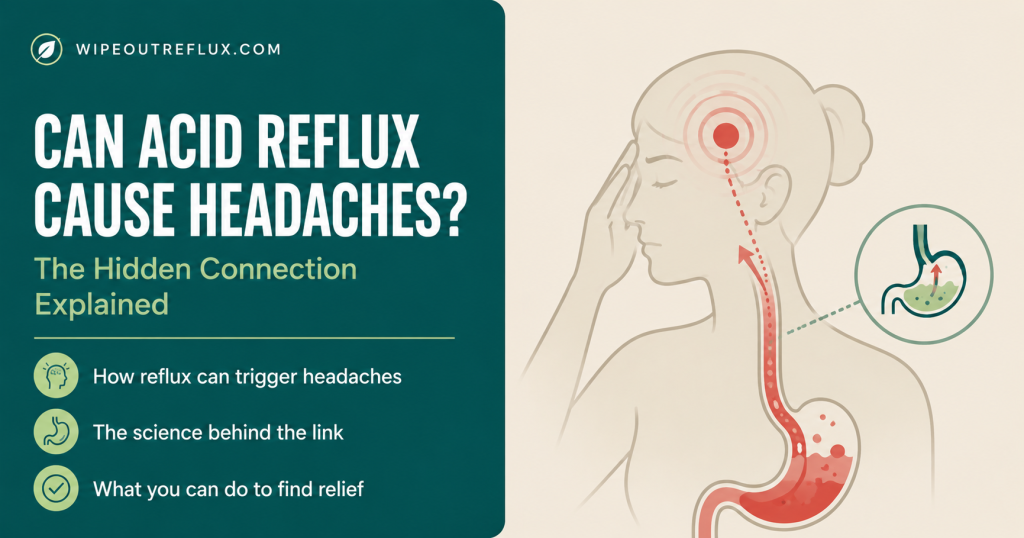
Acid reflux doesn’t cause a headache the direct way it causes heartburn — there’s no acid splashing up into your skull. But the connection between reflux and headaches is real, it’s been shown again and again, and it’s more than coincidence. People with reflux get migraines and tension headaches more often than people without it, and the two conditions clearly travel together.
The catch is that it’s a web of overlapping causes rather than a straight line. Shared nerve wiring, low-grade inflammation, common triggers like stress and broken sleep, an H. pylori infection sitting behind both problems — and, in a twist a lot of people miss, the very medication used to treat reflux can itself trigger headaches. Untangling which thread is pulling on your particular headache is the useful part.
Below is what the evidence actually shows, the mechanisms that plausibly link the two, why your reflux tablets deserve a second look, and when a headache is a sign to stop blaming your stomach and see a doctor instead.
Key Takeaways
- Reflux doesn’t directly cause headaches, but people with GERD get migraines and headaches significantly more often than those without it.
- In one large survey, 22% of migraine sufferers had diagnosed reflux — far above the general rate — and genetic studies hint that reflux may causally raise migraine risk, partly through depression as a shared factor.
- Plausible links include the vagus nerve and brain–gut axis, systemic inflammation, and shared triggers like stress, poor sleep and skipped or late meals.
- Helicobacter pylori, a bacterium behind some reflux and ulcers, is linked to migraine, and eradicating it has improved migraines in trials.
- Reflux medication itself is a common headache culprit: PPIs list headache as a frequent side effect, and acid-suppressing drugs as a group are associated with higher odds of migraine.
- Long-term PPI use can lower magnesium, which can bring on headaches among other symptoms.
- The most useful move is usually to reduce the reflux at its source rather than chase the headache in isolation.
- A sudden, severe, or “worst-ever” headache, or one with neurological symptoms, is never a reflux problem — that needs urgent medical attention.
Is the Reflux–Headache Link Actually Real?
It is, and the evidence is more consistent than you might expect for two problems that seem unrelated. In a large survey of migraine sufferers, 22% had a diagnosis of GERD, another 11.6% had diagnosed heartburn, and a further 15.8% had reflux symptoms they hadn’t yet had diagnosed — rates well above what you’d see in the general population Katic et al., The Journal of Headache and Pain, 2009. Whichever way researchers have looked — starting from headache patients or starting from reflux patients — the same overlap keeps showing up.
More recently, researchers used genetic data to test whether the link is more than people with one complaint simply noticing another. That kind of analysis suggested reflux may actually contribute causally to migraine risk, rather than the two just coexisting, with depression acting as part of the shared pathway between them Shen et al., PLOS One, 2024. So this isn’t a myth or a coincidence — something genuinely connects the gut and the head here.
So Does Reflux Directly Cause Headaches? Not Exactly
Here’s where honesty matters. “Associated with” is not the same as “directly causes.” Reflux almost certainly isn’t reaching up and producing a headache the way it produces a burning chest. What’s far more likely is that the two share underlying machinery and triggers, so anything that stokes one tends to stoke the other. Think of them less as cause-and-effect and more as two symptoms of some of the same background problems.
That framing actually helps you, because it points at several different levers instead of one. Let’s go through the plausible connections.
The Shared Wiring: The Vagus Nerve and Brain–Gut Axis
Your gut and your brain are in constant two-way conversation, and the main cable carrying that conversation is the vagus nerve. It runs from the brainstem down through the oesophagus and stomach, and it carries signals in both directions. When the lower oesophagus is irritated by reflux, those signals travel up the same networks that are involved in pain processing and, in susceptible people, migraine.
This is the same mechanism behind other seemingly-unrelated reflux symptoms — the way reflux can set off tinnitus or heart palpitations, or leave you feeling oddly lightheaded. A sensitive, over-firing brain–gut axis doesn’t keep its effects politely local. It’s a reasonable candidate for why a stomach problem and a head problem so often show up in the same person.
Systemic Inflammation
Chronic reflux keeps a low level of inflammation simmering in the oesophagus, and migraine has an inflammatory component of its own. The theory is that reflux nudges up circulating inflammatory signals, which can lower the threshold at which a migraine-prone brain tips into an attack. It’s not proven to be the mechanism, but it fits the pattern of two inflammatory conditions feeding each other.
Shared Triggers: Stress, Sleep and Meals
This is probably the most practical piece, because it’s where the two conditions most obviously overlap in daily life.
Stress. Stress is a well-known migraine trigger, and it also worsens reflux — it changes how you process pain, tightens everything up, and often comes bundled with worse eating and sleeping. When you’re stressed, both problems tend to flare at once, which makes it look like one caused the other when really a third factor set off both.
Poor sleep. Reflux at night fragments sleep, and nighttime reflux is a classic cause of waking unrefreshed. Poor and broken sleep is itself one of the most reliable migraine triggers, so a night of reflux can set up a headache the next day without any acid ever getting near your head. If reflux is keeping you awake, that alone can explain a morning headache.
Meal timing. Skipping meals or eating very late are triggers for both. Going too long without food is a migraine trigger for many people; eating a large, late meal is a reliable way to provoke reflux overnight. The two habits that wreck your stomach are often the same ones that set off your head.
The Helicobacter pylori Thread
Helicobacter pylori is a stomach bacterium that causes ulcers and gastritis and can drive reflux-type symptoms. Interestingly, it’s also been linked to migraine, and that link may be more than guilt by association. In a randomised, double-blind, controlled trial, patients who had their H. pylori eradicated on top of standard migraine treatment did better than those who got migraine treatment alone, suggesting the infection plays a genuine role for some people Faraji et al., Pain Physician, 2012.
The suspected mechanism is that H. pylori infection releases vasoactive and inflammatory substances that can affect blood vessels and pain pathways. If you have both stubborn reflux or dyspepsia and migraines, it’s a reasonable thing to ask your doctor about testing for — more on the bug itself in H. pylori and acid reflux.
The Twist: Your Reflux Medication Might Be the Culprit
Here’s the part that catches people out, and it’s important. If your headaches started or worsened around the time you began treating your reflux, the treatment itself deserves suspicion.
Headache is one of the most commonly reported side effects of proton pump inhibitors like omeprazole, listed in around 7% of users in drug labelling — it’s right there in the omeprazole side effects. A nationwide study looking specifically at this found the likelihood of headache rose by up to about 1.4 times in the week after starting a PPI, with some individual PPIs carrying a risk comparable to nitrates, which are notorious headache triggers Liang et al., Cephalalgia, 2015.
And it isn’t just PPIs. A large analysis of US survey data found that using acid-suppressing therapy of any kind was associated with higher odds of migraine or severe headache — roughly 70% higher with PPIs, 40% higher with H2 blockers, and 30% higher with plain antacids Slavin et al., Neurology Clinical Practice, 2024. That study can’t prove the drugs cause the headaches — sicker refluxers take more medication and may get more headaches anyway — but it’s a strong hint that the pills are part of the story rather than an innocent bystander.
There’s a plausible mechanism too: long-term PPI use can lower magnesium levels, and low magnesium can itself cause headaches. It’s one of the reasons the medication side of reflux is worth reviewing rather than treating as untouchable. If you suspect your tablets, don’t just stop them — stopping a PPI abruptly causes rebound acid and its own misery — but do raise it with the clinician who prescribed them.
When a Headache Is Not About Your Reflux
This matters, so I’ll be plain about it. Most headaches are benign, but some are not, and none of the reflux connection above applies to a headache that behaves alarmingly. Seek urgent medical attention for a headache that comes on suddenly and severely (“the worst headache of my life” or a “thunderclap”), one that comes with fever and a stiff neck, confusion, weakness, numbness, vision loss, difficulty speaking, or one that follows a head injury. A new or changed headache pattern in someone over 50, or a headache that steadily worsens over days, also warrants prompt assessment.
Those are not reflux. Blaming your stomach for a headache with red-flag features is exactly the wrong instinct. When in doubt, get it checked.
What Actually Helps
Because the connection runs through several channels, the fixes stack up nicely — and most of them are the same things that help reflux anyway.
Tackle the reflux at its source rather than only its acidity, since the shared triggers matter more than the pH. Keep your last meal well before bed so you’re not refluxing into a night of broken sleep. Protect your sleep and manage stress, because those are the levers that move both problems at once. Stay hydrated and keep caffeine steady rather than swinging between too much and sudden withdrawal, which is its own headache trigger. And review your reflux medication with your doctor if the headaches line up with it — there may be a better-tolerated option, and reducing reflux through the right approach for your type of reflux may cut how much medication you need at all. That’s exactly what the Wipeout Diet Plan is designed to do — lower how often you reflux in the first place, which quietly removes one of the threads pulling on your headaches.
Conclusion
So, can acid reflux cause headaches? Not directly — but the two are genuinely, repeatedly linked, and the connection is worth taking seriously. Reflux and headaches share nerve pathways, inflammation, and a whole set of everyday triggers, they’re bound together by things like H. pylori and poor sleep, and, awkwardly, the drugs used to quiet reflux can add headaches of their own. Pinning down which thread applies to you — the reflux, the triggers, or the treatment — is what turns a vague “they seem connected” into something you can act on.
Whichever thread it is, the single most useful move is usually to reduce the reflux at its source, because that eases the irritation, the broken sleep and the reliance on medication all at once. That’s the whole idea behind the Wipeout Diet Plan — a structured, mechanism-first way to cut how often and how hard you reflux, rather than just blunting the acid after the fact. I built it primarily around LPR and silent reflux, the stubborn throat-based form that so often comes with these knock-on, whole-body symptoms, but because it works on the same underlying reflux mechanisms it helps GERD and everyday heartburn just as well. And if you want a concrete place to start today, the Wipeout Food Reference Guide is the essential companion — the full list of which foods and drinks are safe for acid reflux and LPR, with their actual pH values, so you’re working from numbers instead of guesswork.
Frequently Asked Questions
Can acid reflux give you a headache?
Not directly, but reflux and headaches are strongly linked. People with reflux get migraines and tension headaches more often, through shared nerve pathways, inflammation, and common triggers like stress, poor sleep and skipped meals. Reflux medication can also cause headaches. So while acid isn’t reaching your head, the connection is real.
Why do I get a headache and acid reflux at the same time?
Usually because a single trigger sets off both at once. Stress, a late heavy meal, a bad night’s sleep, or skipping meals can each provoke reflux and a headache together, which makes it look like one caused the other when really a shared trigger caused both.
Can omeprazole or other PPIs cause headaches?
Yes. Headache is one of the most commonly reported side effects of PPIs, affecting around 7% of users, and studies link acid-suppressing drugs to higher odds of migraine. Long-term use can also lower magnesium, which can cause headaches. If your headaches started with the medication, discuss it with your doctor — but don’t stop a PPI abruptly, as that causes rebound acid.
Can silent reflux (LPR) cause headaches?
The same connections apply. Silent reflux comes with a lot of knock-on, whole-body symptoms via the same irritated nerve pathways and disrupted sleep, so headaches can travel alongside it just as they do with classic reflux. Treating the reflux at its source is the sensible approach.
Does treating H. pylori help migraines?
It may, for people who carry the infection. In a controlled trial, eradicating H. pylori on top of standard migraine treatment improved outcomes more than migraine treatment alone. If you have persistent reflux or indigestion alongside migraines, it’s worth asking your doctor about testing.
When should I worry that my headache is something serious?
Seek urgent care for a sudden severe “worst-ever” or thunderclap headache, or one with fever and stiff neck, confusion, weakness, numbness, vision or speech problems, or one after a head injury. A new or steadily worsening headache, especially over age 50, also needs prompt assessment. These are not reflux-related.
Will changing my diet help both my reflux and my headaches?
It often helps both, because they share triggers. Not eating late, avoiding the swings of too much then no caffeine, staying hydrated, and reducing reflux overall tend to ease headaches too. Reducing how often you reflux also tends to reduce how much medication you need, removing another possible headache source.
Research & References
- Katic et al., The Journal of Headache and Pain, 2009 — Survey of migraine sufferers finding that 22.0% had diagnosed GERD, 11.6% had diagnosed heartburn, and a further 15.8% had undiagnosed reflux symptoms, documenting a high prevalence of reflux among people with migraine.
- Shen et al., PLOS One, 2024 — Mendelian randomization study suggesting a positive causal effect of GERD on migraine risk (rather than the reverse), with depression identified as a mediator in the relationship.
- Slavin et al., Neurology Clinical Practice, 2024 — Cross-sectional analysis of NHANES data finding that use of acid-suppression therapy was associated with higher odds of migraine or severe headache: about 70% higher for PPIs, 40% for H2 receptor antagonists, and 30% for generic antacids.
- Liang et al., Cephalalgia, 2015 — Nationwide population-based case-crossover study in Taiwan reporting that headache risk rose by up to about 1.41 times within seven days of PPI use, with esomeprazole and lansoprazole carrying a risk comparable to nitrates.
- Faraji et al., Pain Physician, 2012 — Randomized, double-blind, controlled trial of 64 migraine patients concluding that Helicobacter pylori eradication, added to standard migraine treatment, may have a beneficial role in migraine headache.

David Gray
12 years living with LPR · Consultant & researcher
I've lived with LPR for twelve years — the misdiagnoses, the PPI courses that did nothing, the slow work of figuring out what actually helps. Wipeout Reflux is where I translate the research into plain terms for people stuck in the same place. Every claim here is sourced to peer-reviewed work, and I consult one-to-one with LPR sufferers.