
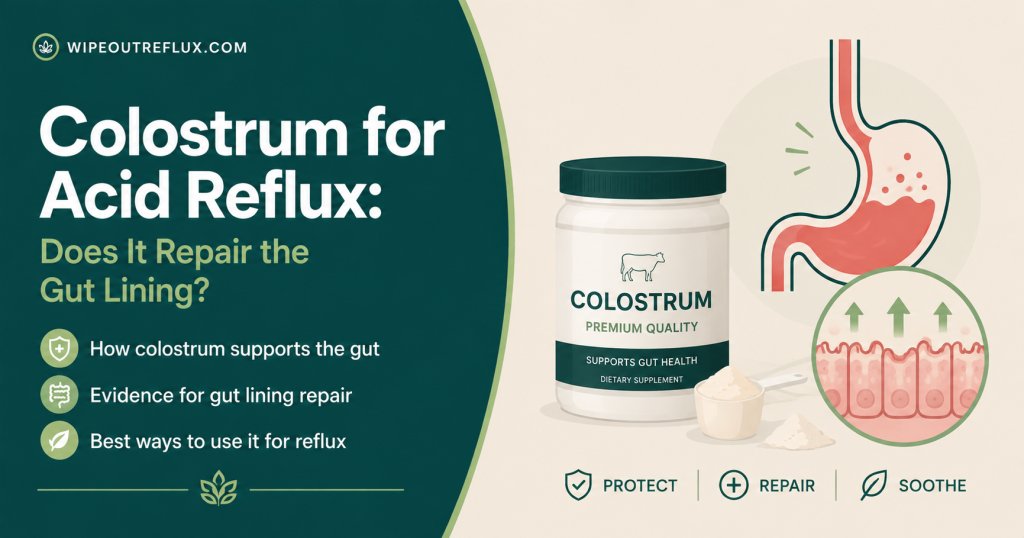
Colostrum — the thick “first milk” a cow produces in the days after calving — is genuinely rich in the growth factors and immune compounds that help repair a gut lining, and there’s real human evidence that it can reduce “leaky gut,” the increased intestinal permeability behind a lot of digestive complaints. So the headline claim isn’t marketing nonsense: colostrum does have a plausible, partly evidence-backed role in gut-barrier repair.
The catch is where that evidence actually applies. Nearly all of it concerns the small intestine, not the oesophagus — and reflux is an oesophageal and throat problem. There are essentially no studies of colostrum for acid reflux, GERD or silent reflux specifically. So “it repairs the gut lining” is a fair statement about the gut; the leap to “therefore it heals reflux” is a bridge the research hasn’t built.
Below is what colostrum is, what its growth factors really do, what the human trials show and don’t show, why the oesophagus is a special case, the dairy problem that rules it out for some people, and where it might reasonably fit — without overselling it as a reflux cure.
Key Takeaways
- Bovine colostrum is packed with growth factors (EGF, TGF-β, IGF), lactoferrin and immunoglobulins that plausibly support repair of the gut lining.
- Human trials show it can reduce intestinal permeability — “leaky gut” — from NSAIDs and from heavy exercise, and a 2024 meta-analysis backs a real reduction.
- Almost all of that evidence is about the small intestine, not the oesophagus, and there are essentially no studies of colostrum for acid reflux or LPR.
- Its growth factors are proteins that stomach acid and digestion partly break down, and oesophageal contact time is brief — so the path from “swallowed colostrum” to “healed oesophagus” is unproven.
- The popular “leaky gut causes reflux” chain is itself unestablished, so colostrum’s gut-barrier effect may not translate into less reflux.
- Colostrum is a dairy product containing lactose and milk proteins — not suitable for those with dairy allergy, and a possible trigger for some.
- It won’t fix the mechanical causes of reflux — a weak valve, raised pressure — so it can only ever be a supporting player, not a treatment.
What Colostrum Actually Is
Colostrum is the first milk mammals produce immediately after giving birth — different from regular milk, and loaded with the compounds a newborn needs to build a functioning gut and immune system fast. The supplements you’ll see are almost always bovine colostrum, collected from cows in the first day or two after calving, then pasteurised and dried into a powder or capsule.
What makes it interesting for gut health is its cargo. Colostrum contains immunoglobulins (antibodies), lactoferrin (an antimicrobial, iron-binding protein), and — the part everyone points to — a whole suite of growth factors, including epidermal growth factor (EGF), transforming growth factor beta (TGF-β) and insulin-like growth factor (IGF) Yalçıntaş et al., Nutrients, 2024. Those growth factors are exactly the kind of signalling molecules the body uses to build and repair mucosal tissue, which is why colostrum gets talked about as a gut-healing supplement in the first place.
What the Growth Factors Actually Do
The theory behind colostrum for gut repair is reasonable. EGF promotes the re-growth of the cells lining the gut after damage, TGF-β is involved in mucosal healing, and IGF encourages the epithelial cells to migrate and multiply to cover a wound — the same re-surfacing process your gut lining uses to recover from any insult. There’s also evidence that colostrum helps maintain the “tight junctions,” the seals between adjacent gut-lining cells that keep the barrier from getting leaky.
So on paper, colostrum delivers a concentrated dose of the signals that tell a damaged lining to rebuild. That’s a genuinely sound biological rationale — and it’s why colostrum has been studied for gut-barrier problems rather than plucked from nowhere. The question is always whether that plausibility survives contact with real human trials.
The Real Evidence: Leaky Gut and the Small Intestine
Here colostrum does better than most supplements. The strongest work comes from Raymond Playford’s group. In one human study, taking bovine colostrum alongside an NSAID (drugs that reliably damage the gut lining) reduced the spike in intestinal permeability those drugs cause Playford et al., Clinical Science, 2001, building on earlier work showing colostrum protects against NSAID-induced gut damage and that its growth-factor content is central to the effect Playford et al., Gut, 1999.
A separate line of research looked at athletes, whose gut lining gets transiently leaky during hard exercise. In a placebo-controlled crossover trial, heavy exercise increased gut permeability about 2.5-fold, and colostrum blunted that rise substantially Marchbank et al., American Journal of Physiology-Gastrointestinal and Liver Physiology, 2011. And a 2024 meta-analysis pulling these trials together concluded that bovine colostrum supplementation does significantly reduce measures of intestinal permeability — while noting the studies are small and varied, and calling for better trials Hajihashemi et al., Digestive Diseases and Sciences, 2024.
That’s a more credible evidence base than the average gut supplement can claim. But read the fine print: every one of those studies measures permeability in the small intestine, using urine sugar-ratio tests. It’s evidence that colostrum can help tighten a leaky lower gut. It is not evidence about the oesophagus — and that distinction is everything for reflux.
But Does It Reach — or Repair — the Oesophagus?
This is the gap the supplement pages skip over. Reflux damages the oesophagus and, in silent reflux, the throat and voice box. For colostrum to heal those tissues, its growth factors would need to actually act on them — and there are two problems.
First, growth factors are proteins, and proteins get partly broken down by stomach acid and digestive enzymes. Some activity survives to reach the lower gut, which is presumably how the permeability effects happen, but how much intact growth factor ever acts on the oesophagus on the way down is unclear. Second, anything you swallow only touches the oesophagus for a few seconds in transit — unlike a coating agent designed to cling, colostrum isn’t formulated to linger there.
Most importantly, there are essentially no clinical trials of colostrum for reflux oesophagitis, GERD or LPR. The mucosal-healing story is real for the gut, but applying it to reflux-damaged oesophageal tissue or an irritated larynx is extrapolation, not demonstrated fact. It might help; nobody has shown it does.
The “Leaky Gut Causes Reflux” Question
A lot of colostrum-for-reflux advice rests on a chain of reasoning: leaky gut drives inflammation, inflammation drives reflux, so sealing the gut eases reflux. It’s an appealing story, and there are real overlaps — gut inflammation, SIBO and dysbiosis can travel with reflux symptoms, and overall gut health genuinely matters.
But the specific claim that intestinal permeability causes reflux is not established. Reflux is fundamentally a mechanical problem — stomach contents escaping upward past a valve that isn’t holding — and no amount of gut-lining repair changes that valve. So even if colostrum tightens your small-intestinal barrier beautifully, there’s no guarantee it reduces how often you reflux. Treating a plausibly-related process is not the same as treating the problem.
The Dairy Problem
Here’s a practical catch that matters for reflux specifically: colostrum is a dairy product. It contains lactose and milk proteins (casein and whey), so it’s off the table entirely if you have a dairy or milk-protein allergy, and it can cause bloating or digestive upset in people who are lactose intolerant.
For reflux, that’s worth pausing on. Full-fat dairy is a reflux trigger for some people, and while colostrum is fairly low in fat, the broader point stands — you’re adding a dairy product to your routine, and if you’re someone whose reflux reacts to dairy, that’s a real consideration. It’s the same reasoning behind the caution around whether milk helps or hurts reflux. Start low, see how you react, and stop if it makes symptoms worse.
How People Take It, and What It Won’t Do
If you want to try it, colostrum usually comes as a powder or capsule, taken on an empty stomach so its proteins face less competition, in doses that vary widely by product. As a supplement it isn’t regulated as tightly as a medicine, so quality and potency differ between brands, and it’s worth choosing one that’s transparent about sourcing and processing. As with any supplement, it’s sensible to run it past your doctor, particularly if you have allergies or take other medication — a point that applies to most reflux supplements.
What it won’t do is fix the mechanics. Colostrum doesn’t tighten the valve at the top of your stomach, lower the pressure pushing acid upward, or change what and how you eat — the things that actually determine how much you reflux. At best it’s a supporting player that may help a gut lining recover; it is not a substitute for reducing the reflux itself. That’s the job the Wipeout Diet Plan is built around — calming the reflux at its source so the oesophagus gets the one thing it truly needs to heal, which is a break from the acid and pepsin hitting it in the first place.
Conclusion
So, does colostrum repair the gut lining? For the small intestine, there’s a fair case — it’s rich in mucosal growth factors, and real human trials show it can reduce leaky gut. For acid reflux, though, the honest answer is that we’re extrapolating: the oesophagus hasn’t been studied, the growth factors are partly digested on the way down, and reflux is a mechanical problem that gut-lining repair doesn’t address. It might be a reasonable supporting supplement if gut inflammation is part of your bigger picture — provided dairy agrees with you — but it isn’t a reflux treatment, and no supplement heals an oesophagus that’s still being bathed in acid every day.
That’s the part worth holding onto: mucosal tissue heals remarkably well once you stop re-injuring it, and for the oesophagus and throat that means cutting the reflux events themselves. That’s exactly what the Wipeout Diet Plan is designed to do — a structured, mechanism-first way to reduce how often and how hard you reflux, so your own tissue gets the chance to recover rather than relying on a supplement to out-repair ongoing damage. I built it primarily around LPR and silent reflux, the stubborn throat-based form where healing is slowest and people reach hardest for gut supplements, but because it works on the same underlying mechanisms it helps GERD and everyday heartburn just as well. And if you want a concrete place to start today, the Wipeout Food Reference Guide is the essential companion — the full list of which foods and drinks are safe for acid reflux and LPR, with their actual pH values, so you’re working from numbers instead of guesswork.
Frequently Asked Questions
Does colostrum heal the gut lining?
There’s reasonable evidence it helps the small-intestinal lining. Colostrum is rich in growth factors like EGF and TGF-β that promote mucosal repair, and human trials show it can reduce intestinal permeability (“leaky gut”) caused by NSAIDs and heavy exercise. That evidence is about the gut, though — not the oesophagus — and the studies are still small.
Can colostrum cure acid reflux?
No. There are essentially no studies of colostrum for acid reflux, GERD or silent reflux, and it doesn’t address the mechanical causes of reflux — a weak valve and raised pressure. It may be a supporting supplement for gut health, but it can’t stop reflux from happening, which is what actually lets the oesophagus heal.
Does colostrum help repair the oesophagus after reflux damage?
It’s unproven. The growth factors that repair gut tissue are partly broken down by digestion, and swallowed colostrum only contacts the oesophagus briefly. No trials have tested it for reflux oesophagitis or throat damage, so any oesophageal benefit is extrapolation from small-intestine research, not a demonstrated effect.
Is colostrum safe for people with acid reflux?
For most people it’s well tolerated, but it’s a dairy product containing lactose and milk proteins. Avoid it if you have a dairy or milk-protein allergy, and be cautious if you’re lactose intolerant or find dairy triggers your reflux. Start with a low dose, see how you react, and stop if symptoms worsen. Check with your doctor if you take other medication.
Is bovine colostrum better than other gut-repair supplements?
It has a somewhat stronger human evidence base for intestinal permeability than many alternatives, but “better” depends on your goal. For soothing an irritated throat or oesophagus, coating agents behave differently, and none of these supplements substitute for reducing the reflux itself. Colostrum’s edge is in gut-barrier research, not reflux specifically.
How long does colostrum take to work?
There’s no established timeline for reflux, because it hasn’t been studied for that. In gut-permeability trials, effects were measured over days to a couple of weeks. If you try it and notice nothing after a few weeks — or if it upsets your stomach — there’s little reason to continue.
Research & References
- Yalçıntaş et al., Nutrients, 2024 — Review of the growth factors in bovine colostrum, detailing its content of EGF, TGF-β, IGF and related polypeptides and their roles in mucosal development and the re-epithelialisation of gut tissue after damage.
- Playford et al., Gut, 1999 — Study showing bovine colostrum protects against NSAID-induced gut damage in animal and human models, and that removing its growth-factor content reduces the protective effect, implicating those growth factors in the benefit.
- Playford et al., Clinical Science, 2001 — Human crossover study finding that co-administration of bovine colostrum reduced the acute increase in intestinal permeability caused by NSAID use.
- Marchbank et al., American Journal of Physiology-Gastrointestinal and Liver Physiology, 2011 — Placebo-controlled crossover trial in athletes showing heavy exercise raised gut permeability roughly 2.5-fold and that bovine colostrum supplementation substantially truncated that increase.
- Hajihashemi et al., Digestive Diseases and Sciences, 2024 — Meta-analysis of randomised trials concluding that bovine colostrum supplementation significantly reduces measures of intestinal permeability, while noting the limited number, size and heterogeneity of available studies.

David Gray
12 years living with LPR · Consultant & researcher
I've lived with LPR for twelve years — the misdiagnoses, the PPI courses that did nothing, the slow work of figuring out what actually helps. Wipeout Reflux is where I translate the research into plain terms for people stuck in the same place. Every claim here is sourced to peer-reviewed work, and I consult one-to-one with LPR sufferers.