
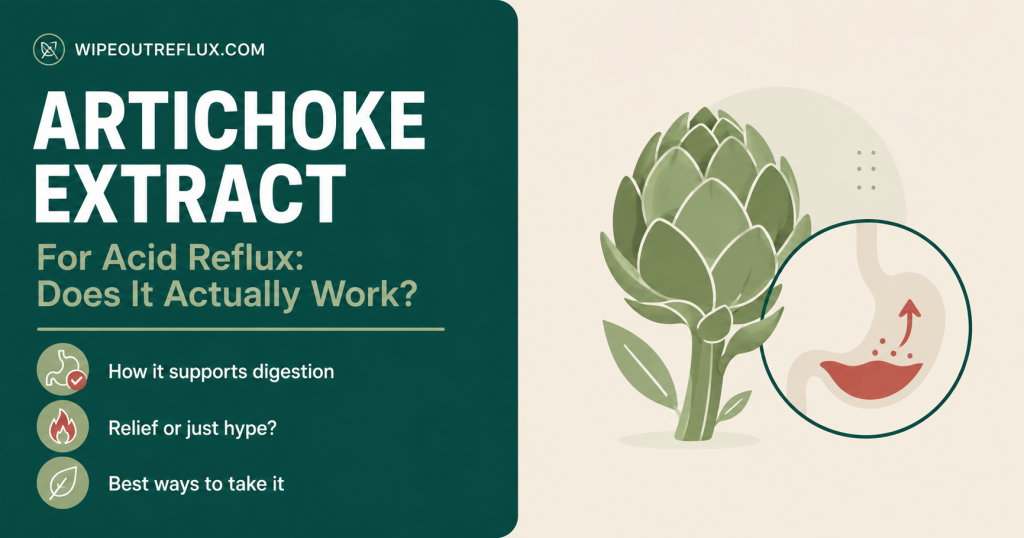
It depends what you mean by “work.” Artichoke leaf extract has genuinely decent clinical evidence — but for functional dyspepsia, the indigestion cluster of upper-belly fullness, bloating, nausea and discomfort, not for acid reflux specifically. Those two get muddled constantly, because their symptoms overlap and plenty of people who think they have reflux actually have dyspepsia, or both. So artichoke may well ease the indigestion side of what you’re feeling.
What it hasn’t been shown to do is treat acid reflux itself. There are no trials of artichoke extract for GERD, reflux oesophagitis or silent reflux, and nothing suggesting it reduces how much acid reaches your oesophagus or helps it heal. It works mainly as a bitter that stimulates bile and digestive secretions — which is also the source of a specific catch: pushing more bile through could aggravate bile reflux for some people, and it’s genuinely off-limits if you have gallstones or a blocked bile duct.
Below is what artichoke extract actually is, the real evidence behind it, why the dyspepsia-versus-reflux distinction is the whole story here, how it might help the overlapping symptoms, and the cautions worth knowing before you try it.
Key Takeaways
- Artichoke leaf extract has real randomised-trial evidence for functional dyspepsia — fullness, bloating, nausea and upper-gut discomfort — not for acid reflux.
- Dyspepsia and reflux overlap heavily and are often confused, so artichoke may help the indigestion part of your symptoms even though it isn’t a reflux treatment.
- It works as a bitter and a choleretic — it stimulates bile flow and digestive secretions, and may support stomach emptying.
- There are no studies of artichoke for GERD, oesophagitis or LPR, and no evidence it reduces acid reflux or heals the oesophagus.
- The bile-stimulating action is double-edged: it could aggravate bile reflux, and it’s contraindicated if you have gallstones or a bile-duct obstruction.
- Being in the daisy/ragweed family, it can trigger allergy in sensitive people, and it may cause gas in some.
- At best it soothes the indigestion component; it doesn’t address the mechanical cause of acid reflux.
What Artichoke Extract Actually Is
Artichoke leaf extract comes from the globe artichoke (Cynara scolymus), and its active compounds — chiefly cynarin and the flavonoid luteolin — are concentrated in the leaves rather than the edible heart. It’s an old digestive remedy, traditionally used as a bitter tonic, and modern interest centres on two properties: it’s choleretic, meaning it stimulates the liver to produce and release bile, and it has antioxidant and cholesterol-lowering effects.
That bitter, bile-stimulating character is the key to understanding it. Bitters have long been used to “wake up” digestion, and artichoke is one of the more studied ones. But note where the evidence actually sits: it’s a digestion-and-bile compound that has drifted into the reflux conversation because indigestion and reflux feel similar, not because it’s been tested on reflux.
The Evidence That Actually Exists
To artichoke’s credit, it has more real clinical data than most digestive supplements — it’s just all pointing at dyspepsia.
The standout is a six-week, double-blind, placebo-controlled trial in 247 patients with functional dyspepsia, where artichoke leaf extract significantly outperformed placebo at relieving symptoms and improving quality of life Holtmann et al., Alimentary Pharmacology & Therapeutics, 2003. A later randomised, placebo-controlled trial combining artichoke with ginger in 126 dyspepsia patients found significant improvements specifically in nausea, epigastric fullness, epigastric pain and bloating Giacosa et al., Evidence-Based Complementary and Alternative Medicine, 2015. And a subset analysis in people with dyspepsia and overlapping IBS found artichoke reduced symptom scores and improved quality of life Bundy et al., Journal of Alternative and Complementary Medicine, 2004.
That’s a respectable, consistent body of evidence — for indigestion. Every one of those trials measured dyspeptic symptoms. None of them measured acid reflux, oesophageal acid exposure, or reflux healing. That distinction is easy to skate past and it changes everything.
Dyspepsia vs Reflux: The Whole Story
Here’s why the evidence doesn’t transfer neatly. Functional dyspepsia is a disorder of the upper stomach — a sense of fullness, early satiety, bloating, upper-abdominal discomfort and nausea, without an obvious structural cause. Acid reflux is a different problem: stomach contents escaping upward past a valve into the oesophagus, causing heartburn, regurgitation or throat symptoms. They can coexist, they share triggers, and their symptoms blur — which is exactly why they’re so often confused, something I dig into in indigestion vs acid reflux.
So when someone says artichoke “helped their reflux,” what may actually have improved is the dyspepsia component — the fullness and bloating — rather than the acid reflux itself. That’s a genuine benefit if fullness and slow digestion are part of your picture. It’s just not the same as reducing reflux, and it’s worth being clear which problem you’re actually trying to treat, ideally with proper diagnosis rather than assumption.
How It Might Help the Overlapping Symptoms
Where artichoke could plausibly take the edge off reflux-adjacent symptoms is through its effect on digestion. By stimulating bile and digestive secretions, and possibly supporting stomach emptying, it may help food move through rather than sitting and fermenting. A stomach that empties more promptly means less fullness, gas and pressure — and since raised pressure in the stomach is one of the things that pushes acid upward, easing that could indirectly reduce reflux triggers for some people. It sits in the same “bitters and digestion” territory as other traditional aids like apple cider vinegar.
That’s a reasonable mechanism, not a proven one for reflux. It’s the sort of thing that might help if your symptoms are dominated by fullness and sluggish digestion, and do nothing at all if your problem is straightforward acid reflux with a leaky valve. Which brings us to the catch.
The Bile Catch
Artichoke’s headline action — stimulating bile — is genuinely powerful. In a controlled human study, artichoke extract increased bile secretion by well over 100% within half an hour of a dose Kirchhoff et al., Phytomedicine, 1994. For sluggish digestion that may be helpful. For reflux, it’s a double-edged sword.
Not all reflux is acid. Some people reflux bile, or a mix of acid and bile, and bile reflux is its own distinct problem — one that acid suppression doesn’t fix. Deliberately ramping up bile production with a choleretic could, at least in theory, give a bile-reflux-prone person more bile to reflux, not less. Nobody has studied artichoke specifically in bile reflux, but the mechanism is a reason for caution rather than enthusiasm if that’s your issue — and it’s especially worth thinking about if you’ve had your gallbladder removed, since bile handling is already altered.
There’s also a firm safety line here: because it stimulates bile flow, artichoke extract should be avoided if you have gallstones or any bile-duct obstruction. Increasing bile flow against a blockage can trigger a painful gallbladder attack. This is standard herbal-medicine guidance, and it isn’t optional — if there’s any chance you have gallstones, clear it with a doctor first.
Other Cautions
A few more things worth knowing. Artichoke belongs to the same plant family as daisies, ragweed and marigolds, so if you’re allergic to those, it can trigger a reaction. Some people get increased gas or mild digestive upset, particularly at first. And as with any supplement, quality and potency vary between brands, and it’s sensible to run it past your doctor if you take other medication — a point that applies to reflux supplements generally.
Crucially, artichoke does nothing to reduce stomach acid. So if your problem is genuine acid reflux — heartburn, regurgitation, an irritated throat — artichoke isn’t addressing the acid or the valve behind it. It’s working on digestion, not on reflux.
So Does It Actually Work for Reflux?
Honest answer: for indigestion and functional dyspepsia, there’s reasonable evidence it works. For acid reflux specifically, there’s no evidence either way, a plausible reason it could help the fullness-and-bloating side of things, and a plausible reason it could aggravate bile reflux. It might be worth a careful trial if your symptoms are dominated by upper-gut fullness and sluggish digestion and you’ve ruled out gallstones — but it’s not a treatment for acid reflux, and it won’t heal an oesophagus that’s still being hit with acid.
That last part is the bit no supplement gets around. The thing that actually settles reflux is fewer reflux events reaching the oesophagus, and that comes down to the mechanics of how and what you eat — which is exactly what the Wipeout Diet Plan is built around, rather than a bitter aimed at the digestion downstream of it.
Conclusion
Artichoke extract is one of the better-evidenced digestive supplements — but read the evidence for what it is. It has real clinical support for functional dyspepsia, the indigestion cluster of fullness, bloating and nausea that so often masquerades as reflux, and if that’s a big part of your symptoms, it may genuinely help. What it isn’t is a reflux treatment: there are no reflux trials, it doesn’t touch stomach acid, and its bile-stimulating action carries a real caution for anyone prone to bile reflux or carrying gallstones. Sort out which problem you’re actually dealing with before reaching for it.
And if acid reflux is the real issue, the durable fix isn’t a supplement at all — it’s reducing how often and how hard you reflux in the first place, so the oesophagus finally gets a break from the acid hitting it. That’s what the Wipeout Diet Plan is designed to do: a structured, mechanism-first way to calm reflux at its source rather than easing the indigestion around the edges of it. I built it primarily around LPR and silent reflux, the stubborn throat-based form where people most often go searching through supplement shelves, but because it works on the same underlying reflux mechanisms it helps GERD and everyday heartburn just as well. And if you want a concrete place to start today, the Wipeout Food Reference Guide is the essential companion — the full list of which foods and drinks are safe for acid reflux and LPR, with their actual pH values, so you’re working from numbers instead of guesswork.
Frequently Asked Questions
Does artichoke extract help acid reflux?
Not directly, as far as the evidence shows. It has real clinical support for functional dyspepsia — indigestion-type fullness, bloating and nausea — which overlaps with reflux and is often mistaken for it. So it may ease the indigestion side of your symptoms, but there are no studies showing it reduces acid reflux or heals the oesophagus.
Can artichoke extract make reflux worse?
It’s possible for some people. Artichoke strongly stimulates bile flow, and if you’re prone to bile reflux, producing more bile could in theory give you more to reflux. It can also cause gas in some people. It’s not been studied in reflux, so the concern is mechanistic rather than proven — but it’s a reason for caution if bile reflux is your issue.
Who should not take artichoke extract?
Avoid it if you have gallstones or a bile-duct obstruction, because stimulating bile flow against a blockage can trigger a painful gallbladder attack. Also avoid it if you’re allergic to plants in the daisy and ragweed family. Check with a doctor first if you take other medication or have had your gallbladder removed.
Is artichoke extract good for indigestion?
Yes, that’s where its evidence is strongest. Randomised, placebo-controlled trials show artichoke leaf extract improves functional dyspepsia symptoms — fullness, bloating, nausea and upper-abdominal discomfort — and quality of life. If indigestion rather than acid reflux is your main problem, it’s a reasonable option to discuss.
How does artichoke extract work for digestion?
It acts as a bitter and a choleretic, stimulating bile production and digestive secretions and possibly supporting stomach emptying. Better bile flow and emptying can reduce the fullness, bloating and pressure of sluggish digestion — which is different from reducing acid reflux, even though the symptoms can feel similar.
Does artichoke reduce stomach acid?
No. Artichoke doesn’t lower stomach acid or strengthen the valve that keeps acid down — the two things that actually drive acid reflux. It works on bile and digestion, so it isn’t addressing the acid or the mechanics behind heartburn and regurgitation.
Research & References
- Holtmann et al., Alimentary Pharmacology & Therapeutics, 2003 — Six-week double-blind, placebo-controlled, multicentre trial in 247 patients with functional dyspepsia, finding that artichoke leaf extract significantly reduced dyspeptic symptoms and improved disease-specific quality of life compared with placebo.
- Giacosa et al., Evidence-Based Complementary and Alternative Medicine, 2015 — Randomised, double-blind, placebo-controlled trial of a ginger-and-artichoke supplement in 126 functional dyspepsia patients, showing significant improvement in nausea, epigastric fullness, epigastric pain and bloating.
- Bundy et al., Journal of Alternative and Complementary Medicine, 2004 — Subset analysis in people with dyspepsia and concomitant IBS, finding artichoke leaf extract reduced symptom scores and improved quality of life over a two-month period.
- Kirchhoff et al., Phytomedicine, 1994 — Randomised, placebo-controlled, double-blind crossover study measuring intraduodenal bile secretion, showing artichoke extract increased bile secretion by more than 100% within thirty minutes, confirming its choleretic action.

David Gray
12 years living with LPR · Consultant & researcher
I've lived with LPR for twelve years — the misdiagnoses, the PPI courses that did nothing, the slow work of figuring out what actually helps. Wipeout Reflux is where I translate the research into plain terms for people stuck in the same place. Every claim here is sourced to peer-reviewed work, and I consult one-to-one with LPR sufferers.