
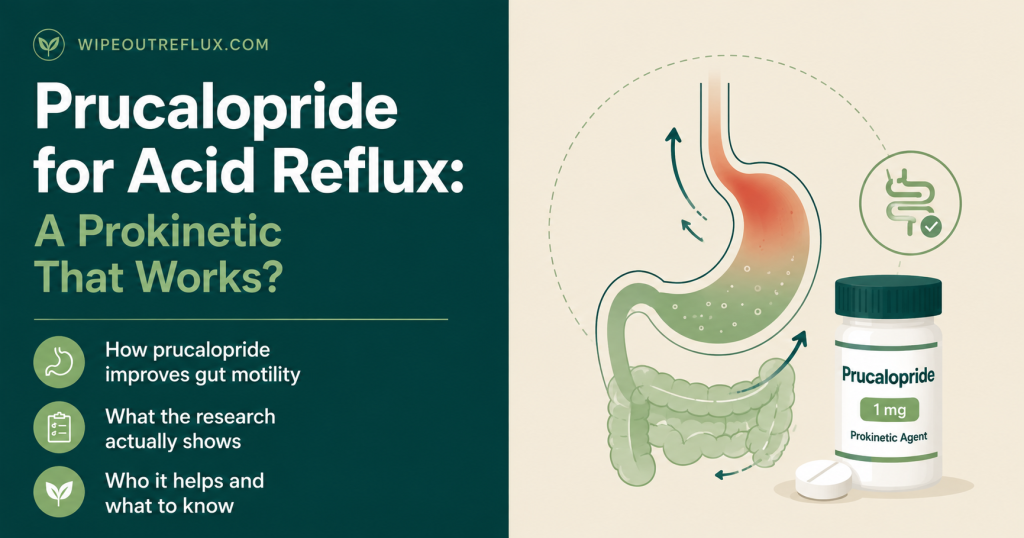
Prucalopride is the most interesting prokinetic in the reflux conversation right now — and the one with the strangest evidence gap. In healthy volunteers it cut oesophageal acid exposure roughly in half, sped up gastric emptying and improved acid clearance. In gastroparesis patients it beat placebo on both symptoms and emptying in a proper randomised trial. And unlike cisapride, it doesn’t appear to carry the cardiac risk that killed off the last generation of prokinetics.
What it doesn’t have is a single randomised controlled trial in GERD patients. Not one. Everything reflux-specific is either healthy volunteers, a four-patient case series, or physiology studies. So the honest answer is: the mechanism is the most convincing of any prokinetic available, the safety profile is the best, and the direct clinical evidence in reflux is almost nonexistent.
That combination makes it a genuine off-label option in specific situations — and a poor choice in others. Here’s how to tell which you’re in.
Key Takeaways
- Prucalopride (Motegrity, Resolor) is a highly selective 5-HT4 receptor agonist licensed for chronic constipation, not reflux.
- In 21 healthy volunteers, six days of prucalopride halved total acid exposure time, reduced reflux reaching the upper oesophagus, improved acid clearance and sped gastric emptying.
- It did not change lower oesophageal sphincter pressure or the number of transient sphincter relaxations — so it works by clearing and emptying faster, not by tightening the valve.
- In 34 gastroparesis patients, four weeks of prucalopride significantly improved symptoms, quality of life and gastric half-emptying time versus placebo.
- In GERD patients with ineffective oesophageal motility, it increased peristaltic wave amplitude and made secondary peristalsis easier to trigger.
- No cardiovascular safety signal has emerged — a 35,000-patient multinational cohort found no increased risk of major cardiac events versus polyethylene glycol.
- Diarrhoea, headache, nausea and abdominal cramping are common in the first few days and usually settle.
- There is still no randomised trial of prucalopride in GERD, and no evidence at all in LPR or silent reflux.
What Prucalopride Actually Is
Prucalopride is a selective serotonin 5-HT4 receptor agonist, sold as Motegrity in the US and Resolor across much of Europe. It’s licensed for chronic idiopathic constipation, typically at 2 mg once daily (1 mg in older adults or renal impairment).
5-HT4 receptors sit on the enteric nerves that run the length of the gut. Stimulating them releases acetylcholine, which strengthens the coordinated muscular contractions that push contents forward. That’s why it works for constipation — and why it also affects the oesophagus and stomach, which carry the same receptors.
The word “selective” is doing a lot of work in that description, and it matters more than it sounds. It’s the whole reason this drug still exists.
Why the Last Generation of Prokinetics Failed
To understand why prucalopride is worth taking seriously, you have to know what happened to its predecessors.
Cisapride was widely used for reflux in the 1990s and worked reasonably well. It was withdrawn from most markets around 2000 because it also blocked the hERG cardiac potassium channel, prolonging the QT interval and causing fatal arrhythmias. Tegaserod was pulled in 2007 over ischaemic cardiovascular events, linked to activity at 5-HT1 receptor subtypes. Both were non-selective — they hit 5-HT4 but they hit other things too.
A systematic review of the whole 5-HT4 class concluded that the newer, highly selective agents — prucalopride among them — showed no cardiovascular safety concerns, and that selectivity for 5-HT4 over non-5-HT4 receptors is likely what determines the risk-benefit profile Tack et al., Alimentary Pharmacology and Therapeutics, 2012.
That prediction has since held up in the real world. A multinational population-based cohort study of 5,715 prucalopride initiators against 29,372 people starting polyethylene glycol found a pooled adjusted incidence rate ratio for major adverse cardiovascular events of 0.64, well below the pre-specified safety threshold Gilsenan et al., Drug Safety, 2019. This data was submitted as part of the US approval package. It’s an unusually solid safety base for a prokinetic, and it’s why prucalopride sits in a different category from metoclopramide, which carries a tardive dyskinesia warning, or domperidone, which has its own QT concerns and isn’t available in the US.
The Healthy Volunteer Study — The Most Important Data We Have
The single most relevant piece of reflux evidence comes from a double-blind, placebo-controlled crossover study in 21 healthy volunteers given 4 mg prucalopride or placebo daily for six days, then put through high-resolution manometry, 24-hour pH-impedance monitoring and a solid-phase gastric emptying study.
The results were striking. Total acid exposure time dropped from a median of 3.4% to 1.7%. Acid clearance time — how long acid sits in the oesophagus before being cleared — improved from 77.5 to 44.0 seconds. The number of reflux events reaching the proximal oesophagus fell from 15.5 to 10.5. Gastric half-emptying time improved from 49.8 to 32.7 minutes, and residue at two hours fell substantially Kessing et al., Neurogastroenterology and Motility, 2014.
Now the part that tells you how it works. The total number of reflux events was unchanged. Lower oesophageal sphincter basal pressure was unchanged. The number of transient sphincter relaxations was unchanged, as was their association with reflux events.
So prucalopride isn’t tightening the valve or stopping reflux from happening. It’s doing two other things: emptying the stomach faster, so there’s less volume available to reflux, and clearing the oesophagus faster once acid arrives, so contact time falls. Less acid contact for the same number of events. That’s a real mechanism, and it’s a different one from everything else on the reflux shelf.
The caveat is unavoidable though: these were healthy volunteers. Healthy oesophagi clear well already. Whether the same magnitude of benefit appears in someone with a genuinely compromised antireflux barrier is exactly the question no trial has answered.
What Happens in Actual Reflux Patients
The direct patient evidence is thin, but it isn’t zero.
Ineffective oesophageal motility
Around 30–50% of GERD patients have ineffective oesophageal motility — weak, poorly coordinated contractions that fail to sweep refluxed material back down. A randomised crossover study gave 15 such patients 4 mg prucalopride or placebo and measured peristalsis. Prucalopride significantly increased primary peristaltic wave amplitude (68.1 vs 55.5 mmHg) and lowered the volume threshold needed to trigger secondary peristalsis, which was also triggered more frequently. The authors concluded the effect came largely through sensory modulation rather than a direct boost to contraction strength Lei et al., Journal of Gastroenterology and Hepatology, 2018.
If your manometry report says ineffective motility, this is the study that applies to you most directly.
PPI-refractory and non-acid reflux
A case series followed four chronically constipated women with GERD whose symptoms persisted despite PPIs and ranitidine, all with elevated reflux episode counts on pH-impedance. On 2 mg prucalopride daily, total reflux episodes and non-acid reflux episodes fell in every patient, matched by subjective symptom relief Nennstiel et al., Journal of Medical Case Reports, 2014.
Four patients is four patients — this proves nothing. But it points at a plausible niche: people with non-acid reflux who get nowhere with acid suppression, because reducing volume and contact time helps regardless of what pH the refluxate is.
Children with refractory upper GI symptoms
A retrospective study of 71 children prescribed prucalopride for refractory upper GI symptoms — most commonly nausea, feeding difficulties and reflux — found 65% improved at follow-up around 3.6 months later Hirsch et al., Paediatric Drugs, 2022. Retrospective and uncontrolled, so it carries all the usual caveats, but it’s consistent with the rest.
The Gastroparesis Evidence Is the Strongest
Prucalopride’s best randomised data in the upper gut is for gastroparesis. In a double-blind, placebo-controlled crossover trial, 34 patients (28 idiopathic) received four weeks of 2 mg daily or placebo with a two-week washout. Prucalopride significantly improved the total Gastroparesis Cardinal Symptom Index (1.65 vs 2.28) and the fullness/satiety, nausea/vomiting and bloating subscales, improved quality of life, and cut gastric half-emptying time from 143 to 98 minutes Carbone et al., American Journal of Gastroenterology, 2019.
Why this matters for reflux: delayed gastric emptying and reflux feed each other. A stomach that holds food too long is a stomach under sustained pressure, with more volume available to push across the junction and more postprandial reflux events. If slow emptying is genuinely part of your picture, treating it treats reflux indirectly — and this is the drug with the best trial data for doing that.
It’s also the same principle behind meal structuring in the Wipeout Diet Plan: smaller, lower-fat, faster-emptying meals reduce gastric pressure without needing a drug to do it.
Side Effects and Practical Use
The side effect profile is predictable from the mechanism. In the first few days, expect some combination of:
- Diarrhoea — the most common, and unsurprising in a drug designed to speed colonic transit.
- Headache — frequent, usually settling within a week.
- Nausea — ironic in a drug used for nausea, and a common reason people stop.
- Abdominal cramping — typically early and transient.
Most of these fade after the first three to five days. In the gastroparesis trial, three of 34 patients dropped out for nausea and headache, so it isn’t universally tolerated.
Practical points worth knowing: it’s cleared renally, so dose reduction to 1 mg is needed with significant kidney impairment. It has minimal drug interactions, which is unusual and useful if you’re already on several things. And it’s licensed for constipation, so using it for reflux is off-label — you’ll need a gastroenterologist willing to prescribe it that way, and in the US the cost without a constipation indication can be substantial.
Give it four weeks. The trials that showed benefit used four-week treatment periods, and that’s a fair test.
Who Might Actually Benefit
Reading the evidence honestly, prucalopride makes most sense if you tick more than one of these:
- You have documented ineffective oesophageal motility on manometry.
- You have delayed gastric emptying, or symptoms strongly suggesting it — early fullness, prolonged post-meal heaviness, nausea.
- You also have chronic constipation, which makes the prescription straightforward rather than off-label.
- Your reflux is largely non-acid or weakly acidic, and acid suppression hasn’t worked.
- Your symptoms are clearly worse after meals and with larger volumes.
It’s a poor fit if:
- Your problem is a mechanically incompetent sphincter or a sizeable hiatal hernia — prucalopride does nothing to lower oesophageal sphincter pressure, and the volunteer study confirmed that directly.
- You have loose stools or diarrhoea-predominant IBS already — you’ll likely make it worse.
- Your symptoms are throat-dominant. There is no LPR data whatsoever, and LPR symptoms are driven substantially by pepsin, which prucalopride doesn’t touch. Faster clearance might theoretically help, but that’s speculation, not evidence.
- You have known bowel obstruction, perforation risk, or severe inflammatory bowel disease — these are contraindications.
How It Compares to Other Prokinetics
Against the alternatives, prucalopride’s case is mostly about safety. Metoclopramide works but carries a black-box warning for tardive dyskinesia that limits it to short courses. Domperidone has decent efficacy and a QT signal, and isn’t available in the US. Erythromycin works powerfully for a few weeks then loses effect through receptor downregulation. Mosapride is only available in parts of Asia.
Prucalopride is the one you can take for months with a reassuring cardiac dataset behind it. Whether it works as well for reflux specifically is the open question — but for a broader look at the class, prokinetics for acid reflux covers where each one fits.
Conclusion
Prucalopride is the most mechanistically convincing prokinetic available for reflux, and simultaneously one of the least proven. The healthy volunteer data is genuinely impressive — acid exposure halved, clearance time cut, gastric emptying accelerated — and the gastroparesis trial shows those effects translate into real symptom relief when slow emptying is the problem. The cardiac safety record is the best in its class. But there has never been a randomised controlled trial of prucalopride in GERD patients, and there is nothing at all in LPR. If you have documented motility or emptying problems, particularly alongside constipation, it’s a reasonable off-label conversation to have with a gastroenterologist. If you’re hoping it will fix a leaky valve, the data says plainly that it won’t.
And whichever way that conversation goes, the drug is working on the same lever you can pull yourself: how much volume is sitting in the stomach and how long it stays there. That’s the core of what the Wipeout Diet Plan is built around — meal size, composition, fat load and timing, structured so the stomach empties before it can generate the pressure that drives reflux across the junction, rather than medicating around a pattern that keeps recreating the problem. I designed it originally for LPR and silent reflux, the throat-based form where people end up chasing off-label prescriptions out of sheer frustration, but because it targets the same underlying mechanisms it works equally well for GERD and ordinary heartburn. If you want something concrete to act on this week, the Wipeout Food Reference Guide is the essential companion — every food and drink that’s safe for acid reflux and LPR with its actual pH value, so you’re deciding from numbers instead of guesswork.
A prokinetic can move things along faster. It can’t undo what you keep putting in.
Frequently Asked Questions
Is prucalopride approved for acid reflux?
No. It’s licensed only for chronic idiopathic constipation in adults. Any use for reflux, gastroparesis or dyspepsia is off-label and needs a prescriber willing to go that route.
How long does prucalopride take to work?
Bowel effects often appear within a day or two. For upper gut symptoms, the trials used four-week treatment periods, and that’s a fair trial length. If nothing has shifted by four to six weeks, it’s unlikely to.
Does prucalopride tighten the lower oesophageal sphincter?
No. The healthy volunteer study specifically measured this and found no change in basal sphincter pressure or in the number of transient sphincter relaxations. Its benefit comes from faster gastric emptying and faster oesophageal acid clearance instead.
Is prucalopride safe for the heart?
The evidence so far is reassuring. Unlike cisapride and tegaserod, it’s highly selective for 5-HT4 with no hERG channel activity, and a 35,000-patient multinational cohort study found no increased risk of major adverse cardiovascular events. That said, discuss it with your doctor if you have existing cardiac disease.
Can I take prucalopride with a PPI?
Yes — they work by entirely different mechanisms and there’s no known interaction. Prucalopride has notably few drug interactions in general. Combining them is exactly the scenario the PPI-refractory case series looked at.
Does prucalopride help silent reflux or LPR?
There’s no evidence either way, because no LPR study has been done. Faster oesophageal clearance could plausibly reduce how much reaches the throat, but that’s a theory, not a finding. Anyone telling you it’s an LPR treatment is going beyond the data. For what does have evidence, see the best medications for LPR.
What are the most common side effects?
Diarrhoea, headache, nausea and abdominal cramping, mostly in the first few days and usually settling within a week. In the gastroparesis trial, three of 34 patients withdrew because of nausea or headache.
Research & References
- Double-blind, placebo-controlled, randomised crossover study in 21 healthy volunteers given 4 mg prucalopride daily for six days, showing reduced total oesophageal acid exposure time, fewer proximally extending reflux events, improved acid clearance time and accelerated gastric emptying, with no change in lower oesophageal sphincter pressure or transient sphincter relaxations Kessing et al., Neurogastroenterology and Motility, 2014.
- Double-blind, randomised, placebo-controlled crossover trial in 34 patients with gastroparesis, in which four weeks of prucalopride 2 mg daily significantly improved the Gastroparesis Cardinal Symptom Index, quality of life and gastric half-emptying time compared with placebo Carbone et al., American Journal of Gastroenterology, 2019.
- Randomised crossover study in 15 reflux patients with ineffective oesophageal motility, showing that 4 mg prucalopride increased primary peristaltic wave amplitude, lowered the volume threshold for triggering secondary peristalsis and increased how often it was triggered Lei et al., Journal of Gastroenterology and Hepatology, 2018.
- Case series of four chronically constipated women with proton pump inhibitor-refractory gastro-oesophageal reflux, in whom prucalopride 2 mg daily reduced total and non-acid reflux episodes on pH-impedance monitoring alongside subjective symptom relief Nennstiel et al., Journal of Medical Case Reports, 2014.
- Retrospective study of 71 children prescribed prucalopride for refractory upper gastrointestinal symptoms — most often nausea, feeding difficulties and reflux — in which 65% showed symptomatic improvement at follow-up Hirsch et al., Paediatric Drugs, 2022.
- Multinational population-based cohort study comparing 5,715 initiators of prucalopride with 29,372 initiators of polyethylene glycol, finding a pooled adjusted incidence rate ratio for major adverse cardiovascular events of 0.64, with no indication of increased risk Gilsenan et al., Drug Safety, 2019.
- Systematic review of the cardiovascular safety profile of 5-HT4 agonists, concluding that the cardiac problems seen with cisapride and tegaserod relate to non-5-HT4 activity, and that highly selective agents including prucalopride showed no cardiovascular safety concerns Tack et al., Alimentary Pharmacology and Therapeutics, 2012.

David Gray
12 years living with LPR · Consultant & researcher
I've lived with LPR for twelve years — the misdiagnoses, the PPI courses that did nothing, the slow work of figuring out what actually helps. Wipeout Reflux is where I translate the research into plain terms for people stuck in the same place. Every claim here is sourced to peer-reviewed work, and I consult one-to-one with LPR sufferers.