
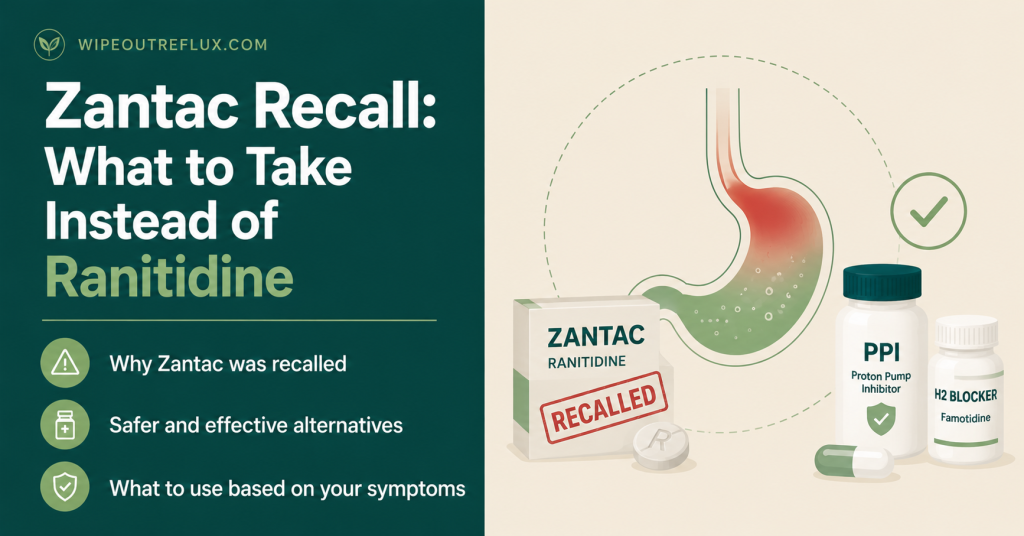
Ranitidine is gone and it isn’t coming back. On 1 April 2020 the FDA requested that every manufacturer withdraw all prescription and over-the-counter ranitidine from the US market immediately, after testing showed that levels of a probable carcinogen called NDMA rise inside the tablets over time — faster in heat, and faster the older the product gets. The same happened across Europe, Canada and Australia.
The straightforward replacement is famotidine. It’s the same class of drug, it’s actually the more potent H2 blocker, the FDA found no NDMA in it, and it’s what “Zantac 360” now contains — the brand name survived, the active ingredient didn’t. If you were taking ranitidine 150 mg twice daily, famotidine 20 mg twice daily is the usual equivalent.
What’s more interesting is what the research has shown since. Several large cohort studies have failed to find any increased cancer risk in people who took ranitidine for years, and one of the papers that drove much of the original alarm was later retracted. That doesn’t mean the withdrawal was wrong — but it’s worth knowing if you took it for a decade and have been quietly worrying ever since.
Key Takeaways
- The FDA requested removal of all ranitidine products on 1 April 2020 because NDMA levels increase over time and with heat during storage.
- Famotidine (Pepcid, Zantac 360) is the direct replacement — same drug class, no NDMA detected, and more potent per milligram than ranitidine.
- A network meta-analysis of 13 trials found famotidine the most effective H2 blocker for GERD, ahead of ranitidine at every dose tested.
- The FDA also confirmed no NDMA in cimetidine, esomeprazole, lansoprazole or omeprazole.
- A multinational cohort of over 1.1 million people found no increased cancer risk with ranitidine versus other H2 blockers.
- A Korean cohort and a US database study reached the same conclusion; one Taiwanese study did find raised risks for liver, lung, gastric and pancreatic cancer.
- The 2016 study reporting that ranitidine raised urinary NDMA excretion — a key plank of the original alarm — was retracted in 2021.
- If famotidine isn’t holding your symptoms, alginates, PPIs and diet change are the next steps — and for throat symptoms, alginates have the better evidence.
What Actually Happened
In summer 2019, an independent laboratory found N-nitrosodimethylamine in ranitidine samples and petitioned the FDA. NDMA is classified as a probable human carcinogen. It’s also present at low levels in ordinary food and drinking water, which is why the initial response was cautious rather than immediate.
The FDA ran its own testing through late 2019 and early 2020. What tipped the decision wasn’t the amount found in fresh product — it was the trajectory. NDMA levels increased in ranitidine under normal storage conditions, increased significantly at higher temperatures, and increased the longer the product had been sitting since manufacture. In other words, a bottle that tested fine leaving the factory could exceed the acceptable daily intake limit by the time someone finished it.
As the FDA’s Janet Woodcock put it in the announcement, unacceptable levels weren’t seen in many samples, but because there’s no way to know how a product has been stored or for how long, it shouldn’t be available unless its quality can be assured US Food and Drug Administration, News Release, 2020.
The same announcement told consumers to stop taking OTC ranitidine and dispose of it, and confirmed that FDA testing had found no NDMA in famotidine, cimetidine, esomeprazole, lansoprazole or omeprazole. That list is essentially your replacement menu.
Famotidine Is the Direct Swap
Ranitidine and famotidine are both H2 receptor antagonists. They block histamine at the H2 receptor on the stomach’s parietal cells, which reduces acid secretion — partially, and for a shorter window than a PPI.
Famotidine isn’t merely an acceptable substitute; on the evidence it’s the better one. A network meta-analysis of 13 randomised controlled trials comparing H2 blockers for GERD ranked famotidine 80 mg daily as the most effective, followed by famotidine 40 mg daily — both ahead of ranitidine at 300, 600 and 1,200 mg daily, and ahead of cimetidine and nizatidine Zhao et al., International Journal of Clinical Pharmacology and Therapeutics, 2016.
Practical conversions most prescribers use:
- Ranitidine 75 mg → famotidine 10 mg
- Ranitidine 150 mg → famotidine 20 mg
- Ranitidine 300 mg → famotidine 40 mg
Famotidine is also cleaner on drug interactions than cimetidine, which inhibits several cytochrome P450 enzymes and interferes with a long list of medications. If you’re on multiple drugs, famotidine over cimetidine is an easy call. There’s more on the wider options in alternatives to famotidine and famotidine versus omeprazole.
The Zantac 360 confusion
Worth spelling out, because it trips people up constantly. Zantac 360° on the shelf today contains famotidine, not ranitidine. The manufacturer kept the brand and swapped the molecule. If you buy it, you are buying famotidine in different packaging — often at a premium over generic famotidine, which is the identical drug.
What the Research Has Shown Since
This is the part that rarely gets covered, and if you took ranitidine for years it’s probably what you actually want to know.
The largest study is a multinational network cohort using 12 databases across the US, UK, Germany, Spain, France, South Korea and Taiwan — 1,183,999 people, comparing 909,168 new ranitidine users against 274,831 new users of other H2 blockers. After propensity score matching and empirical calibration, the hazard ratio for any cancer was 1.04 (95% CI 0.97–1.12). No significant association was found for any of the 16 cancer subtypes examined You et al., JAMA Network Open, 2023.
A Korean nationwide cohort compared 40,488 ranitidine users with 10,122 famotidine users and found overall cancer rates of 7.45% versus 7.56% — no statistical difference, and none across 11 individual cancer types Yoon et al., Journal of Clinical Medicine, 2021. A US database study comparing chronic ranitidine users against famotidine and omeprazole users found no increased odds of oesophageal, gastric, hepatocellular, pancreatic or colorectal cancer — in fact the odds ratios all fell below 1 Kim et al., Alimentary Pharmacology and Therapeutics, 2021.
It isn’t unanimous. A Taiwanese cohort of 55,110 ranitidine recipients, propensity-matched against untreated controls and famotidine users, did report increased risks of liver cancer (HR 1.22), lung cancer (HR 1.17), gastric cancer (HR 1.26) and pancreatic cancer (HR 1.35) Wang et al., International Journal of Environmental Research and Public Health, 2022.
And there’s a detail almost nobody mentions: the 2016 paper reporting that oral ranitidine dramatically increased urinary NDMA excretion — one of the findings that fuelled the original alarm — was retracted by the journal in 2021.
Where does that leave you? The regulatory decision was about an uncontrolled, unpredictable impurity in a product with perfectly good alternatives — a reasonable call regardless of what the epidemiology eventually showed. But if you took ranitidine for years, the weight of the population evidence has not found the cancer signal people feared. That’s genuinely reassuring, and it’s worth hearing from something other than a law firm’s advertising. Separately, if you’re anxious about reflux and cancer risk in general, whether acid reflux causes cancer covers the actual mechanism, which has nothing to do with NDMA.
On the litigation: large settlements have been reached by some manufacturers while other cases continue, and appellate courts have been reassessing how the scientific evidence was handled. I’m not a lawyer and this isn’t legal advice — if it’s relevant to you, take it to someone qualified.
If Famotidine Isn’t Enough
Plenty of people find the swap works fine. Others find their symptoms creep back, and there’s a specific reason that often has nothing to do with the switch.
H2 blockers develop tolerance. Their acid-suppressing effect diminishes with continued daily use over a matter of weeks — this was documented with ranitidine decades ago and applies to famotidine too. Many people do better taking them on demand, or at night alongside a daytime PPI, than swallowing one every morning indefinitely. If your medication has stopped working, why acid reflux medication stops working covers the mechanisms.
Beyond that, the options in rough order:
Alginates. These form a physical raft over the stomach contents rather than suppressing acid, so they block reflux mechanically — including non-acid reflux, which no acid blocker touches. Alginates for acid reflux and Gaviscon Advance in particular have real trial evidence, and they’re the better choice if your symptoms are throat-based. Pepcid versus Gaviscon compares the two approaches directly.
PPIs. Stronger and longer-acting acid suppression, appropriate for erosive oesophagitis and genuine acid-driven damage. Less impressive than most people assume for throat symptoms — see why PPIs don’t work for LPR — and worth understanding the side effects and acid rebound on stopping before starting.
Potassium-competitive acid blockers. Vonoprazan is the newer option, faster and more sustained than a PPI. Voquezna for acid reflux covers where it fits.
For a full comparison of the shelf, the best over-the-counter medicines for acid reflux lays out what each category does. And if your symptoms are throat-dominant, the best medication for LPR is a different conversation entirely, because the driver is pepsin rather than acid.
Worth saying plainly, though: every one of those works on the aftermath. The Wipeout Diet Plan works on how often reflux happens in the first place, which is the part no substitute tablet addresses.
What to Do With Old Ranitidine
If you still have a box in a cupboard — and people do, five years on — don’t take it. Age is precisely the variable that raises NDMA levels. Dispose of it following the medication guide instructions or your pharmacy’s take-back scheme rather than flushing it.
And don’t buy ranitidine online from overseas sellers. Anything still circulating is by definition old stock, which is the worst-case scenario for this particular impurity.
Conclusion
The practical answer to the Zantac recall is simple: famotidine, at roughly half the milligram dose you were taking of ranitidine, is the direct replacement and by the trial evidence a slightly better drug. Zantac 360 already is famotidine. No NDMA has been found in it, or in cimetidine or any of the common PPIs. If you took ranitidine for years, the large cohort studies published since have mostly failed to find the cancer signal that was feared, and one of the papers behind the original alarm was retracted — which doesn’t make the withdrawal wrong, but should take some weight off your mind.
What the swap won’t do is change why you needed the tablet. Acid blockers — whichever molecule — reduce how acidic the refluxate is; they don’t reduce how often stomach contents come up, which is why so many people cycle through the whole shelf and end up where they started. That’s the gap the Wipeout Diet Plan is built to close: a structured, mechanism-first approach to meal size, fat load, timing and trigger load that reduces the number and force of reflux events themselves. I designed it originally around LPR and silent reflux, the throat-based form where acid suppression tends to disappoint hardest, but since it targets the same underlying mechanisms it works just as well for GERD and everyday heartburn. And for something concrete to start with this week, the Wipeout Food Reference Guide is the essential companion — every food and drink that’s safe for acid reflux and LPR with its real pH value, so you’re working from numbers instead of trial and error.
Swap the tablet, by all means. Then deal with the reason you needed it.
Frequently Asked Questions
Is Zantac back on the market?
The brand is, the drug isn’t. Zantac 360° contains famotidine, a different active ingredient in the same class. Ranitidine has not returned to the US, UK, EU, Canadian or Australian markets and there’s no indication it will.
What is the closest replacement for ranitidine?
Famotidine. It’s the same drug class, works the same way, and roughly half the milligram dose gives an equivalent effect — famotidine 20 mg for ranitidine 150 mg. It’s available over the counter and on prescription, and generic famotidine is identical to the branded version.
Did ranitidine actually cause cancer?
The population evidence is mostly reassuring. The largest study, covering over 1.1 million people across seven countries, found no increased cancer risk versus other H2 blockers, and Korean and US cohorts agreed. One Taiwanese study did find raised risks for several cancers. The withdrawal was based on an unpredictable impurity in a product with good alternatives, not on proven harm in patients.
Is famotidine safe from NDMA?
FDA testing has not detected NDMA in famotidine, nor in cimetidine, esomeprazole, lansoprazole or omeprazole. The problem was specific to ranitidine’s molecular structure, which appears to break down into NDMA over time.
Can I still take ranitidine I have at home?
No. The whole basis of the withdrawal is that NDMA accumulates as the product ages and is exposed to heat. Anything you still have is now years old, which is the worst case. Dispose of it properly.
Does famotidine work for silent reflux?
Only partially, and often disappointingly. LPR symptoms are driven largely by pepsin reaching the throat, and pepsin stays active at pH levels that acid blockers routinely achieve. Alginates have better evidence for throat symptoms than any H2 blocker.
Why did famotidine escape the recall when ranitidine didn’t?
It’s a chemistry difference. Ranitidine’s structure contains a dimethylamine group and a nitro group that can react to form NDMA, particularly with heat and time. Famotidine has a different molecular architecture and no comparable degradation pathway.
Research & References
- Regulatory news release announcing the immediate market withdrawal of all prescription and over-the-counter ranitidine products, on the basis that NDMA levels increase over time and at higher storage temperatures, and confirming that FDA testing found no NDMA in famotidine, cimetidine, esomeprazole, lansoprazole or omeprazole US Food and Drug Administration, News Release, 2020.
- International network cohort study across 12 databases in seven countries, comparing 909,168 new ranitidine users with 274,831 new users of other H2 receptor antagonists, finding a calibrated meta-analytic hazard ratio for any cancer of 1.04 (95% CI 0.97–1.12) and no significant association across 16 cancer subtypes You et al., JAMA Network Open, 2023.
- Nationwide South Korean cohort study of 40,488 matched ranitidine users and 10,122 famotidine users, finding no statistical difference in overall cancer incidence (7.45% vs 7.56%, HR 0.99) or across 11 individual cancer outcomes Yoon et al., Journal of Clinical Medicine, 2021.
- US database study comparing chronic ranitidine users with famotidine and omeprazole users over up to 10 years, finding no increased odds of oesophageal, gastric, hepatocellular, pancreatic or colorectal malignancy Kim et al., Alimentary Pharmacology and Therapeutics, 2021.
- Taiwanese population-based cohort of 55,110 ranitidine recipients with propensity-score matching, reporting increased hazard ratios for liver (1.22), lung (1.17), gastric (1.26) and pancreatic (1.35) cancers compared with untreated controls Wang et al., International Journal of Environmental Research and Public Health, 2022.
- Network meta-analysis of 13 randomised controlled trials of H2 receptor antagonists in gastro-oesophageal reflux disease, ranking famotidine 80 mg daily as the most effective agent, ahead of famotidine 40 mg, all ranitidine doses, cimetidine and nizatidine Zhao et al., International Journal of Clinical Pharmacology and Therapeutics, 2016.

David Gray
12 years living with LPR · Consultant & researcher
I've lived with LPR for twelve years — the misdiagnoses, the PPI courses that did nothing, the slow work of figuring out what actually helps. Wipeout Reflux is where I translate the research into plain terms for people stuck in the same place. Every claim here is sourced to peer-reviewed work, and I consult one-to-one with LPR sufferers.