
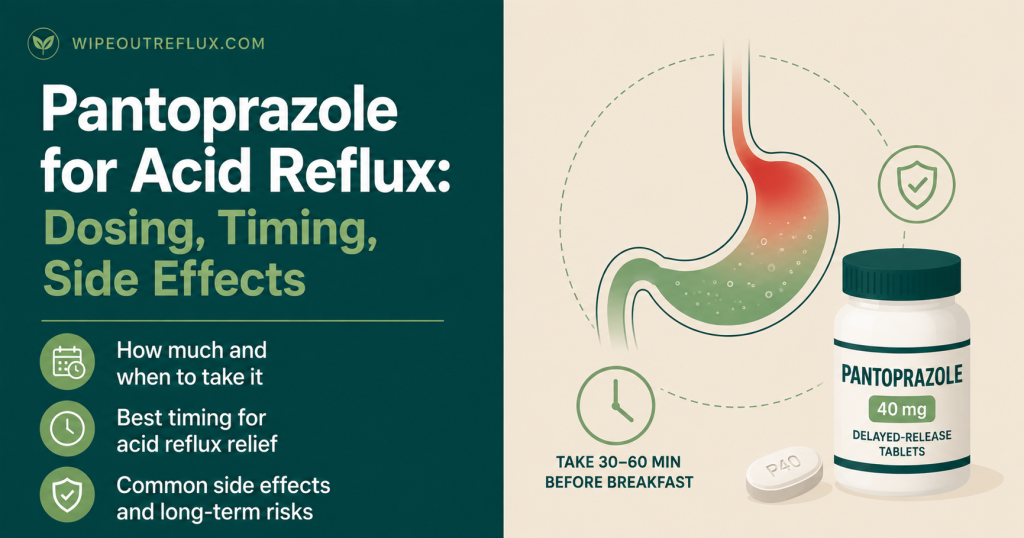
Pantoprazole (Protonix) is a proton pump inhibitor, and the standard adult dose for reflux is 40 mg once daily — taken 30 to 60 minutes before your first meal of the day, not with it and not after. That timing detail is not a nicety. It’s the single most common reason a PPI underperforms, and getting it wrong can more than double the time your stomach spends acidic.
Pantoprazole’s real distinguishing feature isn’t potency. On head-to-head healing data it sits mid-pack among PPIs. What sets it apart is its interaction profile: it’s the weakest inhibitor of the CYP2C19 enzyme in the class, which makes it the PPI of choice for anyone on clopidogrel or a complicated medication list.
It’s also the PPI with the best long-term safety evidence — not from observational data, but from a genuine placebo-controlled randomised trial in 17,598 people followed for three years. What that trial found is worth knowing before you read another scare headline.
Key Takeaways
- Standard dose is 40 mg once daily for GERD and erosive oesophagitis; 20 mg is a maintenance dose.
- Take it 30–60 minutes before breakfast — PPIs only shut down proton pumps that are actively secreting, so a meal has to follow the dose.
- Taking a PPI without a meal left gastric pH below 4 for 42% of the day versus 17% when taken before breakfast.
- It takes 3–5 days of consecutive dosing to reach full effect; it is not an on-demand drug.
- Pantoprazole is the weakest CYP2C19 inhibitor among PPIs and, unlike omeprazole, does not blunt clopidogrel’s antiplatelet effect.
- A randomised trial of 17,598 patients on pantoprazole 40 mg or placebo for three years found no difference in fractures, kidney disease, dementia, pneumonia or cancer — only a small increase in enteric infections.
- For severe grade C/D oesophagitis, vonoprazan and esomeprazole 40 mg outperform pantoprazole 40 mg on healing.
- Never stop abruptly after long-term use — rebound acid hypersecretion is real and will convince you the drug was working better than it was.
How Pantoprazole Works — And Why Timing Decides Everything
Proton pump inhibitors bind irreversibly to the hydrogen-potassium ATPase enzyme — the proton pump — in the parietal cells of the stomach lining. Once bound, that pump is out of action permanently. The cell has to manufacture a new one.
Here’s the crucial bit: a PPI can only bind to pumps that are actively secreting acid. Dormant pumps are invisible to it. And what activates dormant pumps is a meal.
So the sequence has to be: take the tablet, wait for it to be absorbed and reach the parietal cells, then eat — which switches the pumps on just as the drug arrives. Take it with food and absorption is delayed past the peak secretion window. Take it at bedtime on an empty stomach and most of your pumps are dormant when the drug passes through.
This was quantified properly in a randomised crossover study in 21 healthy volunteers who took a PPI either 15 minutes before breakfast or at the same hour with no meal until midday. Taken before breakfast, gastric pH was below 4 for a median 17.2% of the daytime period. Taken without a meal, that figure was 42.0% — and 15 of the 21 subjects had better acid control with the meal Hatlebakk et al., Alimentary Pharmacology and Therapeutics, 2000.
That’s not a marginal difference. That’s the difference between a drug working and a drug half-working, decided entirely by when you swallow it. If your PPI has been disappointing, this is the first thing to check — before concluding the medication isn’t working.
Dosing in Practice
The usual regimens:
- Erosive oesophagitis, healing: 40 mg once daily for 8 weeks.
- Erosive oesophagitis, maintenance: 40 mg daily, or 20 mg for milder disease.
- Non-erosive GERD: 20–40 mg once daily.
- Twice daily: 40 mg before breakfast and before the evening meal — used for refractory symptoms or extraoesophageal presentations. Both doses go before a meal.
Practical points that matter more than people realise:
Swallow it whole. Pantoprazole is enteric-coated because stomach acid destroys the active drug. Crushing or splitting the tablet wrecks it. Delayed-release granules exist if swallowing is a problem.
Give it three to five days. Full acid suppression builds cumulatively as more pumps are inactivated between doses. Judging it after 48 hours is judging it too early — the same pattern covered in how long a PPI takes to work.
Take it every day. PPIs are not rescue medication. If you need something for a sudden flare, an antacid or alginate works in minutes; pantoprazole won’t.
If you’re on twice daily, don’t put the second dose at bedtime. Put it before your evening meal. Same logic — the meal is what activates the pumps.
The ACG’s GERD guideline recommends PPIs as the medical treatment of choice while explicitly flagging the need to use the lowest effective dose and to reassess ongoing need, given the scrutiny long-term use has attracted Katz et al., American Journal of Gastroenterology, 2022.
Where Pantoprazole Sits Against Other PPIs
Honestly? For raw healing power it’s not the strongest option, and it’s worth knowing that if you have significant oesophagitis.
A 2026 network meta-analysis of 39 randomised trials found that at 8 weeks, vonoprazan 20 mg, zastaprazan 20 mg and esomeprazole 40 mg showed moderate-certainty superiority over rabeprazole 20 mg and omeprazole 20 mg. In severe LA grade C/D oesophagitis, vonoprazan 20 mg and extended-release rabeprazole 50 mg beat pantoprazole 40 mg on healing, with risk differences of 0.12 and 0.09. At 24 weeks, esomeprazole 20 mg showed a high-certainty advantage over pantoprazole 20 mg for preventing recurrence Al Hayek et al., EClinicalMedicine, 2026.
So if you have erosive oesophagitis that isn’t healing on pantoprazole, switching agent is a legitimate move rather than a failure of adherence. Vonoprazan is the newer option in that conversation, and Prilosec versus Nexium covers the older comparison.
For ordinary non-erosive reflux, though, the differences between PPIs shrink to near-irrelevance. Which is why pantoprazole’s genuine advantage is elsewhere.
The Interaction Advantage
All PPIs are metabolised by the liver enzyme CYP2C19, but they differ enormously in how much they inhibit it — and CYP2C19 is also the enzyme that converts clopidogrel from an inactive prodrug into its active antiplatelet form. Block the enzyme and you blunt the blood thinner.
Pantoprazole is the weakest CYP2C19 inhibitor in the class. This was tested directly in a randomised crossover trial in 34 patients one month after a myocardial infarction, each measured on no PPI, then on omeprazole 40 mg, then on pantoprazole 40 mg. Omeprazole significantly reduced clopidogrel’s effect, with P2Y12 reaction units rising from 202 to 235 and the proportion of clopidogrel “non-responders” jumping from 26% to 45%. With pantoprazole, clopidogrel efficacy was preserved — non-responders 23%, no significant change Fontes-Carvalho et al., European Journal of Gastroenterology and Hepatology, 2011.
That’s why cardiologists reach for pantoprazole. If you’re on clopidogrel, on multiple medications, or on drugs with narrow therapeutic windows, pantoprazole is the sensible PPI — and if someone has put you on omeprazole alongside clopidogrel, it’s worth raising.
Pantoprazole still reduces absorption of drugs that need an acidic stomach: ketoconazole, itraconazole, atazanavir, and iron and calcium carbonate supplements. That’s a class effect, not a pantoprazole flaw.
Side Effects — What the Randomised Data Actually Shows
Short-term side effects are mild and uncommon: headache, diarrhoea, nausea, abdominal pain, flatulence. Most settle.
The long-term worries — fractures, kidney disease, dementia, pneumonia, gastric cancer — came almost entirely from observational studies, which struggle to separate the drug from the reasons people are taking it. Pantoprazole is the one PPI where this got tested properly.
The COMPASS trial randomised 17,598 patients with cardiovascular disease to pantoprazole 40 mg daily or placebo and followed them for a median of three years — 53,152 patient-years. Data were collected every six months on pneumonia, C. difficile, other enteric infections, fractures, gastric atrophy, chronic kidney disease, diabetes, COPD, dementia, cardiovascular disease, cancer, hospitalisations and all-cause mortality.
The result: no statistically significant difference between pantoprazole and placebo on any safety outcome except enteric infections, which occurred in 1.4% versus 1.0% (odds ratio 1.33). C. difficile was roughly twice as common on pantoprazole, but with only 13 events total the difference wasn’t significant Moayyedi et al., Gastroenterology, 2019.
That is the strongest long-term PPI safety evidence in existence, and it’s substantially reassuring. Three caveats worth keeping: three years isn’t fifteen, the population was cardiovascular patients rather than young reflux sufferers, and the enteric infection signal is real and mechanistically sensible — less stomach acid means fewer swallowed bacteria killed on the way through.
The nutrient effects also remain worth monitoring on multi-year use, since acid is needed to liberate several nutrients from food: vitamin B12, magnesium and iron. Those are class effects and apply to pantoprazole equally. PPI side effects goes into more detail.
Stopping Pantoprazole
Do not stop abruptly after months of daily use. Suppressing acid raises gastrin, gastrin drives parietal cell growth, and when you remove the drug you have more acid-producing capacity than you started with. Symptoms come back worse than baseline for a couple of weeks — and almost everyone reads that as proof they still need the drug.
Taper instead: reduce to 20 mg daily for two to four weeks, then alternate days, then stop, with an alginate on hand for breakthrough. Getting off PPIs and acid rebound covers the full approach.
What Pantoprazole Won’t Do
Worth being blunt about the limits, because they explain most disappointment.
It doesn’t tighten the lower oesophageal sphincter or reduce the number of reflux events. Everything still comes up — it’s just less acidic when it does. That’s why regurgitation, the sensation of fluid rising, and volume-related symptoms often persist on a full dose.
And it does little for throat symptoms. LPR is driven substantially by pepsin, which remains active and damaging at pH levels PPIs routinely produce. Why PPIs don’t work for LPR and PPIs for LPR cover the evidence; alginates are the better-evidenced choice for throat-based symptoms.
Which leaves the part no tablet touches: how often you reflux in the first place. That’s the territory the Wipeout Diet Plan works in, and it’s why a PPI plus a structured dietary approach tends to outperform either alone.
Conclusion
Pantoprazole is a solid, well-tolerated PPI whose real strengths are practical rather than pharmacological: the cleanest interaction profile in the class, making it the right choice on clopidogrel or a busy medication list, and the only PPI with genuine randomised long-term safety data behind it. On raw healing power for severe oesophagitis it’s beaten by esomeprazole 40 mg and vonoprazan, so a switch is reasonable if healing stalls. But before switching anything, check the timing — 30 to 60 minutes before a meal, every day, swallowed whole. That single detail rescues more failing PPI courses than any dose increase.
What it will never do is stop the reflux itself. Pantoprazole changes the pH of what comes up; it doesn’t change how often it comes up, which is why so many people end up on a full dose still feeling fluid rise into the throat. That gap is exactly what the Wipeout Diet Plan is built to close — a structured, mechanism-first approach to meal size, fat load, timing and trigger load that reduces the number and force of reflux events, so the drug has far less to neutralise. I designed it originally around LPR and silent reflux, the throat-based form where acid suppression disappoints most predictably, but because it targets the same underlying mechanisms it works just as well for GERD and everyday heartburn. And if you want somewhere concrete to begin this week, the Wipeout Food Reference Guide is the essential companion — every food and drink that’s safe for acid reflux and LPR with its actual pH value, so you’re working from numbers instead of guesswork.
Take the tablet properly. Then work on the reason you need it.
Frequently Asked Questions
When should I take pantoprazole, morning or night?
Morning, 30 to 60 minutes before breakfast. PPIs only inactivate proton pumps that are actively secreting acid, and a meal is what activates them. If you’re on twice daily dosing, the second dose goes before your evening meal — not at bedtime.
How long does pantoprazole take to work?
Some relief often appears within 24 to 48 hours, but full acid suppression takes three to five days of consecutive daily dosing as more pumps are inactivated between doses. Healing of erosive oesophagitis is assessed at eight weeks.
Is 40 mg of pantoprazole a lot?
No — 40 mg once daily is the standard adult dose for GERD and erosive oesophagitis. 20 mg is the lower maintenance dose. 40 mg twice daily is used for refractory or extraoesophageal symptoms and is still within normal prescribing.
Can I take pantoprazole with clopidogrel?
Yes, and it’s the preferred PPI in that situation. Pantoprazole is the weakest CYP2C19 inhibitor among PPIs, and a randomised crossover trial found it did not blunt clopidogrel’s antiplatelet effect, whereas omeprazole did.
Is long-term pantoprazole safe?
The best available evidence is reassuring. A randomised placebo-controlled trial in 17,598 people over three years found no significant difference in fractures, kidney disease, dementia, pneumonia, cancer or mortality — only a small increase in enteric infections. Longer horizons are less well studied, and nutrient levels are worth monitoring on multi-year use.
Can I stop pantoprazole suddenly?
Not after prolonged daily use. Rebound acid hypersecretion produces worse-than-baseline symptoms for a couple of weeks and convinces people they can’t stop. Taper the dose down over several weeks instead, with an alginate available for breakthrough symptoms.
Does pantoprazole help silent reflux?
Often not much. LPR symptoms are driven largely by pepsin, which stays active at the pH levels PPIs achieve, and the trial evidence for acid suppression in isolated throat symptoms is weak. The best medication for LPR covers what has better support.
Can pantoprazole be crushed?
No. It’s enteric-coated to survive stomach acid, and crushing or splitting destroys the active drug. Delayed-release oral granules are available if tablets are difficult to swallow.
Research & References
- Randomised crossover trial in 21 healthy volunteers comparing a proton pump inhibitor taken 15 minutes before breakfast with the same dose taken without a meal, finding gastric pH below 4 for a median 17.2% of the daytime period with the meal versus 42.0% without Hatlebakk et al., Alimentary Pharmacology and Therapeutics, 2000.
- Double-blind randomised trial of 17,598 patients assigned to pantoprazole 40 mg daily or placebo and followed for a median of three years, finding no significant difference in pneumonia, fractures, chronic kidney disease, dementia, cancer or mortality, with a small excess of enteric infections (1.4% vs 1.0%) Moayyedi et al., Gastroenterology, 2019.
- Randomised crossover trial in 34 patients after myocardial infarction, showing omeprazole significantly reduced clopidogrel’s antiplatelet effect while pantoprazole preserved it, indicating the interaction is not a class effect Fontes-Carvalho et al., European Journal of Gastroenterology and Hepatology, 2011.
- Network meta-analysis of 39 randomised controlled trials comparing potassium-competitive acid blockers and proton pump inhibitors for erosive oesophagitis, finding vonoprazan 20 mg and extended-release rabeprazole 50 mg superior to pantoprazole 40 mg for healing severe grade C/D disease Al Hayek et al., EClinicalMedicine, 2026.
- American College of Gastroenterology clinical guideline for the diagnosis and management of gastro-oesophageal reflux disease, recommending proton pump inhibitors as the medical treatment of choice while advising the lowest effective dose and periodic reassessment of ongoing need Katz et al., American Journal of Gastroenterology, 2022.

David Gray
12 years living with LPR · Consultant & researcher
I've lived with LPR for twelve years — the misdiagnoses, the PPI courses that did nothing, the slow work of figuring out what actually helps. Wipeout Reflux is where I translate the research into plain terms for people stuck in the same place. Every claim here is sourced to peer-reviewed work, and I consult one-to-one with LPR sufferers.