
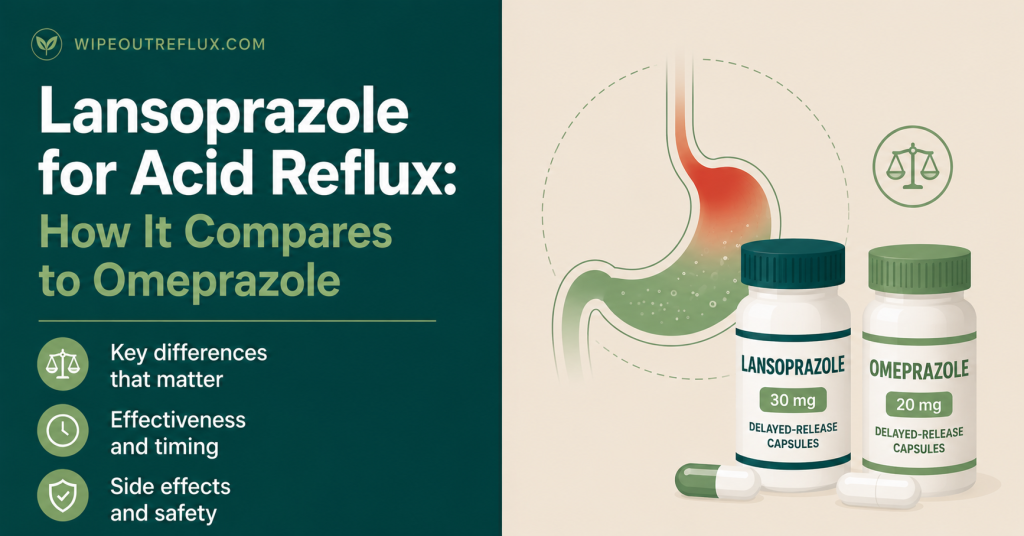
Lansoprazole 30 mg and omeprazole 20 mg are, for practical purposes, interchangeable. A meta-analysis of six randomised double-blind trials put 8-week healing rates for erosive oesophagitis at 88.7% for lansoprazole and 87.0% for omeprazole — a difference whose confidence interval comfortably included zero. If someone has switched you from one to the other, don’t expect a transformation.
The real differences are smaller and more practical: lansoprazole comes in an orally disintegrating tablet that dissolves on the tongue, it’s the PPI most consistently linked to microscopic colitis in the literature, and it’s the drug used in TOPPITS — the trial that found PPIs no better than placebo for persistent throat symptoms. That last one matters enormously if you were prescribed it for a lump-in-the-throat sensation or chronic throat clearing.
Below is the head-to-head data, the timing rule that decides whether either drug works properly, the side effect profile, and where lansoprazole is genuinely the better or worse pick.
Key Takeaways
- Lansoprazole 30 mg and omeprazole 20 mg heal erosive oesophagitis at statistically indistinguishable rates — 88.7% versus 87.0% at eight weeks.
- Both must be taken 30–60 minutes before a meal; taken without food, gastric pH sits below 4 for 42% of the day instead of 17%.
- A head-to-head trial found rabeprazole relieved heartburn faster than either lansoprazole or omeprazole, with no difference in healing at eight weeks.
- Lansoprazole’s orally disintegrating tablet is a genuine advantage for anyone with swallowing difficulty.
- Lansoprazole is independently associated with collagenous colitis in case-control data, with an odds ratio of 6.4 — the strongest drug association in that study after polyarthritis.
- TOPPITS, a 346-patient placebo-controlled trial of lansoprazole 30 mg twice daily for persistent throat symptoms, found no benefit over placebo at 16 weeks or 12 months.
- Both drugs are stronger CYP2C19 inhibitors than pantoprazole, so pantoprazole remains preferable alongside clopidogrel.
- Neither reduces how often you reflux — only how acidic it is when you do.
The Head-to-Head Data
This is the question most people arrive with, so let’s settle it first.
A meta-analysis searched for randomised, double-blind trials comparing omeprazole 20 mg with lansoprazole 30 mg in endoscopically confirmed erosive oesophagitis, and found six without significant heterogeneity. Pooled per-protocol healing rates were 74.7% for omeprazole and 77.7% for lansoprazole at four weeks, and 87.0% versus 88.7% at eight weeks. Intention-to-treat figures showed the same pattern. In every analysis the absolute benefit for lansoprazole was small and the 95% confidence interval crossed zero Sharma et al., Alimentary Pharmacology and Therapeutics, 2001.
You’ll find claims online that lansoprazole relieves heartburn faster. The best direct evidence doesn’t support it. A randomised trial in 85 patients with erosive reflux oesophagitis compared omeprazole 20 mg, lansoprazole 30 mg and rabeprazole 20 mg, tracking heartburn daily over the first week. Rabeprazole produced faster symptom relief than both of the others — complete heartburn remission came significantly sooner than with omeprazole (P = 0.035) and lansoprazole (P = 0.038). Lansoprazole and omeprazole were not distinguishable from each other, and endoscopic healing at eight weeks was the same across all three Adachi et al., Journal of Gastroenterology and Hepatology, 2003.
So: same healing, same speed of relief. If you’re choosing between them on efficacy alone, you’re choosing on a coin flip. Which means the sensible basis for choosing is everything else.
The Timing Rule — Which Matters More Than the Choice
Before anything else, this. PPIs bind irreversibly to proton pumps, but only to pumps that are actively secreting. Dormant pumps are invisible to the drug. What wakes them up is a meal.
A randomised crossover study in 21 healthy volunteers gave a PPI either 15 minutes before breakfast or at the same hour with no food until midday. Before breakfast, gastric pH was under 4 for a median 17.2% of the daytime period. Without the meal, that rose to 42.0%, and 15 of the 21 subjects did better with food following the dose Hatlebakk et al., Alimentary Pharmacology and Therapeutics, 2000.
Take lansoprazole 30 to 60 minutes before your first meal. If you’re on twice daily, the second dose goes before the evening meal, not at bedtime. Give it three to five days for full effect, since suppression builds cumulatively as more pumps are knocked out between doses — the same pattern described in how long a PPI takes to work and the best time of day to take omeprazole.
Switching brands is a far smaller intervention than fixing the timing. If your PPI has stopped delivering, start here before assuming the medication isn’t working.
Dosing and Formulations
Standard regimens:
- GERD / erosive oesophagitis healing: lansoprazole 30 mg once daily for 4–8 weeks.
- Maintenance: 15 mg once daily, or 30 mg if symptoms recur.
- Refractory or extraoesophageal symptoms: 30 mg twice daily, both doses before meals.
- Over the counter: 15 mg is available OTC in several markets for frequent heartburn, intended as a 14-day course.
The formulation is where lansoprazole has a genuine, underrated edge. It’s available as an orally disintegrating tablet (Prevacid SoluTab, Zoton FasTab) that dissolves on the tongue without water and can be dispersed in water for a feeding tube. That’s a real advantage if you have swallowing difficulty — which, given that reflux itself can cause a sensation of obstruction, is not a rare situation. Standard capsules also come as granules that can be sprinkled on soft food, whereas omeprazole capsules are more restrictive.
Don’t crush or chew ordinary lansoprazole capsules. The enteric coating exists because stomach acid destroys the active drug before it can be absorbed.
The Microscopic Colitis Signal
This is the one thing that genuinely differentiates lansoprazole, and it’s rarely mentioned on comparison pages.
Microscopic colitis — collagenous colitis and lymphocytic colitis — causes chronic, watery, non-bloody diarrhoea with a colonoscopy that looks completely normal. The diagnosis only shows up on biopsy, which is precisely why it gets missed.
A prospective case-control study of 120 patients with collagenous colitis, 70 with lymphocytic colitis and 128 controls found lansoprazole use independently associated with collagenous colitis at an odds ratio of 6.4. The only stronger association in that analysis was a history of polyarthritis. Omeprazole appeared too, but attached to lymphocytic colitis and at a much weaker odds ratio of 2.7 Fernández-Bañares et al., Inflammatory Bowel Diseases, 2013.
A systematic review of the wider literature found 19 relevant publications — five case-control studies and 14 case reports or series covering 32 cases — and concluded there is a possible association between PPIs generally and microscopic colitis, while noting that all the studies were small and none investigated dose or agent-specific risk properly Law et al., Annals of Pharmacotherapy, 2017.
Keep this in proportion: microscopic colitis is uncommon, the evidence base is small, and association is not causation. But the practical takeaway is simple and worth knowing. If you develop persistent watery diarrhoea on lansoprazole, don’t assume it’s unrelated or that you’ve picked up a bug. Tell your doctor which PPI you’re on, and mention this specific association — because a normal-looking colonoscopy without biopsies will miss it entirely.
Lansoprazole and Throat Symptoms — The TOPPITS Result
If you were prescribed lansoprazole for a lump-in-the-throat sensation, chronic throat clearing, hoarseness or a persistent cough, this section is the most important thing on the page.
TOPPITS was a UK multicentre, double-blind, placebo-controlled phase III trial across eight ENT departments. It randomised 346 patients with persistent throat symptoms and a Reflux Symptom Index of 10 or above to lansoprazole 30 mg twice daily or matched placebo for 16 weeks.
Symptoms improved in both groups — mean RSI fell from around 22 at baseline to roughly 16 at four months. But lansoprazole patients ended up 1.9 points worse than placebo patients at 16 weeks, a non-significant difference in the wrong direction. At 12 months, 40% of the lansoprazole group had a normal RSI versus 55% of the placebo group. Every secondary measure — the Comprehensive Reflux Symptom Score, the LPR quality of life scales and their subscales — showed the same absence of benefit. The authors’ conclusion was blunt: no evidence of benefit from treating persistent throat symptoms with lansoprazole Wilson et al., Health Technology Assessment, 2021.
This is a properly powered, definitive trial, and it’s the reason acid suppression is no longer recommended as first-line for isolated throat symptoms. The mechanism explains it: LPR is driven largely by pepsin, which stays active and damaging at the pH levels PPIs routinely achieve. Reducing acidity doesn’t remove the enzyme. Why PPIs don’t work for LPR covers the full picture, and PPIs for LPR covers where they still have a legitimate role.
For throat symptoms, alginates — particularly Gaviscon Advance — have better evidence, because they block reflux physically rather than chemically. And the durable answer sits with the Wipeout Diet Plan, which works on how often reflux events happen rather than on their pH.
Side Effects and Long-Term Use
Short-term: headache, diarrhoea, abdominal pain, nausea, constipation, flatulence. Usually mild, usually settling.
Longer-term concerns are class effects and apply to lansoprazole and omeprazole equally. Acid is needed to liberate several nutrients from food, so multi-year use warrants attention to vitamin B12, magnesium and iron. Reduced acid also means fewer swallowed bacteria killed in transit, which is the mechanism behind the modest enteric infection signal seen with PPIs. PPI side effects covers the broader picture, including which of the widely reported risks hold up under randomised evidence and which don’t.
The ACG’s GERD guideline recommends PPIs as the medical treatment of choice while explicitly advising the lowest effective dose and periodic reassessment of ongoing need Katz et al., American Journal of Gastroenterology, 2022. That reassessment is the bit that tends not to happen — repeat prescriptions have a way of running for years unexamined.
On interactions: both lansoprazole and omeprazole inhibit CYP2C19, omeprazole considerably more so. If you’re on clopidogrel, pantoprazole is the preferred PPI in that specific situation. Both also reduce absorption of drugs needing an acidic stomach — ketoconazole, itraconazole, atazanavir, and iron and calcium carbonate supplements.
And don’t stop abruptly after months of daily use. Acid suppression raises gastrin, gastrin expands acid-producing capacity, and stopping suddenly produces rebound symptoms worse than baseline for a couple of weeks — which almost everyone misreads as proof they still need the drug. Getting off PPIs and acid rebound covers tapering properly.
So Which Should You Take?
On the evidence, choose on practicalities rather than potency.
Lansoprazole makes sense if: you have trouble swallowing capsules and want the orally disintegrating tablet; omeprazole hasn’t suited you and you want a same-class alternative; or it’s simply what’s cheapest or available where you are.
Omeprazole makes sense if: it’s already working; cost or availability favours it; or you’ve had unexplained diarrhoea on lansoprazole.
Something else makes more sense if: you have severe grade C/D oesophagitis, where esomeprazole 40 mg and vonoprazan have shown better healing; you’re on clopidogrel, where pantoprazole is preferable; or your symptoms are throat-dominant, where the best medication for LPR is a different conversation entirely.
What almost never makes sense is switching between lansoprazole and omeprazole hoping for a different result while keeping everything else the same. The data says you’ll get the same result.
Conclusion
Lansoprazole and omeprazole are close enough to interchangeable that healing rates differ by under two percentage points and symptom relief arrives at the same speed. Choose between them on formulation, cost and tolerance, not on any expectation of superior potency. Lansoprazole’s dissolvable tablet is a real advantage for difficult swallowing; its association with microscopic colitis is a real thing to keep in mind if you develop persistent watery diarrhoea. And if you were given it for a persistent throat symptom, TOPPITS says plainly that it won’t help — which is worth knowing before you spend another four months on it.
The deeper limitation applies to both drugs, and to every PPI. They change the pH of what refluxes; they do nothing about how often it refluxes. The sphincter opens just as frequently, the volume rises just as far, the pepsin arrives just the same. That’s why so many people cycle through the whole class and end up roughly where they started. Closing that gap is exactly what the Wipeout Diet Plan is built to do — a structured, mechanism-first approach to meal size, fat load, timing and trigger load that reduces the number and force of reflux events themselves. I designed it originally around LPR and silent reflux, the throat-based form where acid suppression fails most reliably, but since it targets the same underlying mechanisms it works just as well for GERD and everyday heartburn. And for a concrete starting point this week, the Wipeout Food Reference Guide is the essential companion — every food and drink that’s safe for acid reflux and LPR with its actual pH value, so you’re working from numbers rather than guesswork.
Pick whichever tablet suits you. Then stop expecting it to do the job the diet has to do.
Frequently Asked Questions
Is lansoprazole stronger than omeprazole?
Not meaningfully. Lansoprazole 30 mg and omeprazole 20 mg are the equivalent standard doses, and a meta-analysis of six randomised trials found healing rates of 88.7% and 87.0% at eight weeks — a difference that wasn’t statistically significant.
Can I switch straight from omeprazole to lansoprazole?
Yes. There’s no washout or taper needed when swapping between PPIs at equivalent doses — omeprazole 20 mg to lansoprazole 30 mg. Keep the same timing: 30 to 60 minutes before your first meal.
When should I take lansoprazole?
Thirty to sixty minutes before your first meal of the day. PPIs only inactivate proton pumps that are actively secreting, and a meal is what activates them. Taken without food following, you lose a large part of the effect.
Does lansoprazole cause diarrhoea?
Mild diarrhoea is a common early side effect that usually settles. Persistent watery diarrhoea is different and worth investigating — lansoprazole has been independently associated with collagenous colitis, which needs colonic biopsies to diagnose because the colonoscopy looks normal.
Does lansoprazole work for silent reflux?
The definitive trial says no. TOPPITS randomised 346 patients with persistent throat symptoms to lansoprazole 30 mg twice daily or placebo for 16 weeks and found no benefit at 16 weeks or at 12 months. Alginates have better evidence for throat symptoms.
How long can I stay on lansoprazole?
Some people need long-term treatment for erosive oesophagitis or Barrett’s, and that’s legitimate. But guidelines advise the lowest effective dose with periodic review, and repeat prescriptions frequently run for years without anyone reassessing whether they’re still needed.
Is lansoprazole safe with clopidogrel?
It’s a weaker CYP2C19 inhibitor than omeprazole, so it’s a better choice than omeprazole in that situation — but pantoprazole is the weakest of the class and generally the preferred option alongside clopidogrel. Discuss it with whoever manages your cardiac medication.
Can lansoprazole be dissolved or crushed?
The orally disintegrating tablet is designed to dissolve on the tongue without water and can be dispersed for a feeding tube. Standard enteric-coated capsules must not be crushed or chewed, though the granules inside can usually be sprinkled on soft food — check the specific product instructions.
Research & References
- Meta-analysis of six randomised double-blind trials comparing omeprazole 20 mg with lansoprazole 30 mg in endoscopically diagnosed erosive oesophagitis, finding pooled per-protocol healing rates of 87.0% and 88.7% at eight weeks with no statistically significant difference Sharma et al., Alimentary Pharmacology and Therapeutics, 2001.
- Randomised trial in 85 patients with erosive reflux oesophagitis comparing omeprazole, lansoprazole and rabeprazole, finding rabeprazole produced significantly faster complete heartburn remission than either of the other two, with no difference in endoscopic healing at eight weeks Adachi et al., Journal of Gastroenterology and Hepatology, 2003.
- Randomised crossover trial in 21 healthy volunteers showing gastric pH was below 4 for a median 17.2% of the daytime period when a proton pump inhibitor was taken before breakfast, versus 42.0% when taken without a following meal Hatlebakk et al., Alimentary Pharmacology and Therapeutics, 2000.
- Multicentre, double-blind, placebo-controlled phase III trial randomising 346 patients with persistent throat symptoms to lansoprazole 30 mg twice daily or placebo for 16 weeks, finding no benefit on the Reflux Symptom Index or any secondary outcome at 16 weeks or 12 months Wilson et al., Health Technology Assessment, 2021.
- Prospective case-control study of 120 patients with collagenous colitis, 70 with lymphocytic colitis and 128 controls, finding lansoprazole consumption independently associated with collagenous colitis (odds ratio 6.4) and omeprazole with lymphocytic colitis (odds ratio 2.7) Fernández-Bañares et al., Inflammatory Bowel Diseases, 2013.
- Systematic review of 19 publications comprising five case-control studies and 14 case reports or series, concluding there is a possible association between proton pump inhibitor use and biopsy-confirmed microscopic colitis, while noting all studies were limited by small sample sizes Law et al., Annals of Pharmacotherapy, 2017.
- American College of Gastroenterology clinical guideline for the diagnosis and management of gastro-oesophageal reflux disease, recommending proton pump inhibitors as the medical treatment of choice while advising the lowest effective dose and periodic reassessment of continued need Katz et al., American Journal of Gastroenterology, 2022.

David Gray
12 years living with LPR · Consultant & researcher
I've lived with LPR for twelve years — the misdiagnoses, the PPI courses that did nothing, the slow work of figuring out what actually helps. Wipeout Reflux is where I translate the research into plain terms for people stuck in the same place. Every claim here is sourced to peer-reviewed work, and I consult one-to-one with LPR sufferers.