
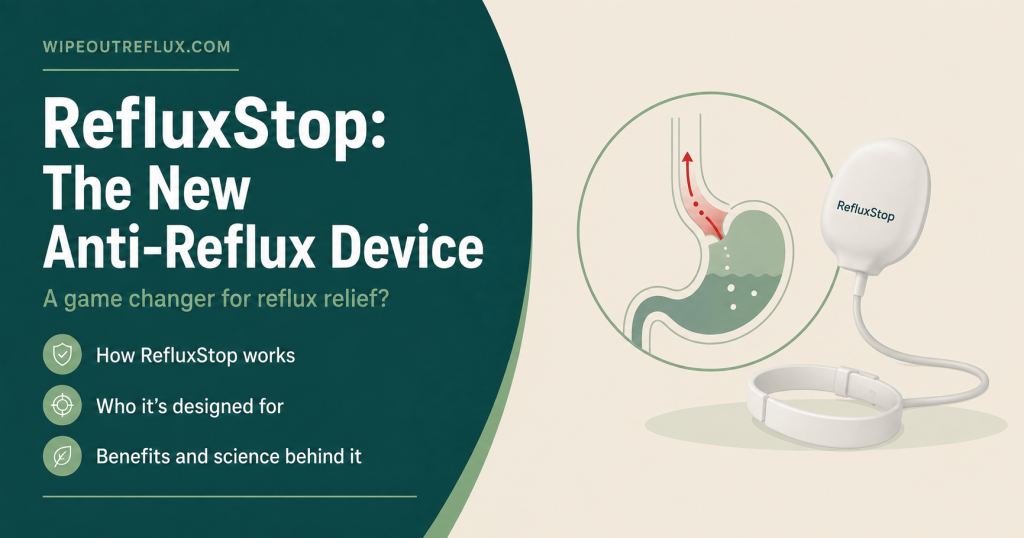
The RefluxStop device is a small silicone implant that treats acid reflux without wrapping, squeezing or narrowing your oesophagus. A surgeon places it in a pouch made from the wall of your stomach, just under the diaphragm, where it holds the lower oesophageal sphincter back down in the abdomen and stops the top of the stomach sliding up through the hiatus again. Because it sits outside the food passageway rather than around it, it doesn’t create the swallowing problems and gas-bloat that put a lot of people off traditional anti-reflux surgery.
The results so far look genuinely impressive. In the five-year data from the CE mark trial, reflux symptom scores and acid exposure both improved by more than 90%, and only one patient out of 47 was still taking a PPI [Altorjay et al., Surgical Endoscopy, 2025].
The catch — and it’s a real one — is that the evidence is all single-arm. Nobody has yet randomised RefluxStop head-to-head against a fundoplication. And if you’re in the US, you can’t have it yet: the FDA application is still pending as of August 2026.
Key Takeaways
- RefluxStop is a non-active silicone implant (no magnets, no battery, no moving parts) placed in a fold of the stomach wall — it never touches or encircles the oesophagus.
- It works by restoring the lower oesophageal sphincter to its correct position below the diaphragm, rebuilding the angle of His, and physically blocking the stomach from re-herniating upward.
- Five-year CE mark trial data showed a 90% improvement in GERD-HRQL scores, acid exposure time falling from 16.35% to 1.57%, and 2.1% PPI use [Altorjay et al., Surgical Endoscopy, 2025].
- A 602-patient real-world study across 22 European centres reported a 1.99% reoperation rate and dilatation for new dysphagia in just 1 patient (0.17%) [Lipham et al., Scientific Reports, 2026].
- Because it doesn’t compress the oesophagus, it’s being used in people with ineffective oesophageal motility (IOM) — a group often turned away from a full Nissen wrap.
- In the UK, NICE says it can be used in the NHS with special arrangements for people with IOM; for everyone else, NICE says more research is needed first.
- CE-marked since 2018. Not yet FDA-approved — Implantica submitted its final PMA response in May 2026 and a decision is pending.
- Every published trial is single-arm and industry-linked. There is no randomised comparison against fundoplication or LINX, and almost no data using LPR-specific outcome measures.
What Actually Goes Wrong in Reflux — and Why It Matters Here
To understand why RefluxStop is designed the way it is, you need to understand what most anti-reflux surgery is actually trying to fix.
Your lower oesophageal sphincter isn’t a standalone valve. It’s part of a system, and that system has three parts working together. First, the sphincter needs to sit below the diaphragm, inside the abdomen, where abdominal pressure helps squeeze it shut. Second, there’s the angle of His — the sharp angle where the oesophagus meets the stomach, which acts like a flap valve. Third, the crura of the diaphragm wrap around the oesophagus and pinch it during breathing and straining.
A hiatal hernia breaks all three at once. The junction slides up into the chest, so it loses abdominal pressure support. The angle of His flattens out. And the diaphragm pinch is gone because the sphincter is no longer sitting in the gap. That’s why hernias and reflux go together so reliably.
Traditional surgery attacks this by building a new valve. In a Nissen fundoplication the surgeon wraps the top of the stomach 360 degrees around the oesophagus; in a Toupet it’s a partial 270-degree wrap. Both work, and they work well for a lot of people — I’ve written about the differences in Nissen vs Toupet fundoplication. But both put tissue around the food pipe, and that’s where the trade-offs come from: difficulty swallowing, bloating you can’t burp away, and the inability to vomit. The LINX device takes a gentler version of the same approach — a bracelet of magnetic beads around the oesophagus — but it’s still a ring on the food passageway.
RefluxStop’s whole design philosophy is to fix the anatomy without putting anything around the oesophagus at all.
How the RefluxStop Device Works
The implant itself is unremarkable to look at: a small, soft silicone body, roughly the size of a walnut, with no electronics, magnets or moving parts. In regulatory language it’s a “non-active implantable device,” which just means it does nothing on its own. It’s a spacer. All the work is done by where it sits.
Here’s the operation, simplified:
- The hernia is repaired. The surgeon pulls the oesophagus and the gastro-oesophageal junction back down into the abdomen and closes the widened hiatus behind it — the same first step as any fundoplication.
- The angle of His is rebuilt. The fundus is sutured to the oesophagus to recreate that sharp flap-valve angle.
- A pouch is made in the stomach wall. The surgeon invaginates a fold of the fundus and creates a small sealed pocket in it.
- The device goes into the pouch. It’s sealed inside the stomach wall, sitting up against the diaphragm — on the outside of the oesophagus, never around it.
Once it’s in, the device acts as a physical stop. It holds the repaired junction down where it belongs and props the fundus in position so it can’t slide back up through the hiatus. That last part matters more than it sounds: re-herniation is one of the commonest reasons a fundoplication eventually fails and symptoms come back years later.
And because the food passageway is untouched, swallowing pressure isn’t changed. That’s the entire selling point. You get the anatomical correction without the outflow resistance.
The procedure is laparoscopic and reasonably quick — one Swiss series reported a median operating time of 57.5 minutes with a laparoscopic completion rate of 97.5% [Fringeli et al., Swiss Medical Weekly, 2024]. Most people are in hospital two to three days.
The Evidence: What the Trials Actually Show
The CE mark trial: 1 year to 5 years
The foundational study is a prospective, single-arm, multicentre trial of 50 adults with chronic GERD. At one year, there were no device-related serious adverse events, GERD-HRQL scores had improved by 86%, mean acid exposure time had dropped from 16.35% to 0.80%, and no patient developed new dysphagia [Bjelović et al., BMC Surgery, 2020].
Forty-four of those patients reached five years. Median GERD-HRQL improved by 90%, from 29.5 down to 3.0. Acid exposure time settled at 1.57%. PPI use was 2.1% — one person out of 47. There were no device explantations, no migrations, no erosions and no oesophageal dilatations across the whole five years, and the contrast-swallow X-rays showed zero re-herniations. Only two procedure-related adverse events occurred between years one and five: one moderate dyspepsia and one mild dysphagia, both of which resolved [Altorjay et al., Surgical Endoscopy, 2025].
Zero re-herniation at five years is the number that should get your attention, because that’s precisely the failure mode that undermines long-term fundoplication results.
The real-world safety data
Small trials with hand-picked patients always look good. The more useful test is what happens once a device is out in ordinary hospitals. A retrospective study pooled 602 patients treated at 22 centres across six European countries, with follow-up averaging two years and stretching out to 6.75 years.
Serious safety outcomes requiring reoperation occurred in 1.99% (12 of 602), all resolved. Re-herniation accounted for 1.33%. Asymptomatic early erosion was seen in 0.66% (4 patients), with no action taken. And dilatation for new-onset dysphagia was needed in exactly one patient — 0.17% [Lipham et al., Scientific Reports, 2026].
That dysphagia figure is the standout. Persistent swallowing difficulty after a Nissen is common enough that it’s a routine part of the consent conversation. A rate of one in six hundred is a different order of magnitude.
The difficult patients
Where RefluxStop gets genuinely interesting is in people who are usually told surgery isn’t a great option.
Ineffective oesophageal motility means your oesophagus doesn’t squeeze strongly enough to reliably push food down. It shows up on oesophageal manometry, and it’s very common in reflux patients. Surgeons are traditionally wary of putting a full 360-degree wrap on a weak oesophagus, because if the oesophagus can’t generate enough force to push through the wrap, you end up with a patient who can’t swallow properly. Many are offered a partial wrap instead, or turned down altogether.
A study of 40 PPI-refractory patients who all had IEM found GERD-HRQL scores fell from 32.83 to 6.6, PPI use dropped by 84%, and 90% were symptom-free or improved and satisfied. There were two severe adverse events: one device slippage needing revision the day after surgery, and one migration that needed no intervention [Schoppmann et al., Scientific Reports, 2024].
A single-institution series of the first 100 patients — a deliberately complex group, with 53% having hiatal hernias of 4cm or more, 66% with IEM and 46% with pre-operative dysphagia — reported median GERD-HRQL falling from 42.5 to 1.0 at twelve months, a 97.6% reduction, with PPI use dropping from 94.8% to 5.2% [Zehetner et al., Journal of Gastrointestinal Surgery, 2026].
Where the Evidence Falls Short
I want to be straight with you here, because the marketing around this device is enthusiastic and the trial numbers are eye-catching.
There is no randomised controlled trial. Every study above is single-arm — everyone got the device, and outcomes are compared to their own baseline. That design reliably overstates benefit, because it can’t separate the device’s effect from the placebo response, from regression to the mean, or from the general improvement that comes with the lifestyle changes people make around surgery. Until somebody randomises RefluxStop against a Toupet fundoplication, “better than fundoplication” is a plausible hypothesis, not a demonstrated fact.
The research is industry-linked. The manufacturer sponsored the CE mark trial and is involved in the follow-on studies. That doesn’t make the data wrong, but it’s context you’re entitled to have.
Follow-up is still short for an implant. Five years in 44 people, and an average of two years in the larger real-world cohort. A permanent implant needs decades of data. Fundoplication has that; RefluxStop doesn’t yet.
Almost nothing here is about LPR. This is the gap that matters most for a lot of the people reading this site. GERD-HRQL is a heartburn and regurgitation questionnaire. It asks about burning behind the breastbone and food coming back up. It does not ask about throat clearing, globus, hoarseness, post-nasal drip or chronic cough — the things measured by the Reflux Symptom Index. So when a trial reports a 90% improvement, that’s a 90% improvement in heartburn-type symptoms. Whether throat symptoms respond as well is largely unstudied.
There’s a mechanistic reason to be cautious. Any surgery that reduces total reflux events should reduce the amount of pepsin reaching your throat, and that’s genuinely encouraging. But LPR symptoms are driven by a mix of reflux exposure, tissue sensitivity and nerve hypersensitivity, and surgery only fixes the first of those. People whose throat symptoms are largely a hypersensitivity problem — which is a big part of why PPIs so often fail for LPR — may not get the result they’re hoping for from any operation, RefluxStop included.
Who Can Actually Get RefluxStop?
United Kingdom
NICE reviewed the procedure and published Interventional Procedures Guidance 803, “Laparoscopic insertion of an inactive implant for gastro-oesophageal reflux disease,” in June 2025. RefluxStop is the only device it covers. The recommendation splits the population in two: for people with ineffective oesophageal motility, the procedure may be used in the NHS with special arrangements for clinical governance, consent and audit or research; for people without IOM, NICE says more research is needed before routine NHS use [NICE Interventional Procedures Guidance 803, 2025].
Practically, that means access on the NHS is limited and depends heavily on your local trust and whether you have documented IOM on manometry. It’s more widely available privately.
On cost, a health-economic model from an NHS England perspective put the incremental cost-effectiveness ratio at £4,156 per QALY versus medical management with PPIs, £6,517 versus laparoscopic Nissen fundoplication, and £249 versus magnetic sphincter augmentation — all comfortably under NICE’s £20,000 threshold [Harper et al., Journal of Medical Economics, 2023]. Worth reading with the usual caution: the model’s inputs come from the same single-arm trials.
Europe
RefluxStop has been CE-marked since August 2018 and is available across the EEA and Switzerland, mostly at specialist upper-GI centres. Availability varies a lot by country and by whether your insurer covers it.
United States
Not available. Implantica has been working through the FDA’s premarket approval pathway and submitted its final response to the agency in May 2026. As of August 2026 a decision is still pending, so RefluxStop cannot be implanted in the US outside a trial. If you’re American and reading about this, the realistic surgical options today are fundoplication and LINX.
Who’s likely to be a candidate
Broadly, the profile is: objectively confirmed GERD (so you’ll need proper reflux testing such as pH-impedance monitoring, not just symptoms), a hiatal hernia, inadequate control on medication or an unwillingness to take PPIs long-term, and manometry showing normal or ineffective motility. Achalasia and other major motility disorders are excluded, as is significant untreated Barrett’s dysplasia. If your medication isn’t controlling things, it’s worth working through why your reflux medication isn’t working before you go down the surgical route — sometimes the problem is the drug, the timing, or the diagnosis rather than the need for an operation.
And I’d say this to anyone considering any reflux surgery: get your diet and your reflux triggers properly under control first. Not because it will necessarily save you from the operation, but because it tells you and your surgeon how much of your symptom burden is actually acid exposure versus sensitivity. The Wipeout Diet Plan is a structured way to do exactly that.
Conclusion
RefluxStop is the most interesting thing to happen in anti-reflux surgery in years. The design logic is sound — fix the anatomy, leave the food pipe alone — and the outcomes so far back it up, particularly the near-absence of dysphagia and the zero re-herniation rate at five years. For people with ineffective oesophageal motility who’ve been told a Nissen is too risky, it opens a door that was previously closed. But the evidence base is single-arm, industry-sponsored and short on long-term follow-up, and it tells us almost nothing about throat-based silent reflux. Surgery is permanent. Certainty this thin deserves a slow decision and a proper conversation with an upper-GI surgeon who does a lot of these.
Whatever you decide about surgery, the underlying work doesn’t change. What you eat, when you eat it and how much pepsin you’re sending north every day determines how much of a problem you have in the first place — and it determines how good your result is if you do have an operation. That’s what the Wipeout Diet Plan is built for. It goes far deeper than a list of foods to avoid: it’s a full structured programme for calming reflux at the source. I built it first and foremost around LPR — the stubborn throat-based kind that surgery and PPIs both struggle with — but because it works on the same underlying mechanisms, it’s just as effective for GERD, heartburn and classic acid reflux.
Alongside it, the Wipeout Food Reference Guide is the essential everyday companion — the quick-reference for which foods and drinks are safe with acid reflux and LPR, with the pH value of each one, so you’re never guessing in a supermarket aisle or at a restaurant table. Between the two, you have both the deep plan and the daily lookup.
Get the foundations right first. Then, if you still need surgery, you’ll go into it with a clearer picture of what’s actually driving your symptoms — and a much better chance of being happy with the outcome.
Frequently Asked Questions
Is RefluxStop better than a Nissen fundoplication?
Nobody knows yet, because the two have never been compared in a randomised trial. RefluxStop’s published results show far less dysphagia and gas-bloat than fundoplication typically produces, which is what you’d expect from a device that doesn’t touch the oesophagus. But comparing across separate studies isn’t the same as comparing head-to-head, and fundoplication has decades of long-term data behind it that RefluxStop simply doesn’t have yet.
Can you still burp and vomit after RefluxStop?
Yes. In the five-year trial data, 100% of patients retained the ability to belch and vomit. This is one of the clearest practical differences from a 360-degree Nissen wrap, where losing that ability is a recognised and sometimes permanent side effect.
Does RefluxStop help silent reflux and LPR?
Probably to some degree, but it hasn’t been properly studied. All the published trials measured heartburn-type symptoms with the GERD-HRQL questionnaire, which doesn’t cover throat clearing, globus, hoarseness or cough. Since the device reduces total reflux events, it should reduce pepsin reaching the throat — but if your throat symptoms are largely driven by nerve hypersensitivity rather than ongoing acid exposure, surgery may disappoint you. Ask your surgeon directly what their own LPR patients’ outcomes have been.
Is the device permanent, and can it be removed?
It’s designed to be permanent. It can be removed surgically if necessary, but in the five-year CE mark trial there were no explantations at all, and in the 602-patient real-world series reoperation for any serious reason ran at 1.99%.
How long is recovery after RefluxStop surgery?
It’s a laparoscopic operation, typically under an hour of operating time, with a hospital stay of around two to three days. You’ll be on a soft or liquid diet for a couple of weeks while swelling settles, then gradually back to normal food. Most people return to desk work within two to three weeks and to heavy lifting at around six.
Can I get RefluxStop on the NHS?
Sometimes. NICE allows it in the NHS with special arrangements for people who have ineffective oesophageal motility documented on manometry. If you don’t have IOM, NICE currently says more research is needed before routine use, so NHS access is unlikely. Private treatment is available in the UK.
Do I still need to take PPIs after the procedure?
Most people don’t. PPI use was 2.1% at five years in the CE mark trial and 5.2% at twelve months in the 100-patient series. If you’re currently on a PPI, don’t stop abruptly on your own — acid rebound is real and it will make you think the surgery hasn’t worked.
Research & References
- Bjelović et al., BMC Surgery, 2020 — The original CE mark trial of 50 patients at one year. No device-related serious adverse events, GERD-HRQL improved 86%, mean acid exposure time fell from 16.35% to 0.80%, and no new dysphagia occurred.
- Altorjay et al., Surgical Endoscopy, 2025 — Five-year outcomes from the same trial in 44 patients. Median GERD-HRQL improved 90% (29.5 to 3.0), acid exposure time fell to 1.57%, PPI use was 2.1%, and there were no explantations, migrations, erosions or re-herniations.
- Lipham et al., Scientific Reports, 2026 — Real-world safety data on 602 patients from 22 centres in six European countries, followed for a mean of two years. Reoperation 1.99%, re-herniation 1.33%, asymptomatic erosion 0.66%, and dilatation for new dysphagia in one patient (0.17%).
- Schoppmann et al., Scientific Reports, 2024 — Forty PPI-refractory patients who all had ineffective oesophageal motility. GERD-HRQL fell from 32.83 to 6.6, PPI use dropped 84%, and 90% were symptom-free or improved and satisfied.
- Zehetner et al., Journal of Gastrointestinal Surgery, 2026 — First 100 patients at a single early-adopter centre with 12-month follow-up in a deliberately complex cohort. Median GERD-HRQL fell from 42.5 to 1.0 and PPI use from 94.8% to 5.2%.
- Fringeli et al., Swiss Medical Weekly, 2024 — Retrospective cohort of 40 patients. Correct device positioning in 100%, median operating time 57.5 minutes, 15% 90-day complication rate, and dilatation for dysphagia in 7.5%.
- Harper et al., Journal of Medical Economics, 2023 — Cost-effectiveness modelling from an NHS England perspective. ICERs of £4,156 per QALY versus PPI management, £6,517 versus Nissen fundoplication, and £249 versus magnetic sphincter augmentation.
- NICE Interventional Procedures Guidance 803, 2025 — Recommends the procedure for use in the NHS with special arrangements in people with ineffective oesophageal motility, and states that more research is needed before routine use in people without it.

David Gray
12 years living with LPR · Consultant & researcher
I've lived with LPR for twelve years — the misdiagnoses, the PPI courses that did nothing, the slow work of figuring out what actually helps. Wipeout Reflux is where I translate the research into plain terms for people stuck in the same place. Every claim here is sourced to peer-reviewed work, and I consult one-to-one with LPR sufferers.