
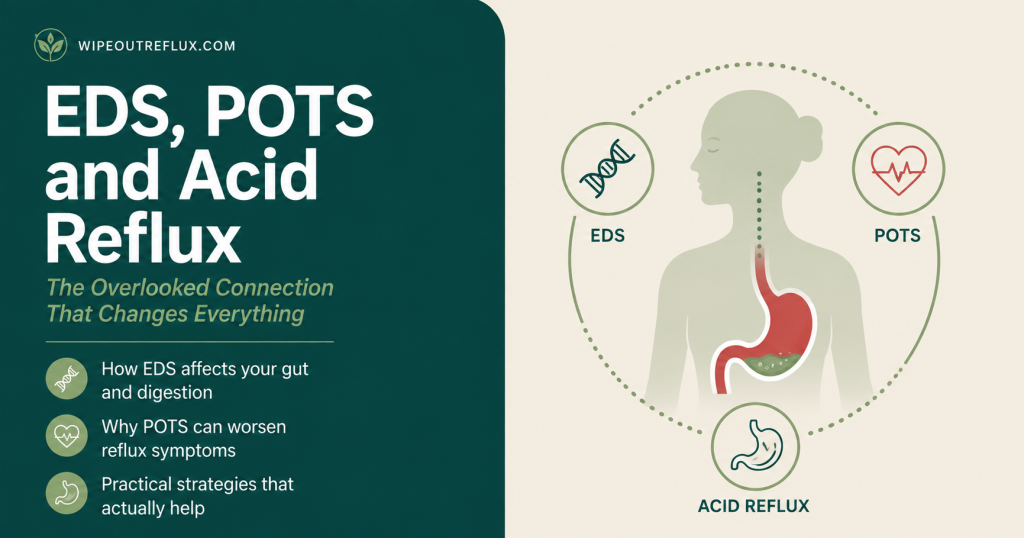
If you have hypermobile Ehlers-Danlos syndrome (hEDS) or postural tachycardia syndrome (POTS), there’s a good chance reflux has come along for the ride — and it’s not a coincidence. These conditions travel together as a recognised cluster, and reflux is one of the most common threads running through all of them. The reason comes down to two overlapping problems: faulty connective tissue and a misfiring autonomic nervous system. One weakens the physical structures that keep acid down; the other disrupts the automatic signals that keep your gut moving.
This matters because reflux in hEDS and POTS often behaves differently from ordinary heartburn. It tends to sit alongside bloating, early fullness, nausea and slow digestion, and it frequently doesn’t respond neatly to standard acid-suppression advice — because acid was only ever part of the story. Understanding why reflux clusters with these conditions is the first step to managing it in a way that actually fits the bigger picture.
Here’s how the connective tissue and autonomic threads each drive reflux, why hEDS, POTS and gut symptoms overlap so consistently, and what genuinely helps when reflux is one part of a wider condition.
Key Takeaways
- Reflux is common in hEDS and POTS because of two overlapping mechanisms: connective tissue laxity (structural) and autonomic dysfunction (functional).
- In hEDS, weak connective tissue can loosen the lower oesophageal sphincter, promote hiatal hernia, and contribute to oesophageal dysmotility — all of which let acid escape upward.
- In POTS, dysautonomia disrupts the automatic nerve signals that drive digestion, commonly causing delayed stomach emptying (gastroparesis) that pushes reflux upward.
- The conditions genuinely overlap: a large share of EDS patients have orthostatic intolerance like POTS, and many POTS patients have joint hypermobility.
- GI symptoms are among the most prominent complaints in this cluster — reflux usually comes packaged with bloating, early fullness, nausea and slow digestion.
- Management works best when it treats reflux as part of the whole picture: smaller meals, digestion-friendly timing, positioning, and coordinated specialist care.
The connective tissue link (hEDS)
Let me start with the structural side, because it’s the most intuitive. Ehlers-Danlos syndromes are disorders of connective tissue — the collagen-based material that gives your body its structure and stretch. In hEDS, that tissue is more lax than it should be, which is why joints are hypermobile. But the same tissue holds your digestive plumbing together, and when it’s too stretchy, the valves and supports that keep acid down don’t hold as firmly.
A review of hEDS and reflux lays out the mechanism clearly: connective tissue laxity can lead to increased relaxations of the lower oesophageal sphincter, weakening the main barrier against reflux. The same laxity, through depletion of elastic fibres in the ligaments around the gastro-oesophageal junction, makes hiatal hernia more likely — and a hiatal hernia is one of the strongest structural drivers of reflux there is. On top of that, the oesophagus itself can move sluggishly, adding oesophageal dysmotility to the mix [Lee et al., Foregut, 2026]. It’s a stretchy-tissue problem showing up in the one place you’d least want it.
The autonomic link (POTS)
Now the functional side, which is where POTS comes in. Your digestive system runs largely on autopilot, controlled by the autonomic nervous system — the same system that manages heart rate and blood pressure. POTS is fundamentally a disorder of that autonomic control (dysautonomia), and the disruption doesn’t stop at the heart. The same faulty signalling that makes your pulse race when you stand up also disturbs the nerve signals that drive digestion.
The practical result is that the gut slows down. Dysautonomia commonly causes delayed stomach emptying — gastroparesis — where food lingers in the stomach far too long. When the stomach stays full and under pressure, that pressure has to go somewhere, and it pushes acid and contents back up. This is a major, under-appreciated reflux driver in POTS, and it runs through the vagus nerve, the main highway between brain and gut. Because the autonomic system is the common thread, GI complaints are among the most prominent non-cardiovascular symptoms in POTS [Wu & Ho, Frontiers in Neurology, 2024].
Why they cluster together
Here’s what ties it into one picture, and why so many people end up with all of it at once. hEDS and POTS are strongly linked: a large proportion of people with EDS also have some form of orthostatic intolerance such as POTS, and a notable share of POTS patients turn out to have joint hypermobility [Wu & Ho, Frontiers in Neurology, 2024]. Many also have mast cell activation issues on top — the histamine-driven overlap I cover in the MCAS and reflux link.
So when reflux shows up, it’s rarely alone. In hEDS specifically, studies find reflux is common and usually accompanied by broader gut dysmotility — one tertiary-centre series reported reflux in over a third of hEDS patients and some form of dysmotility in around three-quarters of those tested, with gastroparesis a frequent finding [Alomari et al., Cureus, 2020]. That’s why treating the reflux in isolation often disappoints: it’s one symptom of a system-wide connective-tissue and autonomic problem, and it tends to come bundled with bloating, nausea, early fullness and the kind of overlap you also see in IBS and functional dyspepsia.
What actually helps
Because reflux here is driven by structure and slow motility rather than simply excess acid, the most effective measures are the ones that reduce pressure on the stomach and help it empty — and they matter more than usual. This should always be coordinated with your specialists, but the practical foundations are:
- Eat smaller, more frequent meals. A stomach that empties slowly copes far better with small volumes. Large meals sit, ferment and push acid upward; small ones move through with less pressure.
- Favour lower-fat, easier-to-digest foods. Fat slows gastric emptying further, so lighter meals leave the stomach faster — especially helpful if gastroparesis is part of your picture.
- Stay upright and move gently after eating. Sitting up and a gentle walk after meals uses gravity and light activity to help the stomach empty — within your energy limits, since fatigue is real in this cluster.
- Leave a long gap before lying down. Slow emptying means food is still in your stomach hours later, so a generous gap before bed reduces night-time reflux.
- Treat the whole picture. Reflux, gastroparesis, POTS and mast cell symptoms interact, so the best results come from a team approach — gastroenterology alongside whoever manages your POTS and EDS — rather than tackling reflux alone.
One thing I want to say plainly: people with these conditions are too often dismissed, and the gut symptoms are real and mechanistically explainable, not imagined. If reflux and digestive symptoms are affecting your life, they deserve proper investigation and joined-up care.
Conclusion
Reflux travels with hEDS and POTS for solid, physical reasons: lax connective tissue loosens the valves and supports that hold acid down, and autonomic dysfunction slows the stomach so pressure builds and pushes contents upward. Add the strong overlap between these conditions — and often mast cell issues too — and you can see why reflux so rarely comes alone. The key is to treat it as one part of a whole-body picture, with reduced-pressure eating, gravity on your side, and specialists working together rather than in isolation.
Within that framework, what you eat does real work to lower the acid load and ease the pressure on a slow, sensitive gut — and that’s where a structured approach earns its place. The Wipeout Diet Plan is the complete, step-by-step method I built to calm reflux through what you eat and drink; it was designed first and foremost around LPR, the throat-based form, but because it works on the same underlying reflux mechanisms it helps reduce the acid burden in GERD and pressure-driven reflux too. Used as a companion to your medical care — not a replacement for it — it gives you a clear, reflux-smart way of eating that fits smaller, gentler meals. The Wipeout Food Reference Guide is the essential quick companion, showing which foods and drinks are gentlest for reflux and their pH values, so you can plan meals that are kind to a stretchy, slow-moving system. Work with your team, ease the pressure on your gut, and reflux becomes a much more manageable part of the picture.
Frequently Asked Questions
Why do EDS and acid reflux go together?
Because Ehlers-Danlos syndrome affects connective tissue throughout the body, including the structures that keep acid down. Lax tissue can loosen the lower oesophageal sphincter, make hiatal hernia more likely, and slow the oesophagus — all of which allow reflux. Reflux in EDS is usually part of broader gut dysmotility rather than a standalone problem.
Does POTS cause acid reflux?
POTS can certainly contribute to it. POTS is a disorder of the autonomic nervous system, which also controls digestion, so the same dysfunction that races your heart can slow your stomach. Delayed stomach emptying (gastroparesis) keeps the stomach full and under pressure, pushing acid upward — which is why reflux and nausea are common in POTS.
Why doesn’t my reflux respond to normal treatment?
Because in hEDS and POTS, reflux is often driven by structure and slow motility rather than excess acid, so acid-suppressing measures only address part of the problem. Approaches that reduce stomach pressure and help emptying — smaller, lower-fat meals, staying upright, long pre-bed gaps — often help more, ideally alongside treatment for any gastroparesis and POTS.
Is it normal to have reflux, bloating and nausea together with hEDS or POTS?
Yes, unfortunately it’s common. GI symptoms are among the most prominent complaints in this cluster, and reflux typically comes packaged with bloating, early fullness, nausea and slow digestion because they share the same underlying connective-tissue and autonomic causes. These symptoms are real and explainable, and worth proper investigation.
What kind of doctor should I see for reflux with EDS or POTS?
A gastroenterologist familiar with dysmotility is ideal, working alongside whoever manages your POTS and EDS — often including autonomic specialists. Because these conditions interact, joined-up care tends to work far better than treating reflux in isolation. Testing for gastroparesis and related dysmotility can be particularly useful in guiding treatment.
Research & References
- Review of gastro-oesophageal reflux and Barrett’s oesophagus in hypermobile Ehlers-Danlos syndrome and joint hypermobility, describing connective-tissue mechanisms — increased lower oesophageal sphincter relaxations, elastic-fibre depletion promoting hiatal hernia, and oesophageal dysmotility [Lee et al., Foregut, 2026].
- Overview of the links between Ehlers-Danlos syndrome, postural orthostatic tachycardia syndrome and gastrointestinal symptoms, explaining how autonomic dysfunction contributes to delayed gastric emptying and reflux, and documenting the strong overlap between EDS and POTS [Wu & Ho, Frontiers in Neurology, 2024].
- Tertiary-centre study of gastrointestinal dysmotility in hypermobile Ehlers-Danlos syndrome, reporting reflux in over a third of patients and dysmotility (including gastroparesis) in around three-quarters of those undergoing motility testing [Alomari et al., Cureus, 2020].

David Gray
12 years living with LPR · Consultant & researcher
I've lived with LPR for twelve years — the misdiagnoses, the PPI courses that did nothing, the slow work of figuring out what actually helps. Wipeout Reflux is where I translate the research into plain terms for people stuck in the same place. Every claim here is sourced to peer-reviewed work, and I consult one-to-one with LPR sufferers.