
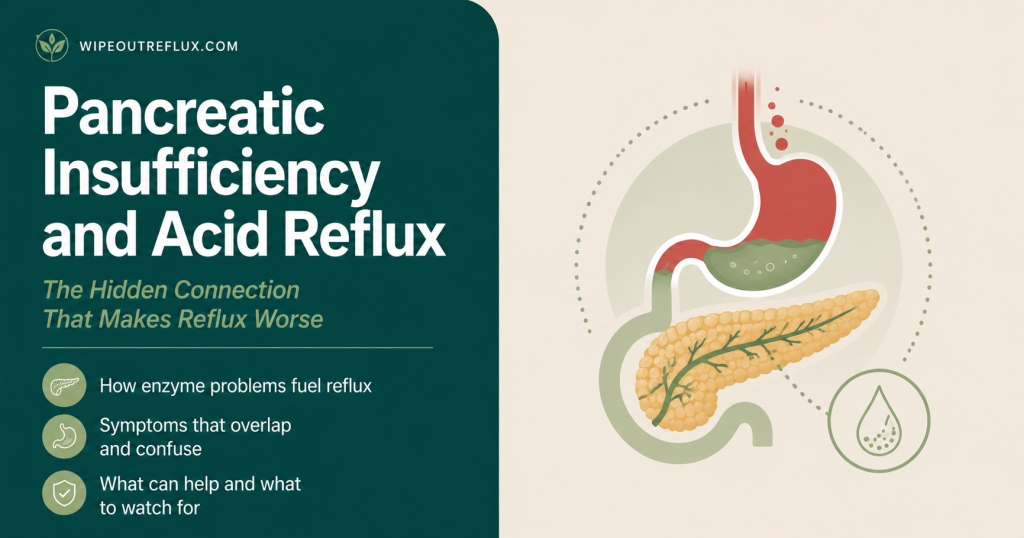
Not everything that feels like reflux or indigestion actually is, and exocrine pancreatic insufficiency (EPI) is one of the most commonly missed impostors. EPI is what happens when the pancreas doesn’t produce enough digestive enzymes to break down food — particularly fat. The symptoms it causes, though, are frustratingly familiar: bloating, gas, upper abdominal discomfort, a heavy over-full feeling after meals and general indigestion. Those overlap so closely with reflux and dyspepsia that EPI is often mistaken for them, or hidden behind them, for years.
This matters because the treatments are completely different. If your problem is genuinely reflux, calming the acid and adjusting your diet is the answer. But if enzyme-poor digestion is driving your symptoms, no amount of acid suppression will fix it — you need the enzymes replaced. That’s why EPI is worth knowing about and, in the right circumstances, worth ruling out: it’s a simple stool test away from an answer, and a very treatable condition once found.
Here’s how EPI overlaps with acid reflux, the tell-tale signs that point toward the pancreas rather than acid, who should be tested, and how it’s diagnosed and treated.
Key Takeaways
- EPI means the pancreas doesn’t make enough digestive enzymes, so food — especially fat — isn’t properly broken down.
- Its symptoms overlap heavily with reflux and indigestion: bloating, gas, fullness, upper abdominal discomfort — which is why it’s frequently misdiagnosed or missed.
- The distinguishing red flags are steatorrhea (pale, oily, floating, foul-smelling stools), unexplained weight loss, and diarrhoea — signs that point to the pancreas rather than acid.
- Certain groups are much higher risk: people with chronic pancreatitis, previous pancreatic or GI surgery, diabetes, or coeliac disease.
- Diagnosis is straightforward — a faecal elastase stool test — and treatment is pancreatic enzyme replacement therapy (PERT) taken with meals.
- EPI and reflux can also coexist, so the goal is to identify what’s actually driving your symptoms rather than assuming it’s all acid.
What EPI is and why it mimics reflux
Let me explain the mechanism, because it makes the overlap obvious. Your pancreas produces enzymes that digest fat, protein and carbohydrate. In EPI, that enzyme output drops too low — most importantly for fat digestion. When fat isn’t broken down, it moves through the gut undigested, and that causes fermentation, gas production, bloating and a heavy, uncomfortable fullness after eating.
Now look at that symptom list: bloating, excessive gas, upper abdominal discomfort, feeling uncomfortably full. Those are almost exactly the complaints people bring when they think they have reflux or persistent indigestion, and they overlap with functional dyspepsia too. The classic EPI symptoms recognised by gastroenterology — steatorrhea, weight loss, bloating and excessive flatulence — sit right on top of everyday digestive complaints [Whitcomb et al., Gastroenterology, 2023]. It’s no wonder it hides in plain sight, and no wonder gas and bloating get blamed on reflux when the pancreas is the real culprit.
The signs that point to the pancreas, not acid
Here’s how to tell the difference, because a few features genuinely distinguish EPI from ordinary reflux. Reflux is fundamentally about acid in the wrong place — burning, regurgitation, a sour taste, throat symptoms. EPI is about food not being digested, and it leaves clues lower down:
- Steatorrhea. This is the standout sign — stools that are pale, bulky, greasy or oily, that float, are difficult to flush, and smell notably foul. It’s undigested fat, and reflux doesn’t cause it.
- Unexplained weight loss. When you’re not absorbing nutrients properly, weight can fall despite eating normally — a red flag that always deserves investigation, as I note in the piece on reflux and weight loss.
- Diarrhoea or loose stools. Maldigested food frequently causes loose, urgent or frequent stools, and EPI is sometimes hidden inside an IBS label.
- Symptoms that track with fatty meals. If a rich, fatty meal reliably brings on the bloating and loose stools, that points toward fat maldigestion rather than acid.
If your “reflux” comes with any of these — especially oily, floating stools or weight loss — that’s the moment to think beyond acid and mention the pancreas to your doctor.
Who should be tested for EPI
EPI doesn’t come out of nowhere; it usually has a cause, and knowing the high-risk groups helps you and your doctor decide when to look for it. Testing is particularly worth considering if you have digestive symptoms plus any of these risk factors [Tang et al., Gastroenterology Report, 2025]:
- Chronic or recurrent pancreatitis — the most common cause, since it damages the enzyme-producing tissue.
- Previous pancreatic or gastrointestinal surgery — including stomach or bowel operations, which very commonly lead to maldigestion.
- Diabetes — both type 1 and type 2 carry a meaningfully raised risk, a connection worth knowing alongside the more familiar diabetes and reflux link.
- Coeliac disease or inflammatory bowel disease — particularly when diarrhoea persists despite treatment.
- Heavy alcohol use or a history of it — a major driver of pancreatic damage.
The overlap is real enough that studies actively looking for it keep finding hidden cases — for example, around one in twenty people diagnosed with diarrhoea-predominant IBS turned out to have undiagnosed EPI on stool testing [Olmos et al., Digestive Diseases and Sciences, 2022]. That’s a reminder that when the label doesn’t quite fit, it’s worth checking.
How EPI is diagnosed and treated
The reassuring part is that both testing and treatment are simple. The first-line test is faecal elastase-1 — a single stool sample that measures how much of a specific pancreatic enzyme is reaching your stool. A low result (below 100 µg/g) indicates EPI, while a middling result (100–200) is indeterminate and prompts further assessment [Whitcomb et al., Gastroenterology, 2023]. No scopes, no fasting — just a stool sample your GP can arrange.
Treatment is pancreatic enzyme replacement therapy (PERT): capsules containing the digestive enzymes your pancreas isn’t making, taken with every meal and snack so the enzymes are present exactly when food is being digested. When EPI is the real cause, PERT can transform symptoms — the bloating, the greasy stools and the weight loss often settle once food is being properly broken down again. It’s a world away from acid suppression, which is precisely why getting the diagnosis right matters. This is also distinct from taking over-the-counter digestive enzyme supplements for general symptoms — genuine EPI needs proper prescription-strength enzymes at the right dose, guided by a doctor.
When reflux and EPI coexist
One nuance worth holding onto: this isn’t always either/or. You can have genuine reflux and EPI at the same time, and the digestive systems interact — poor digestion, bloating and pressure can even aggravate reflux. So the aim isn’t to swap one label for another, but to work out how much of what you feel is acid and how much is maldigestion, and treat each accordingly. If you’ve been managing “reflux” for a long time and something still doesn’t add up — particularly the bowel and weight changes — it’s very reasonable to ask your doctor whether the pancreas deserves a look. Broader gut health feeds into how you feel too, and getting the full picture is what leads to the right treatment.
Conclusion
Exocrine pancreatic insufficiency is a great mimic of reflux and indigestion, and because the treatments are so different, it’s genuinely worth ruling out when the usual reflux story doesn’t quite fit — especially if you have oily, floating stools, unexplained weight loss, or risk factors like pancreatitis, GI surgery or diabetes. The good news is that it’s easy to test for with a stool sample and very treatable with enzyme replacement, so an answer is well within reach. The key is not assuming every bout of bloating and fullness is acid.
For the part of your symptoms that genuinely is reflux, though, what you eat and drink remains the foundation, and that’s where a structured approach pays off. The Wipeout Diet Plan is the complete, step-by-step method I built to calm reflux at its source; it was designed first and foremost around LPR, the throat-based form, but because it works on the same underlying reflux mechanisms it’s just as effective for GERD, heartburn and everyday acid reflux. The Wipeout Food Reference Guide is the essential companion, showing which foods and drinks are safe for reflux and their pH values. Just remember the crucial caveat: if a stool test points to EPI, that side needs enzyme replacement from your doctor, not diet alone — so the smartest move is to nail down what’s actually driving your symptoms first, then treat each cause properly. Get the diagnosis right, and the relief tends to follow.
Frequently Asked Questions
Can pancreatic insufficiency be mistaken for acid reflux?
Yes, very commonly. EPI causes bloating, gas, upper abdominal discomfort and a heavy fullness after eating, which overlap closely with reflux and indigestion. Because these symptoms look so similar, EPI is frequently misdiagnosed or missed. The distinguishing features are oily, floating stools, unexplained weight loss and diarrhoea, which point to the pancreas rather than acid.
How do I know if it’s reflux or my pancreas?
Reflux is about acid — burning, regurgitation, a sour taste and throat symptoms. EPI is about undigested food and shows up lower down, with pale, greasy, foul-smelling stools that float and are hard to flush, plus weight loss and loose stools, often worse after fatty meals. If those bowel and weight changes are present, ask your doctor about testing the pancreas.
What test diagnoses EPI?
The first-line test is faecal elastase-1, a simple stool sample that measures pancreatic enzyme output. A result below 100 µg/g indicates EPI, while 100–200 is indeterminate and needs further assessment. It’s easy to arrange through your GP, requires no scope or fasting, and is the practical way to rule EPI in or out.
Who is most at risk of EPI?
People with chronic or recurrent pancreatitis, previous pancreatic or gastrointestinal surgery, diabetes, coeliac disease, inflammatory bowel disease, or a history of heavy alcohol use are at higher risk. If you have persistent digestive symptoms alongside any of these, EPI is worth actively ruling out rather than assuming your symptoms are simply reflux or IBS.
Can you have acid reflux and EPI at the same time?
Yes. The two can coexist, and poor digestion with bloating and pressure can even aggravate reflux. The goal isn’t to replace one diagnosis with the other but to work out how much of your discomfort is acid and how much is maldigestion, then treat each appropriately — acid measures for the reflux, enzyme replacement for the EPI.
Research & References
- AGA Clinical Practice Update on the epidemiology, evaluation and management of exocrine pancreatic insufficiency, outlining the typical symptoms (steatorrhea, weight loss, bloating, flatulence), the associated risk conditions, faecal elastase as the initial test (below 100 µg/g indicating EPI), and pancreatic enzyme replacement therapy as treatment [Whitcomb et al., Gastroenterology, 2023].
- Review of the causes of exocrine pancreatic insufficiency — including chronic pancreatitis, pancreatic and gastrointestinal surgery, diabetes, coeliac disease and inflammatory bowel disease — highlighting that EPI is frequently overlooked and under-recognised [Tang et al., Gastroenterology Report, 2025].
- Study applying faecal elastase testing to patients with diarrhoea-predominant IBS (Rome IV), finding undiagnosed exocrine pancreatic insufficiency in around 5%, illustrating how EPI can hide behind a functional gut label [Olmos et al., Digestive Diseases and Sciences, 2022].

David Gray
12 years living with LPR · Consultant & researcher
I've lived with LPR for twelve years — the misdiagnoses, the PPI courses that did nothing, the slow work of figuring out what actually helps. Wipeout Reflux is where I translate the research into plain terms for people stuck in the same place. Every claim here is sourced to peer-reviewed work, and I consult one-to-one with LPR sufferers.