
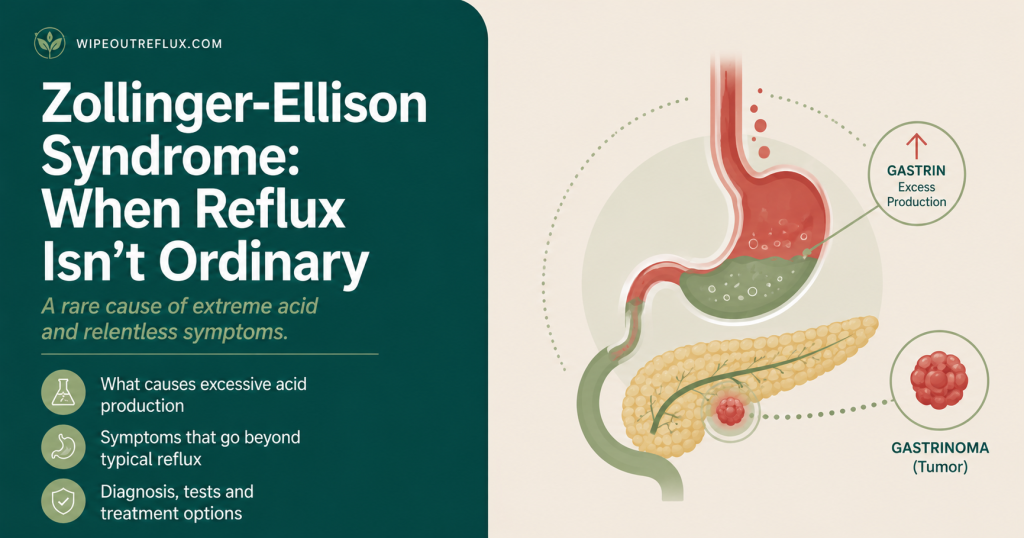
Most reflux is ordinary, even when it’s stubborn. But there’s a rare condition that sits at the far extreme of the spectrum — Zollinger-Ellison syndrome — where a small tumour drives the stomach to pour out enormous amounts of acid, producing severe reflux and ulcers that shrug off ordinary treatment. It’s uncommon, but it’s the classic example of reflux that isn’t behaving normally, and it’s worth knowing about precisely because it changes the whole approach when it’s present.
In Zollinger-Ellison syndrome, a growth called a gastrinoma releases the hormone gastrin, which relentlessly tells the stomach to make acid. The result is acid hypersecretion on a scale everyday reflux never reaches — and that’s why it causes such severe, treatment-resistant symptoms. The good news is that once it’s recognised, the acid can be controlled very effectively; the challenge is recognising it in the first place, because it’s rare and its symptoms look, at a glance, like severe ordinary reflux.
Here’s what Zollinger-Ellison syndrome actually is, the red flags that should raise suspicion, why it resists standard treatment, and how it’s diagnosed and managed — along with some reassurance about just how uncommon it is.
Key Takeaways
- Zollinger-Ellison syndrome is caused by a gastrinoma — a tumour that secretes gastrin, driving the stomach to massively over-produce acid.
- That acid flood causes severe GERD, recurrent or multiple peptic ulcers, and diarrhoea that resist ordinary, standard-dose treatment.
- It’s genuinely rare — roughly one to one-and-a-half cases per million people per year — so it’s the exception, not the explanation for most stubborn reflux.
- Red flags include ulcers that recur or appear in unusual places, ulcers without H. pylori or NSAID use, and severe reflux plus diarrhoea.
- Diagnosis uses a fasting serum gastrin level with stomach acidity testing — but PPIs raise gastrin and complicate this, so testing must be done under specialist supervision.
- Once diagnosed, high-dose acid suppression controls the acid very effectively, alongside locating and treating the tumour.
What Zollinger-Ellison syndrome actually is
Let me start with the mechanism, because it explains everything else. Your stomach’s acid production is regulated by a hormone called gastrin — when gastrin rises, acid-producing cells ramp up. Normally this is a tightly controlled feedback loop. In Zollinger-Ellison syndrome, a small neuroendocrine tumour (a gastrinoma), usually in the pancreas or the wall of the duodenum, secretes gastrin continuously and without any brake. The acid-producing machinery is switched permanently on.
The consequence is gastric acid hypersecretion far beyond anything ordinary reflux involves. All that acid overwhelms the stomach and duodenum’s defences and floods upward into the oesophagus, producing severe reflux and a strong tendency to peptic ulcers and erosive oesophagitis. Roughly a quarter of gastrinomas occur as part of an inherited syndrome called MEN1, which is why family history matters here [Rossi et al., World Journal of Gastroenterology, 2021]. This is the opposite end of the reflux spectrum from the low-stomach-acid picture some people have — here there’s dramatically too much.
The red flags that should raise suspicion
Because it’s rare, doctors don’t test everyone with heartburn for it — nor should they. What raises suspicion is reflux and ulcer disease that behaves unusually. The signs worth knowing are:
- Severe reflux or ulcers that resist standard treatment. Symptoms that don’t settle on normal doses of acid suppression, in the way most reflux does.
- Recurrent or multiple ulcers. Peptic ulcers that keep coming back, or several at once, rather than a single one that heals.
- Ulcers in unusual locations. Ulcers beyond the usual spots — for example further down the duodenum — are a particular clue.
- Ulcers without the usual causes. The two common causes of ulcers are H. pylori infection and NSAID painkillers; ulcers with neither raise the question of why.
- Reflux with chronic diarrhoea. The acid flood can cause persistent diarrhoea that notably improves with acid suppression — a combination that’s a recognised pointer toward gastrinoma.
Modern reviews stress that Zollinger-Ellison syndrome should be considered when reflux and peptic ulcer disease are severe, recurrent or unexplained rather than routine [Chatzipanagiotou et al., Journal of Neuroendocrinology, 2023]. If your reflux fits the ordinary pattern, this simply isn’t the likely answer — but if it’s genuinely severe and not responding to treatment, it’s one of the things a specialist will consider.
Why it resists ordinary treatment
Here’s the important nuance about the “doesn’t respond to PPIs” reputation. It’s not that acid-suppressing drugs don’t work in Zollinger-Ellison syndrome — they do, and they’re the cornerstone of treatment. It’s that the sheer volume of acid means standard doses often aren’t enough. Someone with a gastrinoma is producing so much acid that an ordinary once-daily dose barely dents it, so their symptoms persist and they get labelled as difficult or refractory reflux.
That’s the tell: not total failure of medication, but a need for much higher doses than usual to get control. It’s a more extreme cousin of the general problem where proton pump inhibitors don’t fully control symptoms, except here the reason is a specific, findable, treatable cause. Recognising that pattern — severe symptoms that need unusually high doses to manage — is often what prompts the workup that finds the tumour.
How it’s diagnosed
Diagnosis rests on measuring the hormone at the root of it all: a fasting serum gastrin level, alongside a test of stomach acidity. In Zollinger-Ellison syndrome, gastrin is very high while the stomach is still strongly acidic — a combination that doesn’t happen in ordinary reflux. A markedly elevated fasting gastrin with a low gastric pH is diagnostic, and a secretin stimulation test can confirm ambiguous cases [Rossi et al., World Journal of Gastroenterology, 2021].
But there’s a genuine trap here, and it’s why this must be handled by specialists. Proton pump inhibitors themselves raise gastrin levels — in fact they raise it in the large majority of people who take them, into a range that overlaps with Zollinger-Ellison syndrome. So a high gastrin reading in someone on a PPI can be completely misleading. The catch is that stopping a PPI to test properly can be dangerous in someone who really does have the syndrome, risking severe acid complications. The result is a diagnostic tightrope, and one reason the average time to diagnosis stretches beyond six years [Metz et al., International Journal of Endocrine Oncology, 2017]. The practical message for you is simple: never stop your acid medication on your own to “test” for this — it’s a conversation to have with a gastroenterologist who can do it safely.
How it’s treated
Treatment has two aims: control the acid, and deal with the tumour. Controlling the acid is highly effective — high-dose proton pump inhibitors reliably tame even the massive acid output of a gastrinoma, which is what relieves the reflux and lets ulcers heal. This is why the condition, once diagnosed, becomes far more manageable than its severity might suggest; the same class of drug that seemed to “fail” at standard doses works well at the right dose.
The second half is finding and treating the gastrinoma itself, using specialised imaging to locate it, with surgery offering the potential for a cure when the tumour can be removed. This is firmly specialist territory, coordinated by gastroenterology and often endocrine and surgical teams together. The point for a reader isn’t to self-diagnose — it’s to know that if reflux is truly severe and unusual, this rare but treatable cause exists and can be tested for. If that’s your situation, raising it with your doctor, or asking when to seek specialist input, is the right move.
Conclusion
Zollinger-Ellison syndrome is the rare, dramatic end of the reflux spectrum — a gastrin-secreting tumour driving acid hypersecretion severe enough to cause reflux and ulcers that ordinary doses can’t contain. The reassuring truth is that it’s genuinely uncommon, so it’s not the explanation for the vast majority of stubborn heartburn, and that once it’s identified the acid is very controllable. What it deserves is awareness: if reflux is severe, comes with recurrent or unexplained ulcers or diarrhoea, and needs unusually high doses to manage, it’s worth a proper specialist workup rather than just more of the same.
For the far more common situation — ordinary reflux that simply needs the right daily management — what you eat and drink is where the real, lasting control comes from, and that’s the foundation to get right. The Wipeout Diet Plan is the complete, step-by-step method I built to calm reflux at its source; it was designed first and foremost around LPR, the throat-based form, but because it works on the same underlying reflux mechanisms it’s just as effective for GERD, heartburn and classic acid reflux. The Wipeout Food Reference Guide is the essential companion, showing which foods and drinks are safe for reflux and their pH values. One firm caveat, though: a condition like Zollinger-Ellison syndrome is treated medically, not with diet — so if your symptoms are severe, refractory or unusual, get properly assessed first. For everyone whose reflux is the ordinary kind, a reflux-smart diet is exactly where the durable relief begins.
Frequently Asked Questions
What is Zollinger-Ellison syndrome?
It’s a rare condition in which a tumour called a gastrinoma secretes the hormone gastrin, driving the stomach to produce excessive acid. That acid overload causes severe reflux, recurrent peptic ulcers and often diarrhoea. The tumour is usually in the pancreas or duodenum, and about a quarter of cases are linked to the inherited MEN1 syndrome.
How is Zollinger-Ellison syndrome different from normal acid reflux?
Ordinary reflux involves normal acid ending up in the wrong place, and it responds to standard treatment. Zollinger-Ellison syndrome involves the stomach producing hugely excessive acid because of a tumour, so symptoms are more severe, often come with recurrent or multiple ulcers and diarrhoea, and need much higher doses of acid suppression to control.
Does Zollinger-Ellison syndrome respond to PPIs?
Yes — high-dose proton pump inhibitors are the mainstay and are very effective at controlling the acid. The reason it’s associated with “not responding” is that standard doses are often too low for the enormous acid output, so symptoms persist until the dose is raised. Once diagnosed and dosed correctly, the acid is usually well controlled.
Should I worry that my stubborn reflux is Zollinger-Ellison syndrome?
Almost certainly not — it’s very rare, at roughly one to one-and-a-half cases per million people a year, so stubborn reflux is far more likely to have ordinary causes. It becomes a consideration mainly when reflux is severe and comes with recurrent or unexplained ulcers, or diarrhoea. If that describes you, ask your doctor; if not, it’s very unlikely to be the answer.
How is Zollinger-Ellison syndrome diagnosed?
Through a fasting serum gastrin blood test combined with a measure of stomach acidity, sometimes with a secretin stimulation test to confirm. Importantly, PPIs raise gastrin and can distort the result, and stopping them abruptly can be dangerous — so testing must be arranged and supervised by a specialist. Never stop your acid medication on your own to test for it.
Research & References
- Comprehensive review of gastrinoma and Zollinger-Ellison syndrome, describing gastrin-driven acid hypersecretion, the resulting severe reflux, recurrent/atypical ulcers and diarrhoea, its rarity (around 1–1.5 cases per million per year), the ~25% association with MEN1, diagnosis by fasting gastrin with gastric pH and secretin testing, and high-dose PPI plus tumour treatment [Rossi et al., World Journal of Gastroenterology, 2021].
- Article on diagnosing Zollinger-Ellison syndrome in the PPI era, explaining that proton pump inhibitors raise serum gastrin in most people (overlapping with ZES levels), that stopping PPIs to test can cause dangerous acid complications, and that these factors contribute to diagnostic delays averaging over six years [Metz et al., International Journal of Endocrine Oncology, 2017].
- Thorough update on gastrinoma and Zollinger-Ellison syndrome, emphasising that the diagnosis should be considered when reflux and peptic ulcer disease are severe, recurrent or unexplained, and reviewing modern diagnosis and management [Chatzipanagiotou et al., Journal of Neuroendocrinology, 2023].

David Gray
12 years living with LPR · Consultant & researcher
I've lived with LPR for twelve years — the misdiagnoses, the PPI courses that did nothing, the slow work of figuring out what actually helps. Wipeout Reflux is where I translate the research into plain terms for people stuck in the same place. Every claim here is sourced to peer-reviewed work, and I consult one-to-one with LPR sufferers.