
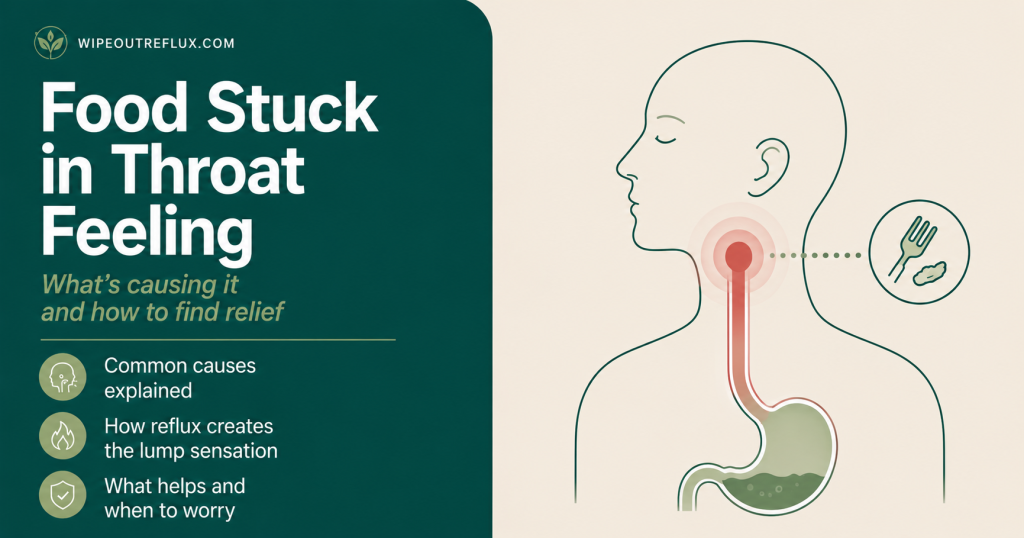
The feeling of food stuck in your throat is unsettling, but it splits into two very different situations — and telling them apart is the most useful thing you can do. In the first, there’s a persistent sensation that something is lodged in your throat even when you’re not eating, yet food and drink actually go down fine. That’s usually globus, and it’s strongly tied to reflux. In the second, food genuinely catches or holds up when you swallow. That’s true dysphagia, and it needs proper checking, because it can point to a physical narrowing.
Reflux is behind a great many of these sensations, particularly the globus kind. Acid and pepsin reaching the throat irritate the sensitive tissue and wind up the muscles at the top of the oesophagus, leaving a lasting “something’s there” feeling even after everything you’ve eaten has cleared. But because the same sensation can occasionally signal something that needs treatment, it’s worth knowing which is which and when to get seen.
Here’s what the food-stuck feeling actually is, how reflux causes it, how to tell harmless globus from true swallowing trouble, and the red flags that mean you should see a doctor promptly.
Key Takeaways
- There are two different things: globus (a lump/stuck feeling when nothing is actually obstructing) and true dysphagia (food genuinely catching when you swallow).
- Reflux — especially silent reflux (LPR) — is a leading cause of the globus type, irritating the throat and tightening the upper oesophageal sphincter.
- Globus that comes and goes, doesn’t stop food going down, and often eases while eating is usually benign and reflux-related.
- Food that physically sticks, catches on solids, or has ever fully lodged is different — it can mean a stricture, a ring, or eosinophilic oesophagitis, and needs assessment.
- Red-flag features — progressive difficulty, sticking on solids, weight loss, painful swallowing, or a prior food-impaction — warrant prompt endoscopy.
- When reflux is the driver, calming the reflux at its source is what settles the sensation — but rule out the mechanical causes first if anything actually sticks.
Globus vs true dysphagia: the key difference
Let me draw the line clearly, because it determines everything that follows. The medical distinction is straightforward: globus is the sensation of a lump or something stuck in the throat when there is no actual obstruction and swallowing itself works normally — food and drink pass without holding up. True (oesophageal) dysphagia is the sensation of food actually getting stuck after you swallow it, as though it’s catching somewhere on the way down [Wilkinson, American Family Physician, 2021].
A few practical tells separate them. Globus is often present between meals, felt high in the throat, doesn’t interfere with getting food down, and frequently eases while you’re actually eating or drinking. True dysphagia shows up during swallowing, tends to involve solids catching (sometimes needing a drink to wash them down), and can worsen over time. If your experience is the first kind — an annoying “something’s there” that never actually stops you swallowing — reflux is a very common cause. If it’s the second, that’s the one to get looked at. This overlaps with the broader question of whether acid reflux can make it hard to swallow.
How reflux causes the stuck feeling
Here’s the mechanism, because it explains why reflux produces such a convincing sensation of something lodged in the throat. In silent reflux, acid and the stomach enzyme pepsin travel up beyond the oesophagus to the throat and voice box, where the tissue is far more delicate and far less protected. That irritation does two things: it makes the throat hypersensitive, so you notice sensations you’d normally filter out, and it winds up the ring of muscle at the top of the oesophagus — the upper oesophageal sphincter — leaving it tense and giving that tight, blocked feeling.
Interestingly, when researchers compared reflux patients who feel globus with those who don’t, the globus group showed more evidence of oesophageal motor dysfunction and higher upper-sphincter pressure, even though their actual acid exposure was similar — suggesting it’s the throat’s muscular and sensory response, not just the amount of acid, that produces the sensation [Tang et al., Revista Española de Enfermedades Digestivas, 2017]. That’s why the feeling can linger long after a meal, and why it overlaps so much with the classic lump-in-the-throat globus sensation and with constant throat clearing.
When it’s genuinely something catching
Now the part that needs care. If food physically sticks — catches mid-swallow, needs washing down, or has ever lodged badly — that’s true dysphagia, and it usually has a mechanical cause worth finding. The common culprits are a peptic oesophageal stricture (a narrowing from years of acid damage), a Schatzki ring (a thin band that narrows the lower oesophagus), and eosinophilic oesophagitis, an allergic inflammation of the oesophagus.
Eosinophilic oesophagitis deserves a special mention, because it’s an increasingly common and easily missed cause of food sticking in younger and middle-aged adults — in fact, around half of adults who end up in emergency departments with food genuinely stuck (a food-bolus impaction) turn out to have it [Perananthan, Australian Prescriber, 2024]. It’s worth knowing about because it’s treatable once identified, and I cover how it differs from ordinary acid disease in the piece on eosinophilic oesophagitis vs acid reflux. The takeaway: a sensation is one thing, but food actually catching is a reason to get scoped.
Red flags: when to see a doctor
Most globus is benign, but certain features shift things from “reasonable to monitor” to “get assessed promptly.” See a doctor without delay if you have any of these alongside the stuck feeling:
- Food physically sticking or a past impaction. Anything that actually holds up when you swallow, especially solids, or an episode where food wouldn’t go down.
- Progressive worsening. A sensation that’s steadily getting worse rather than fluctuating.
- Painful swallowing. Pain on swallowing (as opposed to just tightness) is not typical of simple globus.
- Unintended weight loss. Losing weight without trying is always worth investigating.
- Bleeding or anaemia. Vomiting blood, black stools, or unexplained low iron.
- A one-sided lump, neck mass, or persistent hoarseness. Especially in anyone who smokes or drinks heavily.
None of this is meant to alarm you — the great majority of throat-lump sensations are benign and reflux-related — but these are the situations where a scope is the responsible next step, and knowing when to see a doctor is part of managing this well.
How to settle a reflux-driven stuck feeling
If a doctor has ruled out the mechanical causes — or your sensation is clearly the globus type that never actually blocks swallowing — then calming the reflux is what resolves it. Because the driver is throat irritation and muscular tension rather than a blockage, the fixes are the ones that reduce how much acid and pepsin reach your throat in the first place:
- Reduce reflux at the source. Fewer reflux events mean less irritation reaching the throat, so the tissue can calm and desensitise — the core of any silent reflux treatment approach.
- Protect your throat from pepsin. It’s pepsin as much as acid that keeps the throat reactive, so limiting the triggers that reactivate it helps the sensation fade.
- Don’t fuel it with checking. Repeatedly swallowing to “test” whether the lump is still there heightens your focus and tension and makes it feel worse — a genuinely self-perpetuating loop.
- Be patient. An irritated, hypersensitive throat takes time to settle even once the reflux improves, so give it weeks, not days.
Conclusion
The feeling of food stuck in your throat is most often globus — a sensation of something lodged when nothing actually is — and reflux is one of its leading causes, irritating the throat and tightening the muscles at the top of the oesophagus. The reassuring news is that this type is benign and settles when the reflux behind it settles. The crucial exception is food that genuinely catches when you swallow, or any of the red-flag features, which deserve a prompt look to rule out a stricture, a ring or eosinophilic oesophagitis. Get anything that physically sticks checked; for the pure sensation, calm the reflux and give your throat time.
Since reflux is so often the engine, that’s where lasting relief begins, and it comes down to what you eat and drink. The Wipeout Diet Plan is the complete, step-by-step method I built to calm reflux at its source; it was designed first and foremost around LPR — the throat-based, silent form behind so many globus sensations — but because it works on the same underlying reflux mechanisms it’s just as effective for GERD, heartburn and classic acid reflux. Reduce the acid and pepsin reaching your throat, and the tight, stuck feeling has a real chance to fade. The Wipeout Food Reference Guide is the essential companion, showing which foods and drinks are safe for reflux and LPR and their pH values, so you can strip out the triggers keeping your throat irritated. Settle the reflux, resist the urge to keep checking, and give a sensitive throat the time it needs to quieten down.
Frequently Asked Questions
Why does it feel like food is stuck in my throat when nothing is there?
That’s globus — a sensation of a lump or something lodged in the throat when there’s no actual obstruction and swallowing works normally. It’s commonly caused by reflux, especially silent reflux, which irritates the throat and tightens the upper oesophageal sphincter. The feeling is real, but it reflects irritation and muscle tension rather than something physically stuck.
How do I know if it’s globus or real difficulty swallowing?
Globus is usually felt between meals, doesn’t stop food going down, and often eases while you eat. Real dysphagia happens during swallowing, with food actually catching — especially solids — sometimes needing a drink to clear it. If food genuinely sticks, catches on solids, or has ever lodged, that’s the type to get assessed with an endoscopy.
Can acid reflux make food feel stuck in your throat?
Yes, very commonly. Acid and pepsin reaching the throat in silent reflux irritate the sensitive tissue and wind up the muscles at the top of the oesophagus, producing a persistent lump or stuck feeling even when swallowing is fine. Calming the reflux usually settles it, though a sensitive throat can take several weeks to fully quieten.
When should I worry about a food-stuck feeling?
See a doctor promptly if food physically sticks or has ever lodged, if the problem is progressively worsening, or if you have painful swallowing, unintended weight loss, bleeding, or a one-sided neck lump or persistent hoarseness. These features warrant an endoscopy to rule out a stricture, a ring or eosinophilic oesophagitis. Most globus is benign, but these signs need checking.
How do I get rid of the feeling of something stuck in my throat?
If mechanical causes are ruled out, focus on reducing the reflux that irritates the throat — fewer reflux events let the tissue calm and desensitise. Avoid repeatedly swallowing to test the lump, since that heightens the sensation, and be patient, as an irritated throat takes weeks to settle. A reflux-friendly diet that limits triggers is the most effective long-term step.
Research & References
- Clinical review of dysphagia distinguishing oropharyngeal from oesophageal dysphagia — describing oesophageal dysphagia as the sensation of food getting stuck after swallowing — and outlining structural causes (peptic stricture, eosinophilic oesophagitis, Schatzki ring, motility disorders) and the alarm features that warrant prompt endoscopy [Wilkinson, American Family Physician, 2021].
- Study comparing GERD patients with and without globus sensation, finding the globus group had greater oesophageal dysmotility and higher upper oesophageal sphincter pressure despite similar acid exposure — indicating motor and sensory dysfunction, not acid amount alone, underlies the sensation [Tang et al., Revista Española de Enfermedades Digestivas, 2017].
- Review of eosinophilic oesophagitis noting it is now the second most common oesophageal disease after GORD and a major cause of food-bolus impaction — with around half of adults presenting to emergency departments with food genuinely stuck found to have it [Perananthan, Australian Prescriber, 2024].

David Gray
12 years living with LPR · Consultant & researcher
I've lived with LPR for twelve years — the misdiagnoses, the PPI courses that did nothing, the slow work of figuring out what actually helps. Wipeout Reflux is where I translate the research into plain terms for people stuck in the same place. Every claim here is sourced to peer-reviewed work, and I consult one-to-one with LPR sufferers.