
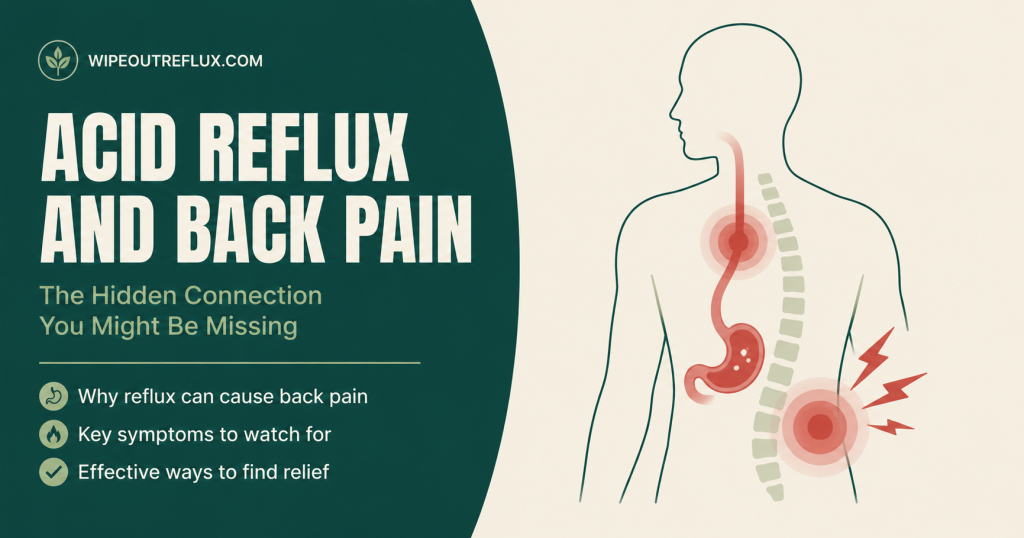
Acid reflux and back pain are linked more often than you’d expect — but the relationship is not the simple “reflux causes back pain” story you’ll see repeated online. Reflux rarely causes isolated back pain on its own. What’s really going on is usually one of three things: pain from a severely irritated oesophagus radiating through to the back, a shared postural cause that drives both problems at once, or — and this is the one that matters most — back pain accompanying reflux-like symptoms that’s actually a sign of something more serious.
That last possibility is why this is worth taking seriously rather than dismissing. Several conditions that need urgent attention — heart problems, issues with the aorta, the pancreas or a deep ulcer — can produce a combination of upper-tummy or chest discomfort and back pain that’s easy to mistake for bad reflux. Most of the time the overlap is benign, but knowing how to tell benign from dangerous is the single most useful thing here.
Here’s the real connection between acid reflux and back pain, the genuine ways they’re linked, and the red flags that mean you should seek medical help rather than reaching for an antacid.
Key Takeaways
- Reflux rarely causes isolated back pain directly — but reflux and back pain are genuinely associated, and studies find people with reflux symptoms are more likely to have back pain.
- Severe reflux or oesophageal spasm can cause chest pain that radiates through to the back, which is the most direct reflux-to-back link.
- Posture and spine shape matter: increased curvature raises abdominal pressure and promotes reflux, so back problems and reflux often travel together.
- The link may be partly bidirectional, with reflux and chronic widespread pain each raising the risk of the other.
- Red flags — back pain with chest pressure, a tearing sensation, severe upper-tummy pain boring through to the back, sweating or breathlessness — need urgent medical attention, not an antacid.
- When it’s benign overlap, treating the reflux and improving posture together tends to help both.
Can acid reflux directly cause back pain?
Let me be honest about this, because the internet oversells it. Reflux is not a common cause of isolated back pain — if your only symptom is an aching back with no digestive symptoms at all, reflux is an unlikely explanation. What reflux can do is produce pain that radiates. The oesophagus sits in the chest, right in front of the spine, and when it’s severely irritated or goes into spasm, the pain it generates can be felt in the chest and travel through to between the shoulder blades or the upper back.
This is the same reason reflux can masquerade as heart pain: oesophageal and cardiac nerves share pathways, so the brain struggles to localise the source. An oesophageal spasm in particular can cause a gripping chest pain that spreads to the back and is easily confused with something cardiac. So reflux can contribute to upper-back or interscapular discomfort as referred pain — but it’s usually part of a picture that includes chest or digestive symptoms, not a lone backache.
The posture and spine connection
Here’s a genuinely under-appreciated link, and it runs in a direction most people don’t expect: your spine can drive your reflux. Research on middle-aged and older adults found that increased spinal curvature (lumbar kyphosis), poor overall spinal balance, and weaker back muscles were significant risk factors for developing reflux symptoms [Imagama et al., European Spine Journal, 2012]. The proposed mechanism is neat: a hunched, forward-curved posture raises pressure inside the abdomen, which presses on the stomach, weakens the anti-reflux barrier and encourages a hiatal hernia — all of which promote reflux.
That matters here because the same spinal changes that cause back pain also promote reflux, so the two conditions naturally cluster. And they do measurably cluster: a study looking specifically at oesophageal symptoms and back pain found that people with reflux-type oesophageal symptoms were around three times more likely to also have back pain [Mittal et al., Gastro Hep Advances, 2024]. In many cases, then, reflux isn’t causing the back pain or vice versa — a shared postural and structural problem is feeding both. This is one reason keeping your core and back strong, through sensible exercise, can quietly help reflux too.
The two-way pain link
There’s a further layer worth knowing about. Beyond posture, reflux and chronic pain appear to be genuinely intertwined at a deeper level. A study using genetic data to test cause and effect found a bidirectional relationship between GERD and chronic widespread pain — each condition increased the risk of the other [Chen et al., Journal of Pain Research, 2025]. In other words, having persistent reflux may make you more prone to widespread pain conditions, and having chronic pain may make you more prone to reflux.
Part of this likely comes down to how the nervous system processes pain and how stress amplifies both. An over-sensitised nervous system tends to turn up the volume on all sorts of bodily signals at once, and stress genuinely worsens reflux while also feeding musculoskeletal tension. So if you have both reflux and nagging back pain, they may share a common thread rather than one straightforwardly causing the other — which also means calming that shared thread can ease both.
Red flags: when back pain is not just reflux
This is the most important section, so read it carefully. Several serious conditions can produce a mix of chest or upper-abdominal discomfort and back pain that people mistake for severe reflux. If your symptoms include any of the following, treat it as a possible emergency and seek urgent medical help rather than assuming it’s your stomach:
- Chest pressure or tightness spreading to the back, arm, neck or jaw, especially with sweating, nausea, breathlessness or lightheadedness — this can be a heart attack, which is often mistaken for reflux. The overlap is exactly why telling heartburn from a heart attack is so important.
- A sudden, severe tearing or ripping pain in the chest or between the shoulder blades — this can signal a problem with the aorta and is a medical emergency.
- Severe upper-tummy pain boring straight through to the middle of the back, often with vomiting — a classic pattern for pancreatitis or gallbladder problems.
- Persistent gnawing pain with back radiation, especially with black or bloody stools — a deep peptic ulcer can penetrate backward and refer pain to the back.
- Fever, unexplained weight loss, or pain that steadily worsens — any of these alongside back pain warrants prompt assessment.
None of this is to make you anxious about ordinary aches — the vast majority of reflux-plus-back-pain is benign overlap. But because a few dangerous conditions hide behind reflux-like symptoms, the rule is simple: severe, sudden, or unusual pain, or pain with any of the features above, is a reason to get checked urgently rather than self-treat.
What helps when it’s benign overlap
Once serious causes are excluded and it’s the ordinary reflux-and-back-pain combination, the good news is that the same measures tend to help both. Because posture, abdominal pressure and reflux are all connected, working on them together is effective:
- Reduce the reflux itself. Fewer reflux events mean less oesophageal irritation to radiate anywhere — the foundation is a reflux-friendly diet and the usual habits.
- Improve your posture and back strength. Since a hunched posture raises abdominal pressure and drives reflux, better posture and stronger back and core muscles can ease both problems at once.
- Don’t eat late or lie down after meals. This reduces overnight reflux and the pressure that comes with a full stomach.
- Calm the shared stress thread. Because stress amplifies reflux and muscular tension alike, downregulating it helps on both fronts.
- Lose excess abdominal weight if relevant. Extra weight around the middle raises abdominal pressure, worsening reflux and straining the back.
Conclusion
Acid reflux and back pain are connected, but rarely in the simple way it’s often described. Reflux can radiate pain to the back when the oesophagus is severely irritated or in spasm; more often, a shared postural cause — increased spinal curvature raising abdominal pressure — drives both, and the two may be linked at the level of how the body processes pain. The essential thing is to stay alert to the red flags, because a handful of serious conditions can wear a reflux disguise, and those need urgent care rather than an antacid. For the common, benign overlap, treating the reflux and improving posture together is the winning combination.
Since calming the reflux is central to both the direct and the shared-cause versions of this, that’s where to focus, and it starts with what you eat and drink. The Wipeout Diet Plan is the complete, step-by-step method I built to settle reflux at its source; it was designed first and foremost around LPR, the throat-based form, but because it works on the same underlying reflux mechanisms it’s just as effective for GERD, heartburn and classic acid reflux. Reducing the reflux takes away the irritation that can radiate to your back and eases the abdominal-pressure side of the problem. The Wipeout Food Reference Guide is the essential companion, showing which foods and drinks are safe for reflux and their pH values. Settle the reflux, mind your posture, and — above all — get any red-flag pain checked promptly rather than waiting it out.
Frequently Asked Questions
Can acid reflux cause back pain?
Reflux rarely causes isolated back pain on its own, but it can contribute in a few ways: a severely irritated oesophagus or an oesophageal spasm can radiate pain to the upper back, and a shared postural cause can drive both reflux and back pain together. Studies also find reflux and back pain are genuinely associated. If back pain is your only symptom with no digestive issues, reflux is an unlikely cause.
Where would reflux-related back pain be felt?
Usually in the upper or mid back — between or around the shoulder blades — because that’s where pain from the oesophagus in the chest tends to radiate. It’s typically accompanied by chest or digestive symptoms rather than occurring alone. Lower back pain is more often linked to reflux through shared posture and abdominal pressure than through direct radiation.
When should I worry about reflux with back pain?
Seek urgent help if back pain comes with chest pressure spreading to the arm, neck or jaw, sweating or breathlessness (possible heart attack); a sudden tearing pain (possible aortic problem); severe upper-tummy pain boring through to the back with vomiting (possible pancreatitis); or black or bloody stools (possible bleeding ulcer). These are emergencies, not reflux to self-treat.
Why do I have reflux and back pain at the same time?
Often because a shared cause drives both. Increased spinal curvature and a hunched posture raise pressure inside the abdomen, which promotes reflux, so back problems and reflux naturally cluster. Reflux and chronic pain also appear to be linked in a two-way fashion. Treating the reflux and improving posture and back strength together tends to help both.
Does improving posture help reflux?
It can. A forward-hunched posture increases abdominal pressure and can weaken the anti-reflux barrier, so better posture and stronger back and core muscles may reduce reflux as well as back pain. It won’t replace dietary changes, but as part of the overall approach it addresses one of the mechanisms that links the two problems.
Research & References
- Study of oesophageal symptoms and back pain finding that people with reflux-type oesophageal symptoms were markedly more likely (around three-fold) to also report back pain, supporting a real association between the two [Mittal et al., Gastro Hep Advances, 2024].
- Study in middle-aged and older adults identifying lumbar kyphosis, poor spinal sagittal balance and reduced back muscle strength as significant risk factors for reflux symptoms — via increased intra-abdominal pressure weakening the anti-reflux barrier — explaining why spinal/postural problems and reflux cluster together [Imagama et al., European Spine Journal, 2012].
- Bidirectional Mendelian randomization study reporting a two-way causal relationship between gastroesophageal reflux disease and chronic widespread pain, with each condition increasing the risk of the other [Chen et al., Journal of Pain Research, 2025].

David Gray
12 years living with LPR · Consultant & researcher
I've lived with LPR for twelve years — the misdiagnoses, the PPI courses that did nothing, the slow work of figuring out what actually helps. Wipeout Reflux is where I translate the research into plain terms for people stuck in the same place. Every claim here is sourced to peer-reviewed work, and I consult one-to-one with LPR sufferers.