
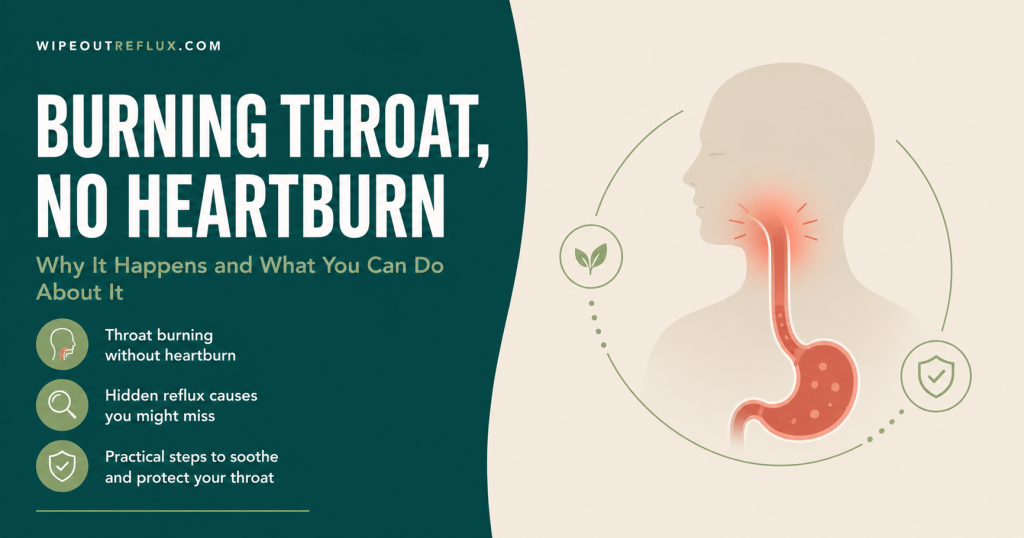
A burning throat with no heartburn is one of the most confusing symptoms in all of reflux — because it doesn’t feel like reflux. There’s no burning behind the breastbone, no sour taste rising after meals, none of the classic signs. Just a raw, hot, irritated throat that won’t settle. So reflux gets ruled out, and the real cause gets missed.
Most of the time, that combination points to one thing: laryngopharyngeal reflux (LPR), also called silent reflux. It’s called “silent” precisely because it skips heartburn. Reflux travels all the way up to your throat and voice box — tissue that’s far more delicate and far less protected than your esophagus — and burns there, while barely troubling the chest on the way past.
That said, not every burning throat is reflux, and it’s worth knowing the alternatives. Here’s why LPR causes a burning throat without heartburn, what it feels like, and the other causes worth ruling out.
Key Takeaways
- A burning throat with no heartburn most often points to silent reflux (LPR) — reflux that reaches the throat rather than staying in the chest.
- LPR skips heartburn because the reflux clears the esophagus quickly and lands on the throat, which is far more sensitive and lacks the esophagus’s protective defences.
- Pepsin, a stomach enzyme, can damage and irritate throat tissue even when there’s little acid — so your throat can burn without the acid load that causes heartburn.
- LPR reflux is often brief, upright and daytime, and in tiny amounts — enough to inflame a delicate throat but not enough to register as heartburn.
- The burning usually comes with throat clearing, hoarseness, a lump sensation, or a cough rather than chest symptoms.
- Not every burning throat is reflux — postnasal drip, allergies, burning mouth syndrome, nerve sensitivity and dry mouth can all mimic it.
- Because acid is only half the problem, calming LPR focuses on pepsin and diet, not just acid suppression.
Why a burning throat without heartburn usually points to LPR
Classic acid reflux (GERD) burns in the chest because acid sits in the lower esophagus long enough to irritate it — that’s heartburn. Silent reflux behaves completely differently. Instead of pooling in the chest, the refluxed material shoots up past the esophagus and reaches the throat, larynx and back of the mouth. The result is throat symptoms without chest symptoms — which is exactly why LPR is so different from classic GERD.
This is more common than most people realise. In the landmark study that first mapped out reflux-related throat disease, nearly all the affected patients had hoarseness while only a small minority reported any heartburn at all Koufman, The Laryngoscope, 1991. In other words, people with LPR typically present with hoarseness, chronic throat clearing, a cough, or a burning, raw throat — often with no classic reflux symptoms whatsoever. So if your throat burns but your chest never does, that absence isn’t evidence against reflux — it’s practically the signature of the silent kind. These are the hallmark symptoms of LPR.
Why LPR skips the classic heartburn
There are three reasons the throat burns while the chest stays quiet, and together they explain the whole puzzle.
Your throat has almost no defences. The esophagus is built to cope with the occasional splash of stomach contents — it has a protective barrier at the top and bottom, muscular waves that sweep material back down, and a tissue lining with some acid resistance. The throat and voice box have none of that to the same degree. So the same reflux that the esophagus shrugs off can inflame the throat badly — the laryngeal and pharyngeal lining is far more susceptible to reflux injury than the esophageal lining, which has much greater resistance to acid and pepsin Koufman, The Laryngoscope, 1991. A little reflux, big reaction.
Pepsin burns even without much acid. This is the piece most people never hear. Reflux isn’t just acid — it carries pepsin, a digestive enzyme that sticks to throat tissue and keeps causing damage. Crucially, pepsin can harm throat cells even at near-neutral pH, when there’s little actual acid present Johnston et al., Annals of Otology, Rhinology & Laryngology, 2009. That’s why your throat can burn from non-acid reflux that would never generate heartburn — and why the pepsin can be reactivated later in the throat by something as ordinary as an acidic drink.
The reflux is brief and often upright. Silent reflux tends to happen in short bursts, frequently while you’re upright during the day, and often as a fine mist or small volume rather than a big wave. That’s enough to coat and irritate a sensitive throat, but not enough acid sitting in the esophagus long enough to trigger heartburn. Small hit, wrong place, no chest warning.
What the burning actually feels like
LPR burning has a particular character. It’s often a raw, dry, hot or scalded feeling — the sensation of having swallowed something too hot — and it tends to sit high, at the level of the throat or voice box rather than the chest. It frequently comes with a cluster of companions: a constant urge to clear your throat, hoarseness or a tired voice, a lump-in-the-throat sensation, a nagging cough, or a bitter or metallic taste. It can be worse after talking a lot, after certain foods, or first thing in the morning. If you want a sense of timelines, our guide on how long a reflux sore throat takes to heal covers what to expect.
It’s not always reflux: other causes of a burning throat
Silent reflux is the most common explanation for a burning throat with no heartburn, but it isn’t the only one — and it’s genuinely worth ruling the others in or out rather than assuming. The main mimics are:
- Postnasal drip and allergies. Mucus dripping down the back of the throat irritates it constantly, producing burning and throat clearing that looks a lot like LPR. The two even overlap — see silent reflux and post-nasal drip and LPR versus allergies.
- Burning mouth syndrome. A burning sensation in the mouth and throat with no visible cause, often felt as a scalded feeling. More on burning mouth syndrome.
- Laryngeal nerve sensitivity. Sometimes the nerves supplying the throat become oversensitive after a virus or irritation, firing off burning and tickling signals on their own — a pattern known as laryngeal sensory neuropathy.
- Dry mouth and dehydration. Without enough saliva to coat and protect it, the throat gets raw and burns — see acid reflux and dry mouth.
- Infections and overuse. Lingering viral irritation, or simply straining the voice, can leave the throat burning for weeks.
Often more than one of these runs alongside reflux, which is part of why a burning throat can be so stubborn to pin down.
How to tell if it’s silent reflux
A few clues point toward LPR: symptoms that flare after meals, when lying down, or after acidic foods and drinks; a cluster of throat symptoms rather than a single one; and a burning that’s worse in the morning after a night of upright-free, gravity-free reflux. If you and your doctor want to confirm it, a saliva test that looks for pepsin — the Peptest — can help show reflux is reaching your throat, and symptom questionnaires like the Reflux Symptom Index help track it. Because the burning has several possible causes, getting the diagnosis right is what makes the treatment work.
What actually helps a burning LPR throat
Here’s the key insight: if acid is only part of the problem and pepsin is the rest, then acid-suppressing pills alone often disappoint. The more effective approach tackles the reflux at its source and the pepsin directly. That means reducing how much you reflux in the first place, avoiding the acidic foods and drinks that reactivate pepsin in your throat, and giving the tissue a chance to calm down — the core of any real silent reflux treatment, and where a structured plan like the Wipeout Diet Plan does most of the work. Simple steps like learning to neutralise pepsin in the throat can bring real relief while the bigger changes take hold.
Conclusion
A burning throat with no heartburn isn’t a contradiction — it’s the classic fingerprint of silent reflux. The reflux clears your chest quickly and lands on a throat that has almost none of the defences your esophagus enjoys, and the pepsin it carries can keep burning even when there’s barely any acid. That’s why the chest stays quiet while the throat suffers. It’s also why the absence of heartburn should never rule reflux out. Just remember the throat can burn for other reasons too, so if simple measures don’t help, it’s worth getting it properly assessed.
Because acid is only half the story with silent reflux, calming it comes down to lowering your overall reflux and steering clear of the foods and drinks that reactivate pepsin in your throat — and that’s exactly what the Wipeout Diet Plan is built to do. It’s the complete, step-by-step approach to settling reflux at its source so it stops reaching your throat in the first place. It was designed first and foremost around LPR and silent reflux — the stubborn, throat-based form — but because it works on the same underlying mechanisms, it’s just as effective for classic GERD and heartburn. Alongside it, the Wipeout Food Reference Guide is the essential companion, showing at a glance which foods and drinks are safe with acid reflux and LPR and their pH values, so you can strip out the throat-burning triggers without guesswork. Take away the reflux and the pepsin, and the burning finally has a chance to fade.
Frequently Asked Questions
Can you have reflux without heartburn?
Yes. Silent reflux (LPR) frequently causes no heartburn at all. The reflux reaches the throat rather than sitting in the chest, so it produces throat symptoms — burning, hoarseness, throat clearing, a lump sensation — without the classic chest burning. Many people with LPR are surprised to learn reflux is behind their throat trouble.
Why does my throat burn but I don’t have heartburn?
Because the reflux is reaching your throat, not staying in your chest. Your throat is far more sensitive than your esophagus and lacks its protective defences, so even small amounts of reflux irritate it. Pepsin in the reflux can also burn throat tissue even when there’s little acid present, which is why there’s no accompanying heartburn.
Is a burning throat always caused by acid reflux?
No. Silent reflux is the most common cause of a burning throat without heartburn, but postnasal drip, allergies, burning mouth syndrome, oversensitive throat nerves, dry mouth and lingering infections can all cause similar burning. If reflux measures don’t help, it’s worth having the other possibilities checked.
How do I know if it’s silent reflux or something else?
Clues that point to LPR include symptoms that worsen after meals, when lying down, or after acidic foods, plus a cluster of throat symptoms rather than just one. A saliva pepsin test and symptom questionnaires can help confirm reflux is reaching your throat, so a proper assessment is the surest way to tell.
Why doesn’t my acid reflux medication stop the throat burning?
Because acid is only part of the problem in silent reflux. Pepsin can keep irritating your throat even when acid is suppressed, so acid-blocking pills alone often underperform. Reducing reflux at the source and avoiding acidic triggers that reactivate pepsin usually does more for the burning than medication by itself.
Research & References
- Landmark clinical and experimental investigation of 225 patients establishing that reflux-related laryngeal disease usually presents with hoarseness and throat symptoms rather than heartburn (only a small minority reported heartburn), and that laryngeal tissue is far more susceptible to acid and pepsin injury than the more resistant esophagus Koufman, The Laryngoscope, 1991.
- Laboratory study demonstrating that pepsin can damage hypopharyngeal epithelial cells even at non-acidic (near-neutral) pH, causing cellular and mitochondrial injury — a mechanism explaining throat symptoms and tissue damage from non-acid reflux Johnston et al., Annals of Otology, Rhinology & Laryngology, 2009.

David Gray
12 years living with LPR · Consultant & researcher
I've lived with LPR for twelve years — the misdiagnoses, the PPI courses that did nothing, the slow work of figuring out what actually helps. Wipeout Reflux is where I translate the research into plain terms for people stuck in the same place. Every claim here is sourced to peer-reviewed work, and I consult one-to-one with LPR sufferers.