
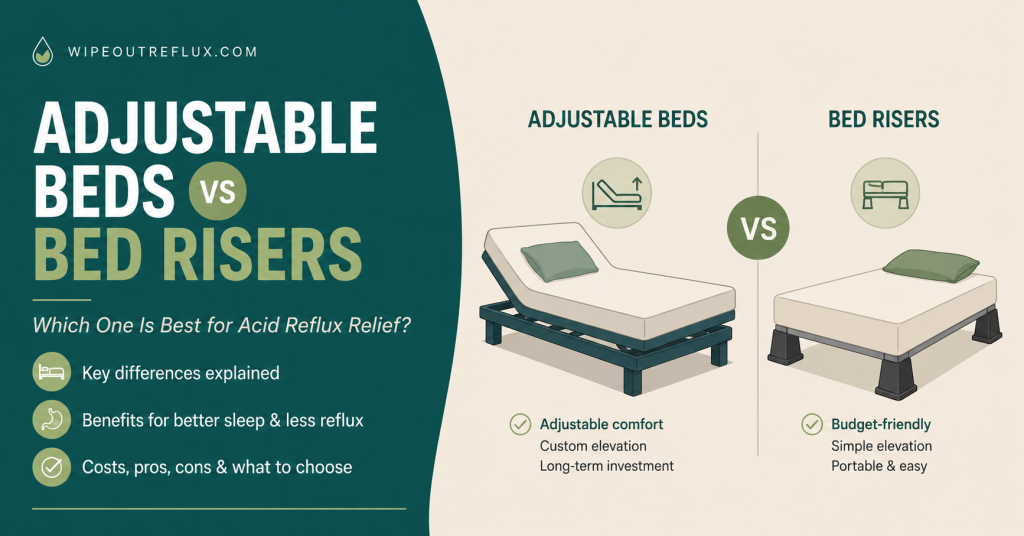
If night-time reflux is your problem, sleeping with your upper body raised above your stomach is one of the best-evidenced things you can do — and you’ve got two main ways to achieve it: cheap bed risers under the head end of your bed, or an adjustable bed that lifts your torso electronically. Both can work, but they’re not equal, and the difference comes down to how they raise you.
The short version: bed risers create a straight incline of the whole bed — which is exactly what the research on head-of-bed elevation used — for a tiny fraction of the price. An adjustable bed is far more convenient and comfortable, but it only matches that benefit when you use it in a “zero-gravity” position (head and knees raised) rather than just folding your torso up at the waist. So for pure reflux value, risers win; for comfort and convenience with a bigger budget, an adjustable bed is excellent.
My value pick is a set of sturdy adjustable-height bed risers; my convenience pick is the Lucid L300 adjustable base. Here’s the full comparison.
Key Takeaways
- Raising your upper body above your stomach at night is one of the best-evidenced measures for nocturnal reflux.
- Bed risers give a straight, whole-bed incline — the exact set-up used in the positive studies — for very little money.
- Best value: adjustable-height bed risers placed under the head-end legs only, aiming for about 6–8 inches of lift.
- Adjustable beds are more comfortable and convenient, but for reflux you should use the zero-gravity position (head and knees raised), not just fold your torso up at the waist.
- Best adjustable base: Lucid L300 — head and foot incline, quiet motor, good value for the category.
- A wedge pillow is the cheaper middle option, though it can be less comfortable to sleep on all night.
- Whichever you choose, combine it with not eating too close to bedtime and sleeping on your left side.
Why sleeping elevated helps reflux
When you lie flat, your stomach and your throat are on the same level, so gravity no longer helps keep acid and pepsin down where they belong — which is why reflux is so often worse at night, and why so many people wake with a sour taste or a cough. Raising your upper body puts gravity back on your side, encouraging stomach contents to stay put.
This is one of the few lifestyle measures with genuinely good evidence. In a randomised controlled trial, elevating the head of the bed significantly reduced overnight acid exposure in the gullet and improved reflux symptoms compared with sleeping flat Khan et al., Journal of Gastroenterology and Hepatology, 2012. A systematic review of treatments for night-time reflux likewise concluded that head-of-bed elevation is an effective, low-risk measure Schuitenmaker et al., Neurogastroenterology & Motility, 2022. The key detail in these studies is that people raised their whole upper body on an incline — and that detail is what separates risers from adjustable beds. There’s more background in acid reflux at night and my how-to on raising the head of your bed.
How bed risers work (and their pros and cons)
Bed risers are simple blocks or cups that go under your bed’s legs to lift it. For reflux, you put the taller risers under the head-end legs only, tilting the entire bed into a gentle slope so your whole body rests on an incline — head highest, feet lowest, spine straight. That’s precisely the position the research supports, which is what makes risers punch so far above their price.
The upsides: they’re cheap (often under $20), they work with your existing bed, and they deliver the exact straight-incline geometry the studies used. Aim for around 6 to 8 inches of lift at the head end — the level commonly used for a meaningful effect.
The downsides: the whole bed is now on a slope, so you can gradually slide down during the night (a firm mattress and a footboard, or a body pillow, help); a shared bed means your partner is on the same incline whether they like it or not; and you need sturdy, stable risers rated for the weight, since you’re loading the head end. Some people also dislike the look of a visibly tilted bed.
How adjustable beds work (and the zero-gravity catch)
An adjustable bed base lets you raise the head (and usually the foot) of the mattress electronically at the touch of a button. It’s a lovely thing to own — great for reading, watching TV, and letting two people sit at different angles — and it makes elevating your torso effortless.
But there’s a catch specific to reflux. If you only raise the head section, you fold your body up at the waist, and bending sharply at the middle can actually increase pressure on your abdomen — which can work against you. The fix is the zero-gravity position most adjustable beds offer: raise the head and lift the knees slightly, so you recline along a gentle curve rather than crunching at the stomach. Used that way, an adjustable bed gives you the elevation benefit comfortably; used as a torso-only fold, it’s less ideal. So the machine is excellent for reflux — provided you use it correctly.
The upsides: effortless, adjustable to the exact angle you like, comfortable, and useful for far more than reflux. The downsides: cost (typically hundreds of dollars), you may need a compatible mattress, and they’re heavy and permanent compared with a set of risers.
Head-to-head: which is better for reflux?
Here’s how I’d choose between them:
- Choose bed risers if you want the most proven, lowest-cost option, you’re happy with a fixed incline, and you don’t need the comfort extras. For value per unit of reflux benefit, nothing beats them.
- Choose an adjustable bed if you have the budget, you want comfort and flexibility, you’ll use the zero-gravity position, or you also want the bed for reading, circulation, snoring or mobility reasons. It’s a lifestyle upgrade that happens to help reflux.
- Consider a wedge pillow if you want a middle path — cheaper than an adjustable bed, more portable than risers — accepting that a fixed foam wedge can be less comfortable to sleep on all night. I compare the options in best wedge pillows for silent reflux.
One point in the risers’ favour worth repeating: they reproduce the straight-incline geometry from the studies by default, whereas an adjustable bed only does so if you deliberately use zero-gravity. That’s why, purely on evidence and value, risers are my default recommendation — with adjustable beds the better pick when comfort and convenience matter and the budget is there.
Best bed risers for reflux
Look for sturdy, stable risers with a high weight rating and, ideally, adjustable or stackable heights so you can dial in a 6–8 inch lift at the head end. Prices and sets change, so check the current listing.
Utopia Bedding Adjustable Bed Risers (3/5/8″) — best overall
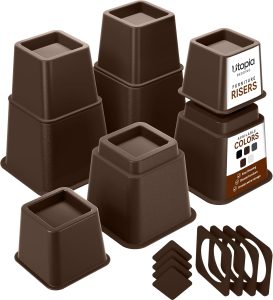
The pick for most people: a set that stacks to 3, 5 or 8 inches, rated to a hefty 1,300 lb, so you can put the 8-inch configuration under the head-end legs and get a proper reflux incline. The adjustability is the key feature — you can experiment with the angle. A set of eight lets you support all four legs while raising the head end higher. Simple, sturdy, and cheap.
Slipstick CB658 Stack-Its Risers — best for fine adjustment and grip
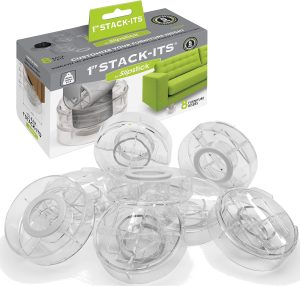
Slipstick’s stackable risers adjust in 1-inch steps (1, 2 or 3 inches each), which is handy if you want to fine-tune a gentler slope or level things up precisely. They also have a rubber grip surface that protects floors and stops the bed sliding — a nice touch when you’re deliberately putting the bed on an incline. Best if you want control over the exact height.
SONGMICS Heavy-Duty Bed Risers (3/5/8″) — best heavy-duty value
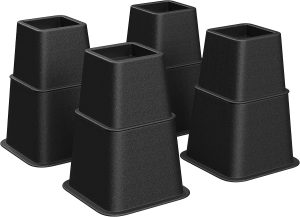
Another strong, high-capacity option with the same useful 3/5/8-inch stacking and a 1,300 lb rating, often at a keen price. A solid alternative to the Utopia set if it’s better value when you look, with the same ability to create a proper head-end incline.
Best adjustable beds for reflux
For reflux, the feature that matters is a proper zero-gravity or independent head-and-foot lift, so you can raise your torso without folding at the waist. Confirm size and mattress compatibility before buying.
Lucid L300 Adjustable Bed Base — best overall
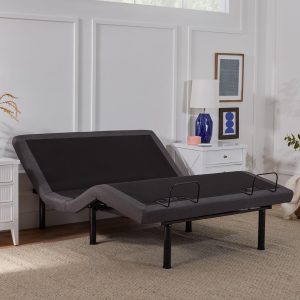
The Lucid L300 is the value benchmark in adjustable bases: independent head and foot incline (so you can set a reflux-friendly zero-gravity angle), a quiet motor, wireless remote, USB ports and straightforward two-person assembly. It works with most mattresses and comes in all the usual sizes. If you want the convenience of an adjustable bed without a premium price, this is the sensible starting point.
Sweetnight Adjustable Bed Frame — best with extra features

A feature-rich alternative with a one-touch zero-gravity preset — convenient for getting straight to a reflux-friendly position — plus extras like wireless syncing, under-bed lighting and dual USB ports. A good choice if you want the comfort features alongside the reflux benefit, usually still well below premium-brand pricing.
How to set either one up for reflux
- Aim for about 6–8 inches of head elevation, or a comparable recline angle on an adjustable bed.
- With risers, lift the head end only so the whole bed forms a straight incline — don’t just prop your pillows, which folds your neck and does little for reflux.
- With an adjustable bed, use zero-gravity — head and knees both raised — rather than a torso-only fold.
- Stop yourself sliding down on an inclined bed with a firmer mattress, a footboard, or a pillow under the knees.
- Stack the habits: combine elevation with sleeping on your left side and not eating within a few hours of bed — see best sleeping position for silent reflux and how long before bed to stop eating.
Conclusion
Both bed risers and adjustable beds can ease night-time reflux, because both put gravity back on your side. The difference is value and geometry: risers deliver the exact straight incline the research supports for a fraction of the price, while adjustable beds offer superior comfort and convenience but only match that benefit in the zero-gravity position. If you simply want the most proven, affordable fix, raise the head end of your bed on sturdy risers. If you want the comfort, flexibility and everyday benefits of an adjustable base and have the budget, it’s a genuinely worthwhile upgrade — just use it head-and-knees, not torso-only.
Elevation is powerful, but it treats the night-time symptom rather than the underlying reflux. To calm things at the source, pair it with the right eating pattern — which is exactly what the Wipeout Food Reference Guide supports, as the essential reference for which foods and drinks are safe for acid reflux and LPR, with their pH values laid out.
And for the complete method, the Wipeout Diet Plan is the in-depth system for actually reducing reflux episodes, night and day. I built it first and foremost around LPR — the stubborn, throat-based form that’s so often worst overnight — but because it works on the same underlying reflux mechanisms, it’s just as effective for GERD, heartburn and everyday acid reflux. Raise the bed to protect your nights, and let the plan do the deeper work.
Frequently Asked Questions
Are bed risers or an adjustable bed better for acid reflux?
For pure reflux value, bed risers win — they create the straight, whole-body incline used in the research for very little money. An adjustable bed is more comfortable and convenient and works well for reflux too, but only in the zero-gravity position (head and knees raised), not as a torso-only fold. Choose risers for value, an adjustable bed for comfort and flexibility.
How high should I raise the head of my bed for reflux?
Around 6 to 8 inches of elevation at the head end is the level commonly used and supported by the evidence. With risers, put the taller ones under the head-end legs only so the whole bed tilts into a straight incline. On an adjustable bed, aim for a comparable recline in the zero-gravity position.
Why shouldn’t I just prop up my pillows instead?
Stacking pillows bends your neck and upper back while leaving your stomach compressed, which does little for reflux and can be uncomfortable. What helps is raising your whole upper body on an incline, so your torso stays above your stomach in a straight line. Risers, a wedge, or an adjustable bed in zero-gravity all achieve that; pillows alone don’t.
Do adjustable beds make reflux worse?
They can if you only raise the head section and fold sharply at the waist, which increases abdominal pressure. Used in the zero-gravity position — head and knees both raised so you recline along a gentle curve — an adjustable bed is a good option for reflux. The position you use matters more than the bed itself.
Will raising the bed help silent reflux (LPR) too?
Yes. Elevation helps keep both acid and pepsin down away from the throat overnight, which is exactly what matters in LPR. It’s one of the most useful night-time measures for throat-based reflux, and it pairs well with sleeping on your left side and leaving a gap between your last meal and bedtime.
Research & References
- A randomised controlled trial found that elevating the head of the bed significantly reduced overnight oesophageal acid exposure and improved symptoms in patients with nocturnal gastro-oesophageal reflux, compared with sleeping flat Khan et al., Journal of Gastroenterology and Hepatology, 2012.
- A systematic review of interventions for nocturnal gastro-oesophageal reflux concluded that head-of-bed elevation is an effective and low-risk measure for reducing night-time reflux Schuitenmaker et al., Neurogastroenterology & Motility, 2022.

David Gray
12 years living with LPR · Consultant & researcher
I've lived with LPR for twelve years — the misdiagnoses, the PPI courses that did nothing, the slow work of figuring out what actually helps. Wipeout Reflux is where I translate the research into plain terms for people stuck in the same place. Every claim here is sourced to peer-reviewed work, and I consult one-to-one with LPR sufferers.