
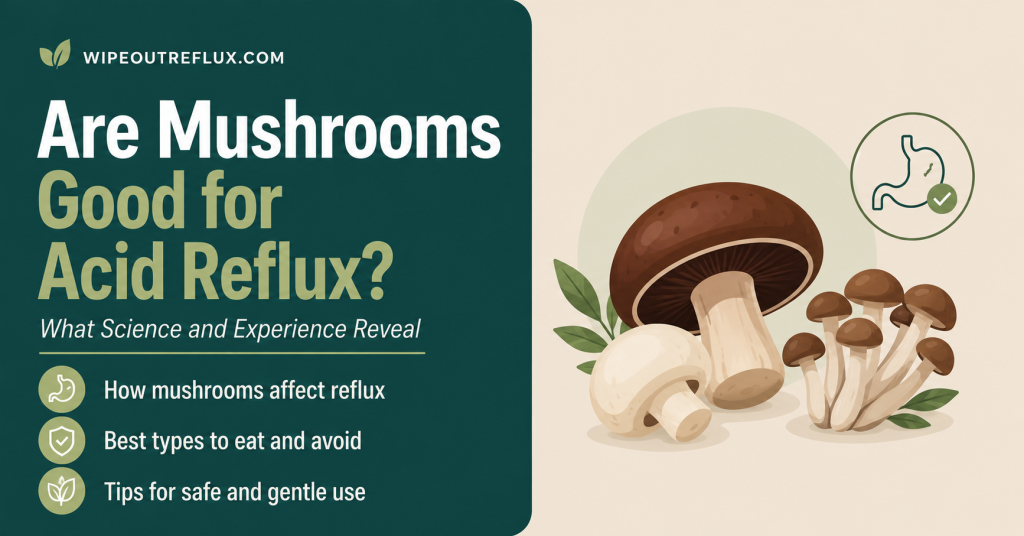
Yes — mushrooms are a good choice for most people with acid reflux. They’re near-neutral in pH (around 6.2 to 6.7), very low in fat, low in calories and mostly water, which puts them comfortably in the reflux-friendly camp on paper.
The catch isn’t the mushroom itself — it’s what you do with it. A grilled or lightly sautéed mushroom is a world away from one fried in butter or drowned in a creamy garlic sauce, and that’s usually where mushrooms turn into a reflux trigger. There’s also a second, quieter issue for some people: mushrooms are naturally high in a fermentable sugar alcohol that can cause bloating.
Below I’ll explain why mushrooms are low-acid and genuinely nutritious, why cooking method matters more than anything else here, and who needs to watch their portion.
Key Takeaways
- Mushrooms are low-acid — their pH sits around 6.2 to 6.7, close to neutral and well above the range that troubles reflux.
- They’re very low in fat and calories, and their natural umami (savoury) flavour lets you season food well without reaching for acidic or fatty triggers.
- Cooking method matters most: grilled, roasted, or lightly sautéed mushrooms are fine; fried-in-butter or creamy, garlic-heavy preparations are the real reflux problem.
- Mushrooms are one of the richest food sources of the antioxidants ergothioneine and glutathione, which is a genuine point in their favour.
- The main caveat is FODMAPs — common white and portobello mushrooms are high in mannitol, a fermentable sugar alcohol that can cause gas and bloating in sensitive guts.
- Oyster mushrooms are the low-FODMAP exception if mannitol bothers you.
- For LPR (silent reflux), mushrooms sit well above the pH 4 pepsin threshold, so they’re safe on acidity — the variables are fat and bloating, not pH.
Are mushrooms acidic or good for acid reflux?
Mushrooms are close to neutral. Their pH sits around 6.2 to 6.7, which places them among the least acidic foods you can eat — nowhere near the pH 3 to 5 zone where most reflux trigger foods live. On acidity alone, mushrooms pose no meaningful challenge to the oesophagus or throat.
They’ve also got a couple of quiet advantages that make them more than just “not harmful.” Mushrooms are very low in fat, which matters because fat is one of the main dietary drivers of reflux — it slows stomach emptying and relaxes the valve at the top of the stomach. And they’re loaded with natural glutamate, the compound behind their deep, savoury umami taste. That’s genuinely useful when you’re cooking for reflux, because a handful of mushrooms can add real depth to a dish and reduce your need for the salty, acidic or fatty flavourings that tend to cause trouble. They earn a regular place on my list of LPR-friendly foods.
The antioxidant angle
Mushrooms bring something more to the table than a safe pH. They’re one of the richest dietary sources of two important antioxidants — ergothioneine and glutathione — and the amounts vary by type, with some specialty mushrooms carrying far more than the common white button [Kalaras et al., Food Chemistry, 2017].
That’s relevant for reflux because chronic reflux keeps the tissue in the oesophagus and throat in a low-grade inflamed, irritated state. A food that delivers antioxidant compounds while adding no acid and almost no fat is exactly the kind of low-acid, low-fat staple I build meals around in the Wipeout Diet Plan — it’s working in your favour on more than one front.
Why cooking method matters most
This is the part that decides whether mushrooms help or hurt, and it’s where most “are mushrooms good for reflux” articles go quiet. The mushroom is nearly always fine. The problem is usually the pan.
Frying in butter or oil is the classic trap. Mushrooms are like little sponges — they soak up fat readily — so a “healthy” mushroom side can end up carrying a surprising amount of butter or oil. Fat is a direct reflux trigger, so a heavily fried mushroom can set off symptoms that have nothing to do with the mushroom itself. The same logic applies to any fried food and reflux.
Creamy and garlic-heavy sauces are the other one. A mushroom stroganoff or a garlic-butter mushroom is a reflux problem because of the cream, butter and garlic and onion — all common triggers — not the fungus underneath.
The reflux-friendly ways to cook mushrooms:
- Grilled or roasted with a light brush of olive oil — concentrates the flavour without much added fat.
- Lightly sautéed in a small amount of oil, or dry-fried in a hot non-stick pan so they release their own moisture.
- Simmered into soups and stews — a natural fit, and a low-fat way to get their umami into a meal. Mushrooms work well in gentle reflux-friendly soups.
- Avoid deep-frying, heavy butter, and cream- or garlic-based sauces during a flare.
Raw mushrooms are worth a small mention too: they’re harder to digest than cooked, so if you’re prone to bloating, cooking them thoroughly is the gentler option.
The FODMAP caveat: mannitol and bloating
Here’s the nuance that a simple “mushrooms are low-acid, so they’re fine” message misses. Common white mushrooms and portobellos are naturally high in mannitol — a sugar alcohol the small intestine absorbs poorly, which then ferments in the large intestine. Mannitol is a fermentable FODMAP, part of the same family of short-chain carbohydrates measured across common vegetables and fruits [Muir et al., Journal of Agricultural and Food Chemistry, 2009].
In people with sensitive guts, that fermentation produces gas and bloating — and bloating is a reflux issue in its own right. When the abdomen distends, pressure builds against the valve at the top of the stomach and can push stomach contents upward. So for a minority of people, mushrooms can worsen reflux — not because of acid, but because of gas-driven pressure. This is especially worth knowing if you have the kind of gut that reacts to fermentable carbohydrates; there’s a well-known overlap between IBS and reflux.
The good news is you have options. If mushrooms consistently leave you bloated, oyster mushrooms are the low-FODMAP exception — they’re well tolerated in normal servings on a low-FODMAP approach, while white, chestnut and portobello mushrooms are best kept to small portions. Cooking and keeping the serving modest also helps.
Mushrooms for LPR vs GERD
For acidity, the guidance is the same for both conditions. In silent reflux, much of the throat damage is done by pepsin — a stomach enzyme — which reactivates when the local pH drops below about 4 [Johnston et al., The Laryngoscope, 2007]. Mushrooms, at pH 6.2 to 6.7, sit comfortably above that threshold, so they’re safe on acidity for LPR and GERD alike. (There’s more on that mechanism in what is pepsin.)
The variables that actually matter for both groups are the same two: the fat you cook them in, and the bloating risk from mannitol. If you have LPR specifically, I’d pay slightly more attention to portion and preparation, because even modest increases in abdominal pressure can push acid high enough to reach the throat. A moderate serving of grilled or lightly sautéed mushrooms is very unlikely to cause that; a big plate of creamy fried mushrooms is a different story. More on the split between the two conditions in GERD vs LPR.
Conclusion
Mushrooms are one of the easier wins for a reflux-friendly diet — low in acid, very low in fat, rich in antioxidants, and packed with umami that helps you cook flavourful food without leaning on triggers. The two things to get right are cooking method and, if you’re FODMAP-sensitive, portion size. Grill, roast or lightly sauté them, go easy on butter, cream and garlic, and keep servings modest if common mushrooms tend to bloat you — or switch to oyster mushrooms. Do that, and mushrooms are a food that works for you rather than against you.
Of course, whether any single food helps or hurts depends on how your whole diet is put together — the combinations, the portions, the timing, and the overall pattern of acid and pressure across a day. That’s the part that makes the real difference, and it’s exactly what the Wipeout Diet Plan is built around. I designed it first and foremost for LPR — the stubborn, throat-based form of reflux — but because it targets the same underlying mechanisms, it works just as well for GERD and everyday heartburn. It takes the guesswork out of building a diet that actually calms reflux, rather than leaving you to judge foods one at a time.
And if you’d like a quick reference for which foods and drinks are safe and where they sit on the pH scale, the Wipeout Food Reference Guide is the essential companion — the allowed foods for reflux and LPR, with their pH values, laid out at a glance.
Frequently Asked Questions
Are mushrooms good for acid reflux?
For most people, yes. Mushrooms are near-neutral in pH (around 6.2 to 6.7), very low in fat, and rich in antioxidants, which makes them a solid reflux-friendly food. The main things to watch are how you cook them — avoid heavy frying and creamy, garlic-based sauces — and, if you’re prone to bloating, the mannitol in common mushrooms.
Can mushrooms cause acid reflux?
They can in two situations. The most common is cooking — mushrooms fried in butter or served in creamy, garlic-heavy sauces can trigger reflux because of the fat and other triggers, not the mushroom. The second is bloating: common mushrooms are high in mannitol, a FODMAP that can cause gas and abdominal pressure in sensitive people.
Are mushrooms acidic?
No — mushrooms are close to neutral, with a pH of roughly 6.2 to 6.7. That’s well above the acidic range that troubles reflux, and comfortably above the pH 4 threshold that matters for silent reflux. On acidity alone, mushrooms are a safe food.
What is the best way to cook mushrooms for acid reflux?
Grilling, roasting, light sautéing in a little olive oil, or simmering them into soups are all good, low-fat options that keep mushrooms reflux-friendly. Avoid deep-frying, heavy butter, and cream- or garlic-based sauces, especially during a flare — these are what usually turn mushrooms into a trigger.
Which mushrooms are best if I get bloated?
Oyster mushrooms are the low-FODMAP choice and are well tolerated in normal servings. Common white, chestnut and portobello mushrooms are higher in mannitol, so keep those to smaller portions if fermentable carbohydrates tend to bloat you.
Are mushrooms safe for LPR (silent reflux)?
Yes, from an acidity standpoint. Mushrooms sit well above the pH 4 pepsin-activation threshold, so they won’t provoke throat symptoms through acid. As with GERD, the precautions are about cooking method and portion size to keep fat and bloating in check.
Research & References
- An analysis of the antioxidant content of mushrooms found them to be among the richest dietary sources of ergothioneine and glutathione, with concentrations varying substantially by species [Kalaras et al., Food Chemistry, 2017].
- A study measuring fermentable short-chain carbohydrates in common Australian vegetables and fruits quantified polyols including mannitol — the fermentable sugar alcohol that makes common mushrooms a high-FODMAP food capable of causing gas and bloating [Muir et al., Journal of Agricultural and Food Chemistry, 2009].
- A study of human pepsin’s activity and stability found the enzyme is maximally active in strongly acidic conditions and retains significant activity up to around pH 4 — the reason near-neutral foods like mushrooms don’t provoke laryngeal reflux symptoms, while acidic ones do [Johnston et al., The Laryngoscope, 2007].

David Gray
12 years living with LPR · Consultant & researcher
I've lived with LPR for twelve years — the misdiagnoses, the PPI courses that did nothing, the slow work of figuring out what actually helps. Wipeout Reflux is where I translate the research into plain terms for people stuck in the same place. Every claim here is sourced to peer-reviewed work, and I consult one-to-one with LPR sufferers.