
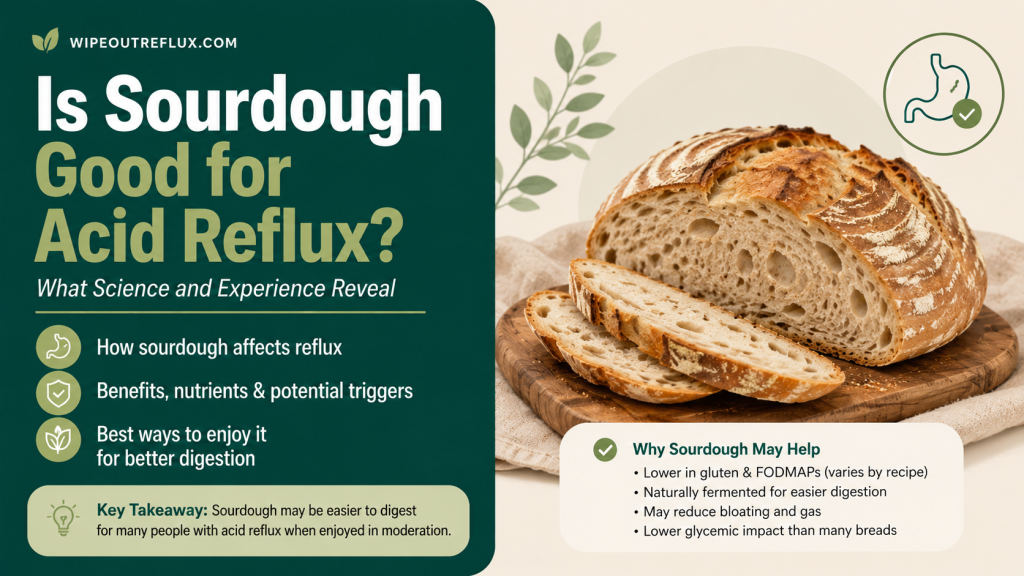
For most people, genuine sourdough is one of the better breads to eat with acid reflux — but not for the reason you might expect. It isn’t that sourdough is less acidic. In fact, it’s slightly more acidic than ordinary bread, thanks to the lactic and acetic acid produced during fermentation.
What makes real sourdough gentler is what the long, slow fermentation does to the wheat: it breaks down the fructans — the FODMAPs that cause bloating — so the bread tends to sit easier and produce less gas. And since bloating is one of the ways bread aggravates reflux, that matters more than the modest acidity of the loaf itself.
The big catch is that only properly fermented sourdough gets this benefit. Below I’ll explain what fermentation actually changes, and how to tell the real thing from the supermarket imitation.
Key Takeaways
- Sourdough is usually better tolerated than ordinary bread — but because of fermentation, not lower acidity.
- The bread itself is mildly acidic (roughly pH 3.5 to 4.5) from the lactic and acetic acid of fermentation, but that small amount of acid isn’t the main reflux driver.
- Long fermentation breaks down fructans, the FODMAPs in wheat that cause gas and bloating — and less bloating means less pressure-driven reflux.
- Fermentation also makes sourdough more slowly digested and, for some people, easier on the gut than standard bread.
- Only genuine slow-fermented sourdough delivers this — many supermarket “sourdough” loaves are made fast with added yeast and flavouring and don’t get the FODMAP reduction.
- Sourdough is still a wheat product containing gluten, so it’s not a fix for coeliac disease or a true wheat allergy.
- What you put on it matters too — lots of butter adds the fat that triggers reflux regardless of the bread.
Is sourdough acidic? The surprising part
Let’s deal with the acidity question first, because it’s the opposite of what most people assume. The whole point of a sourdough starter is that wild bacteria ferment the dough and produce lactic and acetic acid — that’s what gives sourdough its tang. As a result, the finished loaf is genuinely acidic, often around pH 3.5 to 4.5, which is more acidic than a standard supermarket loaf.
So if acidity were the whole story, sourdough would look like a worse choice. But it isn’t, for a simple reason: eating a slice of bread is nothing like drinking an acidic liquid. The acid in bread is a small amount, bound up in a solid, starchy matrix that’s quickly buffered and swallowed, so it makes little difference to what’s happening in your stomach and oesophagus. The pH of the loaf is far less important than what the bread does to your gut once it’s digested — which is where fermentation earns its reputation. You can see how bread compares with other foods on the food pH chart, and I’ve covered bread more broadly in is bread good for acid reflux.
What fermentation actually changes
Here’s the real mechanism. Ordinary wheat bread contains fructans — a type of fermentable carbohydrate (a FODMAP) that the small intestine can’t fully absorb. Fructans travel to the large intestine, where gut bacteria ferment them and produce gas. In people with sensitive, IBS-prone guts, that’s a common cause of bloating — and bloating raises pressure against the valve at the top of the stomach, which can push stomach contents upward. Wheat is one of the bigger dietary sources of fructans [Muir et al., Journal of Agricultural and Food Chemistry, 2007].
A long sourdough fermentation changes this. The bacteria and enzymes at work over those hours don’t just make acid — they also break down a large share of the fructans before the bread is ever baked. Reviews of sourdough baking have shown that extended fermentation substantially reduces the FODMAP content of wheat bread, which is why properly made sourdough is often far better tolerated by people who bloat on ordinary bread [Loponen & Gänzle, Foods, 2018]. Less fructan means less fermentation in your gut, less gas, and less of the bloating that drives pressure-related reflux.
As a bonus, the fermentation also slows how quickly the bread is digested and partially breaks down some of the gluten proteins, which is part of why many people simply find sourdough sits more comfortably.
Real sourdough vs supermarket “sourdough”
This is the part that decides whether you actually get the benefit — and it’s where a lot of people go wrong. The FODMAP reduction only happens with a genuine, slow fermentation lasting many hours. A great deal of what’s sold as “sourdough” is made the fast way: standard baker’s yeast for a quick rise, with a splash of sourdough flavouring or a little starter added for taste. It looks and tastes the part, but it hasn’t fermented long enough to break down the fructans, so it behaves like ordinary bread in your gut.
To get the real thing, look for a short ingredient list — ideally just flour, water and salt, with a live starter rather than added commercial yeast — and buy from a proper bakery or make your own. If the label lists yeast and a long roster of additives, treat it as regular bread for reflux purposes.
Sourdough and LPR (silent reflux)
A quick note for anyone with throat-based reflux. In LPR, much of the damage is done by pepsin — a stomach enzyme — which reactivates when the local pH drops below about 4 [Johnston et al., The Laryngoscope, 2007]. Because sourdough is a mildly acidic bread, the strictest LPR healing protocols may err on the side of caution with it early on. In practice, though, the acid in a slice of bread is small and quickly buffered, so for most people the digestibility benefit of real sourdough outweighs its modest acidity. If you’re in the very strict phase of an LPR diet, you might favour a plainer bread; once you’re past that, well-fermented sourdough is a reasonable choice. More on the split between the two conditions in GERD vs LPR.
Whichever bread you choose, watch what goes on top. A thick layer of butter adds the fat that triggers reflux on its own, quite apart from the bread — so go easy there, and lean on the low-acid, well-tolerated foods that make up the core of the Wipeout Diet Plan.
Conclusion
So, is sourdough good for acid reflux? For most people, yes — genuine, slow-fermented sourdough tends to be gentler than ordinary bread. Just be clear about why: it’s not that sourdough is less acidic (it’s slightly more), but that the long fermentation breaks down the fructans that cause bloating, and less bloating means less pressure-driven reflux. The one thing that undoes all of this is buying fast-made supermarket “sourdough,” which never ferments long enough to earn the benefit.
Bread is only ever one piece of the puzzle, though. Whether reflux settles depends on the whole pattern of how you eat — the balance of acid, fat and fermentable carbohydrates, the portions, and the timing across a day. The Wipeout Diet Plan is the complete, in-depth system I built to get that pattern right. I designed it first and foremost around LPR — the stubborn, throat-based form of reflux — but because it targets the same underlying mechanisms, it works just as well for GERD and everyday heartburn.
And if you’d like a quick reference for which foods and drinks are safe and where they sit on the pH scale, the Wipeout Food Reference Guide is the essential companion — the allowed foods for reflux and LPR, with their pH values, laid out at a glance.
Frequently Asked Questions
Is sourdough bread good for acid reflux?
For most people, genuine sourdough is one of the better bread choices. It’s not because it’s less acidic — it’s actually slightly more acidic — but because long fermentation breaks down the fructans that cause bloating, so it tends to sit easier and cause less gas. The benefit only applies to properly slow-fermented sourdough, not fast-made supermarket versions.
Is sourdough acidic?
Yes, mildly — the finished loaf is often around pH 3.5 to 4.5 because of the lactic and acetic acid produced during fermentation, making it a touch more acidic than standard bread. But the amount of acid in a slice is small and quickly buffered, so it’s not the main factor in whether bread affects your reflux.
Why is sourdough easier to digest?
The long fermentation breaks down much of the wheat’s fructan (FODMAP) content and partially digests some of the gluten proteins before baking. That means less fermentable carbohydrate reaching your gut, so less gas and bloating — which is why many people who react to ordinary bread tolerate real sourdough better.
Does supermarket sourdough have the same benefits?
Often not. Much of what’s labelled “sourdough” is made quickly with added baker’s yeast and sourdough flavouring, and hasn’t fermented long enough to break down the fructans. Look for a short ingredient list — flour, water, salt and a live starter — from a proper bakery, or make your own, to get the real benefit.
Is sourdough safe for LPR (silent reflux)?
For most people, yes, once past the strictest healing phase. Sourdough is mildly acidic, so very strict LPR protocols may be cautious with it early on, but the acid in a slice of bread is small and quickly buffered. The lower FODMAP content of real sourdough usually makes it a reasonable, well-tolerated choice.
Can I eat sourdough if I’m sensitive to gluten?
Well-fermented sourdough has less fructan and some broken-down gluten, so people with mild, non-coeliac wheat sensitivity often tolerate it better. But it still contains gluten, so it’s not safe for coeliac disease or a true wheat allergy — those require genuinely gluten-free bread.
Research & References
- An analysis of the fructan and free fructose content of common foods identified wheat as a significant dietary source of fructans — the fermentable carbohydrates in ordinary bread that cause gas and bloating [Muir et al., Journal of Agricultural and Food Chemistry, 2007].
- A review of sourdough baking showed that extended sourdough fermentation substantially reduces the FODMAP content of wheat bread, making properly fermented sourdough better tolerated by people sensitive to fermentable carbohydrates [Loponen & Gänzle, Foods, 2018].
- A study of human pepsin’s activity and stability found the enzyme is maximally active in strongly acidic conditions and retains significant activity up to around pH 4 — relevant to why very strict LPR protocols treat acidic foods cautiously, though the small amount of acid in a slice of bread is quickly buffered [Johnston et al., The Laryngoscope, 2007].

David Gray
12 years living with LPR · Consultant & researcher
I've lived with LPR for twelve years — the misdiagnoses, the PPI courses that did nothing, the slow work of figuring out what actually helps. Wipeout Reflux is where I translate the research into plain terms for people stuck in the same place. Every claim here is sourced to peer-reviewed work, and I consult one-to-one with LPR sufferers.