
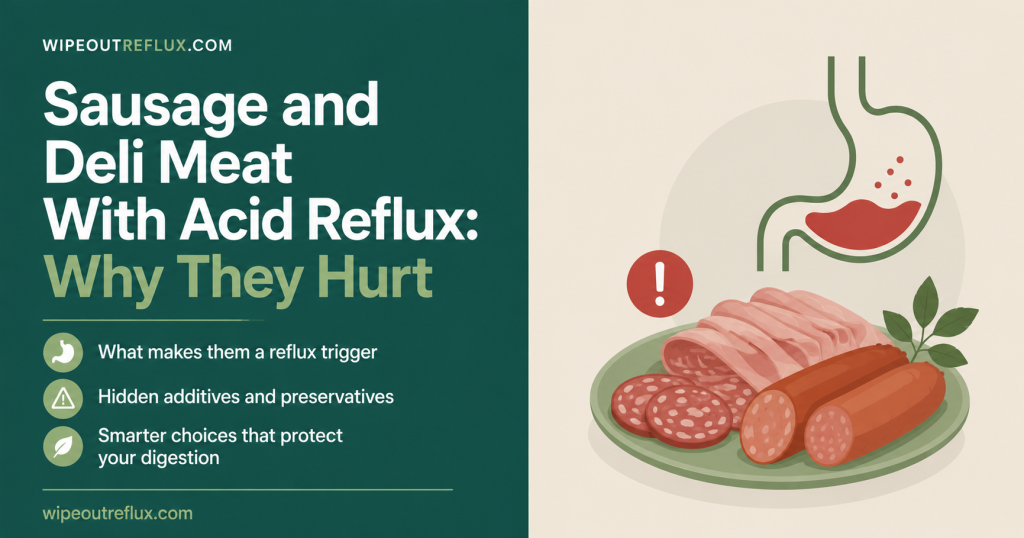
Sausage and deli meat are among the trickier foods to eat with acid reflux, and it’s worth understanding why, because it isn’t one single thing — it’s three at once. These meats tend to be high in fat, heavily salted, and often spiced, and any one of those can nudge reflux; together they stack. Add that sausages are almost always fried, and that cured and processed meats turn up in exactly the fatty contexts that cause trouble, and you have a food group that punches above its weight for triggering symptoms.
That said, it’s not all-or-nothing. There’s a real difference between a fatty, spiced chorizo and a couple of slices of lean turkey breast, and between a cheap fried sausage and a lean grilled one. Knowing where the fat, salt and spice sit lets you keep some of these on the menu and be sensible about the rest.
Here’s what’s actually going on, and how to handle sausage and deli meat without paying for it.
Key Takeaways
- Sausage and deli meat trigger reflux through three routes at once: fat, salt and spice.
- Fat and calorie density are the main dietary drivers of reflux, and most sausages and many cured meats are high in both.
- Sausages are almost always fried, adding more fat, and often eaten as part of fatty meals like fry-ups and pizza.
- Spiced and cured meats — chorizo, pepperoni, spicy salami — add heat, which is a common trigger, especially for the throat.
- Processed meats are very high in salt; salt is a weaker, less certain reflux trigger, but there are good general-health reasons to moderate it.
- Aged and fermented meats like salami and pepperoni are high in histamine, which matters for people whose reflux overlaps with histamine intolerance.
- Leaner deli meats — turkey and chicken breast, lean ham — and lean grilled sausages are the gentler choices.
Why Sausage and Deli Meat Hurt: Three Drivers
1. Fat
This is the main one. Most sausages are a quarter fat or more, and many cured deli meats — salami, chorizo, pepperoni, bologna — are similarly fatty. Fat and calorie density are the most consistent dietary drivers of reflux. In a controlled crossover study that separated the two, oesophageal acid exposure was significantly higher after calorie-dense meals, and the frequency of symptoms tracked with the fat percentage of the meal [Fox et al., Clinical Gastroenterology and Hepatology, 2007]. Larger population data agree, tying higher total and saturated fat intake to more frequent reflux symptoms [El-Serag et al., Gut, 2005]. Processed meats concentrate a lot of fat into a small, easy-to-eat portion, which is exactly the profile that causes problems.
Worth getting the mechanism right: the common claim that fat “relaxes the valve” doesn’t hold up well. When researchers raised a meal’s fat while keeping calories constant, reflux didn’t increase [Penagini et al., Gut, 1998]. Fat isn’t a direct chemical trigger — it’s that fat carries the calories, and the calorie load is what drives the reflux. Fatty sausages and cured meats simply pack a lot in.
2. Salt
Cured and processed meats are, by nature, heavily salted — it’s part of how they’re preserved. Salt is a weaker and less certain reflux trigger than fat: some observational work has linked high salt intake to reflux symptoms, but it’s inconsistent, and I wouldn’t lean on it too hard. The stronger reasons to moderate salt are blood pressure and general health. There’s more in is salt acidic or alkaline. Either way, deli meats are among the saltiest things in the fridge, and that’s worth knowing.
3. Spice
Many cured meats are spiced — chorizo, pepperoni, spicy salami, spiced sausages — and spice is a common reflux trigger, particularly for the throat-based, silent kind. Chilli heat can irritate an already sensitive oesophagus and throat directly. The wider picture is in spicy food and acid reflux. A spiced, fatty, salty cured meat is essentially all three triggers rolled into one slice.
It’s Not Just the Meat — It’s the Company
Processed meats rarely turn up alone, and the context usually makes things worse. Sausages are almost always fried, adding fat on top of fat — and fried food is one of the most reliably reported reflux triggers. They also feature in the classic fry-up, alongside bacon, fried eggs, tomatoes and coffee, which stacks several triggers at breakfast. Pepperoni and other cured meats sit on pizza, combining fatty meat with cheese and acidic tomato. So when a hot dog or a pepperoni slice gives you heartburn, the meat is only part of what’s on the plate. Much of the same logic runs through is red meat bad for acid reflux and the fattier end of is pork bad for acid reflux.
Processed Meat and Histamine
One extra factor, relevant to a minority: aged, cured and fermented meats — salami, pepperoni, some sausages — are high in histamine. For most people that’s a non-issue, but for those whose reflux overlaps with histamine intolerance, high-histamine foods can worsen symptoms independently of the fat and spice. If cured meats reliably bother you more than their fat content alone would explain, it’s worth reading the histamine intolerance and reflux link.
The Gentler Choices
Not all of this category is equally troublesome. Leaner options exist and make a real difference:
- Sliced turkey and chicken breast. The leanest deli meats by a distance — low in fat and unspiced. See is turkey good for acid reflux and is chicken good for acid reflux.
- Lean ham. Lower in fat than salami or chorizo, though still salty — fine in moderation.
- Lean grilled sausages. Look for a high meat content and lower fat percentage, and grill rather than fry so the fat drips away. A world apart from a cheap fried banger.
- Chicken or turkey sausages. Usually leaner than pork sausages, provided they’re not heavily spiced.
The fattiest, spiciest processed meats — chorizo, pepperoni, spicy salami, cheap high-fat sausages, and anything deep-fried — are the ones to keep occasional. Many sit near the top of any LPR foods to avoid list.
How to Handle Sausage and Deli Meat
A few habits take most of the sting out of this category — the same lean-swap thinking the Wipeout Diet Plan uses to keep everyday meals on the menu:
- Choose lean. Turkey or chicken breast and lean ham over salami, chorizo and pepperoni; high-meat, low-fat sausages over cheap fatty ones.
- Grill, don’t fry, so the fat drains away rather than the sausage sitting in it.
- Watch the spice. Unspiced deli meats are gentler than chilli-spiked cured ones, especially if your symptoms are throat-based.
- Keep portions modest. These are calorie-dense, so a smaller amount goes a long way toward keeping the load down.
- Mind the company. The fry-up and the pepperoni pizza stack several triggers at once — changing what’s around the meat often helps as much as changing the meat.
- Don’t eat them late. A fatty, salty meal sits worst right before lying down, since higher-fat meals leave the stomach more slowly — see how long before bed you should stop eating.
Conclusion
Sausage and deli meat are genuinely among the harder foods for reflux, but for reasons worth separating out: fat above all, then salt, then spice, and usually a fatty context on top. That’s a lot stacked into one food, which is why processed meats trigger symptoms so reliably. The good news is that the category is broad — lean turkey or chicken slices, lean ham and a lean grilled sausage are a completely different proposition from chorizo, pepperoni and a fried fry-up banger. Choose lean, grill rather than fry, watch the spice and the timing, and you can keep some of these without the aftermath.
Working out which foods are genuinely off-limits and which just need a leaner version or a different cooking method is exactly what the Wipeout Diet Plan is built around — it walks you through the real triggers, the safe swaps and how to rebuild everyday meals so they don’t set you off. I designed it first and foremost around LPR and silent reflux, the stubborn throat-based form that medication so often fails to touch, but because it works on the same underlying mechanisms it helps GERD and everyday heartburn just as well. And the Wipeout Food Reference Guide is the practical companion for questions exactly like this one — which foods and drinks are safe for acid reflux and LPR, with their real pH values, so you can tell at a glance which processed meats are worth keeping and which to leave.
Frequently Asked Questions
Is deli meat bad for acid reflux?
It can be, and it depends heavily on the type. Fatty, spiced cured meats like salami, chorizo and pepperoni trigger reflux through fat and spice at once, plus a heavy salt load. Leaner deli meats — turkey and chicken breast, lean ham — are much gentler. The fattier and spicier the meat, the more likely it is to cause symptoms.
Why do sausages give me heartburn?
Mainly because they’re high in fat and almost always fried, which adds more. Fatty, calorie-dense food is the most consistent dietary driver of reflux, so a fried pork sausage delivers a large load in a small portion. Spiced sausages add heat as well, and they often appear in fry-ups alongside other triggers.
What is the best deli meat for acid reflux?
Sliced turkey or chicken breast is the best choice — it’s the leanest and usually unspiced. Lean ham is a reasonable second, though it’s salty. Avoid the fatty, spiced cured meats like salami, chorizo and pepperoni, which stack fat, salt and spice together.
Is pepperoni bad for acid reflux?
It’s one of the harder ones. Pepperoni is fatty, spicy and salty all at once, and it usually arrives on pizza with cheese and acidic tomato, stacking several triggers together. If you’re prone to reflux, it’s best kept occasional — a plainer topping on a smaller portion is far gentler.
Are chicken or turkey sausages better for reflux?
Usually yes, because they tend to be lower in fat than pork sausages, and fat is the key driver. Grill rather than fry them, and choose ones that aren’t heavily spiced. A lean, grilled poultry sausage is a genuinely more reflux-friendly option than a fatty fried one.
Does the salt in processed meat cause reflux?
The evidence is weak and inconsistent, so salt is a much less certain trigger than the fat in these meats. Processed meats are very high in salt, and there are solid general-health reasons to moderate it, but for reflux specifically the fat and spice matter more than the sodium.
Research & References
- Fox et al., Clinical Gastroenterology and Hepatology, 2007 — Randomised crossover study separating dietary fat from calorie density in people with reflux. Oesophageal acid exposure was greater after high-calorie meals and symptoms tracked the fat percentage — the main reason fatty sausages and cured meats trigger reflux.
- El-Serag et al., Gut, 2005 — Cross-sectional study of 371 people linking higher total and saturated fat intake with more frequent reflux symptoms in a dose-response pattern — support for choosing leaner deli meats over fatty cured ones.
- Penagini et al., Gut, 1998 — Controlled study showing that raising a meal’s fat content at constant calories did not increase reflux, indicating fat is not a direct chemical trigger and that the calorie load of fatty processed meat is what matters.
- Katz et al., The American Journal of Gastroenterology, 2022 — ACG clinical guideline recommending weight loss where appropriate, avoiding meals within 2 to 3 hours of bedtime, and selectively avoiding individual trigger foods — the practical basis for choosing lean, grilling, and timing meals containing processed meat.

David Gray
12 years living with LPR · Consultant & researcher
I've lived with LPR for twelve years — the misdiagnoses, the PPI courses that did nothing, the slow work of figuring out what actually helps. Wipeout Reflux is where I translate the research into plain terms for people stuck in the same place. Every claim here is sourced to peer-reviewed work, and I consult one-to-one with LPR sufferers.