
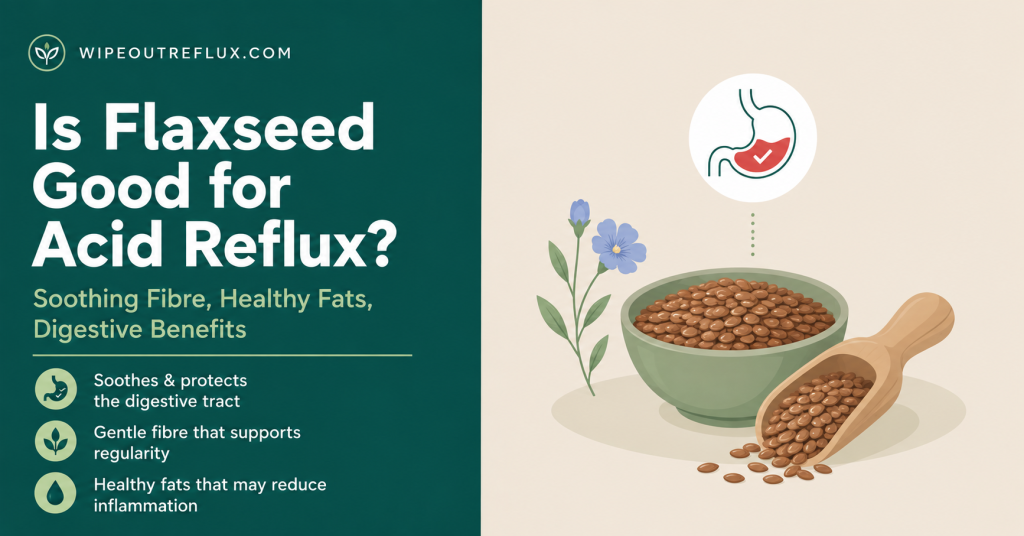
Flaxseed is one of the more genuinely useful additions to a reflux diet — but it helps some people more than others, and only if you use it the right way. Like chia, its appeal is mucilage: a soluble fibre that swells into a soft gel in water. That fibre is the real reason it may help, because higher fibre intake is linked to fewer reflux symptoms, and adding fibre has cut reflux episodes in trials. Flaxseed also brings omega-3 fats and lignans, and it’s non-acidic, so it isn’t a trigger in itself.
The details are where flaxseed lives or dies, though. Whole seeds pass through you largely undigested, so grinding matters. It’s high in fat, so dosing matters. And it suits some situations — low fibre intake, sluggish digestion, silent reflux where you want a gentle demulcent — better than others. This article is about getting those three things right: the mucilage, the dose, and who it’s actually for.
Key Takeaways
- Flaxseed is rich in soluble fibre (mucilage), and higher fibre intake is associated with fewer reflux symptoms — the main reason it may help.
- It’s non-acidic, so it won’t irritate an inflamed throat or oesophagus the way acidic foods do — useful for silent reflux (LPR).
- Grind it, or buy it ground — whole flaxseeds pass through largely undigested, so you miss most of the benefit.
- Flaxseed is high in fat (mostly the beneficial omega-3 kind), so keep portions to a tablespoon or two.
- A gentle mucilage demulcent, it suits people with low fibre intake, sluggish digestion, or throat-based reflux especially well.
- Introduce it gradually with plenty of water, since a sudden fibre jump can cause gas, bloating and a laxative effect.
- Ground flax stirred into porridge, yoghurt or smoothies is the simplest way to use it.
The Mucilage: What It Is and What It Does
Flaxseed’s outer layer is loaded with soluble fibre. In water it forms a soft, slightly slippery gel — the same demulcent quality that makes mucilage herbs like slippery elm and marshmallow root popular with reflux sufferers, and closely related to what chia seeds do.
The solid, evidence-backed benefit is fibre. Higher dietary fibre intake is associated with a lower risk of reflux symptoms [Dietary Fiber and Reflux, Clinical Gastroenterology and Hepatology, 2023], and in a controlled trial, adding fibre to the diet of reflux patients reduced the number of reflux episodes and improved symptoms, with a measurable rise in lower-oesophageal-sphincter pressure [Morozov et al., World Journal of Gastroenterology, 2018]. Flaxseed is a concentrated source of that soluble fibre, which is the credible mechanism behind any improvement.
The soothing, demulcent idea — that the gel calms an irritated throat — is plausible and is why flax has a long folk history for this, but it’s more a reasonable extrapolation than something proven in reflux trials. So it’s fair to say flaxseed may feel soothing and does add helpful fibre, without overstating the coating effect.
Dosing: Grind It, and Don’t Overdo It
Two dosing points make all the difference.
Grind it. Whole flaxseeds have a tough coat and mostly pass straight through undigested, taking their fibre, oils and lignans with them. Ground flaxseed (or buying it pre-milled) releases all of that. If you’re eating whole seeds and wondering why nothing’s happening, this is usually why.
Keep the portion modest. Flaxseed is roughly a third fat by weight. Most of it is the beneficial omega-3 kind rather than the saturated fat linked to more reflux symptoms [El-Serag et al., Gut, 2005], but fat still carries calories, and the most consistent dietary driver of reflux is a large calorie load in a small volume [Fox et al., Clinical Gastroenterology and Hepatology, 2007]. A tablespoon or two of ground flax a day gives you the fibre without a meaningful fat load; half a cup does not.
And drink water with it. Soluble fibre needs fluid to form its gel and move through comfortably — without enough, extra fibre can backfire and leave you more bloated, not less.
Who Flaxseed Suits Best
Flaxseed isn’t equally useful for everyone. It tends to help most if:
- Your fibre intake is low. The reflux benefit of fibre shows up most in people who weren’t getting much to begin with — which describes a lot of Western diets. If that’s you, flax is an easy way to close the gap.
- Your digestion is sluggish or you’re prone to constipation. Flax’s fibre adds bulk and gentle movement, and keeping things regular tends to ease the pressure side of reflux.
- You have silent reflux (LPR) and want a gentle, non-acidic option. Because flax is close to neutral, it fits a low-acid approach and won’t reactivate throat-bound pepsin the way acidic foods can. It belongs on the LPR foods to eat list and among sensible supplements for LPR, and it supports overall gut health.
It’s less likely to add much if your diet is already high in fibre, and anyone who reacts to a sudden fibre increase with bloating should build up slowly — because bloating can make reflux feel worse through pressure, not acid.
How to Use Flaxseed
Getting the practicalities right is what turns flaxseed from a packet claim into a genuinely useful habit — the same use-it-properly approach the Wipeout Diet Plan takes with the foods worth keeping in your routine:
- Use it ground. Buy milled flaxseed or grind whole seeds in a spice grinder; store it in the fridge, as ground flax goes rancid faster than whole.
- Stir it into wet foods. Porridge, yoghurt, or a non-acidic smoothie — see breakfast recipes for acid reflux and acid reflux smoothie recipes.
- Start with a teaspoon and build to a tablespoon or two over a week or two, so your gut adjusts.
- Drink enough water, both with the flax and across the day, so the fibre works with you.
- Don’t rely on flaxseed oil for this. The oil has the omega-3s but none of the fibre — it’s the fibre that matters for reflux, so the ground seed is what you want.
Conclusion
Flaxseed earns its reputation as a reflux-friendly food, but for a specific reason: it’s a concentrated, non-acidic source of soluble fibre, and fibre is genuinely linked to fewer reflux symptoms. The mucilage that forms the gel may also feel soothing, though that part is more traditional than proven. Get the practicalities right — grind it, keep to a tablespoon or two, and build up gradually with plenty of water — and it’s a gentle, useful habit, especially if your fibre intake is low, your digestion is sluggish, or you’re managing silent reflux.
Knowing which foods genuinely help, and exactly how to use them, is what the Wipeout Diet Plan is built to give you — the mechanisms, the doses and the practical detail, so you’re not guessing from packet claims. I designed it first and foremost around LPR and silent reflux, the stubborn throat-based form that medication so often fails to touch, but because it works on the same underlying mechanisms it helps GERD and everyday heartburn just as well. And the Wipeout Food Reference Guide is the companion for questions exactly like this one — which foods and drinks are safe for acid reflux and LPR, with their real pH values, so you always know where something like flaxseed fits.
Frequently Asked Questions
Is flaxseed good for acid reflux?
Yes, for many people. Flaxseed is rich in soluble fibre, and higher fibre intake is linked to fewer reflux symptoms; it’s also non-acidic, so it isn’t a trigger. It helps most if your fibre intake is low or your digestion is sluggish. Grind it, keep portions to a tablespoon or two, and build up gradually.
Does flaxseed soothe the throat and oesophagus?
It may feel soothing thanks to its mucilage — a soft gel similar to slippery elm and marshmallow root — but that coating effect is traditional rather than firmly proven. The better-established benefit is the fibre it provides, which is linked to fewer reflux symptoms. Value it mainly as a fibre food that may also feel calming.
Should flaxseed be ground or whole for reflux?
Ground. Whole flaxseeds have a tough coat and pass through largely undigested, so you miss most of the fibre, oils and lignans. Buy pre-milled flaxseed or grind it yourself, and store the ground seed in the fridge, since it goes rancid faster than whole seeds.
How much flaxseed should I take for acid reflux?
A tablespoon or two of ground flaxseed a day is plenty. It’s high in fat, so larger amounts add unnecessary calories, and a sudden fibre jump can cause bloating. Start with a teaspoon, build up over a week or two, and drink enough water so the fibre works comfortably.
Can flaxseed make reflux worse?
Occasionally, if overdone. Too much too quickly can cause gas, bloating and a laxative effect, and bloating can worsen reflux through pressure rather than acid. Its fat content also means very large servings add calories. A modest, well-hydrated portion introduced gradually avoids these problems for most people.
Is flaxseed or flaxseed oil better for reflux?
Ground flaxseed, because the reflux benefit comes from the fibre, which the oil doesn’t contain. Flaxseed oil provides the omega-3 fats but none of the soluble fibre or bulk, so for reflux specifically the whole ground seed is the more useful form.
Research & References
- Morozov et al., World Journal of Gastroenterology, 2018 — Prospective trial in non-erosive reflux patients with low fibre intake. Adding psyllium fibre reduced total reflux episodes (from 67.9 to 42.4), cut heartburn, and raised lower-oesophageal-sphincter pressure — the basis for flaxseed’s soluble-fibre benefit.
- Dietary Fiber and Reflux, Clinical Gastroenterology and Hepatology, 2023 — Population analysis finding higher dietary fibre intake associated with a decreased risk of gastro-oesophageal reflux symptoms.
- Fox et al., Clinical Gastroenterology and Hepatology, 2007 — Randomised crossover study showing oesophageal acid exposure rose after calorie-dense meals — the reason flaxseed’s high fat content means portions should stay modest.
- El-Serag et al., Gut, 2005 — Cross-sectional study linking higher total and saturated fat intake with more frequent reflux symptoms; relevant context for flaxseed, whose fat is mainly the beneficial omega-3 kind rather than saturated.

David Gray
12 years living with LPR · Consultant & researcher
I've lived with LPR for twelve years — the misdiagnoses, the PPI courses that did nothing, the slow work of figuring out what actually helps. Wipeout Reflux is where I translate the research into plain terms for people stuck in the same place. Every claim here is sourced to peer-reviewed work, and I consult one-to-one with LPR sufferers.