
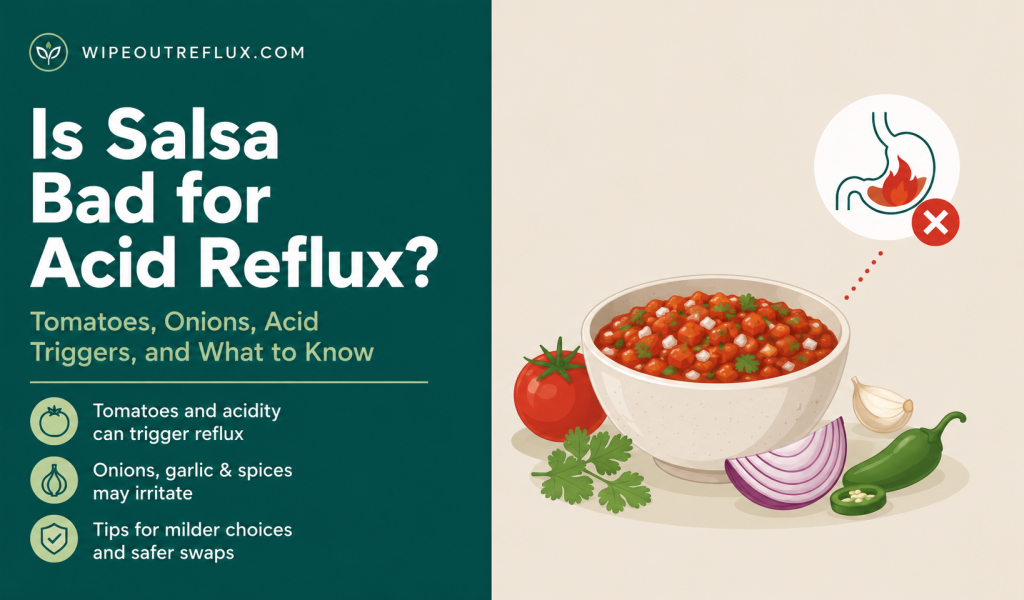
Yes — salsa is one of the hardest foods for acid reflux, and it’s almost a case study in why. Most reflux-triggering foods have one problem. Salsa has four or five, all in the same bowl. Tomato is acidic. Onion is a classic trigger. Lime is intensely acidic. Chilli brings capsaicin. Garlic, and sometimes a splash of vinegar, round it off. It’s difficult to design a food that ticks more reflux boxes at once.
That’s the frustrating thing about salsa: there’s no single ingredient to blame or remove. It’s the combination that does it, which is why even a “mild” salsa — with the heat dialled down but the tomato, onion and lime intact — can still set symptoms off. Understanding what each part contributes at least tells you which versions are least bad and what to reach for instead.
Key Takeaways
- Salsa stacks several reflux triggers in one bowl: acidic tomato, onion, acidic lime, chilli and often garlic.
- There’s no single culprit to remove — it’s the combination that makes salsa so reliably troublesome.
- Tomato and lime make salsa genuinely acidic, which matters especially for silent reflux (LPR).
- Onion and garlic are among the most commonly reported reflux triggers, separate from the acid.
- Chilli adds capsaicin, which can irritate a sensitive oesophagus directly.
- Even mild salsa isn’t “safe” — dialling down the heat leaves the tomato, onion and lime untouched.
- Gentler dips — a small amount of avocado-based dip made without onion and lime, or a cucumber-yoghurt dip — are better swaps.
Every Ingredient Is a Trigger
Tomato
Salsa’s base is tomato, which is acidic and one of the more commonly reported dietary reflux triggers. Fresh tomato is milder than the concentrated kind in ketchup, but there’s a lot of it in a bowl of salsa, and it sets the acidic foundation everything else builds on. You can see where tomato falls on the food pH chart.
Lime (or lemon)
Salsa is almost always finished with a squeeze of lime, and citrus is about as acidic as everyday food gets — well down the pH scale. It’s added precisely for that sharp, sour hit, which is the last thing a sensitive oesophagus or throat wants. More in is lime acid or alkaline. Between the tomato and the lime, salsa is doubly acidic.
Onion
Raw onion is a frequent reflux trigger in its own right, independent of acidity — it’s one of the foods people most often identify in their own symptom diaries, and raw is worse than cooked. Salsa uses it raw and in quantity. The detail is in is onion good for acid reflux.
Chilli
The jalapeño or other chilli brings capsaicin, which activates heat- and pain-sensing receptors in the oesophagus and can provoke symptoms directly — more so in people who already have reflux [Herrera-López et al., Revista de Gastroenterología de México, 2010]. Even a mild salsa usually has some. The wider picture is in spicy food and acid reflux.
Garlic and vinegar
Many salsas include garlic, another common trigger, covered in is garlic acidic or alkaline, and jarred salsas are often preserved with vinegar — yet more acid, as explained in is vinegar acid or alkaline. By the time you’ve added everything, salsa is a genuine multi-trigger food, which is why it earns its place on any condiments to avoid list.
Why “Mild” Salsa Isn’t the Answer
The instinct when salsa bothers you is to choose a milder one. But “mild” only refers to the chilli heat — it does nothing about the tomato, the lime, the onion or the garlic. So a mild salsa can still be strongly acidic and still contain the raw onion that triggers many people. Reducing the heat solves at most one of the five problems. That’s the key insight: because salsa’s trouble is a combination, no single tweak makes it safe.
Salsa and Silent Reflux (LPR)
If your reflux is the throat-based, silent kind, salsa is particularly worth avoiding, because it attacks on two fronts at once. The tomato and lime make it acidic, and the chilli and onion irritate directly. In LPR, pepsin lodged in the throat can be reactivated by acidic food and drink, keeping symptoms going — and human pepsin stays partly active well above the pH people assume [Johnston et al., The Laryngoscope, 2007]. A low-acid diet removing everything below about pH 5 improved symptoms in the large majority of treatment-resistant LPR patients [Koufman, Annals of Otology, Rhinology & Laryngology, 2011]. With tomato and lime together, salsa sits well below that threshold. If pepsin is new to you, start with what is pepsin. Clinical guidance likewise supports avoiding personal trigger foods, with acidic and spicy foods among the usual reports [Katz et al., The American Journal of Gastroenterology, 2022].
What to Have Instead
Swapping salsa for a gentler dip is the practical move — the same find-a-swap-you’ll-enjoy approach the Wipeout Diet Plan takes with the multi-trigger foods worth replacing:
- A simple avocado dip. Mashed avocado with a little salt and herbs — skipping the onion and lime that guacamole usually includes — is creamy, gentle and non-acidic.
- Cucumber-yoghurt dip. A tzatziki-style dip without garlic, or with just a touch, is cooling and low-acid.
- A mild bean or sweetcorn dip made without tomato, lime and raw onion gives you something to scoop without the acid load.
- If you must have salsa, keep it tiny. A small spoonful does less than a loaded bowlful, since every trigger scales with the amount.
- Watch what it’s on. Salsa usually rides on fried tortilla chips, and sits beside its multi-trigger cousins hot sauce and ketchup — so the salsa is often one part of a difficult plate. It’s near the top of most LPR foods to avoid lists.
Conclusion
Salsa is genuinely one of the worst foods for acid reflux, and not by chance — it gathers acidic tomato, acidic lime, raw onion, chilli and often garlic into a single bowl. There’s no one ingredient to pull out, and choosing “mild” only touches the heat while leaving the acid and the onion in place. For silent reflux especially, the tomato-and-lime acidity is exactly what keeps throat symptoms going. The realistic approach is to treat salsa as an occasional, small-portion food at most, and to lean on gentler dips — a plain avocado dip, a cucumber-yoghurt one — when you want something to scoop.
Seeing why a food like salsa causes trouble — and finding swaps you’ll actually enjoy rather than just tolerate — is exactly what the Wipeout Diet Plan is built around. I designed it first and foremost for LPR and silent reflux, the stubborn throat-based form that medication so often fails to touch, but because it works on the same underlying mechanisms it applies just as well to GERD and everyday heartburn. And the Wipeout Food Reference Guide is the practical companion for exactly this question — which foods and drinks are safe for acid reflux and LPR, with their real pH values, so a multi-trigger food like salsa never catches you off guard.
Frequently Asked Questions
Is salsa bad for acid reflux?
Yes, it’s one of the harder foods for it. Salsa combines acidic tomato, acidic lime, raw onion, chilli and often garlic — several distinct reflux triggers in a single bowl. Because the problem is the combination rather than any one ingredient, salsa reliably provokes symptoms in people prone to reflux.
Why does salsa give me heartburn?
Because it hits reflux from multiple directions at once. The tomato and lime make it acidic, the raw onion and garlic are triggers in their own right, and the chilli adds capsaicin that can irritate the oesophagus directly. Few foods stack this many triggers together, which is why salsa causes trouble so consistently.
Is mild salsa okay for acid reflux?
Not really. “Mild” only means less chilli heat — it doesn’t change the acidic tomato and lime or the raw onion, which are the bigger problems for most people. A mild salsa can still be strongly acidic and still trigger symptoms, so reducing the heat alone isn’t enough.
Which part of salsa is worst for reflux?
It varies by person, but the acidity from tomato and lime and the raw onion tend to cause the most trouble, with the chilli adding to it. That’s why there’s no easy fix — removing just one ingredient leaves the others, and the combination is what makes salsa so reliably troublesome.
What can I use instead of salsa if I have reflux?
Try gentler, non-acidic dips: mashed avocado with herbs but no onion or lime, a cucumber-yoghurt dip, or a mild bean or sweetcorn dip made without tomato and raw onion. These give you something to scoop without the stacked acid and trigger load of salsa.
Can I eat salsa with silent reflux (LPR)?
It’s best avoided. The tomato-and-lime acidity puts salsa well below the pH 5 threshold used in low-acid diets for LPR, so it can reactivate throat-bound pepsin, while the chilli and onion irritate the sensitive throat directly. A small portion of a gentle, non-acidic dip is a far safer choice.
Research & References
- Herrera-López et al., Revista de Gastroenterología de México, 2010 — Study perfusing capsaicin into the oesophagus, which induced symptoms in 90% of GERD patients versus 35% of healthy controls — evidence that the chilli in salsa can provoke oesophageal symptoms in people with reflux.
- Johnston et al., The Laryngoscope, 2007 — Laboratory work showing human pepsin retains proteolytic activity well above pH 4, the basis for why salsa’s tomato-and-lime acidity matters in silent reflux, where it can reactivate throat-bound pepsin.
- Koufman, Annals of Otology, Rhinology & Laryngology, 2011 — Prospective study of treatment-resistant LPR patients on a strict low-acid diet removing everything below pH 5; 95% improved — the pH threshold that places acidic salsa firmly on the side to avoid.
- Katz et al., The American Journal of Gastroenterology, 2022 — ACG clinical guideline suggesting identification and avoidance of individual trigger foods for symptom control, with acidic and spicy foods among the commonly reported culprits.

David Gray
12 years living with LPR · Consultant & researcher
I've lived with LPR for twelve years — the misdiagnoses, the PPI courses that did nothing, the slow work of figuring out what actually helps. Wipeout Reflux is where I translate the research into plain terms for people stuck in the same place. Every claim here is sourced to peer-reviewed work, and I consult one-to-one with LPR sufferers.