
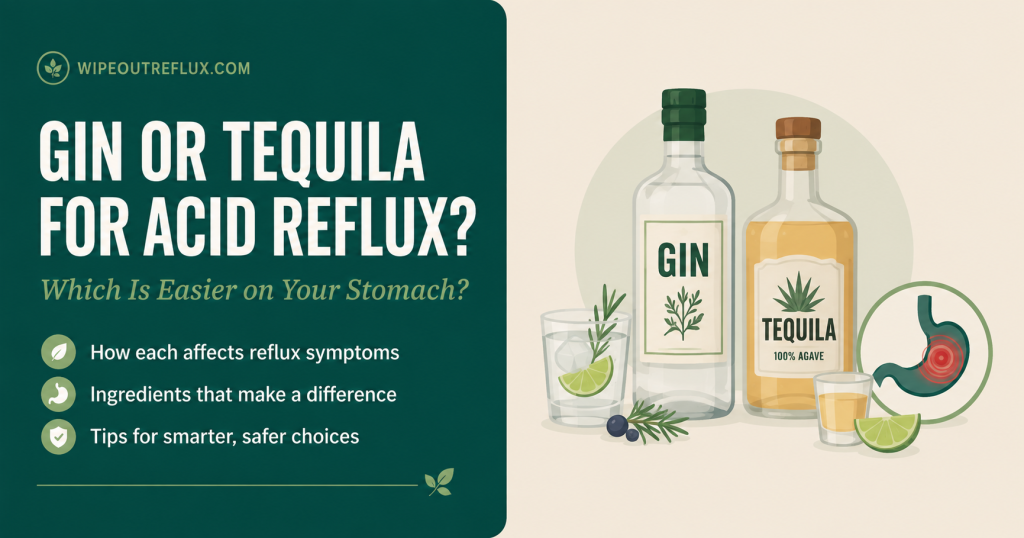
If you’ve decided a spirit is your best bet with reflux — skipping the fizz of beer and the acidity of wine — the next question is usually which one. Gin and tequila are two of the most common choices, and people often have a gut feeling that one is “cleaner” than the other.
Here’s the honest answer up front: neat and unmixed, gin and tequila are remarkably similar for reflux. Both are roughly 40% ABV distilled spirits, and both share one genuine advantage over beer and wine — distillation strips out the fermentation compounds that make beer and wine such strong stimulants of stomach acid. So the real difference between gin and tequila isn’t in the bottle. It’s in the glass: what you mix them with, and how you drink them. That’s where one can end up far harsher on your throat than the other.
Let me explain what actually separates them, and how to pick the less aggravating option.
Key Takeaways
- Gin and tequila are both about 40% ABV, so their effect on the lower esophageal sphincter — the valve that holds acid down — is essentially the same.
- Both have a real edge over beer and wine: distilled spirits don’t strongly stimulate stomach acid, because distillation removes the fermentation by-products that do.
- The deciding factor is the mixer. Gin’s classic partner is tonic (carbonated); tequila’s is lime and margarita mix (very acidic and often sugary).
- Sipped slowly over ice or with still water, a plain gin or a clean blanco tequila are about equally gentle — and among the least harsh alcoholic options.
- The worst versions are margaritas, tonic-heavy gins, and neat tequila shots on an empty stomach.
- For LPR / silent reflux, acidic mixers like lime and tonic are the main problem, because they can reactivate pepsin in the throat.
Where Gin and Tequila Are the Same
Alcohol Content — a Tie
Both spirits are typically bottled around 40% ABV. Alcohol relaxes the lower esophageal sphincter, the muscular valve that’s supposed to keep stomach acid where it belongs, and a comprehensive review confirmed that alcohol facilitates reflux by reducing LES pressure and impairing the esophagus’s ability to clear acid [Bujanda, American Journal of Gastroenterology, 2000]. Because gin and tequila carry the same alcohol concentration, they relax the valve to much the same degree, measure for measure. On this front — the most important one — there’s nothing to choose between them.
It’s worth noting that concentrated spirits also contact the throat and esophagus more directly than a diluted drink, which is why a neat shot can feel like a burn on the way down. That direct irritation applies equally to both.
The Shared Advantage Over Beer and Wine
Here’s something most people don’t realize. Beer and wine are among the strongest dietary stimulants of stomach acid — but that effect comes from non-alcoholic fermentation by-products, not the alcohol itself. Research comparing beverages found that fermented drinks like beer and wine strongly stimulate gastric acid and the hormone gastrin, whereas distilled spirits do not [Chari et al., Gut, 1993].
Distillation leaves those acid-stimulating compounds behind. So both gin and tequila, in their pure form, avoid one of the mechanisms that makes beer and wine such reliable triggers. This is why, for some people with reflux, a well-chosen sipped spirit sits better than a beer — a point I make in more detail in my comparison of whiskey versus vodka for acid reflux. The catch, as always, is what happens once you add a mixer.
Where They Differ: Congeners
The one meaningful difference in the spirits themselves is congeners — the flavor compounds produced during fermentation and aging. Clear, unaged spirits have fewer of them; darker, barrel-aged spirits have more.
Gin is unaged and clear, so it’s relatively low in congeners. Tequila depends on the type: blanco (silver) tequila is unaged and clean, while reposado and añejo tequilas are barrel-aged and pick up more congeners. Congeners are best known for making hangovers worse, and they can add to general stomach irritation, though the evidence tying them specifically to reflux is thin — treat this as a minor tiebreaker, not a headline. The practical version: a blanco tequila is on par with gin for cleanliness, while an aged añejo is slightly more likely to irritate. If you’re choosing tequila with reflux in mind, blanco is the safer style.
Where They Really Differ: the Mixer
This is where gin and tequila part ways in real life, because they’re almost never drunk the same way. And the mixer usually matters more than the spirit.
Gin’s Problem: Tonic
Gin’s default partner is tonic water — and tonic is carbonated. Carbonation is its own reflux trigger: when the gas expands your stomach, it lowers LES pressure and provokes the transient valve relaxations and belching that let acid escape [Yenidunya et al., Indian Journal of Gastroenterology, 2012]. Tonic also contains sugar and quinine, giving it a mildly acidic profile. So a gin and tonic takes a relatively clean spirit and bolts a carbonation trigger onto it — I go deeper on this in my look at whether tonic water is good for acid reflux. Gin itself, though, is flexible: with still water, over ice, or in a low-acid form, it loses that carbonation problem entirely.
Tequila’s Problem: Lime and Margaritas
Tequila’s culture leans acidic. The classic serve is a shot with lime — one of the most acidic things you can put in your mouth — and its signature cocktail, the margarita, combines tequila with lime juice, orange liqueur, and often a sugary sour mix. That’s a genuine reflux bomb: high alcohol, a large dose of citric acid, and sugar, usually drunk cold and fast. A margarita is one of the harder drinks on this list for anyone with reflux. Straight tequila, however, doesn’t have to be acidic at all — a sipped blanco on the rocks skips the lime entirely.
The Serving Culture Gap
There’s also how each tends to be consumed. Tequila carries a shot culture — neat, fast, often on an empty stomach — which is close to the worst way to drink any spirit if you have reflux. Gin is more often sipped or mixed long, which slows the alcohol down, though the tonic reintroduces a different problem. Neither pattern is inherently better; they just fail in different ways.
So Which Is Better for Reflux?
It depends almost entirely on the serve, not the spirit:
- Both drunk cleanly — a plain gin or a blanco tequila, sipped slowly over ice or with a splash of still water — they’re about equal, and among the gentler alcoholic choices because neither strongly stimulates stomach acid.
- Gin and tonic vs. sipped tequila — the sipped tequila wins, because you’ve removed the carbonation.
- Margarita or tequila shots vs. gin with still water — the gin wins easily, because you’ve removed the lime and the acidity.
If you want a single rule: the least harsh way to drink either is neat or with still water, sipped slowly, with food — and the spirit you choose matters far less than whether you add carbonation (tonic) or citrus (lime). Given tequila’s usual pairings tend to be more acidic, gin is often the easier default in practice, but a clean blanco tequila closes that gap completely.
If you’d like a clear picture of which drinks genuinely calm reflux and which quietly aggravate it, my Wipeout Diet Plan lays out where alcohol fits in a reflux-friendly approach. It was built around LPR — the stubborn, throat-based form of reflux — but because it works on the same underlying mechanisms, it applies just as well to GERD and everyday heartburn.
A Note for Silent Reflux (LPR)
If your reflux shows up in your throat — hoarseness, throat clearing, a lump sensation, a lingering cough — the mixer question becomes even more important. LPR is driven by pepsin, the stomach enzyme that travels up into the throat with reflux and stays there. Pepsin can lie dormant and then switch back on whenever its surroundings turn acidic: human pepsin has been shown to remain stable after neutralization and regain its activity when re-exposed to acid [Johnston et al., The Laryngoscope, 2007]. That means an acidic mixer — the lime in a tequila shot, the citrus in a margarita, even the mild acidity of tonic — can reactivate the pepsin already sitting in your throat. For LPR specifically, this makes lime-heavy tequila serves the bigger concern and pushes you toward a plain, non-acidic pour of either spirit — or, honestly, toward skipping it while symptoms are active.
Practical Tips for Either Spirit
- Sip, don’t shoot. A slow pour is far gentler than a fast neat shot on an empty stomach.
- Skip the acidic mixers. Swap lime and margarita mix for a splash of still water; swap tonic for still water or ice.
- Choose clean spirits. Plain gin or blanco tequila over aged, congener-heavy styles.
- Always with food. Never drink spirits on an empty stomach if you’re prone to reflux.
- Keep the quantity down. Alcohol’s valve-relaxing effect is dose-dependent — two drinks open the door wider than one.
- Stop well before bed. Spirits within two to three hours of lying down are a recipe for night-time reflux.
- When in doubt, don’t. If your reflux is active, the gentlest choice is no alcohol — many people are struck by how much calmer things get once it’s out of the picture.
FAQ
Is gin or tequila better for acid reflux?
Drunk cleanly — plain gin or blanco tequila, sipped over ice or with still water — they’re about equal, and both are gentler than beer or wine because distilled spirits don’t strongly stimulate stomach acid. The difference comes from the mixer: gin is usually served with carbonated tonic, tequila with acidic lime or in margaritas. Remove those and the two are very close.
Are spirits really better than beer and wine for reflux?
In one specific way, yes. Beer and wine strongly stimulate stomach acid via fermentation by-products, while distilled spirits don’t — distillation removes those compounds. But spirits are high in alcohol, which relaxes the valve at the top of the stomach, so they’re only “better” when sipped in small amounts without acidic or carbonated mixers.
Why is a margarita so bad for acid reflux?
A margarita stacks several triggers at once: a high dose of alcohol, a large amount of citric acid from lime juice, orange liqueur, and often sugary sour mix — usually drunk cold and quickly. The acidity is the standout problem, especially for silent reflux, where it can reactivate pepsin in the throat.
Is a gin and tonic bad for reflux?
The gin itself is relatively clean, but the tonic adds carbonation, which lowers LES pressure and triggers belching and valve relaxations. Tonic is also mildly acidic and sugary. Swapping tonic for still water or ice removes most of the problem while keeping the gin.
Which tequila is easiest on reflux?
Blanco (silver) tequila, because it’s unaged and lower in congeners than reposado or añejo. Sip it slowly over ice or with still water, and skip the lime and salt. A clean blanco is about as gentle as a plain gin.
Can I drink either if I have LPR?
With active LPR, it’s best to avoid alcohol altogether, because any alcohol-driven valve relaxation risks sending pepsin toward your throat. If you do drink, the priority is avoiding acidic mixers — no lime, no margarita, minimal tonic — since acid is what reactivates pepsin in the throat. A plain, non-acidic pour of either spirit is the least aggravating option.
Conclusion
Gin versus tequila for acid reflux turns out to be the wrong question, or at least an incomplete one. As spirits, they’re near-identical where it counts: same alcohol strength, same effect on the valve at the top of your stomach, and the same genuine advantage over beer and wine in that neither strongly stimulates acid production. If you drank them the same way, you’d struggle to tell them apart symptom-wise — with a slight edge to gin or blanco tequila over aged, congener-heavy tequila.
The real answer lives in the glass. Gin’s usual partner, tonic, adds carbonation; tequila’s usual partners, lime and margarita mix, add a lot of acidity. So in practice a sipped gin with still water tends to beat a tequila shot or a margarita, while a clean blanco tequila on the rocks matches a plain gin. Pick the serve, not just the spirit: sip slowly, skip the lime and the fizz, drink with food, and stop well before bed.
And remember that no spirit is truly reflux-friendly — the biggest gains come from your overall pattern of eating and drinking. My Wipeout Diet Plan is the complete, in-depth guide to calming reflux at the source; it was designed around the harder-to-treat silent-reflux form but works equally well for classic GERD and heartburn. For a lighter starting point, the Wipeout Food Reference Guide is the essential companion — a quick reference to the foods and drinks that are safe for acid reflux and LPR, with their pH values, so you can check where a given drink or mixer really stands.
Research & References
Bujanda L. The effects of alcohol consumption upon the gastrointestinal tract. American Journal of Gastroenterology. 2000;95(12):3374-3382. This review describes how alcohol reduces lower esophageal sphincter pressure and impairs esophageal acid clearance, facilitating reflux regardless of the type of drink [Bujanda, American Journal of Gastroenterology, 2000].
Chari S, Teyssen S, Singer MV. Alcohol and gastric acid secretion in humans. Gut. 1993;34(6):843-847. This work showed that fermented drinks such as beer and wine strongly stimulate gastric acid and gastrin, whereas distilled spirits do not — because the stimulant lies in the non-alcoholic, fermentation-derived components that distillation removes [Chari et al., Gut, 1993].
Yenidunya B, et al. Ingestion of a carbonated beverage decreases lower esophageal sphincter pressure and increases the frequency of transient lower esophageal sphincter relaxation in normal subjects. Indian Journal of Gastroenterology. 2012;31(4):174-177. This study demonstrated that carbonation — as in tonic water — lowers LES pressure and increases transient LES relaxations, the most common mechanism of reflux [Yenidunya et al., Indian Journal of Gastroenterology, 2012].
Johnston N, Dettmar PW, Bishwokarma B, Lively MO, Koufman JA. Activity/stability of human pepsin: implications for reflux attributed laryngeal disease. The Laryngoscope. 2007;117(6):1036-1039. This study found that human pepsin remains stable after neutralization and regains its enzymatic activity when re-exposed to acid, explaining how acidic mixers such as lime and tonic can reactivate pepsin retained in the throat [Johnston et al., The Laryngoscope, 2007].

David Gray
12 years living with LPR · Consultant & researcher
I've lived with LPR for twelve years — the misdiagnoses, the PPI courses that did nothing, the slow work of figuring out what actually helps. Wipeout Reflux is where I translate the research into plain terms for people stuck in the same place. Every claim here is sourced to peer-reviewed work, and I consult one-to-one with LPR sufferers.