
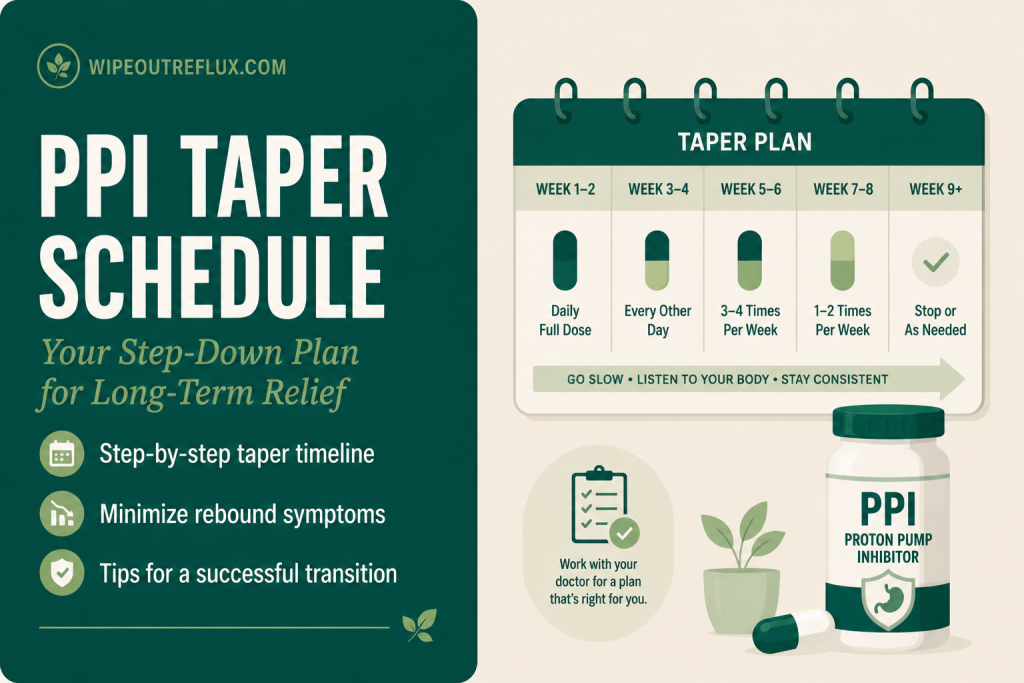
Most people who fail to come off a PPI fail for the same reason: they stop too fast, get hit by rebound acid two weeks later, and conclude they needed the drug after all. The rebound is real, it’s predictable, and it passes — but only if you know it’s coming and have a plan that lasts longer than it does.
What follows is a week-by-week calendar you can actually follow, with the doses, the decision points, and what to do when a week goes badly. It runs to around ten weeks for someone on a standard dose. That sounds long. It’s considerably shorter than another year on a drug that isn’t helping.
One thing before anything else: this is a plan to discuss with your doctor, not a reason to bypass them. There are situations where stopping is the wrong move entirely, and they’re listed first for a reason.
Key Takeaways
- Rebound acid hypersecretion is documented: in a placebo-controlled trial, 44% of healthy volunteers developed acid symptoms after stopping an 8-week course, versus 15% on placebo.
- Rebound typically peaks around 2 weeks after a dose reduction and settles within 4 weeks.
- Deprescribing guidelines support tapering after at least 4 weeks of treatment where symptoms have resolved — but explicitly exclude Barrett’s, severe esophagitis and a history of bleeding ulcers.
- The preparation fortnight matters more than the taper itself: diet and alginates should be in place before you touch the dose.
- Halve the dose, hold two weeks. Then alternate days, hold two weeks. Then every third day, then stop.
- Never move to the next step during a bad week — hold instead. There’s no schedule to keep to.
- Judge progress on the trend across a fortnight, not on individual days.
First: who should not do this
Deprescribing guidance is clear that reducing or stopping is appropriate for adults who’ve had at least four weeks of treatment for heartburn or mild-to-moderate reflux and whose symptoms have settled. It explicitly does not apply to people who have or have had Barrett’s esophagus, severe esophagitis (grade C or D), or a documented history of bleeding gastrointestinal ulcers [Farrell et al., Canadian Family Physician, 2017].
To that list I’d add: anyone taking a PPI to protect the stomach while on long-term NSAIDs, aspirin or anticoagulants. There, the drug is preventing a bleed that could be life-threatening, and the trade is clearly worth it.
If any of those apply to you, this article isn’t for you. Talk to your doctor about whether long-term treatment remains the right call, but don’t taper on your own initiative.
For everyone else — particularly the very large group taking a PPI for throat symptoms it has never visibly improved — read on.
What you’re actually up against
When acid production is suppressed for weeks, your stomach compensates. Gastrin rises, the acid-producing cells increase in number and capacity, and the system is primed to produce more acid than before. Remove the drug and that extra capacity is unopposed for a while.
The evidence for this in real people is good. In a randomized, double-blind, placebo-controlled trial, 120 healthy volunteers with no reflux problems took either esomeprazole 40mg for eight weeks followed by four weeks of placebo, or placebo throughout. In the weeks after withdrawal, 44% of the PPI group reported at least one clinically relevant acid-related symptom, compared with 15% of the placebo group [Reimer et al., Gastroenterology, 2009].
These were people with no reflux to begin with. The drug created the symptom.
Being straight about the limits of this evidence: a systematic review found that while volunteer studies consistently show this effect, studies in people who already have reflux disease haven’t clearly demonstrated symptomatic rebound — though those studies had significant methodological weaknesses [Lødrup et al., Scandinavian Journal of Gastroenterology, 2013]. So rebound may be less dominant in existing reflux patients than the volunteer data suggests. Plan for it anyway — the cost of preparing for something that doesn’t arrive is nil.
For the full mechanism, I’ve written it up separately in getting off PPIs and acid rebound. This article is the schedule.
Weeks 1–2: preparation (do not change your dose yet)
This is the fortnight people skip, and skipping it is the single most common reason the whole thing fails. You are not reducing anything yet. You’re building the thing that will replace the drug.
- Get the diet in place now. Not “start eating better as you go” — fully in place, running for two weeks before the first reduction. If you’re still drinking coffee and eating late, taking the drug away just returns you to where you were before you started it. This is the whole reason the Wipeout Diet Plan exists, and it’s the part that determines whether this works.
- Get alginates in and learn to use them. Alginate rafts are your main tool during the taper because they work as a physical barrier rather than by changing acid production — so they don’t add to the rebound problem. After each meal and last thing before bed. Gaviscon Advance is the formulation worth having.
- Fix the night-time setup. Head of the bed raised, three hours between the last food and lying down. Do it now so it’s habit by the time you need it.
- Start a symptom log. Score your main symptom 0–10 each evening. Two weeks of baseline before you change anything, so you know what “normal for me” looks like. Without this you’ll have no way to tell a rebound week from a bad week.
Don’t shorten this phase. Two weeks of groundwork buys you the margin you’ll need at week 5.
Weeks 3–4: halve the dose
Now reduce to half your current daily dose.
- Omeprazole 40mg → 20mg daily
- Omeprazole 20mg → 10mg daily
- Lansoprazole 30mg → 15mg daily
- Esomeprazole 40mg → 20mg daily
- Pantoprazole 40mg → 20mg daily
- Rabeprazole 20mg → 10mg daily
If you’re on twice-daily dosing, your first step is simply to drop to once daily at the same strength, and hold there for two weeks before halving. That makes the whole process about two weeks longer.
What to expect: often very little in the first few days. Any rebound tends to arrive around days 10–14, which is precisely when people wrongly conclude the reduction was fine and cut again.
Decision point at the end of week 4: compare your symptom scores for week 4 against your baseline. If they’re similar or only mildly raised, move on. If they’re clearly worse, hold at this dose for another two weeks. Holding is not failure — it’s the mechanism working, and it will settle.
Weeks 5–6: alternate days
Take your halved dose every other day. Same strength, half the frequency.
This is usually the hardest fortnight, because it’s the first time your stomach goes a full 48 hours with acid production unsuppressed. Expect some breakthrough symptoms, particularly on the off days.
How to handle the off days: alginate after every meal without exception, keep meals smaller, and don’t eat within three hours of bed. If you need something more, this is a reasonable point to ask your doctor about famotidine as a short-term bridge on the off days — it suppresses acid by a different route and doesn’t reproduce the same rebound cycle. Famotidine versus omeprazole covers how they differ.
Decision point at the end of week 6: same rule. Trending back toward baseline, continue. Still clearly elevated, hold another fortnight.
Weeks 7–8: every third day
Same dose, now every third day.
Most people find this easier than the alternate-day phase, which surprises them. By this point your acid production has been adjusting downward for a month, and the gap between doses matters less than it did.
Keep the alginates going at full frequency. This is not the moment to relax the routine because things feel better — the routine is why things feel better.
Decision point at the end of week 8: if your scores are at or near baseline, you’re ready to stop. If not, hold. Some people spend six weeks at this stage. That’s fine.
Weeks 9–10: stop
Stop the PPI entirely.
Keep everything else running exactly as it is — the diet, the alginates after meals and at bedtime, the raised bed head, the three-hour gap. Change one thing at a time, and the one thing you’re changing is the drug.
What to expect: a possible mild uptick around days 10–14, settling over the following fortnight. Because you’ve stepped down gradually rather than stopping from a full dose, this should be considerably milder than the classic rebound.
Keep the log running for four more weeks. This is when you find out what your reflux is actually like without medication, and it’s information worth having accurately.
Weeks 11–14: the settling period
Don’t judge anything yet. Acid production takes several weeks to normalize, and throat tissue heals more slowly still — if you have silent reflux, the tissue has been irritated for a long time and won’t recover in a fortnight.
Hold the full routine. Around week 14, look back over your log and compare against your baseline from weeks 1–2. That comparison — two months apart, same measure — is the only honest way to answer whether you’re better, worse, or the same without the drug.
A great many people discover they’re no worse. Which tells them something important about what the drug was doing.
Troubleshooting
“I had one terrible day”
Ignore it. Single days mean nothing — a large meal, a bad night, stress, or an accidental trigger will do it. Judge on the fortnight, not the day. This is exactly what the log is for.
“Week two of a step was much worse”
That’s textbook rebound timing rather than a sign the taper is failing. Hold at the current step. Don’t go back up, and don’t push forward. It settles.
“I’ve been stuck at the same step for a month”
Fine, provided you’re stable rather than deteriorating. But use the time to audit the foundations honestly — is the diet genuinely in place, are you taking alginates after every meal, is the bed actually raised? Stalling is usually a foundations problem, not a dosing one.
“My throat symptoms haven’t changed at all through any of this”
Common, and informative. It generally means the PPI wasn’t doing much for your throat in the first place, which is the usual finding in laryngopharyngeal reflux — I’ve set out why in why PPIs don’t work for LPR. It also means the diet and pepsin side of things is where your effort should go.
“I’ve gone back on it”
Then you’ve learned something and you can try again later with better preparation. The usual reason is starting the taper before the foundations were solid. There’s no penalty for a second attempt.
Conclusion
The taper isn’t the hard part. Ten weeks of dose reductions is straightforward once you know that the bad fortnight is coming and that it ends. What determines success is what you build in weeks 1 and 2 — because coming off acid suppression without changing anything else just returns you to the reflux that started all this.
That’s why the diet has to lead. The Wipeout Diet Plan is the complete protocol for it: the pH thresholds that determine whether a food or drink reactivates pepsin in your throat, meal timing, the night-time routine, and a structured programme to work through rather than a list of things to avoid. It was designed first around LPR — the throat-based form where acid suppression disappoints most consistently — but because it targets the same underlying mechanisms it works just as well for GERD and everyday heartburn. If you’re planning to come off a PPI, run it for a fortnight before you touch your first dose.
The Wipeout Food Reference Guide is the essential companion for the taper weeks specifically — every food and drink that’s safe for acid reflux and LPR alongside its pH value, so you can check anything in seconds during the period when you can least afford a mistake. The Diet Plan is the programme; the guide is what you’ll have open in the kitchen.
Last thing, and it’s the one I’d most want you to hold onto: rebound symptoms in week two are not proof that you need the drug. They’re proof that you were taking it. Knowing the difference is most of what separates people who get off successfully from people who’ve been trying for years.
Frequently Asked Questions
Can I just stop taking it?
You can, and some people are fine. But rebound acid hypersecretion is well documented, it peaks around two weeks after stopping, and it’s convincing enough that most people go straight back on the drug. Tapering costs you a few weeks and substantially improves the odds.
How long does the whole thing take?
About ten weeks on a standard once-daily dose, plus a month of settling afterward. Longer if you’re on twice-daily dosing, or if you need to hold at a step — which is common and entirely fine. There’s no prize for finishing quickly.
Can I open capsules to get a smaller dose?
Don’t. PPI granules are enteric-coated for a reason and splitting or crushing can destroy the drug or change how it’s absorbed. Use the tablet strengths that exist, or reduce frequency instead — which is what this schedule does.
Should I switch to famotidine instead?
As a temporary bridge during the harder weeks, it’s a reasonable option to discuss with your doctor. As a permanent replacement, you’ve substituted one long-term acid suppressant for another, which may not be what you wanted. Useful as a tool, less so as a destination.
What if my symptoms are genuinely worse a month after stopping?
Then you may be someone who benefits from the drug, and that’s worth knowing rather than resisting. Go back to your doctor with your symptom log — that record is genuinely useful clinical information. Restarting after an honest trial isn’t a failure; it’s an answer.
Do I need to keep taking alginates forever?
No. Most people taper them off too, once things have been stable for a couple of months, keeping them for flare-ups and difficult meals. Do that after the PPI taper is finished and settled, not during it.
Will my heartburn be worse than before I ever started?
Temporarily, possibly — that’s what rebound means. But it’s a transient physiological adjustment, not permanent damage, and it resolves. The gradual step-down exists precisely to keep that peak as low as possible.
Is it safe to stay on a PPI instead?
For many people, yes — the randomized safety data is more reassuring than the headlines suggest, with only enteric infections clearly increased over three years [Moayyedi et al., Gastroenterology, 2019]. The argument for coming off isn’t fear of the drug. It’s that a medication doing nothing measurable for you isn’t worth any risk at all.
Research & References
- [Reimer et al., Gastroenterology, 2009] — Randomized double-blind placebo-controlled trial in 120 healthy volunteers found that 44% of those given esomeprazole for 8 weeks reported clinically relevant acid-related symptoms after withdrawal, compared with 15% of the placebo group, demonstrating that PPI therapy can induce the symptoms it treats.
- [Lødrup et al., Scandinavian Journal of Gastroenterology, 2013] — Systematic review found consistent evidence of symptomatic rebound acid hypersecretion in asymptomatic volunteers up to four weeks after withdrawal, while noting that studies in existing reflux patients showed no clear symptomatic rebound but carried significant methodological weaknesses.
- [Farrell et al., Canadian Family Physician, 2017] — Evidence-based deprescribing guideline recommending dose reduction, cessation or on-demand use in adults who have completed at least four weeks of PPI treatment for heartburn or mild to moderate reflux with resolved symptoms, explicitly excluding those with Barrett’s esophagus, severe esophagitis or a history of bleeding ulcers.
- [Moayyedi et al., Gastroenterology, 2019] — Randomized double-blind trial of 17,598 participants on pantoprazole or placebo for a median of three years found no statistically significant difference in safety outcomes except enteric infections, providing context on the actual risks of continued use.

David Gray
12 years living with LPR · Consultant & researcher
I've lived with LPR for twelve years — the misdiagnoses, the PPI courses that did nothing, the slow work of figuring out what actually helps. Wipeout Reflux is where I translate the research into plain terms for people stuck in the same place. Every claim here is sourced to peer-reviewed work, and I consult one-to-one with LPR sufferers.