
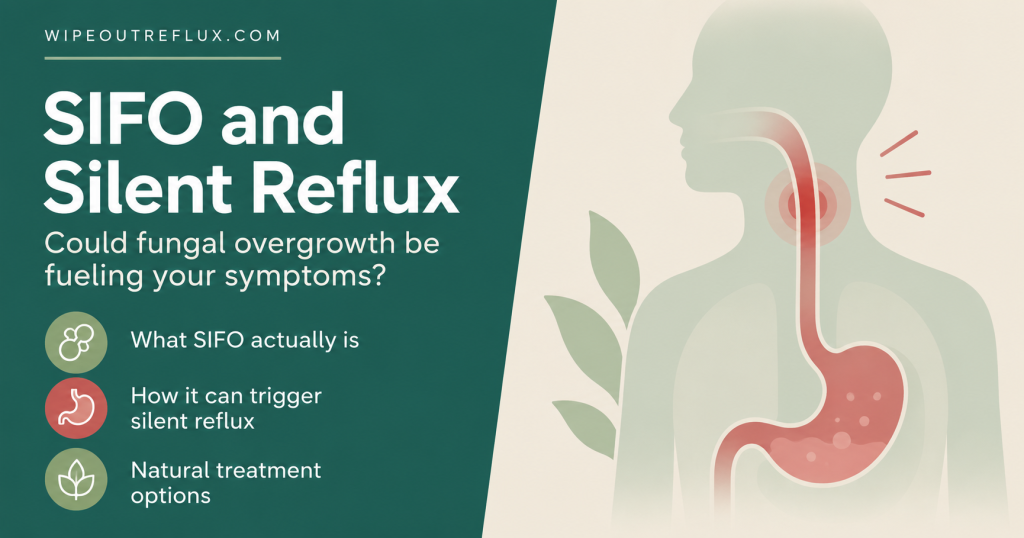
Short answer: yes, fungal overgrowth in the gut can contribute to reflux, including the throat-based silent reflux (LPR) many of us struggle with — but it’s an indirect player, not the main event, and it’s badly oversold online. SIFO (small intestinal fungal overgrowth) means too many fungal organisms, usually Candida, growing in the small intestine where there should be very few. It doesn’t erode your esophagus or reactivate pepsin in your throat directly. What it does is generate gas, bloating and pressure lower down, and that pressure is exactly what pushes stomach contents up in the first place.
Here’s the part that makes SIFO genuinely relevant to reflux, and to LPR in particular: the acid-suppressing drugs so many of us are put on — proton pump inhibitors (PPIs) — are themselves a documented risk factor for fungal overgrowth. So you can end up in a loop where the reflux treatment quietly encourages the very overgrowth that then makes the reflux harder to shift.
Below I’ll walk through what SIFO actually is, the honest evidence linking it to acid reflux and silent reflux, why the PPI connection matters most, how it’s diagnosed (and why breath tests aren’t the answer), and what to do about it without falling for the “kill the Candida” industry.
Key Takeaways
- SIFO is an excess of fungal organisms — almost always Candida — in the small intestine, associated with GI symptoms. It’s a real, culture-confirmed finding, not a wellness buzzword.
- In studies of people with unexplained gut symptoms, roughly a quarter had fungal overgrowth on small-bowel sampling.
- Its link to acid reflux is mostly mechanical and indirect: fungal fermentation produces gas and bloating, and that raised abdominal pressure pushes reflux upward — the same route by which any bloating worsens symptoms.
- The strongest reflux connection is the PPI loop: long-term acid suppression is an independent risk factor for overgrowth and increases Candida colonisation in the gut and stomach.
- For silent reflux (LPR) specifically, SIFO is a possible contributor rather than a proven cause — treat it as one piece of the pressure puzzle, not the answer.
- Symptoms are non-specific (bloating, gas, belching, nausea, indigestion) and overlap heavily with SIBO, so you cannot diagnose SIFO by symptoms alone.
- Diagnosis needs small-bowel aspiration and culture; standard hydrogen/methane breath tests do not reliably detect fungi.
- Treatment is a short course of antifungals under medical supervision plus fixing the cause — motility, acid suppression, diet — because eradication alone rarely holds.
What SIFO Actually Is
SIFO stands for small intestinal fungal overgrowth: an excessive number of fungal organisms in the small intestine, associated with gastrointestinal symptoms [Erdogan & Rao, Current Gastroenterology Reports, 2015]. In almost every case the organism is Candida — the same yeast that lives quietly in most people’s guts as a normal resident. The problem isn’t its presence; it’s overgrowth, when it multiplies beyond what the small intestine is meant to carry.
It’s the fungal sibling of SIBO, small intestinal bacterial overgrowth. The two are close cousins — same neighbourhood, same broad symptoms, often present together — and if you’ve read my piece on SIBO and acid reflux, a lot of the SIFO story will feel familiar. The small intestine is normally kept relatively sparse of microbes by stomach acid, bile, and the sweeping muscular waves that clear it between meals. When those defences slip, bacteria or fungi can take hold where they shouldn’t.
The important thing to hold onto: this is a specific, testable microbiological finding, not the vague “systemic Candida” or “yeast is taking over your body” story sold with expensive cleanses and supplement stacks. SIFO is narrow and real. Most of what’s marketed around it is neither.
How Common Is It — and Who Gets It?
SIFO turns up more often than you’d expect in people with stubborn, unexplained gut symptoms. In two case series of patients whose symptoms had no clear cause on standard testing, around a quarter were found to have fungal overgrowth on small-bowel sampling — 26% in one and 25% in another [Erdogan & Rao, Current Gastroenterology Reports, 2015]. That’s a meaningful slice of people who’d otherwise be told nothing was wrong.
The two conditions that keep showing up as risk factors are impaired gut motility and the use of acid-suppressing drugs. In a study of 150 people with persistent GI complaints, 63% had overgrowth of some kind; of those, 26% had SIFO, 40% had SIBO and 34% had both — and both gut dysmotility and PPI use came out as independent risk factors [Jacobs et al., Alimentary Pharmacology & Therapeutics, 2013]. Slow, uncoordinated gut contractions mean the small intestine isn’t cleared properly between meals, so microbes linger and multiply. That’s the same motility problem behind gastroparesis and reflux.
The Reflux Connection: Where It’s Real, and Where It’s Overstated
This is where I want to be careful, because it’s the part the internet gets wrong. SIFO does not sit in your esophagus dissolving the lining, and it does not directly dump acid or pepsin into your throat. Its effect on reflux is real but comes through two indirect routes.
1. Gas and pressure push reflux upward. Fungi ferment carbohydrates and produce gas, just as the bacteria in SIBO do. That gas distends the gut and raises pressure inside the abdomen. Higher pressure below the stomach makes it easier for stomach contents to force their way up past the valve at the top — the lower esophageal sphincter. It’s the exact mechanism I describe in why gas and bloating so often travel with reflux: more pressure below, more reflux above. So if SIFO is inflating you with gas, it’s plausibly nudging your reflux worse — not because it’s a reflux disease, but because it’s a pressure problem.
2. Reflux treatment feeds the fungus. This is the connection that matters most, and it’s a genuine loop. Stomach acid is one of your body’s front-line defences against microbes colonising the gut. Suppress that acid long-term and you tilt the odds toward overgrowth — bacterial and fungal alike. PPI use is an independent risk factor for overgrowth [Jacobs et al., Alimentary Pharmacology & Therapeutics, 2013], and when researchers looked specifically at reflux patients, PPI treatment increased Candida colonisation in the stomach lining and shifted the whole fungal community, with long-term users affected most [Shi et al., Frontiers in Cellular and Infection Microbiology, 2023]. The clinical end of that is visible too: in a large hospital study, PPI use raised the odds of esophageal thrush (candidiasis) even in people with normal immune systems — odds ratio 1.69, rising to 3.13 when combined with low-acid atrophic gastritis [Ogiso et al., Scientific Reports, 2021].
Put those together and you can see the trap. You’re prescribed a PPI for reflux. Over months, the acid suppression encourages fungal overgrowth. The overgrowth produces gas and pressure that worsen reflux. You feel worse, so the dose goes up. It’s a big part of why I keep pushing people to understand the long-term trade-offs of PPIs rather than staying on them indefinitely by default — and why, for silent reflux especially, PPIs so often don’t deliver in the first place.
So can SIFO cause LPR?
Honestly? It can contribute, but I’ve seen no good evidence that it causes LPR on its own, and I’d be sceptical of anyone claiming otherwise. Silent reflux is driven by refluxate — acid and, crucially, the enzyme pepsin — reaching the throat and larynx, where pepsin can reactivate and irritate delicate tissue. SIFO doesn’t produce pepsin. What it can do is increase the abdominal pressure and gas that make reflux events more likely, so in someone who already has LPR, unchecked fungal overgrowth might be one of the things keeping symptoms lit. Think of it as a possible aggravator sitting underneath the reflux, not the origin of it. If you’re new to how the throat side of this works, my complete guide to LPR lays out the real mechanism.
Why You Can’t Diagnose SIFO by Symptoms
The symptoms of SIFO are frustratingly ordinary: belching, bloating, indigestion, nausea, diarrhea and gas [Erdogan & Rao, Current Gastroenterology Reports, 2015]. There’s nothing on that list that screams “fungus.” Worse, the symptom profiles of people with and without overgrowth in these studies were basically the same — symptoms were poor predictors of who actually had it [Jacobs et al., Alimentary Pharmacology & Therapeutics, 2013].
That single fact should make you wary of every online quiz and symptom checklist promising to tell you that you “have Candida.” Bloating and gas are shared by SIFO, SIBO, ordinary food intolerances, and plain reflux. You can’t sort them apart by feel.
What actually detects it
SIFO is diagnosed by aspirating fluid from the small intestine during an endoscopy and culturing it for fungi. That’s the only method with real validity. Note what’s not on that list: the hydrogen and methane breath tests used for SIBO don’t reliably pick up fungi, because yeasts don’t produce those gases the way bacteria do. Stool “Candida” panels and the popular spit-in-a-glass test tell you next to nothing about what’s happening in your small intestine. If overgrowth is genuinely suspected, it’s a conversation about proper testing and diagnosis with a gastroenterologist, not a home kit.
What To Actually Do About It
If SIFO is confirmed, the medical treatment is a two-to-three-week course of antifungal therapy, which can improve symptoms — though the evidence that it fully eradicates the overgrowth is limited [Erdogan & Rao, Current Gastroenterology Reports, 2015]. That’s prescription territory and needs a doctor; I’m not going to hand out an antifungal protocol here, and you should be wary of anyone online who does.
The more useful point — and the one that ties SIFO back to everything I write about — is that killing the fungus without fixing why it grew is a temporary win. Overgrowth returns when the conditions that allowed it are still in place. So the durable work is on the causes:
- Re-examine long-term acid suppression. If a PPI is part of what’s feeding the overgrowth, staying on it forever works against you. That doesn’t mean stopping abruptly — acid rebound is real — but it’s worth a proper plan with your doctor.
- Support motility. Keeping the small intestine sweeping properly between meals is one of the best defences against anything overgrowing there. Meal spacing, not grazing all day, and managing any underlying slow-transit issues all help.
- Bring the pressure down. Since the reflux link runs through gas and abdominal pressure, the same measures that calm bloating tend to calm the reflux: smaller portions, fewer fermentable triggers, not eating late. This is also where a considered approach to overall gut health pays off.
- Rebuild sensibly, don’t “cleanse.” Skip the aggressive anti-Candida regimes. A steadier, lower-pressure way of eating does more for reflux than any purge.
This is exactly the ground the Wipeout Diet Plan is built to cover — a liveable eating pattern that keeps gas, pressure and reflux down together, rather than a short-term crackdown you can’t sustain. It was designed first and foremost around LPR, the stubborn throat-based form, but because it works on the same underlying reflux mechanics, it helps classic GERD and heartburn just as well.
And if fungal overgrowth is genuinely in the picture for you, it’s worth reading alongside my piece on the elemental diet for SIBO and reflux, since the elemental approach is one of the few dietary tools studied for starving out small-intestine overgrowth — with all the caveats I lay out there.
Conclusion
SIFO is real, it’s more common than most people realise in stubborn gut cases, and it deserves to be taken seriously — but kept in proportion. Its connection to acid reflux and silent reflux is genuine and worth understanding: fungal overgrowth adds gas and pressure that push reflux upward, and the acid-suppressing drugs used to treat reflux are among the things that let the fungus flourish in the first place. What it is not is a hidden master cause of LPR, or a problem you can diagnose from a symptom quiz and fix with a cleanse. If you suspect it, the route is proper small-bowel testing and a doctor, not a supplement funnel.
For the day-to-day work — the eating pattern that keeps pressure, gas and reflux down at the same time, whether your problem is silent reflux or classic heartburn — the Wipeout Diet Plan is the most complete framework I’ve put together, and it’s where I’d point you first. If you want the lighter starting point, the Wipeout Food Reference Guide is the essential companion — it lays out which foods and drinks are safe for reflux and LPR and where they sit on the pH scale, so you can start lowering the pressure on your gut today.
Frequently Asked Questions
Can Candida overgrowth cause acid reflux?
Indirectly, yes. Candida overgrowth in the small intestine (SIFO) ferments carbohydrates and produces gas, and that raised abdominal pressure can push stomach contents up past the valve at the top of the stomach, worsening reflux. It doesn’t cause reflux directly by irritating the esophagus, and it’s usually one contributor among several rather than the sole cause.
Is SIFO the same as SIBO?
No. SIBO is bacterial overgrowth in the small intestine; SIFO is fungal, almost always Candida. They share the same location, similar symptoms and similar risk factors, and often occur together — in one study a third of people with overgrowth had both — but they’re distinct findings that need different treatment.
Do PPIs cause fungal overgrowth?
Long-term PPI use is a documented, independent risk factor for small intestinal overgrowth, and studies show it increases Candida colonisation in the stomach lining and raises the odds of esophageal thrush even in people with healthy immune systems. It’s not guaranteed to happen, but it’s a real reason not to stay on high-dose acid suppression indefinitely without review.
How do I know if I have SIFO?
You can’t tell from symptoms — bloating, gas, belching and nausea overlap with SIBO, food intolerances and ordinary reflux, and research found symptoms were poor predictors of who actually had overgrowth. A reliable diagnosis needs a small-intestine fluid sample taken during endoscopy and cultured for fungi. Stool Candida panels and spit tests don’t reliably detect it.
Does a breath test detect fungal overgrowth?
Not reliably. The hydrogen and methane breath tests used for SIBO rely on bacteria producing those gases; fungi don’t produce them the same way, so a breath test can miss SIFO entirely. That’s why small-bowel aspiration and culture is the reference method.
Will an anti-Candida diet fix my reflux?
Probably not on its own, and the strict “anti-Candida” cleanses sold online aren’t well supported. What genuinely helps reflux is reducing the gas and abdominal pressure that drive it — smaller portions, fewer fermentable triggers, not eating late — alongside addressing motility and long-term acid suppression. A sustainable low-pressure eating pattern beats an aggressive purge.
Can treating SIFO improve silent reflux (LPR)?
It might help if fungal overgrowth is genuinely adding to your gas and pressure, but SIFO doesn’t produce pepsin, the enzyme central to LPR, so clearing it won’t fix silent reflux by itself. Treat it as one possible aggravator to address alongside the core LPR work, not as a cure for the throat symptoms.
Research & References
- [Erdogan & Rao, Current Gastroenterology Reports, 2015] — Review defining SIFO as excess fungal organisms in the small intestine with GI symptoms; found fungal overgrowth in 26% and 25% of patients with unexplained GI symptoms, identified dysmotility and PPI use as risk factors, and recommended a 2–3 week antifungal course while noting limited evidence for full eradication.
- [Jacobs et al., Alimentary Pharmacology & Therapeutics, 2013] — In 150 patients with unexplained GI symptoms, 63% had overgrowth (26% SIFO, 40% SIBO, 34% mixed); both gut dysmotility and PPI use were independent risk factors, and symptoms did not predict who had overgrowth.
- [Shi et al., Frontiers in Cellular and Infection Microbiology, 2023] — In GERD patients, PPI treatment increased Candida colonisation of the gastric mucosa and shifted the gut fungal community, with long-term users showing the greatest changes.
- [Ogiso et al., Scientific Reports, 2021] — Among 7,736 patients undergoing endoscopy, PPI use raised the odds of esophageal candidiasis in immunocompetent people (odds ratio 1.69), rising to 3.13 when combined with low-acid atrophic gastritis.

David Gray
12 years living with LPR · Consultant & researcher
I've lived with LPR for twelve years — the misdiagnoses, the PPI courses that did nothing, the slow work of figuring out what actually helps. Wipeout Reflux is where I translate the research into plain terms for people stuck in the same place. Every claim here is sourced to peer-reviewed work, and I consult one-to-one with LPR sufferers.